
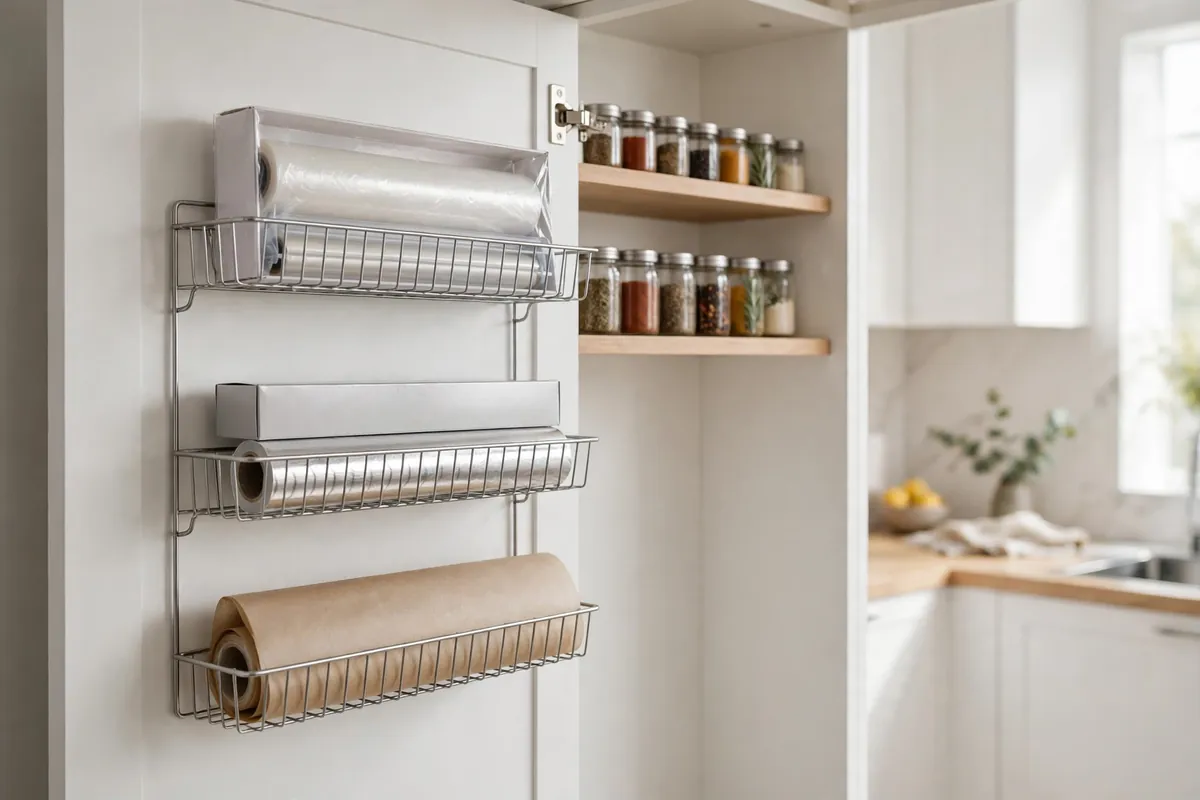

Kitchen cabinet door storage ideas are the closest thing to free square footage in a busy kitchen. The inside of every cabinet door is a flat, unused surface, and once you put it to work, the everyday things that used to pile up on your shelves and counters suddenly have a home of their own. The cling wrap that slid to the back of the drawer, the pot lids that clattered every time you reached for a pan, the measuring cups you could never find — all of them can live on a door, right where you can see them.
I first tried it on a Tuesday night, mid-recipe, when I was hunting for the foil while the garlic was already browning in the pan. My under-sink cabinet door was bare, my shelves were full, and it hit me that I had been ignoring a whole wall of storage in every single cabinet. A ten-pound rack, a strip of hooks, and half an hour later, I had a full shelf back. If your kitchen feels crowded, start with the doors before you buy anything bigger.
Measure First: Why Kitchen Cabinet Door Storage Ideas Fail Without a Tape Measure
Every good door-storage project starts with a tape measure, not a shopping cart. Cabinet doors look identical from the outside, but inside they vary more than most people expect, and a rack half an inch too deep will stop the door from closing — or scrape a shelf every time you shut it.
Before you order anything, measure these four things on each door you plan to use:
- Door thickness: most cabinet doors are between 5/8 and 3/4 of an inch thick, and over-the-door hooks are sized for that range. A thicker custom door will make a hook wobble or refuse to sit flat.
- Clearance to the shelf edge: close the door slowly and watch the gap between the inside of the door and the front edge of the shelves. A rack plus its contents must be shallower than that gap, usually no more than 2 to 3 inches.
- Clearance to items already on the shelf: a spice rack on the door is useless if it knocks over the cereal boxes every time you close the cabinet. Leave at least half an inch of breathing room between the loaded rack and the nearest shelf item.
- Hinge swing and handle clearance: check that the rack does not hit the hinge, the knob, or the neighbouring door when it swings. Doors next to a wall or an appliance are the usual troublemakers.
Under-Sink Door Caddies: The Hardest-Working Spot in the Kitchen
If you only ever use one door, make it the one under the sink. That cabinet is where cleaning supplies go to hide: spray bottles fall over, sponges vanish behind the pipes, and the bin bags end up in a crumpled heap. A door caddy turns that chaos into a tidy row you can actually use.
A simple wire caddy with two or three compartments holds a spray bottle, a dish brush, and a box of bin bags without taking any shelf space. Look for one with a drip tray or open wire base, because the things that live under a sink are often damp. Plastic caddies are easier to wipe down when something leaks — which, under a sink, it eventually will.
Mounting matters here more than anywhere else. The under-sink door gets opened and closed dozens of times a day, often with wet hands, so adhesive strips alone can give up after a few months of steam and splashes. If you own your home, two small screws are worth it; the holes are hidden on the inside of the door and nobody will ever see them. Renters should look for over-the-door hooks or heavy-duty adhesive rated for kitchens. For more ideas on taming this particular cabinet, see our guide to under-sink kitchen organization ideas, which covers the shelf and pipe space around the door too.
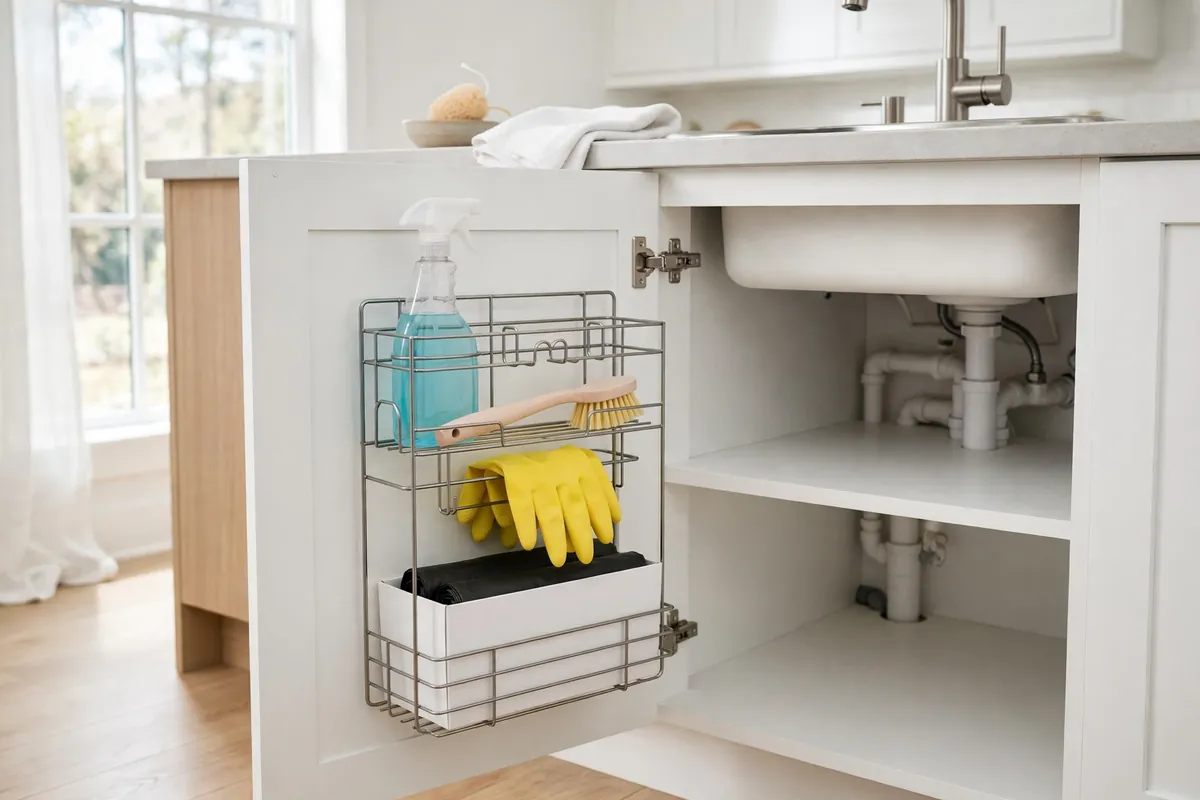
What to put in an under-sink door caddy:
- Your most-used spray bottle — the all-purpose cleaner you reach for daily
- A dish brush or sponge holder, so sponges dry instead of going sour in a puddle
- Bin bags, either in a small box or rolled and tucked into a tall compartment
- Rubber gloves, hung from a hook so they are easy to grab and easy to air out
Wrap, Foil and Bag Racks That End the Drawer Tangle
Cling wrap, foil, baking paper, and sandwich bags are the classic drawer tangle. The boxes are long and awkward, and the one you want is always at the bottom of the pile. A rack on the inside of a cabinet door fixes all of that at once.
A horizontal rack with two or three slots holds each box separately, labels facing out, so you can see at a glance whether you are out of foil before you start wrapping leftovers. Mount the rack at about chest height on the door, so you can pull a sheet with one hand while holding a bowl with the other.
The door next to the food-prep area is the natural home for this. If your prep space is the counter between the sink and the stove, pick the cabinet door closest to it. Keep the heaviest box — usually the foil — at the bottom slot, so the rack stays balanced and the door does not feel top-heavy when it swings. Moving wraps to the door also frees a drawer; our kitchen drawer organization ideas will help you put that space to good use.
Kitchen Cabinet Door Storage Ideas for Pot Lids and Measuring Cups
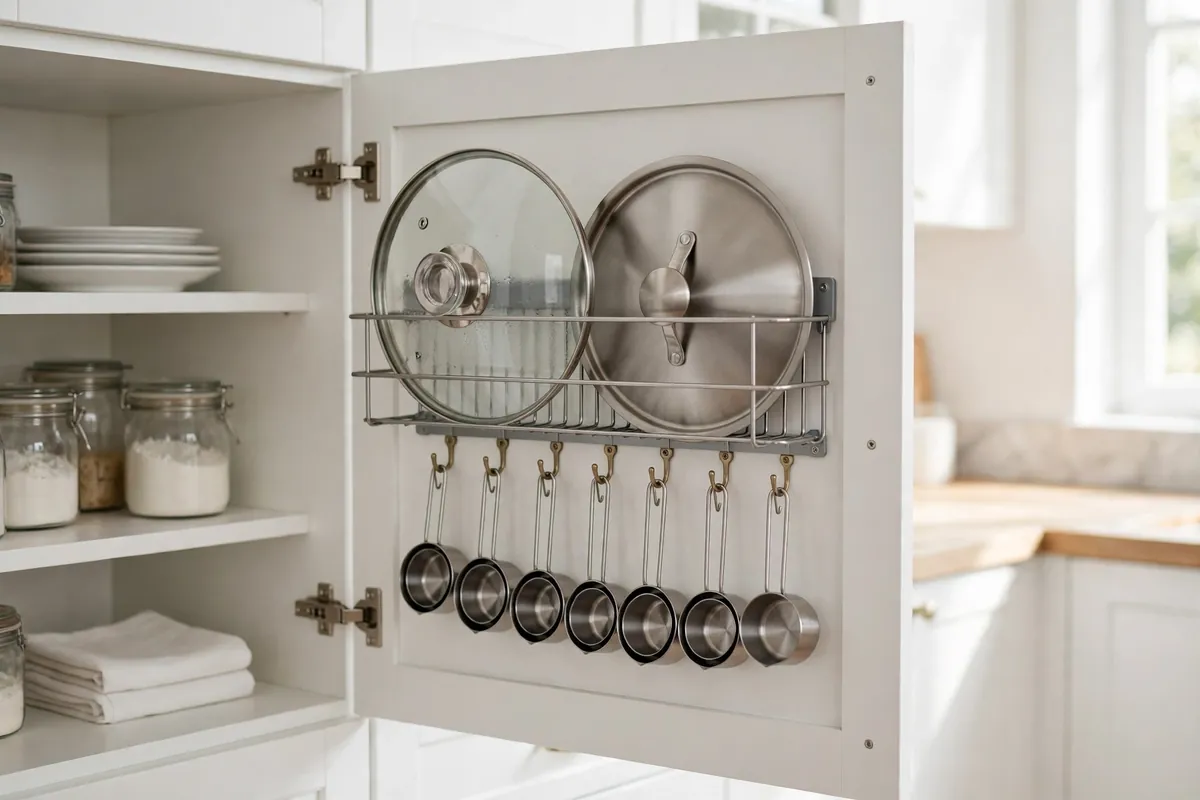
Pot lids are the worst tenants in any kitchen. They do not stack neatly, they slide off piles of pans, and they clatter every time you reach past them. A cabinet door is one of the best places to keep them, because a lid is flat, light, and exactly the shape that hangs well.
A lid rack with two or three horizontal bars holds each lid by its rim, so you can lift one out without disturbing the rest. Mount it on the door of the cabinet where your pots already live — ideally the one right next to the stove — and match the rack’s width to your largest lid. Glass lids need a rack with a little padding or rubber coating on the bars; bare metal on glass chips edges over time, and nobody wants a lid that sheds tiny flakes into a simmering pot.
Measuring cups are the other natural fit for door storage. A row of small hooks along the inside of a door holds a full nested set, handles down, each cup visible and reachable. Hang them in size order, largest on the left, and you will never again dig through a drawer for the one-third cup while the batter waits.
For a fuller plan on where lids and pans should live together, see our pot and lid storage ideas.
Spice Racks and Cutting-Board Files on the Door
Spices are small, numerous, and constantly needed mid-recipe, which makes them perfect for door storage — as long as the rack is shallow and the jars are light. A two-tier wire rack on the inside of a pantry door keeps the everyday spices at eye level: salt, pepper, paprika, cumin, and garlic powder.
A few rules make door spice storage work. Keep one row of jars per tier, with a small lip so jars cannot slide off when the door closes. Standard four-ounce jars are the upper limit; anything heavier belongs on a shelf. And never store spices on a door directly above the stove — heat and steam age them twice as fast.
Cutting boards are another flat, awkward item that doors handle beautifully. A pair of vertical dividers or a slim file-style rack on the inside of a tall cabinet door holds two or three boards upright, like files in a drawer, so you can pull out the one you want without the whole stack toppling. This works best on a lower cabinet door near the sink. For the full spice picture, including shelf layouts and labelling, see our spice organization ideas that end the cluttered-cabinet chaos.
Renter-Friendly Mounts: Adhesive vs Screws, and What NOT to Hang
Choosing how to attach a rack is really a question about your home. If you own it, screws are the honest answer: two small screws into the inside of a door hold far more weight than any adhesive, they last for years, and the holes are invisible from the front. Pre-drill with a bit slightly smaller than the screw, keep the screws short enough that they cannot poke through the face of the door, and you will never think about them again.
If you rent, adhesive is your friend — but only the right kind. Look for removable strips rated for at least twice the weight you plan to hang, and for kitchen use, so they handle steam and temperature changes. Clean the door with rubbing alcohol first, press firmly for thirty seconds, and wait the full curing time on the packet (usually an hour) before loading the rack. Over-the-door hooks that grip the top edge of the door are the other renter-friendly option; they need no adhesive at all, though they only suit doors with a standard thickness and a gap above them.
Just as important is knowing what not to hang. A cabinet door is a moving part, and every time it swings, its contents swing with it. Heavy items will loosen screws, peel adhesive, and eventually damage the hinges. Keep these off the doors:
- Cast iron or heavy pans: far too heavy, and a falling pan is a safety hazard.
- Full bottles of oil or vinegar: heavy, and a leak inside a closed cabinet is a miserable cleanup.
- Glass jars larger than four ounces: the weight and the breakage risk are both too high.
- Anything you use with wet hands daily: if it is constantly damp, it belongs in a caddy with drainage or on a shelf, not on a painted door surface.
- Sharp knives: never on a door, where they can shift as it swings. Knives belong in a block or a drawer insert.
When in doubt, ask whether you would be happy for the item to fall from waist height onto a hard floor. If the answer is no, it does not belong on a door.
You do not need to transform every cabinet in a weekend. Start with the single most annoying spot — the under-sink door, the lid avalanche, the wrap drawer — and fit one rack to it. Measure first, mount it properly, and live with it for a week. You will notice the difference every time you cook.
Then move on to the next door, and the next. Four doors, four small projects, and you will have freed up a whole shelf without buying a new cabinet or drilling a visible hole. That is the quiet magic of door storage: it reveals the space that was hiding there all along. Your shelves get breathing room, your counters get clearer, and cooking gets a little easier every day — which is what an organized kitchen is really for.