
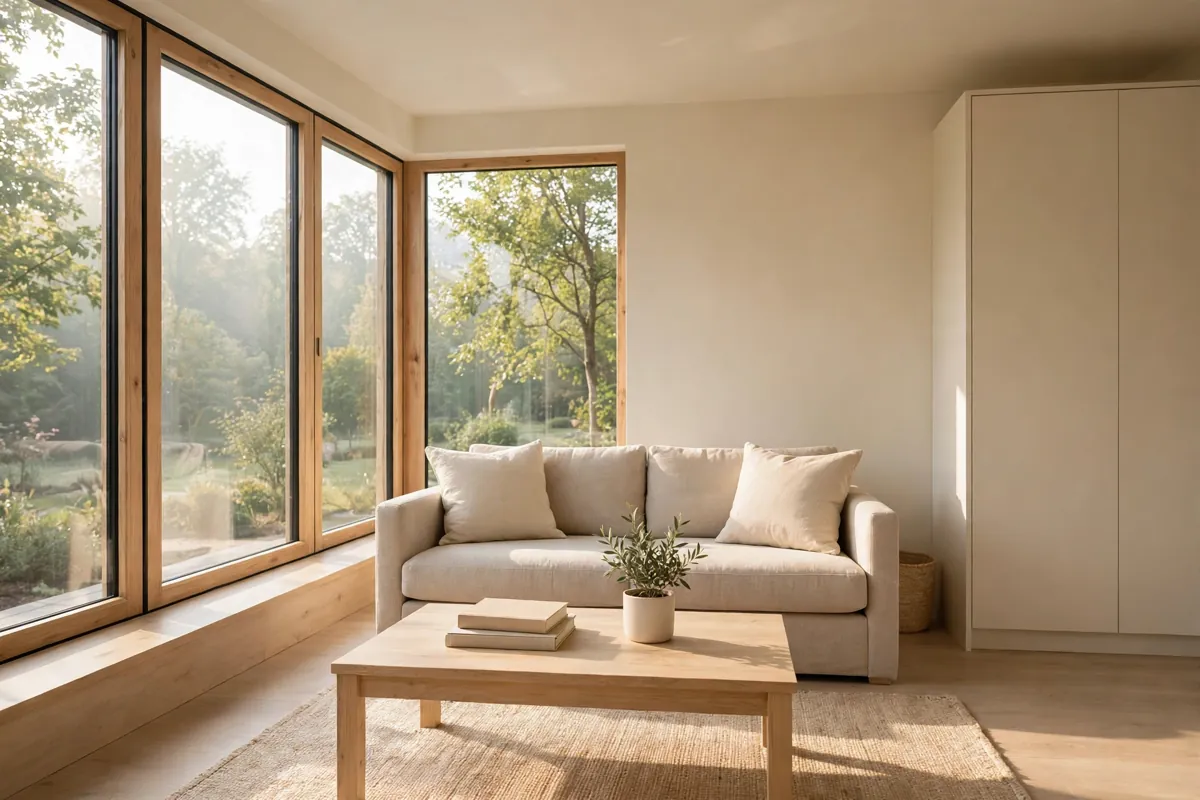

Minimalism when your partner isn’t on board can feel like a lonely project. You have just watched a video of a calm, nearly empty living room, and something in you clicked: easier mornings, a quieter house, the low-level stress of stuff everywhere finally lifting. Then you look up at your actual living room — the pile of chargers on the side table, the chair buried under clothes — and you realise the hardest part was never going to be the clutter. It was going to be the person you share the house with.
Partner resistance is one of the most common struggles in the simple-living world. In online communities where people talk about simplifying, it comes up more than where to start or what to keep. Your home is shared ground, and one person’s freedom can feel like another person’s loss. But here is the good news: you do not need your partner to become a minimalist. You need a way forward that respects them, protects the relationship, and still lets you build a calmer home.
Why Minimalism When Your Partner Isn’t on Board Feels So Hard
Before you change a single drawer, it helps to understand what you are up against — because it is rarely just about the stuff. When you suggest getting rid of the bread maker that has not been used since 2019, you think you are talking about a bread maker. Your partner hears something different: that their choices were wasteful, or that the home they love is somehow wrong. Clutter is tied to identity and memory, so a suggestion to let go can land like a criticism even when you mean it kindly.
Sometimes the resistance has a history. A partner who grew up where money was tight may hold on to things because letting go feels reckless — the “just in case” instinct runs deep. Someone else may associate a tidy house with being controlled. And sometimes it is simpler: they genuinely do not see the clutter, or it does not bother them. Your tolerance for disorder and theirs are just different.
That is why the usual approach fails. Lectures do not work. Neither do dramatic weekend purges, guilt trips, or surprise trips to the charity shop with bags that were not yours to fill. Each turns a practical question — what should live in this house? — into a contest about who is right. The way through is slower and quieter, but it works, and it starts with the only person you can change.
Start With Your Own Stuff — and Only Your Own Stuff
Every organiser and every person who has actually done this says the same thing: start with your own belongings and nothing else. Not the shared shelves. Not the spare room. Your clothes, your books, your toiletries, your paperwork, your half of the wardrobe. That is your territory, and working there first does three important things at once.
First, it is fair — hard to ask someone to let go when you have not done the work on your own things. Second, it builds trust: when your partner sees you clearing your own drawers without touching their belongings, the fear that minimalism means “someone is coming for my stuff” starts to fade. And third, it gives you visible results fast, and your cleared spaces start doing the persuading for you.
So pick one small area that is clearly yours and do it properly: your side of the bedroom, your desk, the top drawer of your dresser. Give away half of your wardrobe if that feels right, or start with ten items if it does not. The size of the first step matters far less than the fact that it is yours alone. If you are new to the idea, our minimalism for beginners starter guide walks through those first gentle steps — and a pause before every purchase does more for a calm home than any single decluttering weekend.
Talk About the Feeling, Not the Stuff
At some point you will need to talk about it, because silent resentment is worse than an awkward conversation. But how you talk about it changes everything. Keep it positive and resist the urge to criticise their clutter or push them to simplify. Nobody has ever been nagged into minimalism. What works is talking about how you feel, not about what they are doing wrong.
Lead with your own experience instead of a complaint. “I feel calmer when the kitchen counter is clear” lands very differently from “You never put anything away.” One is an invitation; the other is an accusation. Explain what you hope for — less stress, less time cleaning — and let them respond without demanding an answer on the spot. A partner who says “let me think about it” is not saying no.
It also helps to ask questions and genuinely listen. What do they love about the way the house is now? Is there anything about the clutter that bothers them too? Many reluctant partners are not happy with the mess either; they are just overwhelmed, or afraid of losing things that matter. If the fear is about losing memories, our guide to decluttering sentimental items without the guilt has gentle approaches that honour the memories while freeing up space. You do not need to win this conversation. You need to keep it open.

Set Up Zones: Clutter-Free Spaces and Protected Keep Zones
Once you have made progress on your own things, agree on how the shared spaces work — and the simplest framework is zones. Instead of trying to make the whole house minimalist, which will feel like an invasion, divide it. Some areas become clutter-free zones you both look after; others become protected keep zones where your partner’s things are safe from comment or tidying. Both need to be agreed together, not imposed.
Start with just one shared surface. The kitchen counter is a good first choice, because everyone uses it and everyone benefits when it is clear. Decide together what earns a permanent place there — the kettle, the fruit bowl, maybe a chopping board — and agree that everything else gets put away at the end of the day. One small rule both people chose beats a long list one person wrote.
Keep zones are what make the clutter-free zones feel fair. A keep zone might be:
- One shelf or drawer in the living room where your partner’s magazines, notebooks, or hobby bits live untouched.
- A corner of the garage or a spare room that belongs entirely to them, however full it gets.
- Their side of the wardrobe and their bedside table, which you never tidy, sort, or comment on.
- A memory box or a storage tub for the things they are not ready to let go of — the box itself is the limit.
The rule for keep zones is simple: what is inside them is never questioned. No counting, no sighing, no “helpful” suggestions. When your partner knows their things are safe, they stop defending them so fiercely — and people who stop defending their stuff often start letting some of it go. The container sets the limit: if it fits, it stays.
Shared spaces also work best when each person has a defined place for the things that tend to drift: a hook by the door for keys, a basket for sunglasses, a small tray for the post so it stops colonising the kitchen table. These little systems make tidying easier for both of you without requiring your partner to care about minimalism. And if you share a wardrobe, our guide to shared closet organisation ideas for couples has practical ways to divide it fairly.
The Donation Box With a Grace Period
Here is a trick that quietly changes everything in a mixed household: a shared donation box with a grace period. Put a sturdy box somewhere easy to reach and agree on two rules. Either person can add their own items at any time, and either can rescue anything from it, no questions asked, until the date written on the side. Two to four weeks is the sweet spot: long enough for second thoughts, short enough that the box does not become storage.
What makes this work is that it removes the pressure of the final decision. Your partner does not have to be sure about letting something go; they only have to be willing to put it in the box. That is a much smaller ask, and smaller asks get more yeses. Meanwhile, you fill the box with your own things and show that nothing bad happens when stuff leaves. The date arrives, the contents go to the charity shop, and the house is a little lighter.
A few other gentle systems help the same way:
- One in, one out. When something new comes in, something similar leaves. It is fair to both of you and stops the slow creep of clutter. Our one in, one out rule guide explains how to make it stick.
- A nightly reset, just for you. Spend ten minutes each evening returning shared spaces to their agreed state — counters clear, shoes by the door, cushions straight.
- Small, optional invitations. “I’m going through my books on Saturday — fancy joining me for twenty minutes?” Accept a no gracefully and leave the offer open. Many reluctant partners wander over halfway through, curious about what you are doing.
- Experiences over things. For birthdays and holidays, suggest a meal out or a day trip together instead of another object.
Minimalism When Your Partner Isn’t on Board: The Long Game
So what does success look like here? Not your partner suddenly donating half their belongings. It looks smaller and better: a kitchen counter that stays clear most days, a bedroom that feels calm, and a partner who, six months from now, holds up an old jumper and asks, “Do you think the charity shop would want this?” — and means it. That moment will feel like something you built together, not a victory over them.
Along the way, expect setbacks — they are part of the process, not a sign it has failed. There will be weeks when the donation box sits untouched and the clutter creeps back. The couples who get through this are not the ones who never argue about stuff; they refuse to let stuff define the relationship. When a disagreement flares up, step back, return to the zones you agreed on, and remember what you are protecting: the relationship first, the tidy house second.
It is also worth checking in with yourself honestly. Is your push for minimalism still about the calm and freedom you wanted, or has it quietly become about control — about the house looking a certain way, about being right? If it is the second, take a breath and loosen your grip. A home slightly messier than you would like but full of goodwill beats a perfect one full of tension. Your partner is not a project to complete.
Minimalism when your partner isn’t on board is not a watered-down version of minimalism. It is the real thing, practised with patience and respect. Start with your own belongings. Talk about feelings instead of faults. Agree on a few calm zones and protect a few keep zones. Keep a donation box with a grace period, and invite your partner in without ever demanding they join. That is building your vision in a way that lasts — with the person you love, not around them.
So begin tonight, with something small and entirely yours. One drawer, ten items, five quiet minutes. Clear it, enjoy the little rush of space, and let the result speak for itself. Your home does not need to become a showroom — just a little calmer than yesterday, and tomorrow a little calmer still. That is how a minimalist home grows where only one person started the journey.