
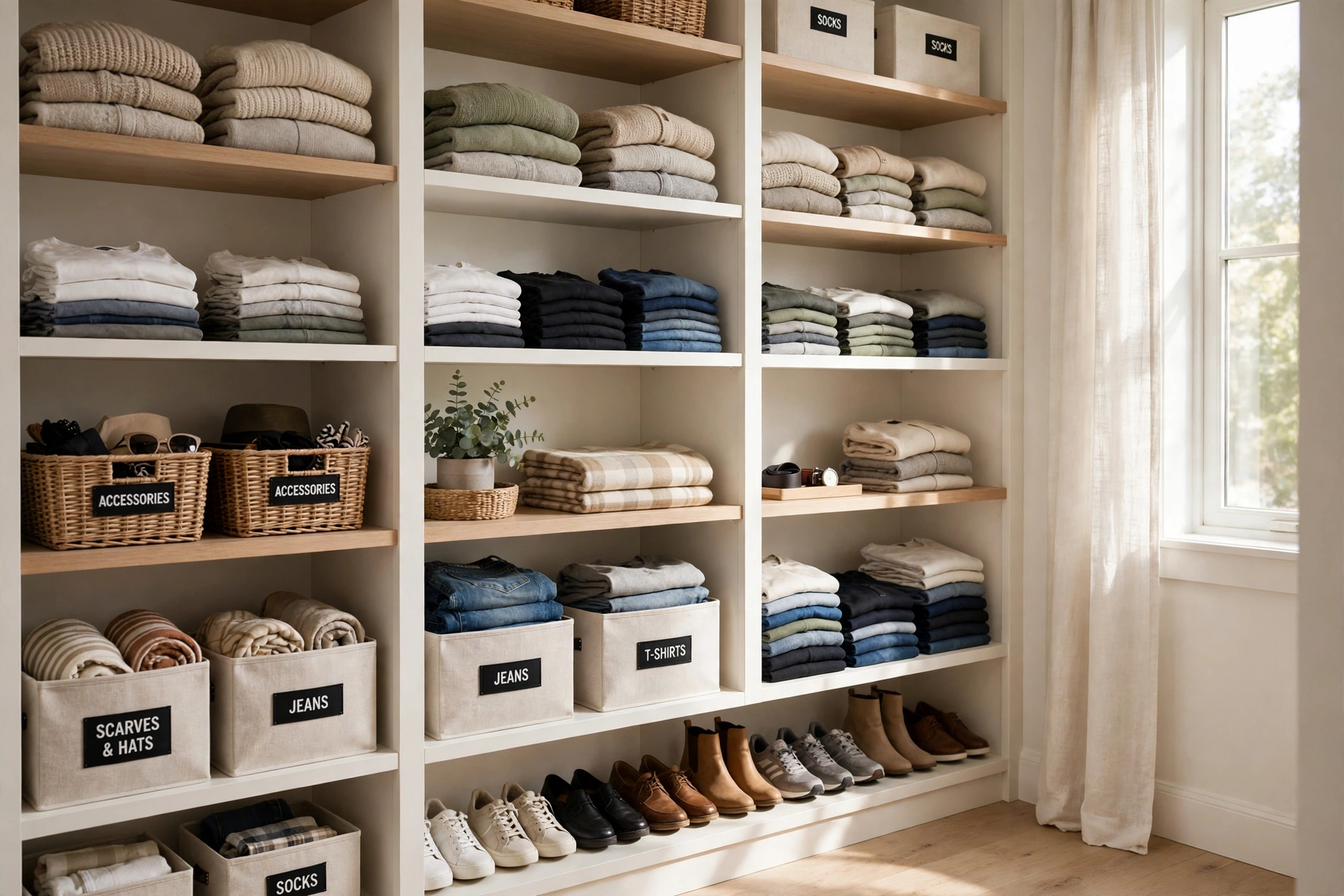

Open a closet door and you can tell in about three seconds whether the shelves are working for you or against you. When closet shelf organization is done well, you reach for a sweater without knocking over a stack, you can see what you actually own, and getting dressed feels calm instead of chaotic. When it is done badly, every shelf becomes a pile, the good stuff gets buried at the back, and you end up wearing the same three outfits simply because they are the ones on top.
The good news is that you do not need a bigger closet, a full renovation, or expensive built-ins to fix this. Most shelves fail for a few very ordinary reasons: they are too deep, too tall, or used without any kind of boundary. Clothes slide, stacks lean, and small things disappear into corners. A handful of practical changes — the right containers, a sensible layout, and a folding method that actually holds — can turn the same shelves into storage you enjoy using every single day.
This guide walks through ideas that work in real homes, for real wardrobes, whether you have a generous walk-in or a single reach-in closet with two lonely shelves. You will learn how to sort before you organize, how to divide shelves into zones that make sense, which bins and dividers are worth buying, and how to keep everything tidy long after the first big sort-out.
Closet Shelf Organization Starts With a Proper Reset
Before you buy a single bin, take everything off the shelves. Yes, everything. It sounds drastic, but it is the only way to see what you are really working with. A shelf that looks full is often only half-used: there is dead space above short stacks, forgotten items pushed to the back, and clothes you have not worn in two years quietly taking up prime real estate.
As you empty each shelf, sort items into four piles: keep and wear regularly, keep for another season, donate or pass on, and repair or throw away. Be honest with yourself here. If a jumper has sat untouched through two winters, it is not waiting for the right occasion — it is taking space from the clothes you actually reach for. The same goes for stretched-out T-shirts, single gloves, and bags you keep meaning to mend.
Once the shelves are bare, give them a proper clean and measure them. Note the width, depth, and the height between shelves, because those numbers decide what will fit. A bin that is even an inch too tall for the gap is useless, and a deep shelf needs a different strategy from a shallow one. This ten-minute measuring job saves you from the classic mistake of buying pretty containers that do not fit your actual closet.
Give Every Shelf a Job
The single biggest change you can make is to stop treating shelves as general storage and start giving each one a clear job. When a shelf has a purpose, it is far easier to put things back in the right place — and far harder for clutter to creep back in.
A practical layout for most wardrobes looks something like this:
- Eye-level shelves: everyday clothes you wear most weeks — T-shirts, jeans, work tops, and favourite jumpers.
- Waist-level shelves: heavier or bulkier items such as hoodies, thick knitwear, and pyjamas.
- Top shelves: out-of-season clothes, special-occasion outfits, and spare bedding, stored in labelled boxes.
- Low shelves: shoes, bags, and everyday accessories you grab on the way out.
Of course, your life will shape your own version. If you work from home, your lounge clothes may deserve the eye-level spot. If you have young children, their school clothes might need the most accessible shelf. The principle stays the same: the things you use most should be the easiest to reach, and the things you rarely need should live higher up or further back.
It also helps to think in zones rather than individual items. Group all your knitwear together, all your gym clothes together, and all your work clothes together. When you are looking for a running top at 6 a.m., you should only need to check one place, not hunt through three different stacks.
Use Bins, Dividers, and Baskets Wisely
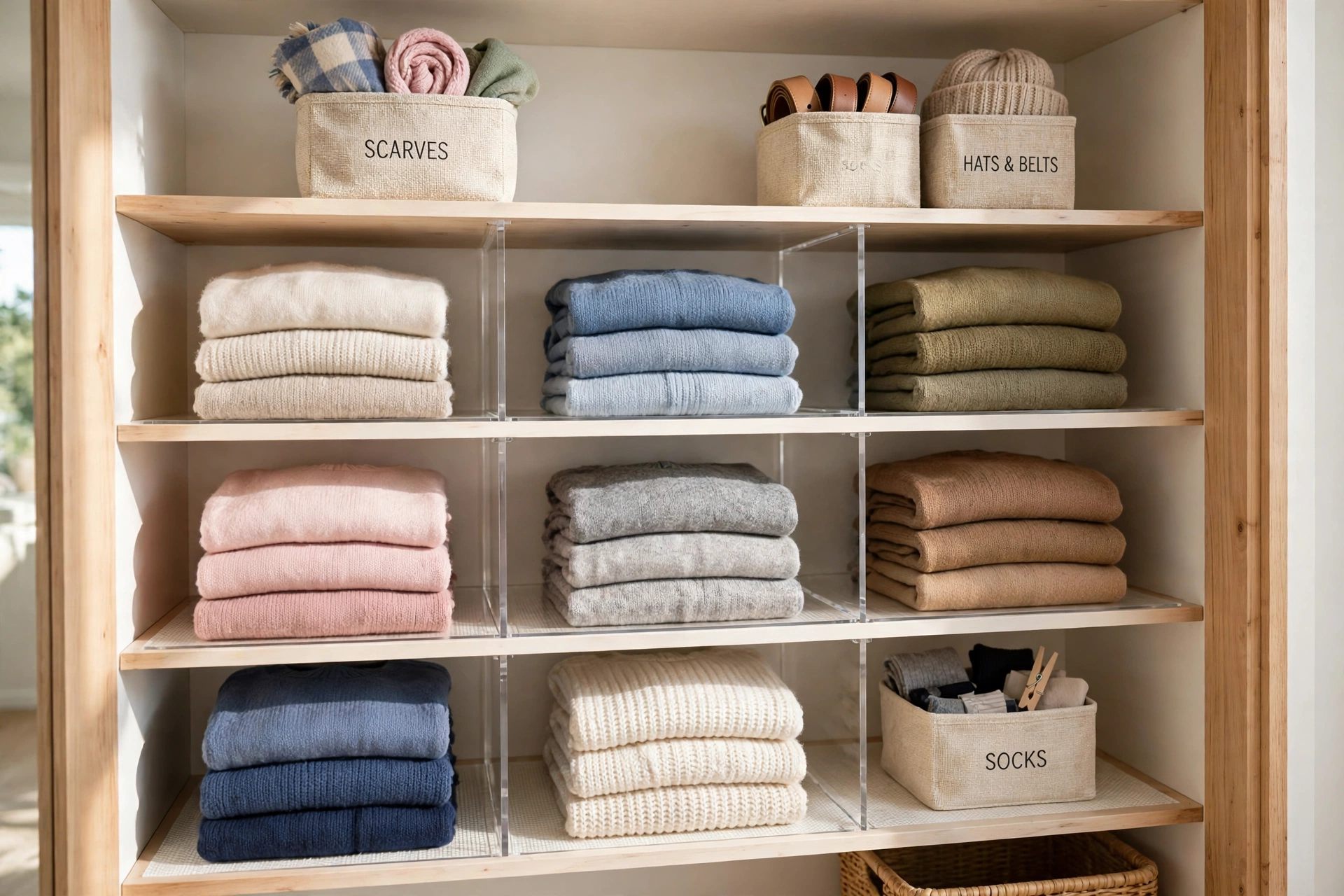
Shelves without boundaries are just waiting to become piles. Bins, dividers, and baskets give each stack a home and stop it from sliding sideways the moment you pull one item out. You do not need dozens of them — a few well-chosen pieces, used consistently, will do far more than a whole basket collection bought in a rush.
Shelf dividers are brilliant for tall shelves. They slot upright and act like bookends, keeping stacks of folded clothes standing neatly instead of leaning into each other. They are especially useful for jumpers and jeans, which tend to topple when a stack gets tall. For deep shelves, open-front bins work beautifully: you can pull the whole bin out like a drawer, find what you need, and slide it back without disturbing everything else.
Small fabric bins are ideal for the fiddly things that otherwise end up in a jumble — scarves, belts, swimwear, and underwear. Label them if it helps, even if you are the only person using the closet. A simple label turns a vague box into a destination, which makes putting laundry away much quicker. And if you are working with a smaller space, you will find plenty of ideas that scale down well in these reach-in closet organization ideas, which focus on making narrow shelves and tight corners genuinely useful.
One word of caution: do not buy containers before you have sorted and measured. It is tempting to stock up on matching baskets first, but containers should fit your clothes and your shelves, not the other way round. Start with what you already own — shoe boxes, gift boxes, and old baskets can all work as a trial run — then replace them gradually with pieces you know you need.
Fold for Shelves, Not for Drawers
How you fold matters just as much as where you store things. Clothes folded for a drawer are often folded flat and wide, which makes tall, wobbly stacks on a shelf. Clothes folded for a shelf should be compact, roughly the same size, and sturdy enough to stand in a neat row.
A good method is to fold each item into a rectangle about the width of your shelf divider or bin, then stack no more than six to eight items high. Any taller and the bottom pieces get crushed, while the top of the stack becomes a landslide waiting to happen. For chunky knitwear, keep stacks even shorter — four or five items is plenty — and place the heaviest pieces at the bottom.
Rolling can work well for T-shirts and casual tops, especially in bins, because you can see each item from above and pull one out without disturbing the rest. It is less suited to smart shirts or anything that creases easily, so save rolling for your everyday, wash-and-wear clothes. Sweaters deserve special care, since they stretch and lose their shape if hung or squashed; these sweater storage ideas for a tidy closet explain how to fold and stack knitwear so it stays looking good season after season.
Whatever method you choose, consistency is what makes shelves look tidy. When every folded item is roughly the same size, stacks line up, bins look calm, and you can spot at a glance when something is out of place. It takes a little longer at laundry time, but it saves you time every single morning.
Make the Top Shelf Work, Not Just Hold
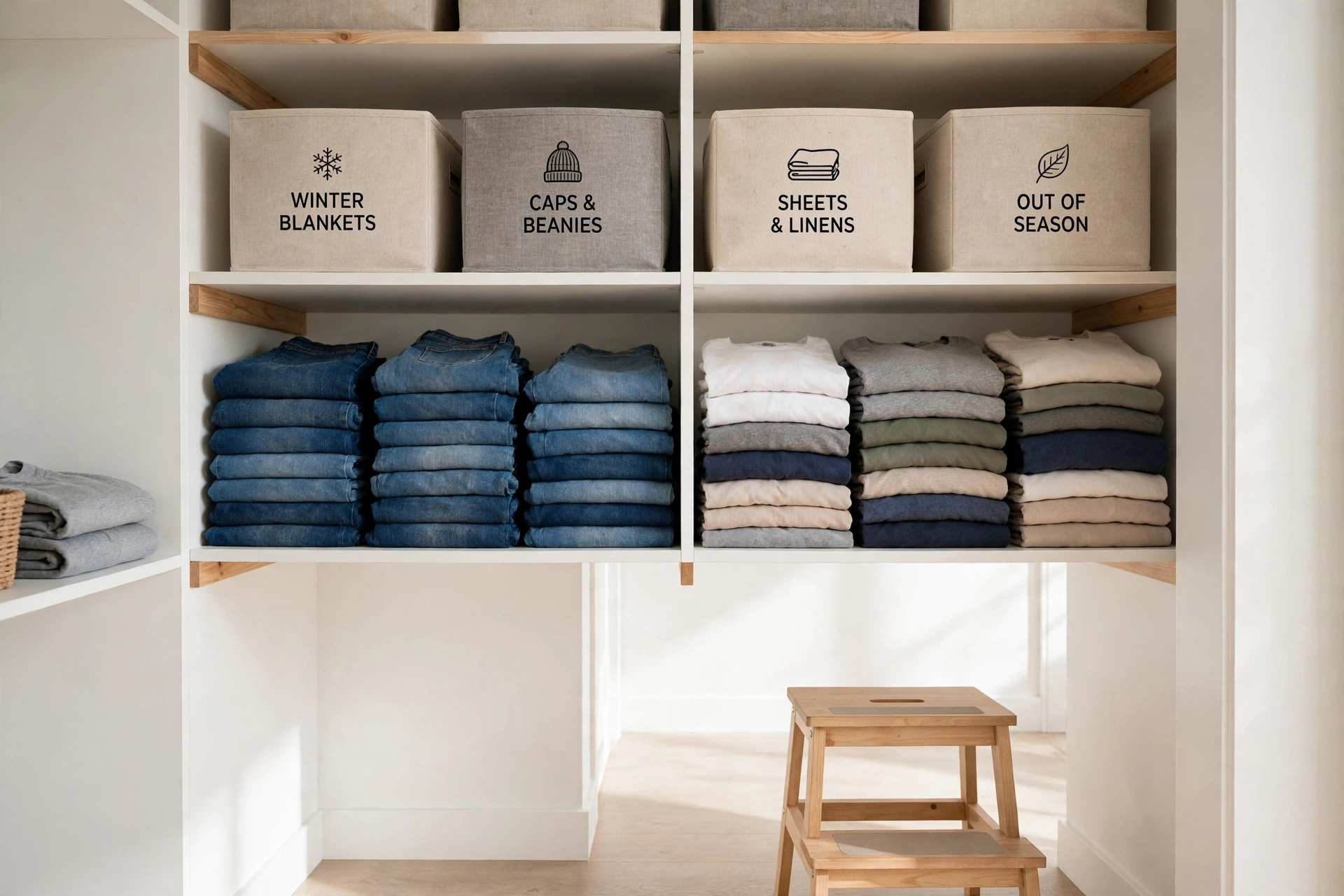
The top shelf is the most wasted space in most closets. It is too high to reach comfortably, so it becomes a dumping ground for things you cannot quite bring yourself to throw away. With a little planning, though, it can become genuinely useful storage rather than a forgotten ledge.
Use the top shelf for things you need only a few times a year: out-of-season clothes, holiday outfits, formal wear, and spare bags. Store them in clear or clearly labelled boxes so you can identify contents without dragging everything down. A small, sturdy step stool kept nearby makes the top shelf accessible instead of off-limits — if reaching it feels like a chore, you will avoid it, and the shelf will stay a mess.
Seasonal rotation is the secret weapon here. Twice a year, swap the clothes on your everyday shelves with the ones stored up top. When summer ends, your heavy coats and thick jumpers move down and your shorts and light dresses move up, and vice versa in spring. If you want a simple system for that twice-yearly switch, these seasonal closet rotation ideas walk through a routine that takes an afternoon and keeps your everyday shelves relevant all year round.
Keep the very top shelf lighter, too. Heavy boxes stored overhead are awkward to lift down and can be a safety issue, especially in a household with children. Bulky but light items — spare pillows, beach bags, and out-of-season hats — are perfect up there, while anything heavy belongs lower down.
Keep Shelves Tidy With a Simple Routine
An organized closet is not a one-time project; it is a habit. The good news is that the habit can be very small. A five-minute tidy once a week — refolding anything that has slumped, returning stray items to their zone, and pulling out anything that no longer fits — is enough to stop shelves sliding back into chaos.
Build the routine into something you already do. When you put clean laundry away, take thirty seconds to straighten the stack you are adding to. When you take something off a shelf, try to put it back in the same spot rather than on top of the nearest pile. These tiny choices are what separate a closet that stays tidy from one that needs a full reset every few months.
It also helps to set a simple rule for new clothes: one in, one out. When a new jumper comes home, an old one leaves — donated, passed on, or recycled. Without that rule, wardrobes quietly grow until shelves overflow again, no matter how good your system is. The same principle works beyond the closet, too; a tidy bedroom starts with a tidy wardrobe, and learning how to organize a dresser can help you keep the rest of the room just as calm as your shelves.
Finally, do a bigger review twice a year, ideally at the same time as your seasonal rotation. Check for clothes that no longer fit, no longer suit you, or simply have not been worn. Letting go of a few items each season keeps your shelves breathing, your choices easier, and your mornings noticeably smoother.
You do not need to overhaul your whole home to feel the benefit of better shelves. Start with one shelf — just one — and give it a job, a boundary, and a folding method that holds. Once you feel how much easier that shelf is to use, the rest of the closet tends to follow naturally.
Good closet shelf organization is not about perfection or a closet that looks like a shop display. It is about knowing where things are, being able to reach them without a struggle, and ending the daily hunt for a missing top or a buried pair of jeans. A few dividers, a few honest decisions about what to keep, and a weekly five-minute tidy can give you exactly that — shelves that work as hard as you do, every single day.