

Last Tuesday morning, I was standing in my bathroom half-asleep, reaching for the contact lens solution — and knocking over three half-empty shampoo bottles in the process. One of them leaked something minty-smelling onto the counter. It was 6:45, I had a call at 7, and I found myself wondering how a room this small holds this much stuff. If you’ve had a morning like that, you’ll understand why minimalist bathroom essentials matter far more than they sound. The bathroom is the smallest room in the house, yet it somehow becomes the storage graveyard for every half-used lotion, every hotel shampoo bottle you “might use one day,” and every gadget that promised clearer skin or whiter teeth.
Here’s what nobody tells you: a minimalist bathroom isn’t about deprivation. Nobody is asking you to wash your hair with a bar of mystery soap you hate, or to throw away the moisturizer your skin actually likes. It’s about being honest — truly honest — about what you use, what you love, and what is just taking up space because throwing it away feels like admitting you wasted money. That last one is the trap. The money is already spent. The only question is whether the product earns the space it occupies every single day.
Over the past year, I pared my own bathroom down from “pharmacy aisle exploded” to a tidy, calm handful of items. My mornings got faster, my counter stays clean without effort, and — this surprised me most — I enjoy my routine more now, because every product I own is one I chose on purpose. This guide walks you through the same process: the one-per-category rule, how to declutter expired and duplicate products without guilt, the true essentials list, tiny storage systems that work in real bathrooms, and a simple rhythm for keeping it that way.
The One-Per-Category Rule for Minimalist Bathroom Essentials
The whole philosophy of minimalist bathroom essentials fits into one sentence: one product per job, and every product must earn its place. One shampoo. One conditioner (or a two-in-one, if your hair agrees). One body wash. One face moisturizer. One sunscreen. It sounds strict until you realize how many of us are running a small warehouse: the expensive shampoo you bought because it smelled like a holiday, sitting next to the cheap one you actually use; four moisturizers in different stages of abandonment; a serum you stopped using in March.
Why does one-per-category work so well? Three reasons. First, you can actually see what you have. When nine bottles crowd the shower, you stop seeing any of them — which is exactly how you end up buying a fifth body scrub “just in case.” Second, products get used up before they expire. Sunscreen loses protection about a year after opening; mascara should be replaced every three months; that miracle cream from two years ago is a science experiment now. Third, you finally learn what you like. Use one moisturizer for a whole month and you’ll know for certain whether your skin likes it. Rotate through four and you never learn a thing.
The honest exceptions: if you share the bathroom, it’s one per category per person — not one shampoo for a family of four. And one unopened backup of something you’re actively using up is fine. What needs to go is the three backup bottles of a thing you haven’t touched since spring. If you want the full logic behind killing duplicates, our rule of one guide covers it in depth — bathrooms are where duplicates multiply fastest.
Start With a Ruthless (But Kind) Purge
Before you buy a single organizing basket, deal with what’s already there. Set aside an hour on a weekend — put on a podcast, because this gets satisfying fast — and pull absolutely everything out. The shower caddy, the medicine cabinet, under the sink, that drawer where cotton pads go to die. Lay it all on the bed so you can see the full picture. Most people are genuinely shocked at this stage. I was: I found eleven lip products in a bathroom used by one person with one mouth.
Sort with three questions: Do I use this every week? Is it still good? Do I already own another one? Anything that fails all three goes. For “is it still good”: mascara and liquid eyeliner, three months; sunscreen, one year after opening; anything that smells off, has separated, or changed color — gone, no debate. Old medications go to a pharmacy take-back program, never the trash or the sink.
For duplicates — the four half-used body lotions — keep your favorite and release the rest. Unopened, in-date products can go to a shelter or a friend; they don’t have to become landfill. And give yourself permission to let go of the expensive mistake. That $40 serum that did nothing? The money is gone whether the bottle sits in your cabinet for two more years or goes in the recycling today. Decluttering calmly, without the guilt spiral, is a skill — and the bathroom is a perfect, contained place to practice it. When I purged mine, I filled an entire grocery bag with bottles containing less than a teaspoon of product each. Ridiculous — and incredibly freeing.

The Minimalist Bathroom Essentials Checklist
Once the purge is done, what’s left is your personal essentials list — and then you decide whether each category truly needs a dedicated product, or whether one hardworking item can cover two jobs. Here’s the honest, category-by-category baseline. Adjust for your hair, skin, and household.
In the shower
- Shampoo — one bottle, the one your hair genuinely likes. If a shampoo bar works for you, even better: no plastic, lasts for months.
- Conditioner — or a two-in-one if your hair tolerates it. Long or dry hair usually needs the real thing; short hair often doesn’t.
- Body wash or bar soap — one. A good castile soap can cover hands, body, and even shaving in a pinch.
- Shaving supplies — one razor, one cream or soap. If you don’t shave, this category simply doesn’t exist in your bathroom.
At the sink
- Hand soap — one refillable dispenser. Refills are cheaper and cut plastic dramatically.
- Toothbrush and toothpaste — one each in use, plus one unopened backup toothpaste if you like.
- Floss — the item almost everyone owns and skips; keeping exactly one visible makes it more likely you’ll use it.
- Deodorant — one. Not the sport one, the regular one, and the “going out” one. One.
Skincare
- Cleanser — one gentle cleanser, morning and night.
- Moisturizer — one that works for your face; many double as hand or body cream in a pinch.
- Sunscreen SPF 30+ — one, worn daily. The single highest-impact skincare product most people own.
- Treatment (optional) — one active at a time: retinol, vitamin C, whatever your skin needs. Finish one before starting the next.
Hair, grooming, and health
- Styling product — one: the one you reach for on good-hair days, not the three you bought hoping for good-hair days.
- Hairbrush or comb — one. Hair ties and clips live in one small container, not scattered across every surface.
- Nail clippers and tweezers — the small tools that vanish into drawers; give them one home.
- First aid basics — current medications, basic pain relief, plasters, and a thermometer in one small pouch, checked twice a year for expiry.
Most people land between 15 and 25 items — a far cry from the 60-plus crowding the shelves before. Notice what’s missing: the twelve hotel sample sachets, the “someday” face masks, the backup-backup razor heads. If it doesn’t serve your actual weekly routine, it’s not an essential.
Smart multi-use swaps
To shrink the list further, a few products genuinely pull double duty. Castile soap works as hand soap, body wash, and shaving lather — a diluted mix even cleans the sink. Jojoba or argan oil removes makeup, moisturizes dry skin, tames frizz, and softens cuticles. A shampoo bar often doubles as a travel body bar. One honest caution: multi-use only counts if you actually like using the product that way. If you hate how a two-in-one makes your hair feel, it’s not saving you anything. Buy the small size first; commit to the big refill only once it’s earned its place.
Tiny Storage Systems: Every Essential Gets a Home
Storage doesn’t keep a bathroom tidy — having less stuff keeps a bathroom tidy. But once you’ve pared down, a few small systems make the calm permanent. The goal: every item has one obvious home, so putting things away takes seconds and the counter never becomes a landing strip again.
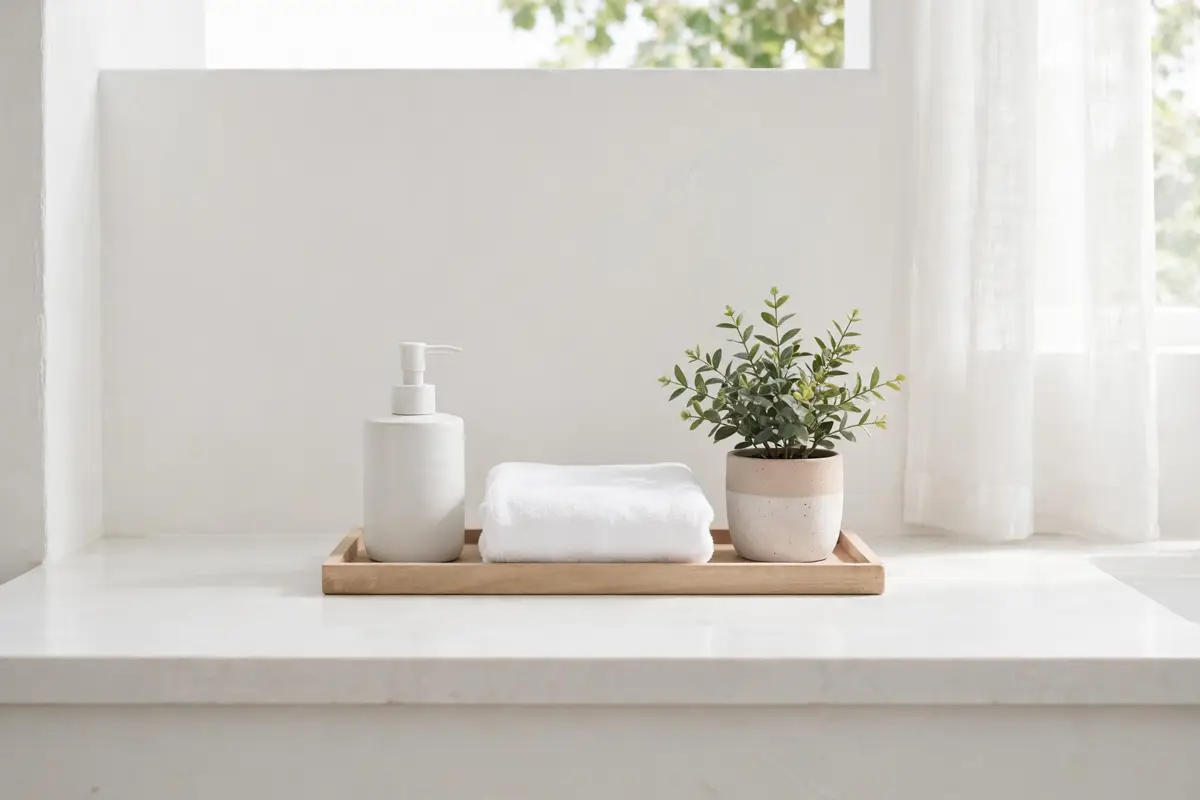
Start with the counter, because it’s what you see every morning. The rule: the counter holds a tray and nothing else. One small tray — wood, stone, ceramic — corrals the 3–5 things you use daily: hand soap, toothbrush holder, moisturizer. Everything else lives behind a door or in a drawer. A tray turns “stuff scattered on the counter” into “one intentional arrangement,” and wiping the counter takes five seconds because you lift one tray instead of moving eleven bottles.
Under the sink is where the rest lives, and where most bathrooms fall apart. Pull-out baskets or stackable bins beat loose piles — you see everything at a glance instead of excavating. Group by category: hair things, skincare backups, cleaning supplies. Drawer organizers do the same job inside vanity drawers, giving nail clippers and tweezers a slot instead of a tangled drawer-soup. No drawers at all? A slim rolling cart or lidded baskets on a shelf work just as well — the principle is containment, not fancy furniture.
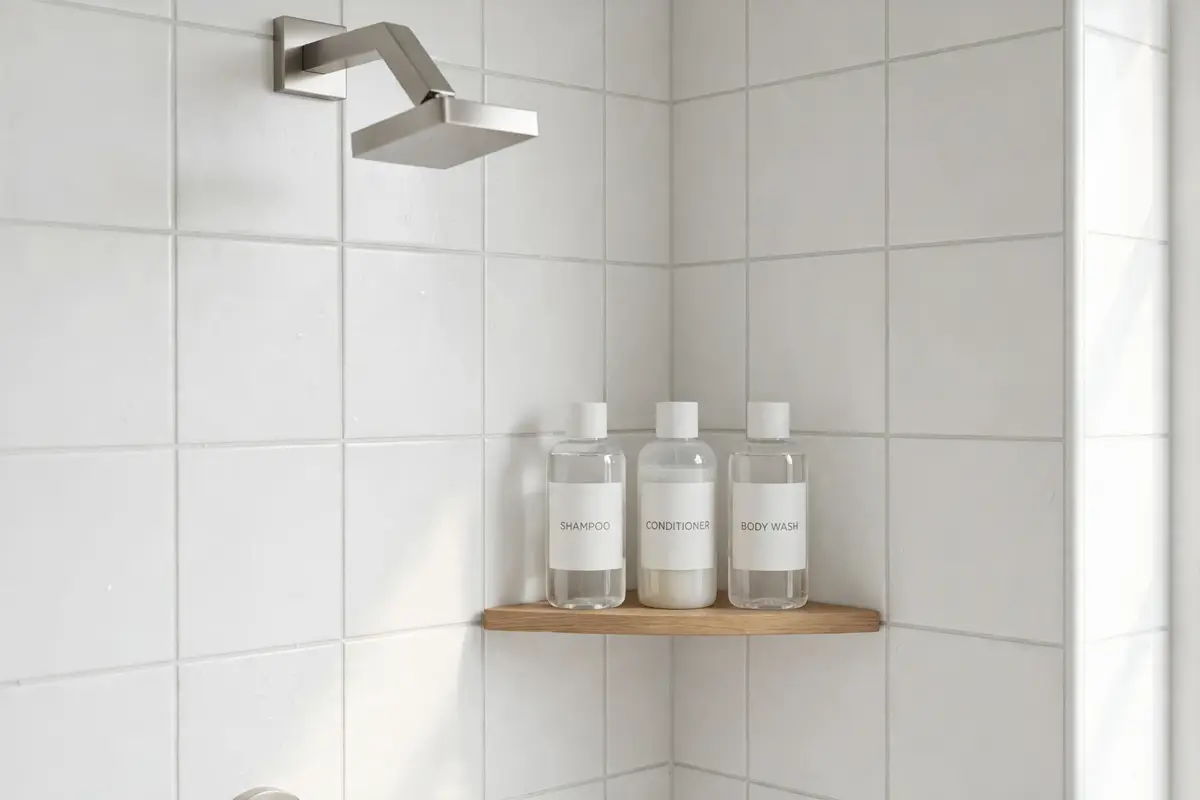
Two upgrades punch above their weight. First, decant into refillable dispensers: matching bottles for shampoo, conditioner, and body wash cut visual noise instantly and cost less to refill. Second, mount what you can: a wall-mounted toothbrush holder, a corner shower shelf, hooks for towels instead of bars that collect damp piles. Getting things off flat surfaces is the fastest visual declutter there is.
Keep It Minimal: The 10-Minute Weekly Reset
A minimalist bathroom stays minimalist with almost no effort — that’s the point — but it needs a tiny rhythm, or clutter creeps back one free sample at a time. Once a week, spend ten minutes: wipe the counter, mirror, and sink (easy with only a tray to lift); put everything back in its home; toss anything now empty; and run the one-in-one-out rule — a new product only enters when its predecessor is finished. Ten minutes, and the bathroom resets to calm.
Twice a year, do a 20-minute expiry sweep through the bins and first aid kit, timed with something memorable like the clock change. And when the old collecting habit stirs — the travel minis, the “it was on sale” serums — remember that a calm bathroom isn’t maintained by willpower, it’s maintained by a system that makes the right choice the easy one. If you started with minimalism elsewhere in your home, you’ll recognize the pattern: less to manage means more energy for everything else.
Less Stuff, Calmer Mornings
What I didn’t expect when I pared my bathroom down: the room started to feel like a small spa instead of a storage unit. Mornings got quieter — not silent, just smoother. No more digging, no more choosing between four moisturizers, no more mint-scented counter disasters at 6:45. Just the few good things I chose, in their places, ready to go.
You don’t have to do it all this weekend. Start with the purge — one honest hour — and the one-per-category rule. The storage systems can come later, one tray at a time. Minimalist bathroom essentials aren’t a finish line; they’re a way of deciding, every time something tries to move into your bathroom, whether it truly earns the space. Keep asking that question, and the calm takes care of itself.