
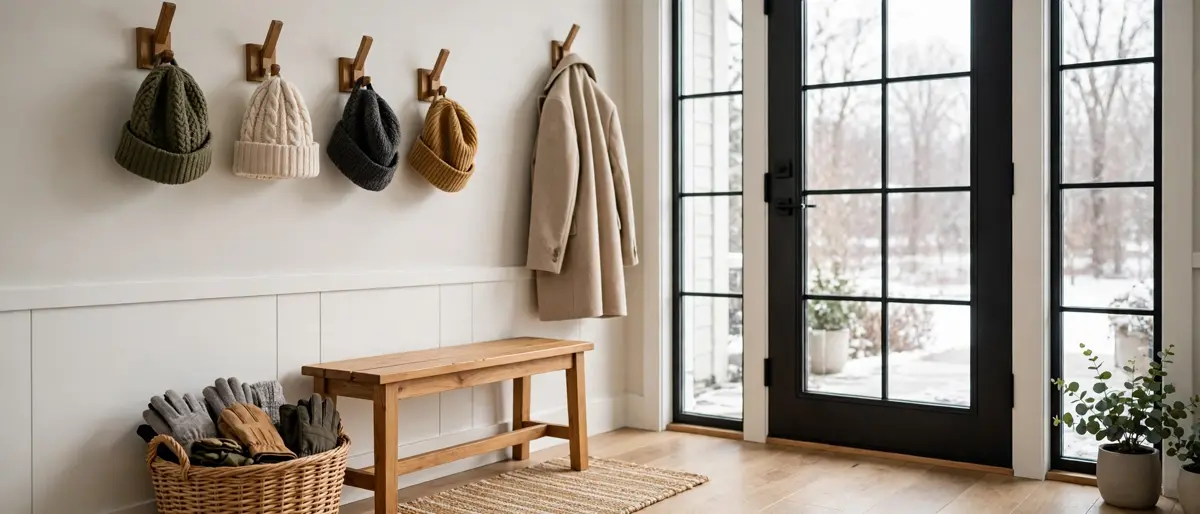

If you have ever stood in a cold hallway at 7:40 in the morning, holding one mitten and yelling a child’s name into the stairwell, this article is for you. Good hat and glove storage ideas are not really about bins and hooks — they are about getting your whole household out the door without the scavenger hunt. Every January, the same pile appears by the front door: hats with stretched-out cuffs, single gloves nobody claims, and a scarf that has lived on the floor since December. That pile is the reason you are late, the reason the good wool gloves disappeared, and the reason the morning routine falls apart.
Here’s the honest truth: winter accessories multiply. One person does not own one hat and one pair of gloves — they own a favorite beanie, a dressier wool hat, thin touchscreen gloves, heavy snow gloves, and a gas-station pair bought in a panic. Multiply it by a family and you are managing twenty-plus small items that slip everywhere. You need a system: a home for every item, a rule for keeping pairs together, and a seasonal rhythm so February’s mess never returns. If your coats are also part of the problem, a well-planned coat closet you can actually navigate in February makes the hat and glove system ten times easier.
Start With the Great Winter Purge
You cannot organize what you should have thrown away three years ago. Before a single bin gets labeled, dump every hat, glove, and mitten in the house onto one surface. The living room floor works best, because it forces you to finish. Then sort into four honest piles: keep, donate, toss, and re-home (things that belong to someone who doesn’t live here anymore).
The toss pile is bigger than you think. Gloves with broken seams, beanies stretched so wide they sit on your ears like a salad bowl, anything pilled beyond recognition, and — the winter equivalent of the odd sock — every single glove whose partner has been missing for more than one winter — if it hasn’t shown up by now, it is a ghost. Let it go.
For kids’ stuff, use the “two-season rule.” Mittens that fit perfectly last year but not this year are not keepsakes — they are clutter wearing a disguise. Bag them for a younger sibling if one exists, donate the rest while the season still has life in it. And here is the rule that ends the mystery: from now on, one person owns a maximum of two hats and two pairs of gloves in active rotation. A daily driver pair and a heavy-weather pair. Everything else goes into deep storage or leaves the house. This single limit does more for your entryway than any product you can buy.
Check what survives for damage and wash everything that can be washed. Most acrylic beanies and fleece-lined gloves do fine on a gentle cycle, and starting the season with clean gear makes people actually want to put it back where it belongs. Nobody returns a smelly hat to its hook.
Build an Entryway Station That Fits Your Household
The biggest mistake people make is copying someone else’s entryway system. A single person in an apartment needs something different from a family of six with a mudroom. The principle is the same — every person gets one landing spot for their daily hat and gloves — but the furniture changes.
One or two people, small entry
You need almost nothing: two hooks and one shallow basket. One hook holds today’s hat, one holds the scarf, and the basket catches the gloves — because gloves are dropped, not hung. They are the least cooperative clothing item ever invented. A wall-mounted shelf with hooks, twelve inches deep, gives a tray for gloves and hooks below for hats, and can transform a tight entryway into a hardworking one without touching the floor plan.
Family with kids, standard hallway
This is where the pile is born, and where labeling earns its keep. Give every family member a personal cubby, hook, or bin — with their name on it in big letters. Kids who won’t read a label will respond to color: one color bin per child, all of their accessories live in that bin. Put kids’ hooks at kid height — a hook a seven-year-old can’t reach is just wall decoration. The golden rule for families: the bin must be faster than dropping things on the floor.
When five or more people share one door, vertical space is your only friend. A tall narrow unit with one row of hooks per person beats one long row at a single height. Hang a shoe organizer on the back of the entryway door — the clear pockets are the perfect size for folded gloves, and the visibility means you see all twenty pairs at a glance instead of digging. Pair that with a slim bench with cubbies underneath, one cubby per person, and you have a complete system in about three feet of wall.
Hat and Glove Storage Ideas for Keeping Pairs Together
Single mittens are a physics problem: two small items yanked off in a hurry will separate. The systems below fight that tendency.
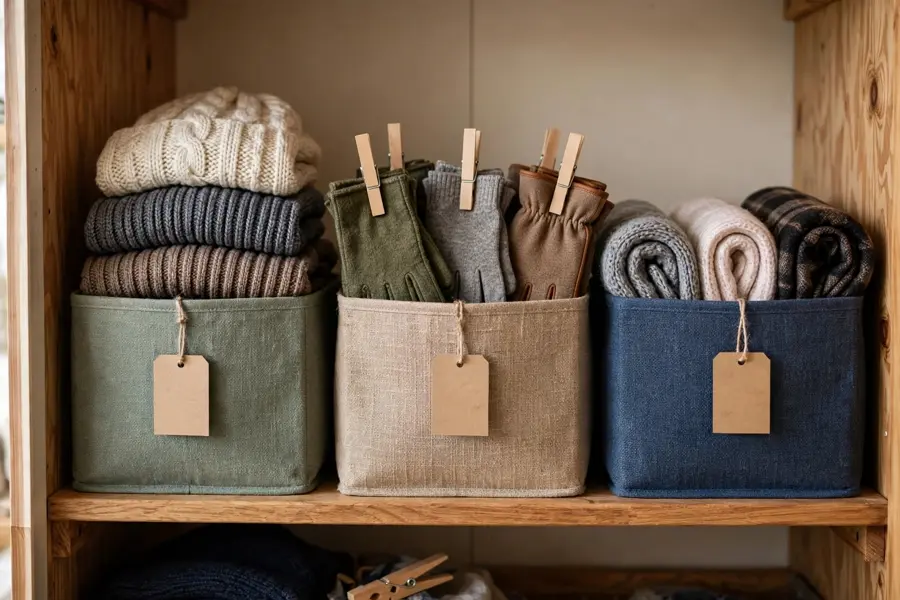
Clips on a line. String a short length of cord or curtain wire across the inside of a closet door or along a shelf edge, and attach glove clips or small carabiners. Each pair hangs clipped together, visible and grabbable. The rule is dead simple: when you take gloves off, clip them back together and hang them on the line.
The carabiner trick for backpacks and coat loops. Keep a cheap carabiner on every backpack, school bag, and coat zipper pull from November through March. Gloves get clipped to the bag the moment they come off — they never sit loose anywhere, so they never get left anywhere.
Color-coded household bins. If the whole family shares one shelf, assign each person a color — not a label, a color. Red bin for you, blue for your partner, green for kid one, yellow for kid two. Everything that person owns goes in their color. When a stray glove shows up on the stairs, its color tells you exactly where it lives. No detective work required.
One basket, one pair rule. Keep a small basket labeled “singles” in the entryway drop zone. Any lone glove goes in it. Once a month, empty it and reunite pairs — or admit defeat and donate the loners.
If scarves, belts, and bags need the same treatment, the same pairing logic extends beautifully — a dedicated accessory system for belts, scarves, bags, and jewelry uses the same one-home-per-item thinking and keeps the whole closet calm.
Treat Your Good Hats Like the Investment They Are
There is a difference between a ten-dollar acrylic beanie and a wool fedora, a structured ski helmet, or the good felt hat you wear to winter weddings. The beanie can live crammed in a bin forever and come out fine. The structured hat cannot. Crush a structured brim for three months and it comes back looking like a sombrero.
Structured hats need one of three things: a hat box, a dedicated hook with nothing stacked on top, or a shelf where the hat sits crown-down, which protects the brim’s shape. Hat boxes are the classic answer — they stack, they protect from dust, and they look good on a high closet shelf. One box can hold two or three soft hats nested crown-to-crown, but structured hats each get their own. Before boxing anything for the season, tuck tissue paper in the crown to hold the shape and add a cedar ring or lavender sachet to keep moths away from the wool ones.
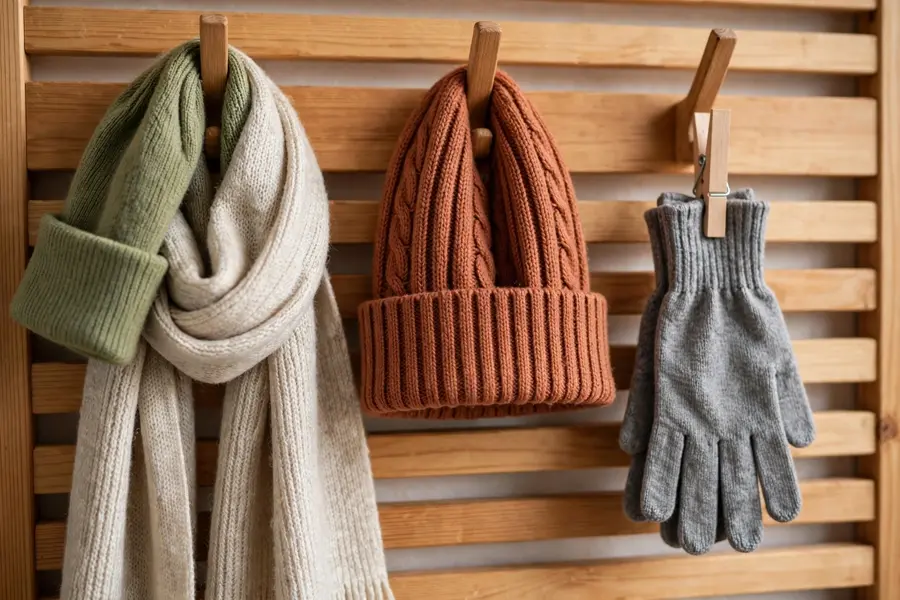
For wide-brim hats you wear regularly, individual hooks are the kindest storage. Space the hooks at least eight inches apart so brims don’t overlap and dent each other, and use a wide peg rather than a thin nail, which stretches and warps the band. Keep all of them out of direct sun and away from radiators: heat and UV fade and dry out good felt and straw, even in winter.
Renter-Friendly Hanging Without Touching a Drill
Half the battle is that the ideal spots — the wall by the door, the inside of the closet — belong to landlords who do not want holes in them. The good news is that no-drill hardware has gotten genuinely good.
- Large adhesive hooks rated for several pounds will hold a row of beanies and lightweight scarves on a smooth wall or door. Clean the surface with rubbing alcohol first, press for thirty seconds, and wait a full 24 hours before hanging anything — most adhesive failures are impatience failures.
- Over-the-door hook racks need zero installation and turn the back of any door into a six-to-eight-hook station. They are ugly on the outside of a door but invisible on the inside of a closet door, which is exactly where a hat and glove station belongs.
- Tension rods wedged inside a closet or between two walls create an instant hanging bar for glove clips and carabiners — no screws, no adhesive, and you can move it when the season ends.
- Magnetic hooks on a metal door, a steel entry bench, or the side of a metal filing cabinet hold surprising weight and move in seconds.
- Adhesive picture ledges mounted inside a closet door become narrow shelves for folded gloves and rolled beanies, using dead space that was doing nothing.
One caution: adhesive hooks and damp walls are enemies. If your entryway wall gets condensation in winter, mount your hooks on the closet door or a freestanding rack instead. A hook that peels off in January and dumps four hats behind the radiator is worse than none.
Rotate the Off-Season Off the Prime Shelf
Here is the uncomfortable math: you use winter hats and gloves for roughly four months of the year. For the other eight, they are squatters occupying the most valuable real estate in your entryway — the hooks and shelf you reach every single day. A seasonal rotation is what keeps the system working instead of slowly filling back up.
In late March or April, when the heavy gloves go unworn for two straight weeks, pack them. Wash everything first — sweat and oils left in storage attract moths and set stains over summer. Let it all air-dry completely — damp gloves in a sealed bin will greet you in October smelling like a swamp — then pack by household member into labeled bins or vacuum bags. The heavy-weather gear goes to the highest shelf or the back of the closet. Keep one lightweight pair of gloves and one thin hat per person in the entryway through spring, because weather lies.
When October rolls around, reverse the move — and make it your natural re-purge moment. Before the winter gear comes back down, check each pair for the year’s damage and retire anything that won’t survive another season. Kids who outgrew last year’s gloves get sized now, not in a first-frost panic. A good seasonal closet rotation routine turns this swap into a thirty-minute job twice a year. Write the contents on the outside of the off-season bin in plain words: “Winter hats and gloves — 4 people.”
A Calmer Doorway Is Closer Than You Think
None of this requires a renovation, a big budget, or a personality transplant. It requires one honest purge, one landing spot per person, a pairing rule that even a tired six-year-old can follow, and a twice-a-year rotation. The morning mitten hunt is a system flaw, not a character flaw — and systems can be fixed in a single weekend afternoon. Start with the purge this week. By the first real cold snap, every hat and glove in your house will have a home, and you will walk out the door on time — both mittens in hand, no yelling required.
[…] realistic systems are the ones that survive. If winter accessories are part of your daily pile, our hat and glove organization guide pairs perfectly with this […]