
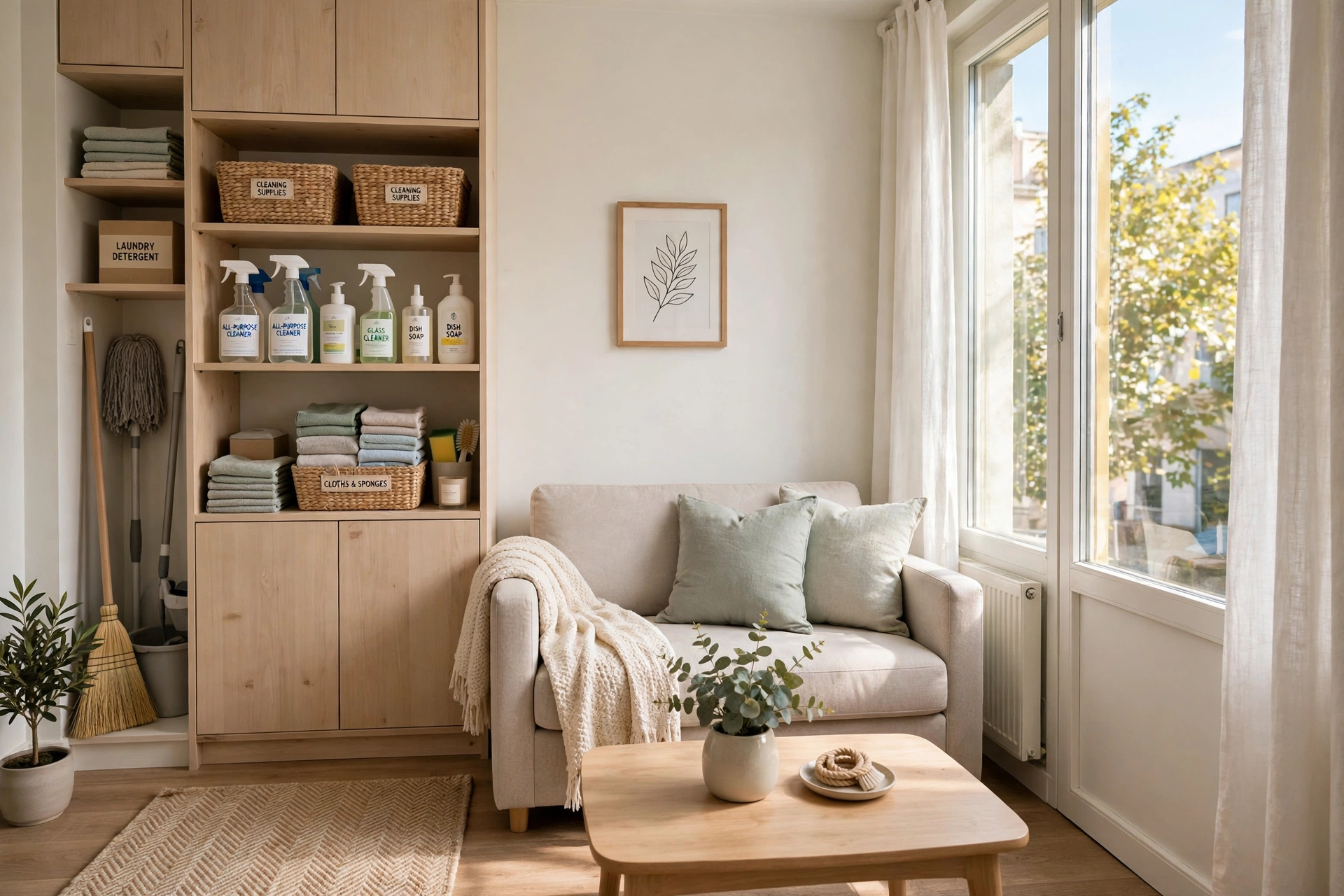

Why a Small Apartment Cleaning Routine Works Differently
A small apartment cleaning routine is not a scaled-down version of a house-cleaning routine. In a house, a stray jacket in the hallway is easy to ignore. In a studio or one-bedroom flat, that same jacket is the first thing you see when you walk in, it blocks the chair you need, and it makes the whole room feel crowded. Small spaces are honest like that. They show every shortcut, but they also reward every small effort almost immediately. Ten minutes of real tidying can change how a tiny flat looks and feels, in a way ten minutes in a large house never could.
That is the good news, and it is also the trap. Because a small home gets messy faster, it is tempting to clean constantly, or to give up entirely and decide a tiny space will always look cluttered. Neither approach works for long. Constant cleaning is exhausting, and giving up leaves you living in a space that quietly drains your energy. The middle path is a simple, repeatable routine: a short daily reset, a focused weekly plan, and a few sensible habits for the spots that always collect clutter.
This routine is built for real life in a small footprint. It assumes you may work long hours, share the flat, and own very little storage. It does not need fancy equipment or a perfectly organised home to start. It only asks that you do a little, often, and in the same order each time, so cleaning becomes a habit, like making coffee in the morning.
The Daily 10-Minute Reset That Keeps Chaos From Building Up
If you take only one idea from this article, take this one: a daily ten-minute reset is the backbone of a tidy small apartment. It is not a deep clean. It is a quick pass that returns the flat to its baseline, so mess never piles up into a weekend-sized job. Set a timer if it helps. Ten minutes feels short when you know there is an end in sight, and most people finish with a minute or two to spare once the habit settles in.
Work in the same order every day, and carry a small basket for things that belong in another room. Start at the front door and move through the flat in one direction, so you never retrace your steps. Fluff the sofa cushions, fold the throw, and clear the coffee table. In the kitchen, load the dishwasher or wash the few dishes in the sink, wipe the worktop, and put away anything that has drifted out of place. In the bathroom, hang up towels and wipe the sink quickly. Finish in the bedroom by making the bed and hanging up clothes.
The secret of the reset is that it deals with surfaces, not cupboards. You are not reorganising drawers or scrubbing grout. You are putting things back where they live and straightening what has been used. That keeps the reset fast and stops it turning into an hour-long project. For a fuller look at how a short daily habit can stick, this daily cleaning routine that actually sticks is a helpful companion to this plan.
Timing matters too. Many people find the reset works best in the evening, when the day is winding down. A calm, clear living room makes it easier to relax, sleep well, and wake up to a home that feels like a fresh start. If evenings are hectic, try this evening reset cleaning routine in 10 minutes as your closing ritual. The exact time matters less than consistency: pick a slot you can keep, attach it to something you already do, like after dinner, and let it become automatic.

Your Weekly Room-by-Room Plan for a Small Footprint
Once the daily reset handles surface clutter, a weekly plan takes care of the actual cleaning: dust, floors, bathrooms, and kitchen surfaces that need more than a wipe. In a small apartment, this does not need to take all Saturday. Spread it across the week, or do it in one focused hour, whichever fits your life better. The plan below assumes a studio or one-bedroom flat of roughly 400 to 700 square feet. If your flat is smaller, it will be quicker.
Start with the kitchen, because it affects health and mood most directly. Wipe cabinet fronts and handles, clean the hob and the inside of the microwave, and give the sink a proper scrub. Empty the fridge of anything past its best, and wipe one shelf while you are there. You do not need to empty the whole fridge every week; rotating one shelf or drawer each week keeps it fresh without turning it into a chore.
Next, move to the bathroom. Clean the toilet, shower or bath, mirror, and sink, and change hand towels. In a small bathroom, steam and splashes build up quickly, so a weekly clean really makes a visible difference. Keep a dedicated bathroom cloth and spray under the sink, so you are not hunting for supplies mid-clean. For a step-by-step version you can finish fast, see this 10-minute bathroom cleaning routine, which fits neatly into this weekly plan.
Then tackle the living area and bedroom together, since in many small flats they flow into one another. Dust shelves, light fittings, and electronics, vacuum or mop the floors, and shake out rugs or door mats outside if you can. Change bed linen weekly, and check the places dust loves to hide: the top of a wardrobe, behind a door, and under the bed. Storage choices matter as much as cleaning here, because a room with a home for everything is far easier to keep clean. These small living room storage ideas that make a tiny space feel twice as big pair well with this weekly pass.
Finish with floors: vacuum rugs, mop the kitchen and bathroom floors, and empty all bins.
One Caddy, Every Tool: Multi-Use Supplies for a Tiny Home
Small apartments punish cluttered cleaning cupboards. If your supplies are scattered across three cupboards, a hallway closet, and the top of the washing machine, you will waste half your cleaning time just gathering them, and you will be tempted to skip the job altogether. The fix is simple: one portable caddy that holds everything you need for the daily reset and the weekly clean.
A good caddy for a small flat is sturdy, easy to carry with one hand, and small enough to live on a shelf or under the sink without taking over. Inside it, keep only multi-use tools that earn their place: an all-purpose spray, a bathroom cleaner, a microfibre cloth for dusting, a second cloth for wet work, a small scrub brush, rubber gloves, and a roll of bin bags. Add a duster with an extendable handle if you have high shelves.
Leave out single-use gadgets, duplicate sprays, and bulk buys with nowhere to live. Every extra bottle is weight in the caddy and a reason to put off starting. When a product runs out, replace it with the same one if it worked.
- All-purpose spray: for counters, tables, and most hard surfaces.
- Bathroom cleaner: for the toilet, shower, and sink.
- Two microfibre cloths: one dry for dust, one damp for wiping.
- Small scrub brush: for grout, taps, and stubborn spots.
- Rubber gloves and bin bags: so the job is quick and hygienic.
Taming the Clutter Hotspots: Entry, Kitchen Counter, and Bathroom
Every small apartment has hotspots: the places where clutter lands first and spreads fastest. In most tiny homes, three spots cause most of the trouble. Deal with those three, and the rest of the flat almost looks after itself. Ignore them, and even a freshly cleaned flat can look messy again by the evening.
The entry is first, because it is the landing strip for everything you carry home. Keys, post, bags, coats, and shoes all arrive here, and without a system they end up on the floor or the nearest chair. Give every arrival a home, and keep the system simple. One hook or rail for coats, one small tray for keys and coins, one basket for post, and a shoe rack that actually fits the shoes you own. Empty the post basket weekly, and return anything that does not belong at the door during the daily reset.
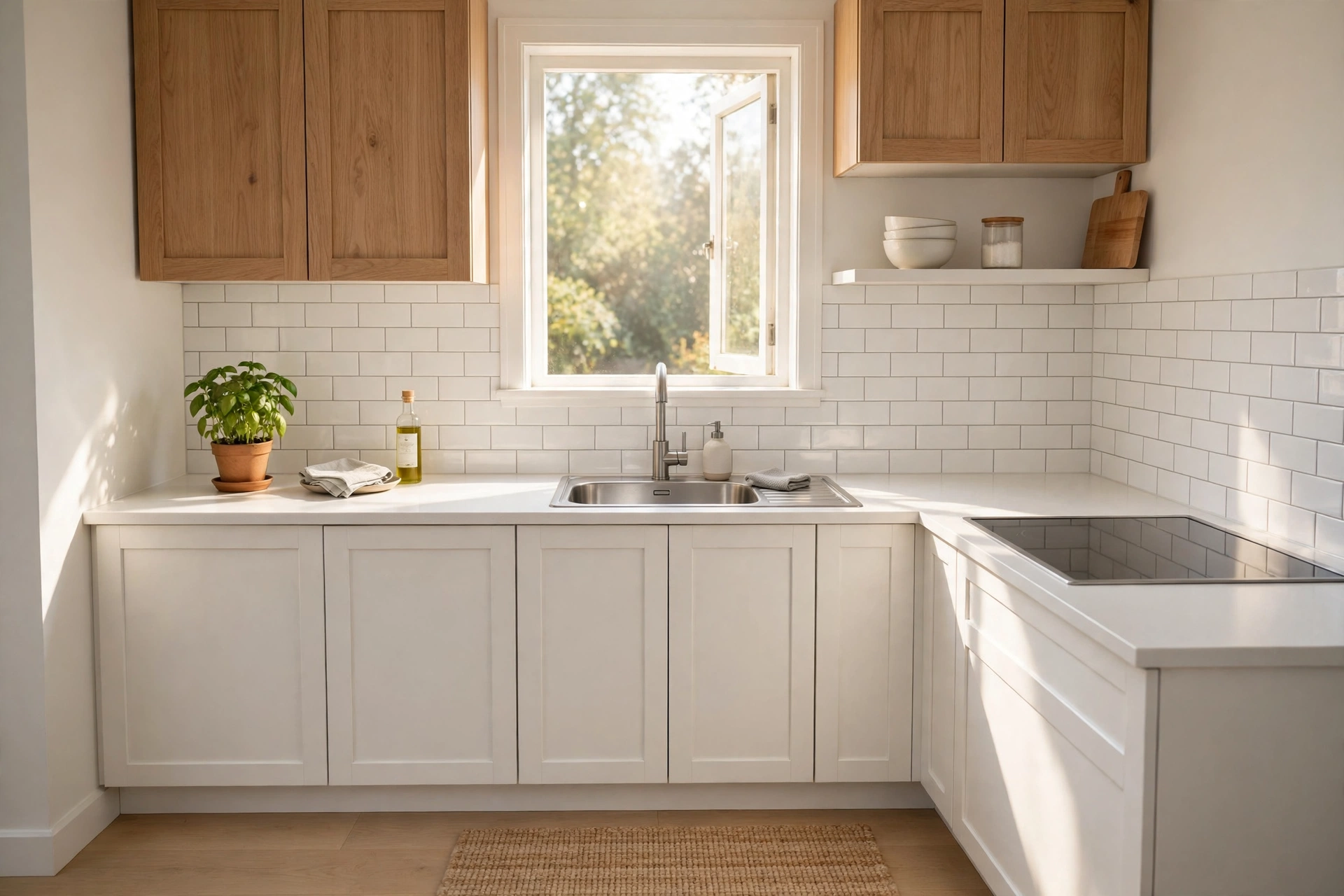
The kitchen counter is the second hotspot, and it is often the most frustrating, because a clear counter makes a small kitchen feel twice as big. The rule here is strict: the counter is a workspace, not a storage shelf. Keep out only what you use every single day, such as a kettle and a chopping board. Everything else, from the blender you use twice a month to the stack of recipe books, belongs in a cupboard. When post and chargers start colonising the counter, move them to their real homes during the reset.
The bathroom is the third hotspot, and in a tiny bathroom the problem is usually too many half-used products and damp towels with nowhere to dry. Keep only the products you use daily on the shelf or in the shower caddy, and store the rest together in one box under the sink. Hang towels so air can reach them, use a small lidded bin, and wipe splashes during the daily reset so they never harden into a weekly scrubbing job.
A Realistic Schedule for Busy People
A routine only works if it survives a busy week, a late night, illness, or guests. The schedule below is deliberately forgiving. It gives you a structure to return to, not a test to pass perfectly. If you miss a day, you do not start again from zero. You simply do the next reset, and the flat recovers quickly, because small spaces recover quickly.
Here is a simple weekly shape many busy renters find sustainable. Monday to Friday, do the ten-minute daily reset, preferably in the evening. Choose one small weekly task per weekday if you prefer spreading the work: kitchen on Monday, bathroom on Tuesday, dusting on Wednesday, floors on Thursday, and laundry on Friday. Or, if you would rather keep weekdays free, do the whole weekly clean in one hour on Saturday morning. Both versions work. Pick the one that matches your energy, not the one that looks most impressive on paper.
- Daily (10 minutes): surfaces, dishes, bed, towels, and a quick floor sweep if needed.
- Weekly (60 minutes total): kitchen, bathroom, dusting, floors, and fresh linen.
- Monthly (30 minutes): one deeper job, such as the fridge, oven, or a cupboard, on rotation.
- Seasonally: a short declutter of one hotspot, like the entry or a single drawer.
Be honest about your own limits, too. If you share the flat, share the routine, and agree who does what, rather than silently resenting an uneven split. If you work nights or irregular shifts, anchor the reset to waking up or coming home, not to a clock time that rarely fits. And if a week falls apart completely, forgive it. A small apartment can go from chaotic to calm in under an hour, and that is one of its greatest advantages.
A tidy small home is not about perfection. It is about a space that supports your life: a clear table to eat at, a calm bedroom to sleep in, and a front door you are happy to open to friends. With a ten-minute daily reset, a weekly plan, one caddy, and attention to the three hotspots, that home is within reach, even on the busiest weeks. Start tonight, with just ten minutes.