

Let’s talk honestly about the knife drawer in your kitchen. You know the one — the drawer where your chef’s knife, the paring knife, and the bread knife all rattle around loose with the vegetable peeler and a tangle of rubber bands. Every time you reach in, you hesitate for a second, fingers carefully curled, hoping today’s not the day you learn the hard way why proper kitchen knife storage matters. If that sounds familiar, you’re not alone, and the good news is that fixing it is one of the simplest, most satisfying upgrades you can make in your kitchen.
I learned this the painful way: reaching for a potato peeler, I sliced my thumb on a chef’s knife that had slid loose in the drawer. Nothing dramatic — but it made me rethink the whole system. A sharp knife is only a safe knife when it’s stored with care. So I spent a weekend figuring out what actually works in a real kitchen where people cook dinner on a Tuesday, not in a showroom.
Here’s what I found: there’s no single “best” method — the right choice depends on how many knives you own, whether you have kids, and how much counter and drawer space you can spare. Below are the most practical kitchen knife storage ideas, from magnetic wall strips to clever drawer inserts, so you can pick the one that fits your kitchen and your habits.
Why how you store your knives matters more than you think
Most of us buy decent knives and then undermine them with bad storage. Tossing blades loose in a drawer dulls the cutting edge every time metal scrapes metal, and turns reaching in into a small gamble. A razor-sharp knife can feel disappointingly dull within months of bouncing around unprotected.
There’s a hygiene angle too: slots and blocks can trap moisture if you put knives away damp, while storage that keeps blades dry and ventilated — like a magnetic strip — stays cleaner. And safety, of course: chefs store blades with their edges protected, whether that’s inside a slot, under a guard, or on a magnetic bar where little hands can’t reach.
The mindset shift is simple: think of knife storage as part of knife care, not as an afterthought. You wash and dry your knives carefully — the least their storage can do is return the favor.
If you have small children, or if you simply love a clean, uncluttered countertop, an in-drawer knife organizer is hard to beat. These are slotted trays or blocks — usually bamboo or beech wood, sometimes plastic — that sit inside a standard kitchen drawer and hold each knife in its own slot, edge protected and handles lined up neatly. You open the drawer, you see the handles, you grab the one you want without touching a single blade. It’s the storage method recommended by Martha Stewart herself, and there’s a reason it keeps coming up: it’s the most flexible option for mixed knife collections.
What I like most about drawer storage is that it fits any knife — steel, ceramic, bread knives, even shears — regardless of shape. A magnetic strip can’t hold a ceramic knife (no metal), but a drawer slot doesn’t care.
A few practical tips before you buy one:
- Measure twice. Most inserts are around 2 to 2.5 inches deep, but drawers vary. Measure your drawer’s interior depth, width, and length before ordering, and remember you need enough clearance for the drawer to close with the longest knife inside.
- Put a liner underneath. A thin silicone or rubber liner under the insert stops it sliding around when the drawer opens and protects the drawer bottom.
- Keep knives bone dry. Enclosed slots hold moisture, so never put a damp knife into a drawer organizer. Hand-wash, towel-dry thoroughly, and give blades a minute of air time before storing.
- Angle the blade correctly. Slide knives in with the sharp edge facing down or away from you, so when you lift the handle the blade naturally moves away from your fingers.
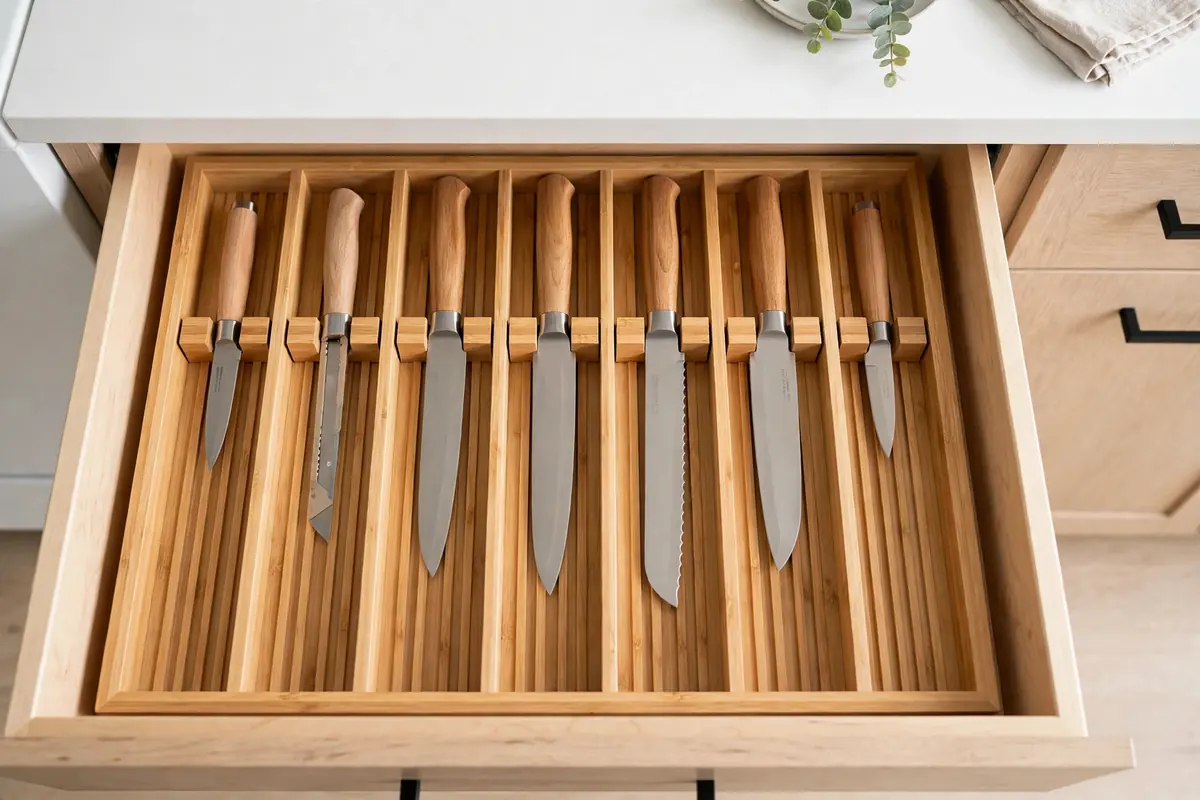
The trade-off is that it eats a whole drawer — annoying if your kitchen only has two or three. If that’s you, size down your collection first: most home cooks do 95% of their prep with just a chef’s knife, a paring knife, and a bread knife. Store the daily drivers in the organizer and box up the rest. If you’re tackling a broader drawer cleanout, my kitchen drawer organization ideas guide walks through decluttering and zoning your drawers so every tool has a proper home.
Magnetic knife strips: the wall-mounted favorite
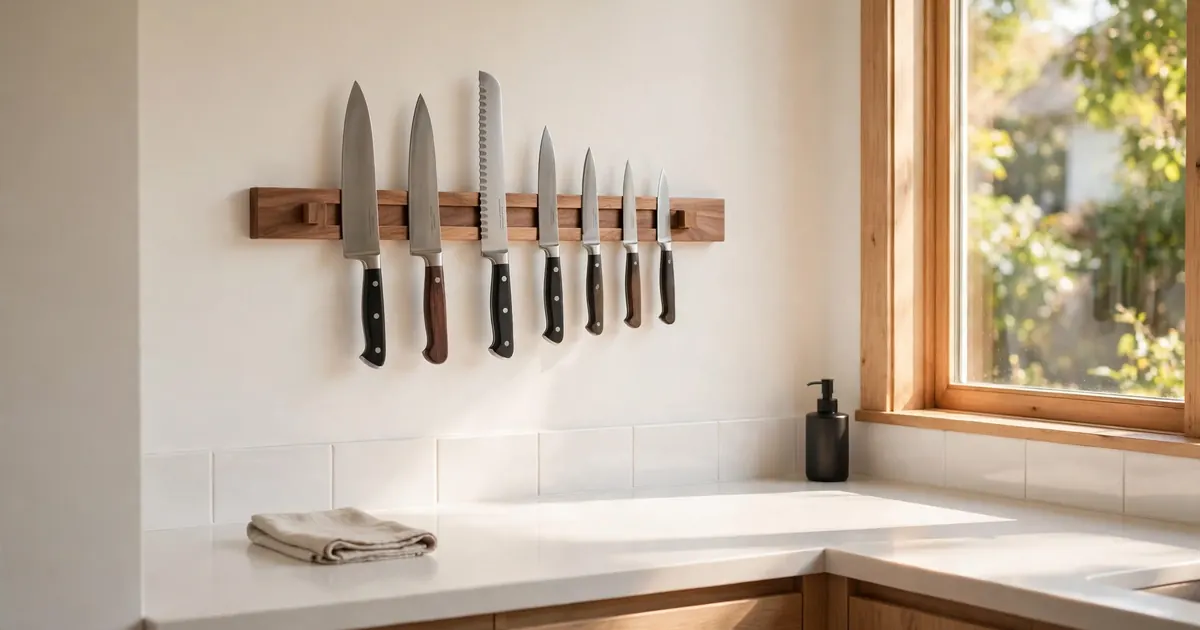
Magnetic knife strips are the darling of cooking shows and small-kitchen living for good reason. A strip mounted on the wall — or even under a wall cabinet — holds each knife by its spine with a strong magnet, blade visible, edge untouched by anything. Grabbing your chef’s knife mid-chop becomes one fluid motion: pluck it off the wall, use it, stick it back. For anyone who cooks daily, this is the fastest, most convenient storage method there is.
They’re also the kindest to your blades. Nothing touches the cutting edge, so there’s no slot friction dulling your knife the way traditional blocks can over time. Blades stay ventilated and dry, which makes the magnetic strip arguably the most hygienic option. And it takes up zero counter and zero drawer space — in a small kitchen, that’s almost magical.
But it’s not perfect for everyone. Three honest caveats:
- Not renter-friendly by default. Most strips screw into the wall. If you’re renting, look for heavy-duty adhesive-mounted strips rated well above the weight of your knives, or skip to drawer storage.
- Keep it away from kids’ reach. Visible knives are tempting to little hands. Mount the strip high enough that children can’t grab a handle, or choose a different method if your kitchen is very kid-accessible.
- Watch the heat and steam. Don’t mount a strip directly above the stove. Heat and steam accelerate rust, and you’ll also splash the blades during frying. Pick a spot over the prep counter instead.
One last tip: choose a wooden-faced strip over bare metal if your knives are good — wood is gentler on blade spines, so you’ll get fewer micro-scratches over the years.
Knife blocks: the classic, upgraded
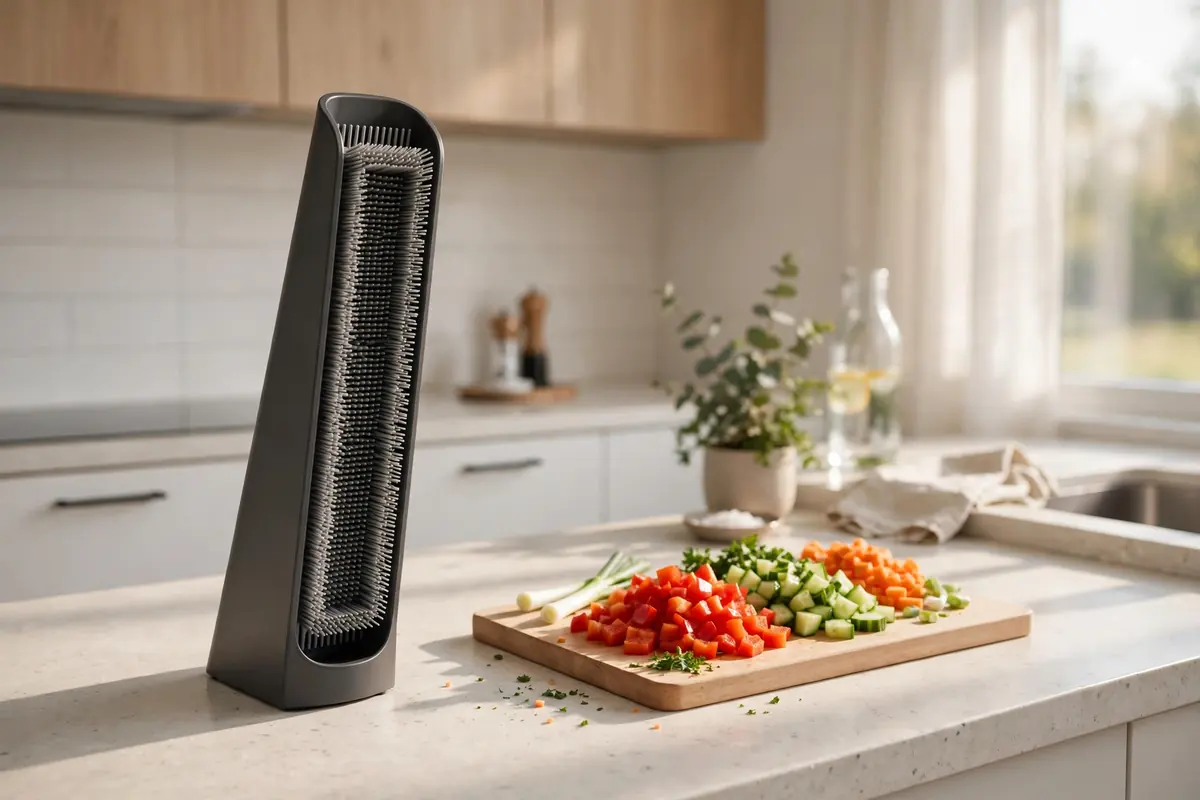
The countertop knife block is the storage most of us grew up with. It still works, especially if you have counter space to spare. Modern versions have improved a lot: universal blocks with flexible bristle-style slots hold any knife shape, and some are dishwasher-safe and designed so blades never rest on their edges — the main edge-dulling complaint about old blocks.
If you’re attached to your block, a few upgrades make it genuinely good storage:
- Choose a horizontal or angled block where blades rest on their spines rather than their edges, so the cutting edge never touches anything during storage.
- Go slotless or universal. The bristle-style blocks accept knives of any length and shape, including shears, and there are no molded slots to collect crumbs and moisture.
- Keep it small. If your kitchen is tight on counters, a compact block for just your two or three daily knives beats a 15-slot tower hogging the prep zone. A tidier counter is part of the point — see my kitchen counter organization ideas for more ways to keep your prep surface clear.
One maintenance note: clean your block every couple of months — shake out the crumbs upside down, scrub the slots with a bottle brush and soapy water, and dry it completely before restocking. It’s a five-minute job that prevents the musty smell old blocks develop.
Safe kitchen knife storage for homes with kids
With children in the house — your own, grandkids, or little visitors — safety comes first. A magnetic strip at toddler height is a no; a drawer organizer only works with a child lock on the drawer. Here’s my ranking for a family kitchen:
- Best: locked drawer organizer. Knives hidden in a drawer with a child-safety latch is the most secure everyday setup. The blades are out of sight and out of reach, and adults can still access them easily.
- Good: high wall-mounted magnetic strip. Placed well above a child’s reach — think adult chest height or higher — a strip keeps blades visible but physically inaccessible. Just be consistent about putting knives back immediately.
- Also good: a block stored inside a cabinet. If your block lives on a high shelf inside a closed cabinet instead of on the counter, it doubles as kid-proofing.
- For travel and mixed storage: blade guards. Inexpensive plastic blade guards (sheaths) slip over any blade and make even a loose drawer far safer. They cost almost nothing and are also brilliant for knives stored in a picnic or camping kit.
The biggest habit matters more than the hardware: knives get washed, dried, and put away immediately after use — never left in the sink under soapy water where a hand reaches in blindly. That one rule prevents more cuts than any organizer. Build knife put-away into your evening routine — my nightly kitchen reset is a 15-minute checklist that makes sure every tool, knives included, ends the day in its place.
Knife storage habits that keep blades sharp for years
The storage method is only half the story. These small habits determine whether your knives stay sharp for a decade or need sharpening every six months:
- Always hand-wash and dry immediately. Dishwashers knock blades against racks and baskets, and the prolonged heat and moisture are brutal on edges and handles. Hand-wash, towel-dry, and store — no air-drying loose on the counter.
- Store blade-up when slots are involved. In a traditional block or drawer insert, rest the knife so the cutting edge faces up or rests on its spine — never let the blade’s weight sit on its edge.
- Don’t store knives with other utensils. The vegetable peeler, tongs, and metal spoons are the enemy of sharp edges. Give knives their own dedicated zone, whatever method you choose.
- Match the storage to your real habits. If you know you’ll never walk to the far cabinet to put a knife away, don’t store them there — the counter becomes the default and your good intentions evaporate. Keep daily knives within one step of where you use them.
- Declutter the collection. Duplicate knives and never-used specialty blades take up slots and create rummaging. Keep the knives you actually use; donate or relocate the rest to somewhere out of the daily flow. If your knife situation is part of a bigger kitchen overload, kitchen gadget organization ideas can help you tame the whole tool collection at once.
Here’s the lovely thing about sorting out your knife storage: it’s a small project with an outsized payoff. One drawer organizer, one magnetic strip, or one good block — that’s a single afternoon of effort, maybe twenty dollars — and from then on, every time you cook, you get that tiny hit of satisfaction when the right knife is exactly where it should be, sharp as the day you bought it. Your fingers are safer, your counters are calmer, and your knives will quietly thank you with years of easy, precise cuts. Pick the method that fits your kitchen, install it this weekend, and enjoy the feeling of one more corner of your home truly organized.