


You love your dog. You love your cat. You do not love the tumbleweeds of fur drifting across the hallway, the muddy paw prints on the kitchen floor five minutes after you mopped, or the faint smell you can no longer notice but your guests definitely can. A good cleaning routine for pet owners is not about keeping a show home. It is about small, repeatable habits that stop pet mess piling up into a weekend-long chore.
Here is the honest truth: cleaning a home with pets is a different job from cleaning a home without them. Dogs shed every day, cats track litter every day, and mud arrives on four feet whether it rained or not. So the routine has to match that rhythm — ten minutes a day beats three hours on a Saturday, every single time. This guide gives you that rhythm: a short daily routine, a weekly reset, and a monthly checklist.
Why a Cleaning Routine for Pet Owners Has to Work Differently
In a pet-free home, dust settles slowly and a weekly clean is usually enough. In a pet home, the dirt is alive: it sheds, it walks in from the garden, and it occasionally throws up on the rug you just bought. And you cannot simply ban the dog from the sofa when the sofa is the dog’s favourite place in the world.
That is why the best pet cleaning routines work with your animals instead of against them. Catch fur at the source — on the pet, at the door, on washable covers — and run tiny daily passes over the spots your pets actually use. The goal is not a fur-free home; no honest pet owner has one. It is a home that looks and smells clean to anyone who walks in.
Some mess is seasonal, too. Double-coated dogs blow their undercoat in spring and autumn, and rainy weeks end every walk with four muddy paws at the back door. A routine that bends a little is a routine you will actually keep.
The 10-Minute Daily Cleaning Routine for Pet Owners
This is the heart of the whole system. Ten minutes, once a day — after dinner works for most families. Set a timer if it helps. It is short enough to do even on a bad day, because skipped days are what turn a two-minute job into a twenty-minute one.
- Wash the bowls. Food bowls after every meal, water bowls daily, in hot soapy water or the dishwasher. That slimy film inside a water bowl is bacterial biofilm, and it builds up fast.
- Scoop the litter tray. Once a day at minimum for cats, and wash your hands afterwards. A thirty-second scoop does more for household smell than any air freshener. Top up litter so the tray stays inviting — a cat that avoids a dirty tray finds somewhere else to go.
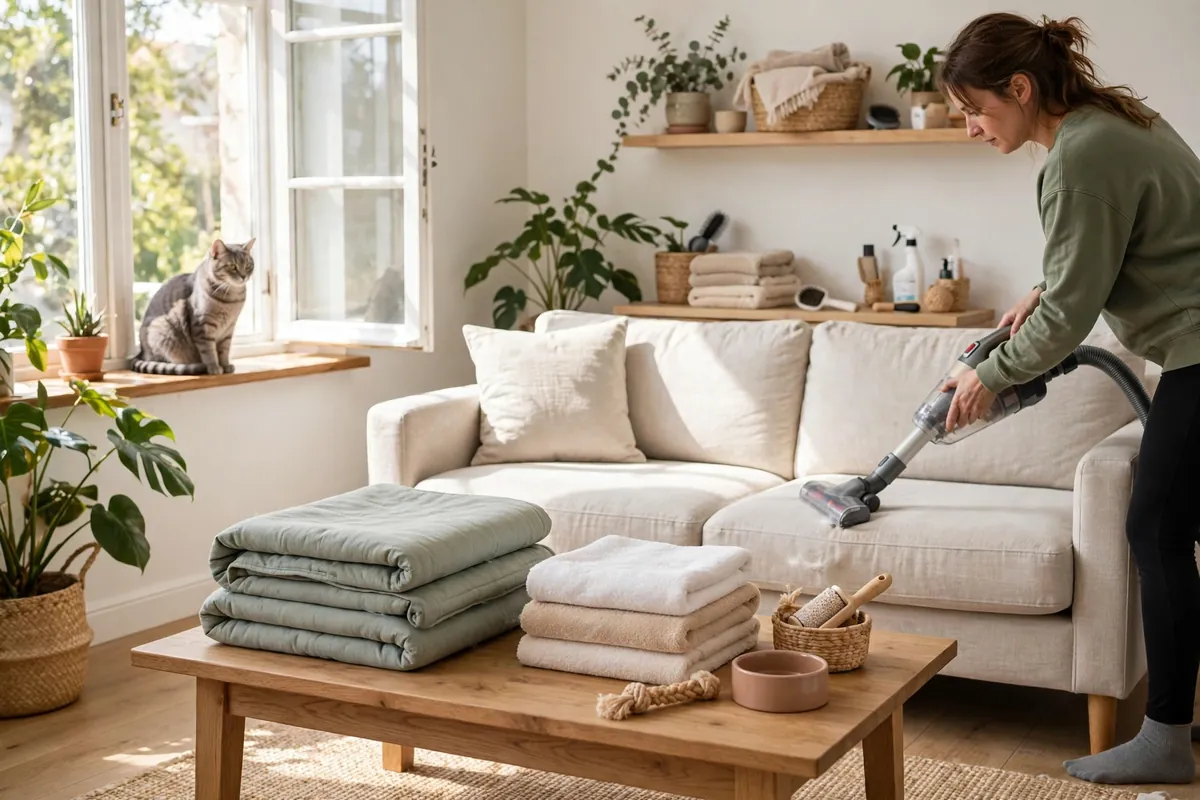
- Do a two-minute fur pass. Only the hotspots: the sofa arms, your pet’s favourite nap spot, and the hallway. A cordless stick vacuum or a robot vacuum on a timer makes this almost effortless.
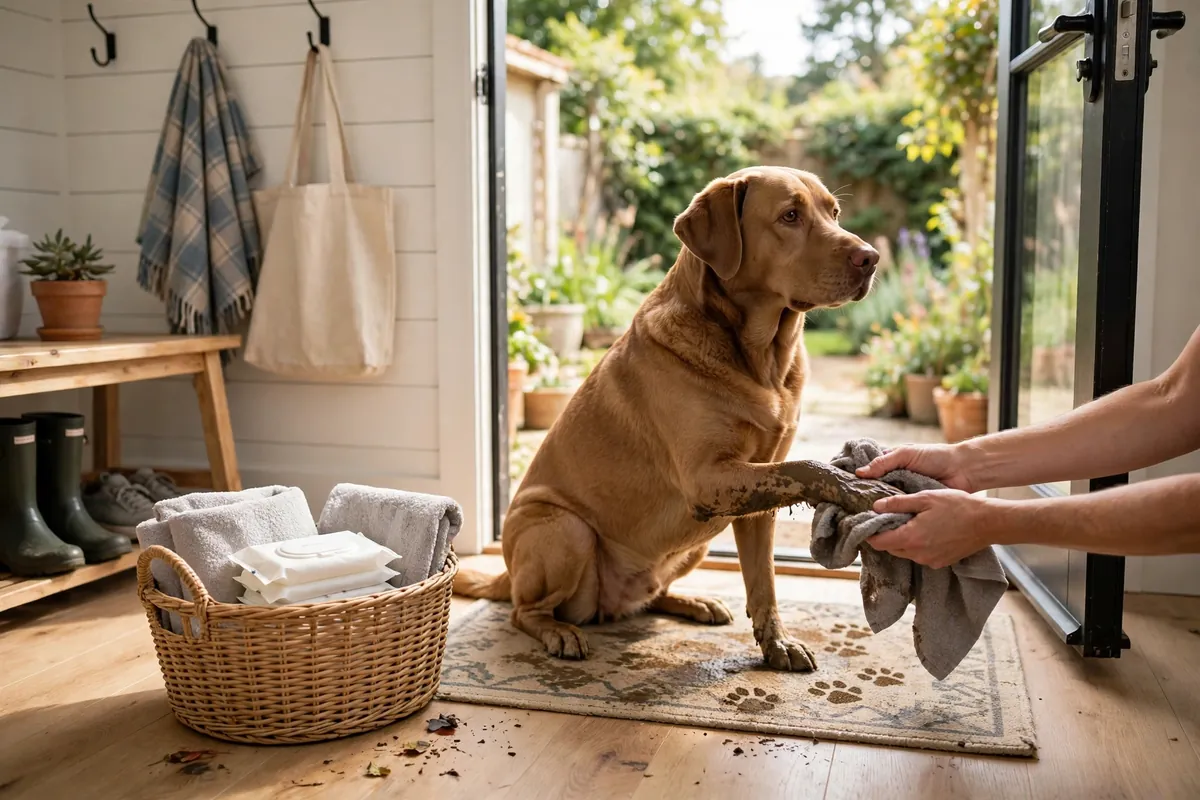
- Wipe paws at the door. Keep a towel or pet wipes by the entrance you use for walks. Thirty seconds of paw-wiping saves you from muddy prints through the whole house — and it is a good moment to check for sore pads or something stuck between toes.
- Tidy the pet clutter. Toys back in the basket, chews off the rug, lead hung up. One minute, and the whole room looks cared for before you have vacuumed anything.
That is it. Five small jobs, ten minutes, and your home stays ahead of the mess instead of chasing it. A daily cleaning routine that actually sticks is always built from tiny steps you can repeat on your worst day, not heroic efforts you can only manage on your best one.
The Weekly Reset: Fur, Floors and the Smells You Stop Noticing
Once a week, give the house a proper reset — about an hour to ninety minutes for a typical two-bedroom home. Pick a day and protect it. Without this reset, fur settles into the fibres, smells sink into the soft furnishings, and the daily pass starts losing ground.
Work from the top down, because pet hair drifts downward. Strip the pet bedding first — the dog bed cover, the cat blanket, the throw on the armchair — and start a wash while you work through the rest.
- Vacuum every room, slowly. Go over carpets in overlapping lines, against the grain of the pile where you can. Use the upholstery attachment on sofas, armchairs and the pet bed, and vacuum under furniture too — pet hair gathers under sofas, beds and cabinets and quietly becomes a dust and dander reservoir.
- Mop hard floors. A damp microfiber mop picks up the fine dust and dander a vacuum leaves behind. In the kitchen and hallway, mop twice if the water looks grey after the first pass.
- Wipe the low surfaces. Skirting boards, the bottom of doors, the wall beside the food bowls, and glass doors your dog presses its nose against. Guests notice these surfaces without realising it.
- Wash the soft stuff. Pet bedding, throws, cushion covers and washable toys. Pet bedding is one of the biggest sources of household pet odour, and clean bedding means a healthier, more comfortable pet.
- Empty and wash the litter tray fully. Scooping is daily, but every two to four weeks the whole tray needs emptying, scrubbing with warm soapy water and refilling. Old litter holds odours no topping up will fix.
You stop noticing your own home’s smell — nose blindness, and every pet owner has it. The weekly wash of bedding and soft furnishings removes odour at its source rather than covering it up. If allergy sufferers live with you, our allergy-season cleaning routine pairs well with this weekly reset, since pet dander and pollen behave in very similar ways.
Litter Trays, Bowls and Feeding Corners: The Germ Hotspots
Every pet home has three spots that quietly collect more germs than anywhere else: the litter tray area, the food and water bowls, and the patch of floor where your pet actually eats. These deserve their own attention because they are the places where hygiene genuinely matters, not just appearances.
For cats, contain the litter. A good mat outside the tray catches most granules before they travel, and a quick daily sweep around the tray stops the rest from spreading. Keep the tray on hard flooring if you can — litter on carpet is a losing battle — and keep a scoop and small dustpan nearby so the job is never a trek to the cupboard.
For dogs and cats alike, the feeding corner needs a washable mat under the bowls to catch splashes and scattered kibble — shake it outside or toss it in the wash. Wipe the wall and skirting behind the bowls weekly; food spray travels further than you would expect, especially with dogs that eat like it is a competitive sport.
A word on products: not every cleaner is safe around animals. Cats are especially sensitive — phenol-based cleaners and concentrated essential oils can be very toxic to them, and undiluted bleach is dangerous if a pet licks a freshly cleaned surface. Choose pet-safe, fragrance-free cleaners where your animals walk, eat and sleep, and keep pets out until surfaces are dry. You do not need a cupboard full of specialist products: a short minimalist cleaning supplies list — a good vacuum with a pet attachment, microfiber cloths, an enzyme cleaner, and a gentle floor cleaner — covers almost everything.
Muddy Paws, Accidents and Shedding Season: Handling the Messy Days
Some days the routine meets reality: a week of rain, the one muddy puddle in the park, a plant knocked over, somebody sick on the rug at 2 a.m. These are the moments that make pet owners give up on routines — and exactly the moments a routine is for.
Muddy paws. Set up a paw station by the door and never skip it: an old towel, a shallow tray of warm water for truly muddy days, and pet wipes for quick jobs. Wipe each paw gently, including between the toes. If mud reaches the floor, let it dry first — dried mud vacuums up in seconds, while wet mud smears into every grout line.
Accidents. Deal with them straight away, with an enzyme cleaner rather than a regular disinfectant. Enzyme cleaners break down the proteins in urine and vomit, which is what actually removes the smell; ordinary cleaners only mask it — and your pet can still smell the spot, which is why accidents often repeat in the same place. Blot first, never rub, then saturate the area and give it the contact time the bottle asks for.
Shedding season. When your dog starts blowing its coat, brush more, not less. A few minutes of daily brushing — outside, or somewhere easy to sweep — catches loose fur before it reaches your furniture, and it is the single most effective thing you can do. Short coats suit a rubber mitt, thick double coats need an undercoat rake, and long coats need a slicker brush. During the worst weeks, vacuum living areas daily and wash throws twice a week. It is a short season.
When someone is sick. If your pet has a stomach bug, switch to easy-clean surfaces — washable bedding, hard floors, old towels — and wash bedding on a hot cycle and bowls daily until everyone is back to normal. Unwell for more than a day or two means a vet visit, not a cleaning problem.
The Monthly and Seasonal Checklist for Pet Homes
Some jobs do not need doing every week, but they quietly decide whether your home stays fresh over the long term. Put them in your calendar so they happen without you having to remember them.
- Every month: wash collars, leads and harnesses; clean the crate or carrier; wash hard toys; vacuum the car seats and boot; change vacuum filters, which clog faster in pet homes.
- Every one to three months: replace HVAC filters, more often in shedding season, and deep-clean sofas and armchairs with an upholstery cleaner or steam pass.
- Every season: wash curtains and cushion covers, clean under and behind large furniture, and reset the pet’s sleeping area. In spring and autumn, expect shedding to peak and step up brushing and vacuuming for a few weeks.
- A few times a year: book a professional carpet and upholstery clean. No home vacuum reaches the hair and dander worked deep into carpet fibres over months; a professional clean resets the baseline, and your daily routine keeps it there.
If you share your home with children as well as pets, the layers stack up — the toys, the crumbs, the laundry — and the same small-steps logic applies. Our guide to keeping a house clean with kids and pets builds on this routine with family-specific systems that keep the whole household, furry members included, running smoothly.
Living with pets will never be as tidy as living without them, and that is not the point. The point is a home where the fur is managed, the smells are gone, and nobody spends the weekend scrubbing. A cleaning routine for pet owners that takes ten minutes a day and an hour a week is not a chore list — it lets you say yes to the dog on the sofa, the cat on the bed, and the muddy walk in the rain.
Start tonight: wash the bowls, scoop the tray, do a two-minute fur pass, wipe the paws, put the toys away. Ten minutes, and tomorrow morning you will wake up to a house that feels looked after — and a pet with no idea how much work went into it, which is exactly how it should be.