
The space under a queen bed is roughly 30 square feet — about the size of a small closet. For years, mine held exactly three things: dust, a missing sock, and a gift bag I’d been “saving.” Then I actually organized it, and it swallowed an entire dresser’s worth of stuff.
Under-bed storage is the highest-value storage real estate in most bedrooms. But it’s also the easiest to get wrong — done badly, it becomes a clutter graveyard where things go to be forgotten. Here’s how to do it right, and the mistakes to avoid.
First: Measure Before You Buy Anything
This sounds obvious, and everyone skips it. Measure three things:
- Clearance height — floor to the bottom of the bed frame. Standard is 7–14 inches; platform beds may have almost none.
- Length and width you can actually access — account for legs and center supports.
- How far you can reach — if the bed is against a wall, you only get one-sided access.
Buy containers that fit your measurements with room to slide. A box that’s technically short enough but scrapes the floor every time you pull it out will drive you mad within a week.
Too-low bed? Bed risers lift most frames 3–8 inches safely and cost very little. Check your frame’s weight rating first, and use sturdy risers — not stacks of books, no matter what the internet suggests.
The Smart Ideas: What Works
Flat rolling drawers
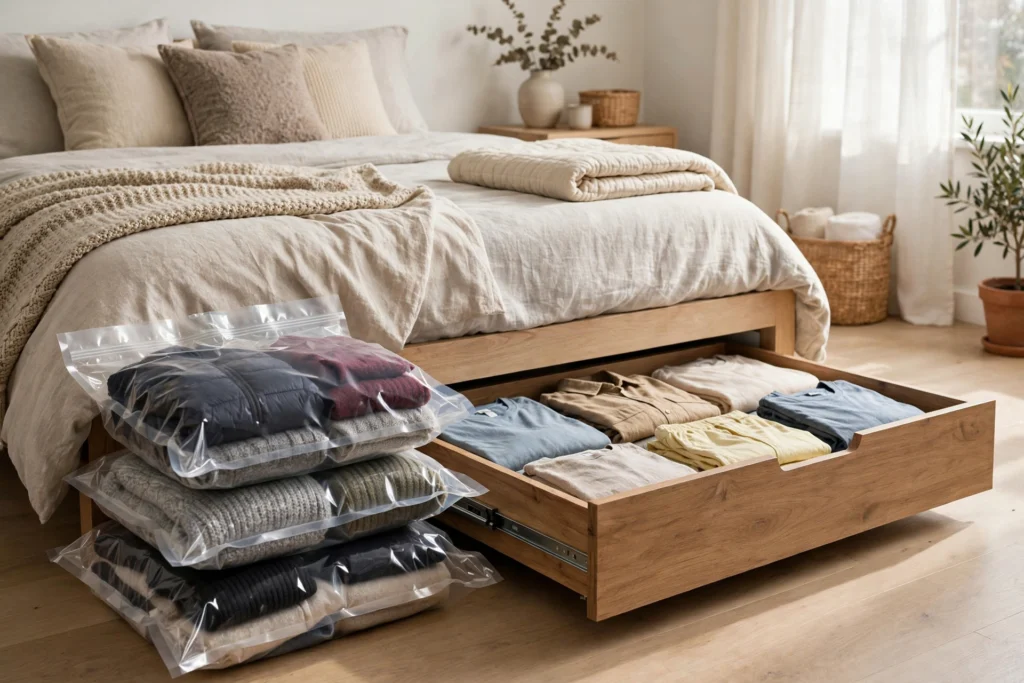
The gold standard. Low, wide drawers on wheels slide out like a built-in dresser — full visibility, full access, no crawling on the floor. Best for clothes, shoes, and anything you access regularly. If you buy one under-bed product, make it these.
Lidded flat boxes
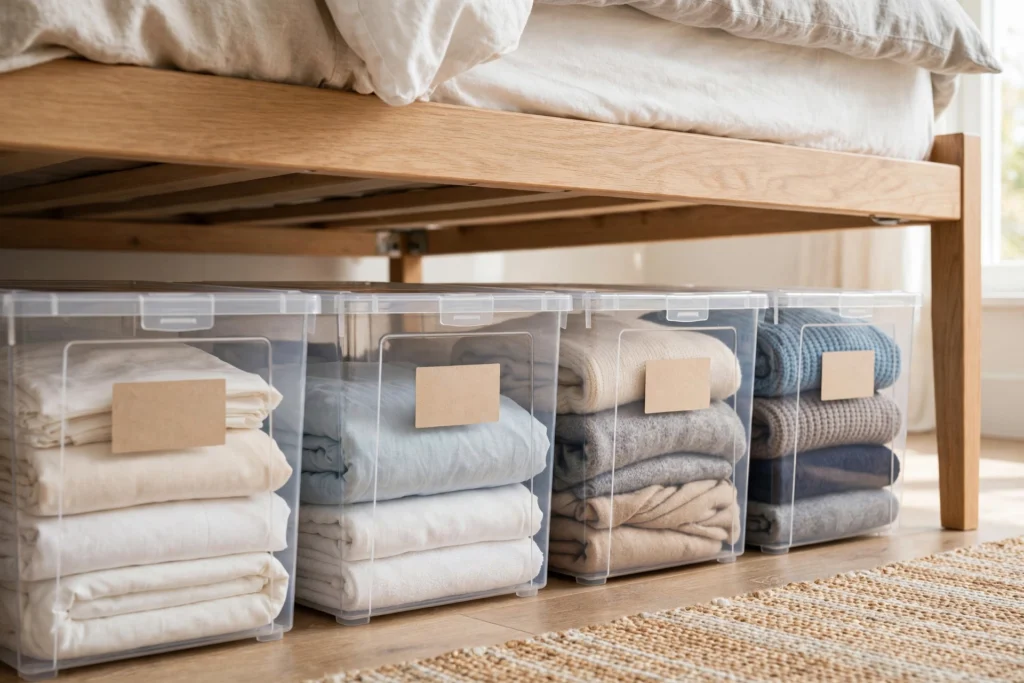
Clear, lidded boxes keep dust out and let you see contents at a glance. Perfect for off-season clothes, extra linens, and keepsakes. The lids matter — open boxes under a bed become dust collectors within months.
Vacuum storage bags
For bulky seasonal items — winter coats, duvets, spare pillows — vacuum bags compress them to a fraction of the size. One caveat: natural fibers (down, wool) shouldn’t stay compressed for years; use these for seasonal rotation, not permanent storage.
Divided organizers for shoes
A flat organizer with compartments keeps shoes paired, visible, and off the closet floor. Great for the pairs you wear occasionally but not daily.
Rolling carts for narrow gaps
If your bed sits against a wall with only a side gap accessible, a slim rolling cart fits where boxes can’t slide. Good for books, chargers, and bedside overflow.
What to Store Under the Bed (and What Never To)
Store here:
- Off-season clothing — the classic use, and still the best one
- Extra bedding and linens — guest sheets, spare duvets, seasonal blankets
- Shoes you wear occasionally (daily shoes belong by the door)
- Luggage — empty suitcases are just pre-shaped storage boxes
- Keepsakes and memory items — in sealed containers, protected from dust
- Books and magazines you’re actively reading — in a small rolling cart
Never store here:
- Anything that needs airflow — leather goods, important documents, and anything moisture-sensitive can suffer in the still, sometimes humid air under a bed
- Food or snacks — this is how you meet pests
- Things you’ll need urgently — first-aid supplies, important paperwork, daily medications
- “Someday” clutter — if you’re storing it under the bed because you can’t decide, that’s a declutter decision you’re postponing, not storage
- Heavy items you’ll struggle to pull out — if accessing it requires a workout, it doesn’t belong there
The Mistakes That Ruin Under-Bed Storage
Mistake 1: No lids, no labels
Open boxes under a bed collect dust, pet hair, and mystery debris. Unlabeled boxes become archaeological digs — you pull out four boxes to find one thing. Every container gets a lid and a label. Every one.
Mistake 2: Storing things you never use
The under-bed zone has a way of becoming where decisions go to die. “I’ll store it under the bed for now” is procrastination with extra steps. If you haven’t opened a box in a year, schedule a declutter session — don’t just buy a prettier box. (Our 15-Minute Declutter Method is perfect for these boxes.)
Mistake 3: Blocking access
Pushing the bed against the wall on both long sides, stacking boxes two deep, or cramming containers so tight they can’t slide — all of these turn storage into a wall. You need clear pull-out space on at least one long side. If accessing your stuff requires moving furniture, the system has failed.
Mistake 4: Ignoring dust and moisture
Under-bed areas accumulate dust faster than anywhere else in the bedroom, and ground-floor rooms can have moisture issues. Vacuum under the bed every few months when you do a deeper clean. In damp climates, use sealed containers and consider moisture absorbers — and never store anything directly on the floor in a basement bedroom.
Mistake 5: Buying containers before decluttering
The eternal rule: declutter first, contain second. Measure your actual remaining stuff, then buy containers to fit it — not the other way around. Half of most people’s “under-bed storage problem” disappears after a good wardrobe edit. (Start here: How to Declutter Your Wardrobe: The Keep-Toss-Donate System.)
Keeping It Tidy: The Seasonal Rotation
The system that keeps under-bed storage working forever is seasonal rotation. Twice a year — when you swap wardrobes — pull everything out, wipe the containers, and reassess:
- Anything you didn’t touch all season? Donate it.
- Anything damaged? Toss or recycle it.
- Containers still in good shape? Wipe and reuse.
This 30-minute ritual, done with each season change, means your under-bed storage never becomes a graveyard. It stays a working part of your home.
Small-Space Bonus: The Bed as a Storage System
In truly small bedrooms, think of the bed as a storage appliance:
- Storage beds with built-in drawers replace an entire dresser
- Loft beds free the entire footprint underneath for a desk, dresser, or seating
- Ottoman beds (lift-up mattress base) offer huge hidden capacity for rarely-needed items
If you’re buying a new bed for a small space, storage capacity should be a top-three criterion — right up there with comfort. For more small-space strategies, see our 10 Best Storage Ideas for Small Apartments and Tiny Homes.
Frequently Asked Questions
Is it bad to store things under your bed?
Not inherently — it’s excellent storage when done right (lidded, labeled containers; appropriate items; regular rotation). It becomes bad when it’s unorganized, inaccessible, or used to avoid decluttering decisions.
What should you not store under the bed?
Food, moisture-sensitive items (leather, important papers), anything needed urgently, and “someday” clutter you’re avoiding deciding about. Also avoid very heavy items that are hard to pull out.
How do I keep dust out of under-bed storage?
Use containers with tight lids, vacuum under the bed every few months, and avoid fabric-only bins without covers. In dusty or pet-heavy homes, sealed hard containers beat fabric boxes.
Are vacuum storage bags safe for clothes long-term?
For a season or two, yes for most fabrics. For years, no — natural fibers like down and wool can lose loft permanently. Use vacuum bags for seasonal rotation, not permanent archiving.
Under-bed storage done right is like finding a free closet you didn’t know you had. Measure first, choose lidded and labeled containers, store the right things, rotate seasonally — and never let it become the place where decisions go to hide. Your bed is for sleeping; the space under it is for smart storage.
Pair this with a lean wardrobe: How to Declutter Your Wardrobe: The Keep-Toss-Donate System.
[…] Keep one rule: under-bed storage is for things you need occasionally, not things you’re hiding. If you haven’t opened the box in a year, that’s a declutter signal, not a storage problem. (We have a whole guide on getting this right: Under-Bed Storage: Smart Ideas and the Mistakes to Avoid.) […]