
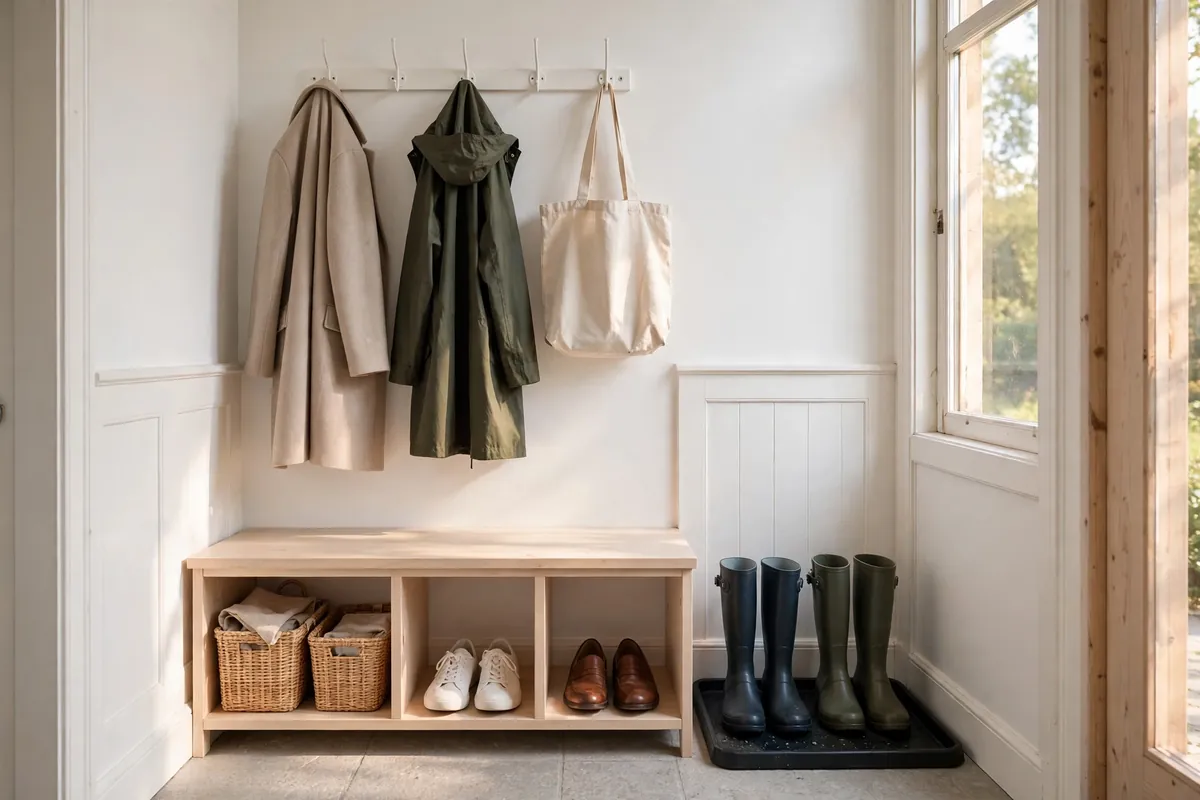

Walk into most homes and the first thing you notice isn’t the décor — it’s the pile. Shoes kicked off by the door, a coat draped over the banister, keys buried under a drift of mail, and a dog leash tangled in a winter scarf. If your front door opens into a hallway the width of a broom closet, or straight into your living room with nowhere to land, you are not alone — and you don’t need a full renovation to fix it. These small mudroom storage ideas borrow the best tricks from big, beautiful mudrooms and shrink them to fit the space you actually have: a strip of wall, a corner, even the back of a door.
Here’s the secret most design magazines skip: a mudroom isn’t really a room at all. It’s a system — a set of landing spots for coats, shoes, bags, keys, and outdoor gear so they stop colonizing the rest of your house. In a tiny footprint, every piece of that system has to earn its square inches. A bench that only offers a seat is a luxury you can’t afford; a bench that seats you and hides six pairs of shoes is a workhorse. Once you think in systems instead of square feet, a five-foot stretch of wall beside your front door can hold everything a dedicated mudroom does.
Start With the Floor: Small Mudroom Storage Ideas for Shoes and Boots
Shoes are the loudest visual clutter in any entryway. In a small space, a sprawling shoe situation makes the whole house feel messy the second someone walks in. The single most effective rule I know for tiny entries: only daily shoes live in the mudroom. Everything else — the hiking boots, the heels, the extra sneakers — belongs in a bedroom closet or a labeled bin elsewhere. Give yourself permission to keep just two pairs per person in the entry, and the floor chaos shrinks overnight.
Next, give those remaining shoes a home that protects your floor. A boot tray is the unsung hero of small mudroom storage ideas. It catches slush, mud, and road salt in winter, mud and rain in spring, and it rinses clean in seconds. In the off-season, most trays store upright on their side against a wall or behind a bench, so they stop eating floor space the moment you don’t need them. They are cheap, available everywhere, and in a rental they protect flooring you don’t own and can’t afford to repair.
For the shoes themselves, you have two good paths:
- Closed tilt-out cabinets (about 9–10 inches deep) are the calmest choice for a small entry. Rows of shoes disappear behind doors, the room looks instantly tidy, and dust stays out. They are also the friendliest option when the entry opens straight into a living room — no one sees the mess.
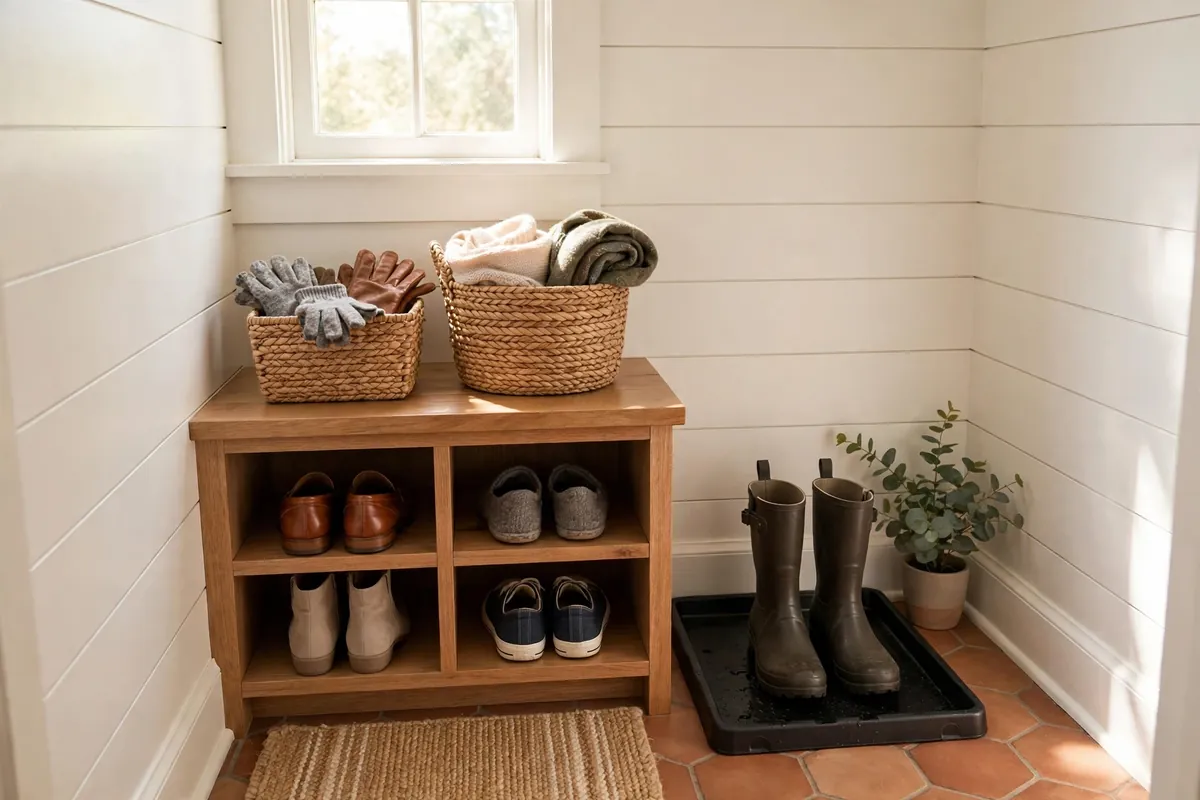
- Open cubbies or low racks work better for families with small kids, because children will use what they can see and reach. A low bench with open cubbies under the seat does two jobs at once: a spot to sit while lacing sneakers, and storage for four to six pairs below it.
One real-world example: a family of four I helped had fourteen pairs of shoes permanently camped by their front door. We kept two pairs per person in a slim closed cabinet, moved everything else to bedroom closets, and added a boot tray for winter. The entry didn’t get bigger — but it felt twice as big, because the floor was finally clear.
Go Vertical: Your Walls Are Your Extra Square Footage
When the floor is full, the walls are your second storey. In a tiny mudroom, vertical storage isn’t a nice bonus — it’s the whole strategy. A single well-planned wall can hold coats, hats, bags, keys, umbrellas, and sunglasses without a single thing touching the floor.
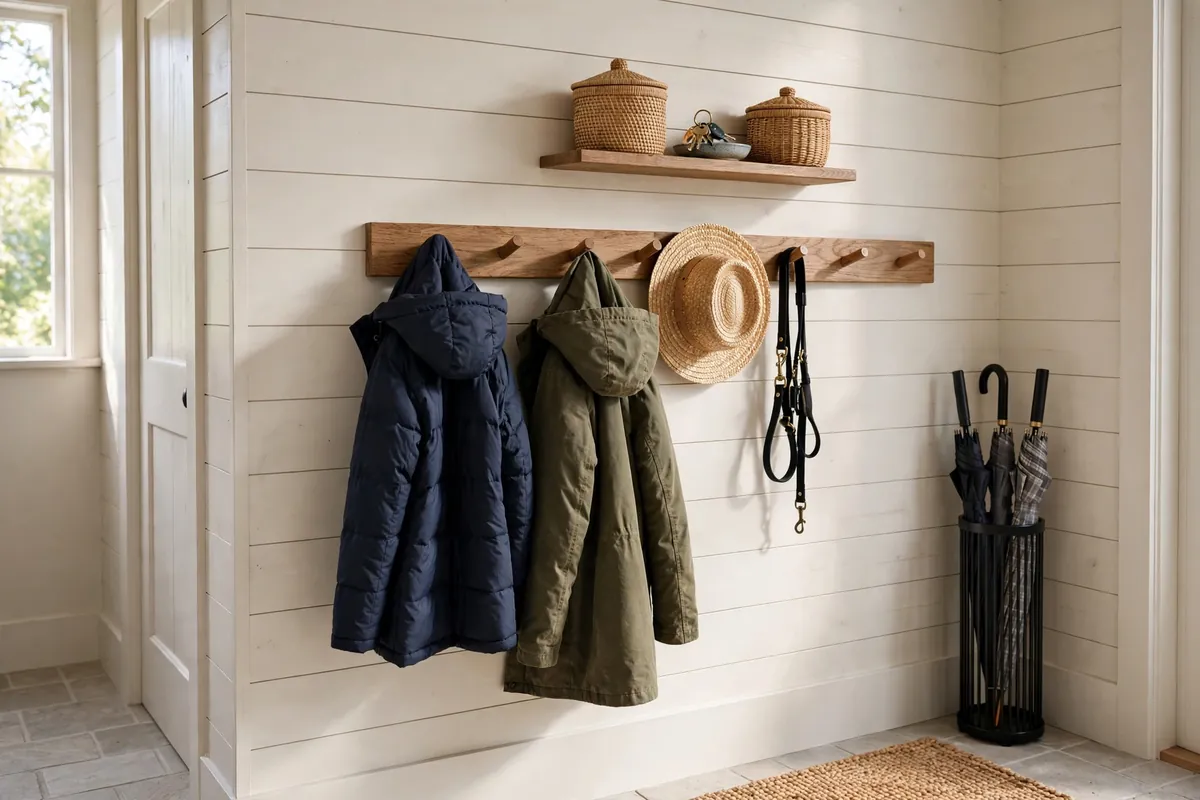
Start with a hook rail at two heights. This is the detail that separates mudrooms that work from ones that frustrate everyone. Mount one row of strong hooks at 60–66 inches for adults and a second row at about 36 inches for kids — low enough that a five-year-old can hang her own backpack and coat. That one change ended the coat-on-the-floor epidemic for more families than any storage cabinet I know. Space hooks 12–18 inches apart horizontally so heavy winter coats don’t crush each other, and stagger the two rows so nothing overlaps.
Above the hooks, add one shallow floating shelf (10–12 inches deep). This becomes the landing strip for everything small: keys in a dish, sunglasses, mail, the dog’s treat pouch, sunscreen in summer. A shelf with a low lip or rail keeps things from walking off. Mount a row of small hanging baskets under the shelf for gloves, hats, and scarves — one basket per person, or one per category. Hanging baskets are one of my favourite small mudroom storage ideas because they deliver most of the benefit of built-in cubbies at a fraction of the cost and depth.
If your space feels dark and cramped, treat light and reflection as storage tools, not décor. A full-length mirror on the wall or the back of a door bounces daylight around and roughly doubles the perceived depth of a narrow entry. A battery-powered LED strip or a couple of warm puck lights under the shelf banishes the shadow pockets that make small spaces feel smaller. None of this adds storage, but it removes the cramped feeling that makes people resist using the space at all. If you want to lean into vertical thinking in every room, these vertical storage ideas for small spaces pair perfectly with the tricks here.
Choose Seating That Works Double Duty
Every mudroom needs a place to sit — putting shoes on while hopping on one foot at the front door gets old fast. But in a small entry, seating is a commitment, so choose a piece that earns its footprint by doing at least two jobs at once.
The dimensions matter more than the style. For a narrow entry, look for a bench that is:
- 14–16 inches deep — deep enough to sit on comfortably, slim enough not to block the walkway.
- 36–48 inches wide — seats one or two people without dominating the wall.
- Storage underneath — a lift-up seat, deep drawers, or open cubbies that hold shoes, sports gear, or seasonal items.
A lift-up bench seat is the hardest-working option: the whole top becomes a hidden bin for off-season gear, reusable shopping bags, or the dog’s towels. Open cubbies are easier to live with day to day — assign one cubby per person and shoes more or less put themselves away. If a full bench won’t fit, don’t force it. A sturdy stool tucked into a corner, or even a wall-mounted folding seat that drops down only when someone needs it, covers the sit-down function in a fraction of the space.
One caution: resist the decorative bench. In a tiny entry, the moment a piece of furniture is purely decorative, it becomes an obstacle. Every item beside your door should either store something, hang something, or catch something — or it should live somewhere else in the house.
Give Every Person (and Every Item) a Spot
Shared spaces fail when everything is communal and nothing is assigned. In a small mudroom, the fix is almost comically simple: one spot per person. One hook or peg for your coat, one basket for your hats and gloves, one cubby for your shoes. When every member of the household has a clearly defined home base, nothing drifts into the communal pile by the door — and everyone, down to a four-year-old, knows exactly where their things go.
Baskets and bins are the workhorses here. Choose them in one material and colour family — woven seagrass, grey felt, or natural wood — because a row of matching baskets looks like one calm system instead of five separate problems. Label them with simple tags, wooden beads, or a paint pen: the labels aren’t decoration, they’re the contract that keeps the system honest. Hanging baskets on the wall below your shelf handle gloves and hats; lidded baskets on top of the bench swallow sports equipment and school gear.
Then give the awkward extras a plan before they become floor clutter:
- Umbrellas: a slim stand or wall-mounted tube in the corner by the door. Wet umbrellas drip where the boot tray already catches water.
- Dog gear: one hook at knee height for the leash, and a small basket for waste bags and treats. This is one of those small mudroom storage ideas dog owners call life-changing — no more hunting through coat pockets for a bag at 6 a.m.
- Keys and wallets: a tiny dish or wall-mounted ledge on the shelf above the hooks, in exactly the same spot every day. Habits beat storage systems, but a designated landing spot makes the habit effortless.
- Backpacks and gym bags: one sturdy hook per person at reachable height, or the back of the front door if wall space is gone. The door’s inner face is genuinely underused real estate — see these over-door storage ideas for what it can hold without a single screw.
That slim strip between the door frame and the wall deserves a mention too. In many entries there’s a dead 6–12 inch gap that collects nothing but dust — a narrow rolling cart, a tall thin basket, or even a slim pull-out shelf can turn it into umbrella, scarf, or cleaning-spray storage. These narrow gap storage ideas show exactly how much function fits in spaces you’d swear were too thin to use.
The Drill-Free Playbook: Small Mudroom Storage for Renters
Renting doesn’t mean living with door-pile chaos — it just means every solution has to come down cleanly at the end of the lease. The good news is that most of the best small mudroom storage ideas need zero holes in the wall.
Start freestanding. A narrow cubby unit or hall tree that stands on the floor gives you hooks, shelves, and shoe storage in one piece of furniture — and it moves with you when you move. A slim bench with storage cubbies does the same double duty as its mounted cousins with no installation at all. Place a boot tray in front of it and you’ve built a complete drop zone that protects flooring you don’t own.
Use the doors you have. An over-door organizer with pockets or hooks on the inside of your front door or entry closet door holds shoes, umbrellas, reusable bags, pet supplies, and cleaning cloths — no drilling, no landlord conversation. If your entry has two doors (front plus closet), that’s two full vertical surfaces of free storage most renters never touch.
Stick, don’t drill. Removable adhesive hooks and strips from brands like Command hold keys, light bags, dog leashes, and hats without a single hole. Test them on a hidden corner of wall first — some paint finishes react differently — and respect the weight limits. They won’t carry a full winter coat, but they’re perfect for the lightweight daily items that otherwise live on the doorknob.
Go narrow and tall. A tall, slim bookcase or a rolling cart (one foot wide or less) can hold everything from shoes to sunscreen in a hallway that’s barely wider than a person. A tension rod between two walls near the ceiling holds curtain-free storage for out-of-season coats in a garment bag. None of these need tools, and all of them leave the walls exactly as you found them.
Keep It Working: The Ten-Minute Seasonal Reset
Here’s the maintenance truth most storage articles skip: any system, no matter how clever, slowly fills with gear nobody uses. Last winter’s cracked gloves, the single rain boot whose partner vanished, the scarf nobody likes — they all creep into prime mudroom real estate and push today’s essentials back onto the floor. The fix is a seasonal reset, twice a year: once when the boots come out, once when the sandals return.
It takes an afternoon, not a weekend, because the space is small:
- Empty everything. Pull every item out of the baskets, hooks, and bench so you can see what actually lives there.
- Sort into three groups: current season stays, off-season goes upstairs or into a labeled bin on the top shelf, and worn-out or never-used goes straight to the donation bag.
- Photograph each off-season bin’s contents and tape the photo to the lid. Future you, digging through storage in January, will be genuinely grateful.
- Donate the worn-out pile the same week. A donation bag that sits in the mudroom for a month is just clutter with better intentions — and it will migrate back onto the hooks.
While everything is out, wipe down the bench, shake out the baskets, and rinse the boot tray. You will be amazed how new a five-foot wall of storage feels after ten minutes of attention. And if the entryway reset makes you want to take the calm further into the house, this step-by-step guide to decluttering your entryway covers the full room-by-room approach.
A Small Mudroom Is a System, Not a Room
You don’t need a dedicated room, built-in lockers, or a renovation budget to stop the front-door pile. You need five feet of wall, a slim bench that stores, hooks at two heights, one basket per person, and a boot tray. That’s the whole system — and it fits in spaces most people have written off as hopeless.
Start with the single change that would make your mornings easiest. For most households, that’s the two-height hook rail or the shoe cabinet that finally clears the floor. Get one win, feel the difference every time you walk in, and let the rest of the system grow from there. A mudroom is just a collection of functions, and your functions are already there waiting for a home — they just need five feet of wall and a little intention.
[…] Start with a boot tray. Choose one with a raised edge and a ridged surface so water drains away and air circulates underneath. A tray about 30 inches wide holds two to three pairs and protects floors from slush, salt, and mud. Empty and wipe it once a week; a tray full of standing water helps nobody. If your entry is tight, a slim tray beside the door works just as well, and it pairs nicely with these small mudroom storage ideas that make a tiny entry work hard. […]