


Why Your Floor Became the Default Drawer
Your bedroom floor tells on you. You can make the bed with hospital corners, fluff the pillows, even light a candle — but if the floor is buried under yesterday’s jeans, one lonely sock, and a hoodie you swear you’ll wear again, the whole room still feels messy. Bedroom floor clutter is one of the most common complaints in any home, and here’s the part worth hearing: it’s almost never about being lazy.
It’s about physics and decisions. A floor is the largest flat surface in your room, so anything without a clear home lands there first. And every item on that floor represents a tiny unmade decision: is this shirt dirty or wearable? Do these shoes live in the closet or by the door? Your brain, already tired at 11 p.m., chooses the path of least resistance — down it goes. That “chairdrobe” (the chair every bedroom seems to grow) is the same phenomenon in furniture form: clothes that are too clean for the hamper and too worn for the drawer, waiting for a verdict that never comes.
The good news? You don’t need more discipline. You need fewer decisions. Every idea below works by giving the things on your floor a home that’s easier to reach than the floor itself — because that’s the only real competition.
Start With a Total Floor Sweep
Before you buy a single hook or basket, clear the deck. This takes about thirty minutes, and you do it exactly once.
Grab four bags or laundry baskets and label them in your head: laundry, belongs elsewhere (mugs, books, mail that wandered in), goes back in this room (clean clothes, shoes), and leaving the house (donations, trash, that broken hair tie you’ve been stepping on for a week). Pick up everything off the floor — yes, everything, including the “I’ll deal with it later” corner — and sort it. Don’t organize yet. Just sort.
- Laundry goes straight into the machine or hamper. If the pile is big, run a load right now while you keep working. Momentum matters.
- Belongs elsewhere gets carried out in one trip when you’re done. Don’t run it room by room — finish the sweep first.
- Goes back in this room stays in its basket while you read the next sections. You’ll give each category a home on purpose this time.
- Leaving the house goes in a bag by the front door today, not “when I get around to it.”
What you’re left with is the honest version of your bedroom — and a much shorter list of things that actually need a place to live. If the whole room feels like a bigger project than the floor, that’s a different job with its own rhythm; this guide to decluttering a bedroom walks through the full room-by-room approach. But for most of us, the floor was never a whole-room problem. It was a handful of categories with nowhere to go.
Bedroom Floor Clutter Fix #1: Give Every Pile a Real Home
Now look at your “goes back in this room” basket. Almost every case of bedroom floor clutter comes down to the same four culprits: worn-once clothes, shoes, bags and jackets, and laundry that never made it to the hamper. Give each one a home that takes less effort than dropping it, and the floor stays clear almost by itself.
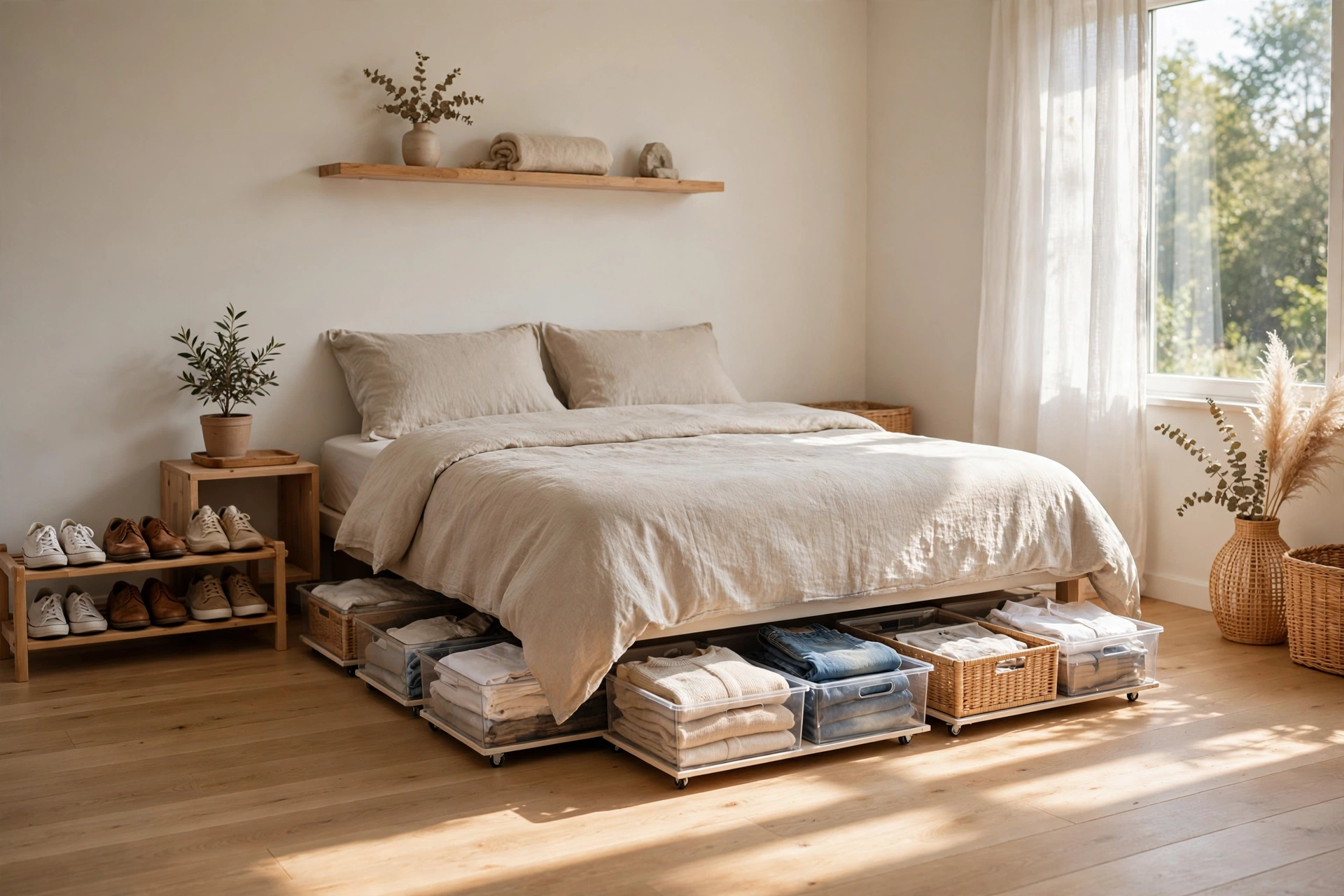
Shoes. Shoes are the worst floor clutter because they scatter — one by the bed, one kicked under the dresser, a pair abandoned mid-room. They need a single landing zone: a low rack, a tray, or even just a clearly defined corner of the closet floor. The rule that makes it stick is simple — shoes never get to be somewhere; they live in their spot. If your closet floor is already crowded, an over-the-door shoe organizer or a slim under-bed shoe tray moves them off the floor entirely without taking new space.
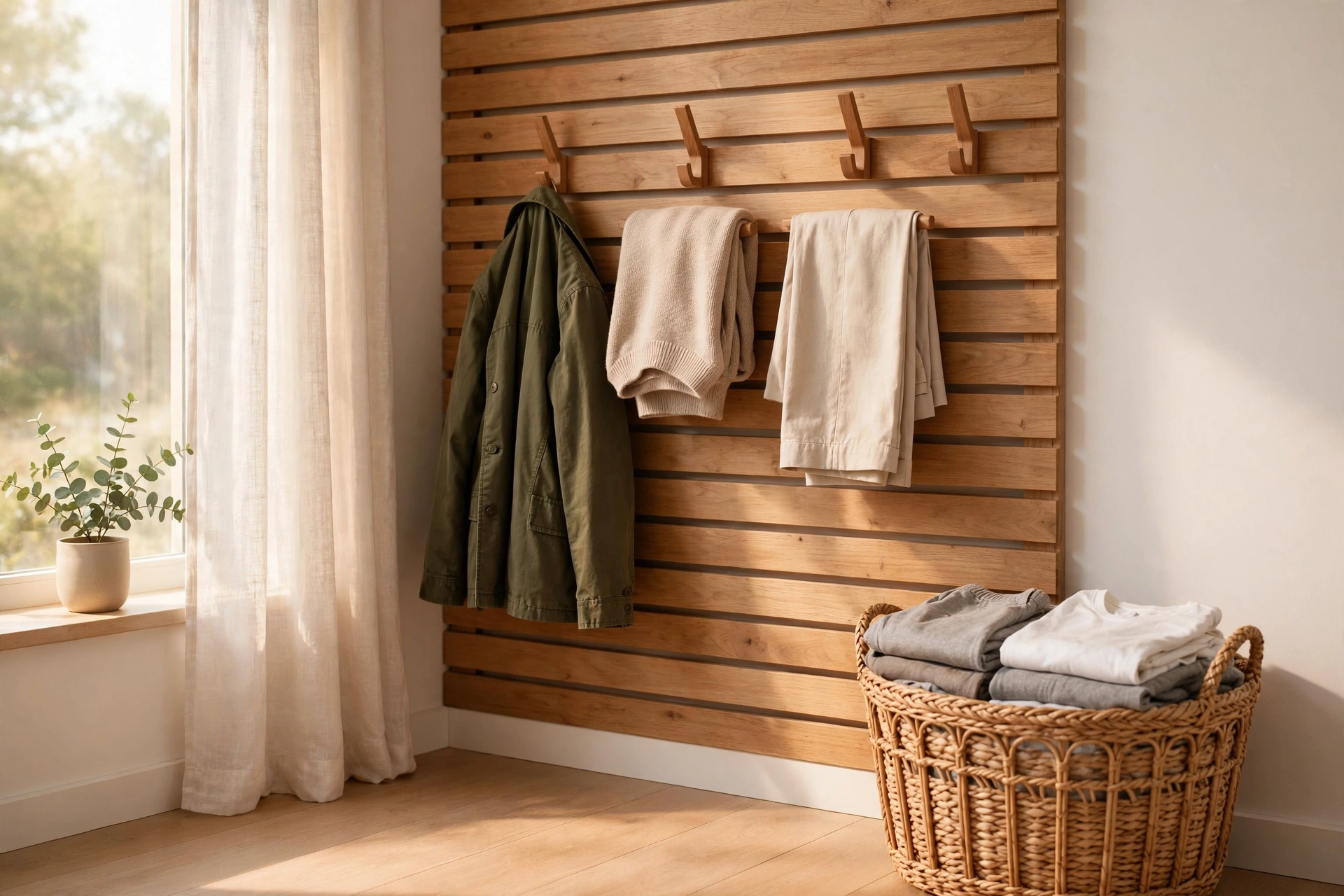
Bags, jackets, and tomorrow’s outfit. These are vertical-clutter items: they want to hang, not fold. Two or three sturdy hooks — behind the door, on a blank stretch of wall, or inside the closet — catch everything you’d otherwise drape over the chair. One hook can be your designated “tomorrow” hook: lay out tomorrow’s outfit there the night before, and you’ve solved both the floor problem and the morning scramble in one move.
Laundry that missed the hamper. If dirty clothes land on the floor, your hamper is either too far away or too full. Move it to the exact spot where clothes get taken off — most people undress in one particular place, usually between the bed and the closet. A hamper there beats a prettier one across the room every time. And if your hamper overflows mid-week, that’s not a you problem, it’s a laundry-rhythm problem: two smaller hampers (one for lights, one for darks) often fix it without any extra effort.
In a truly small room, the floor is also competing for space you barely have. Pairing these homes with small-bedroom storage ideas that actually work — under-bed boxes, a storage bench at the foot of the bed — means the “homes” don’t eat your remaining floor space.
The Worn-Once Wardrobe Problem
Here’s the category that defeats almost everyone: the jeans you wore for three hours, the sweater that’s fine for one more day, the pajamas you changed out of this morning. Not dirty enough for the hamper, not fresh enough for the drawer. Without a system, they all end up on the floor or the chair — and they multiply, because each new day adds another “fine for one more wear” layer.
The fix is a dedicated in-between station. It can be as simple as a single hook, a valet stand, or one clearly labeled shelf — but it has to be a real, named place, not a vague “I’ll remember this spot.” One hook behind the bedroom door with a small sign in your head that says worn but wearable ends the chairdrobe overnight.
Two rules keep the station from becoming a second floor:
- One layer per hook, two hooks maximum. If the station is full, something on it has to graduate — to the drawer or to the wash. That constraint is the whole point.
- Set a wear limit. Decide once: house clothes get two wears, jeans get three, bras get two or three. When an item hits its limit, the decision is already made — it goes in the hamper, no sniff test required. Decision fatigue was the original cause; a pre-made rule is the cure.
This is also where the wardrobe itself deserves an honest look. If your in-between station is always overflowing, the real problem is volume — too many clothes competing for too few homes. The one-in-one-out rule is the gentlest way to shrink a wardrobe without a dramatic purge: every new item in means one item out, and over a few months the floor pressure drops on its own.
Bedroom Floor Clutter Fix #2: Five Two-Minute Habits That Keep It Clear
Systems handle the categories; habits handle the drift. None of these take more than two minutes, and together they’re what keep the floor clear on day thirty, not just day one.
- The evening reset. Before you get into bed, do a sixty-second lap: shoes to their spot, worn-once clothes to their hook, anything stray into its home. It feels pointless the first night and transformative by the second week — you start every morning in a room that already feels calm.
- Never leave the room empty-handed. Heading to the kitchen? Take the mug. Going to the laundry room? Take the hamper overflow. This one habit clears more “belongs elsewhere” clutter than any organizing product ever will.
- Make the bed badly on purpose. A roughly made bed — sheet pulled up, pillows tossed on — still removes the bed as a landing surface. Clutter migrates to the flattest available surface, and a covered bed quietly redirects it to the proper homes instead.
- Laundry on a rhythm, not a crisis. Pick two laundry days and stick to them. Hampers that get emptied on schedule never overflow onto the floor, and the whole system stays believable.
- The weekly five-minute floor audit. Once a week, stand in the doorway and scan the floor. Anything down there is a system failure, not a personal one — ask what home it was missing and add it. The audit is how the system improves instead of slowly dying.
If the evening reset keeps slipping, anchor it to something you already do — right after brushing your teeth, or while the kettle boils. A habit stacked on an existing routine sticks far better than one floating on willpower, and a daily cleaning routine built to actually stick can carry the rest of the house along with it.
When the Room Is Small, Think Up — Not Out
Small bedrooms make floor clutter feel twice as bad, because every stray item is a tripping hazard instead of background noise. The answer isn’t owning less (though it helps) — it’s using the square footage you can’t see: the vertical kind.
Under the bed is the single biggest free storage zone in most bedrooms. Low-profile boxes with lids hold off-season clothes, spare bedding, or the shoe collection that currently lives in a drift by the wall. Behind the door, the back of the closet door, the six inches between the dresser and the wall — all of these take hooks, slim organizers, or narrow rolling carts that cost almost nothing and claim zero floor space.
One caution from experience: don’t solve floor clutter by buying a big storage unit that eats the last open patch of floor. Measure first, and favor furniture that does double duty — a bench with storage at the foot of the bed, a nightstand with real drawers. The goal is a floor you can see, not a room full of prettier boxes sitting on it.
The Calm Floor Is Closer Than You Think
Nobody’s bedroom floor got messy in a day, and it doesn’t need a weekend overhaul to get clean. One sweep, four homes, and a sixty-second evening reset — that’s the whole system. A week from now, you’ll walk into your bedroom and the first thing you’ll notice is the floor, because there’s nothing on it. And that quiet, clear feeling? That’s what the rest of the room was waiting for.
[…] a glass-fronted cabinet genuinely reduces your weekly workload. It is also one of the reasons clearing bedroom floor clutter makes such a noticeable […]