

If your laundry room is barely big enough to turn around in, you are not alone. Millions of homes have a laundry nook that’s really just a closet with plumbing — detergent bottles teetering on top of the dryer, a leaning tower of baskets, and that one lost sock nobody can account for. The good news? These small laundry room storage ideas can genuinely double the usable storage in the space you already have, without knocking down a single wall.
The secret is not buying more stuff. It’s making every inch earn its place. A small laundry room fails when everything lives at “arm height” and the walls go to waste. Once you start thinking in vertical layers — above the machines, in the gaps, on the back of the door, and underfoot — a 5-by-6-foot room can hold everything a room twice its size holds, and still feel calm instead of cramped.
I’ve reorganized more tiny laundry spaces than I can count, for friends, family, and my own rental apartments. What follows are the ideas that actually survived real life — with kids, pets, and a weekly mountain of soccer uniforms. No gut renovations required.
Think Up, Not Out: Vertical Storage Above Your Machines
The single biggest storage gain in a small laundry room comes from the wall space above your washer and dryer. That empty patch of wall is usually two to three feet of completely free real estate, and in a room this small, that’s gold.
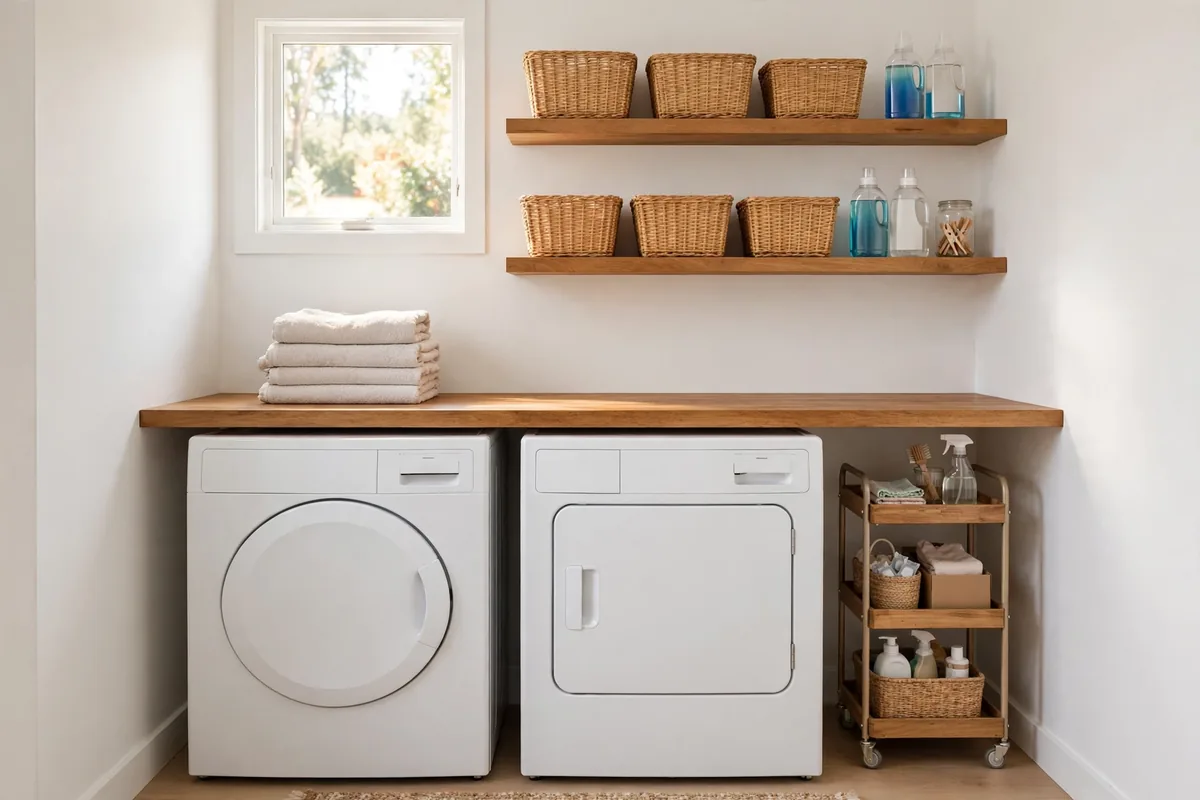
For front-loading machines, a solid countertop across both units instantly creates a folding and sorting surface — then mount shelves or shallow cabinets above it. For top-loaders, where you can’t build over the lids, run two open shelves above the machines high enough to clear the open lids, and keep everyday detergent on the lower shelf, rarely used items up top.
- Two sturdy open shelves above the machines for detergent, stain remover, and a small basket of clothespins and dryer balls. Open shelves are cheaper than cabinets and let you grab things one-handed while holding a laundry basket.
- A shallow wall cabinet (12 inches deep) with doors if your room is visible from the living area — it hides the visual noise of colorful bottles and keeps everything dust-free.
- A slim magnetic strip or metal rail mounted on the wall for small metal items: scissors, a lint roller, a measuring cup for detergent powder. It sounds fussy; it saves a surprising amount of shelf space.
- Hooks on the side of the upper cabinet for the iron, a spray bottle, and your drying rack — the cabinet’s side panels are storage too.
One rule worth keeping: nothing heavy overhead. Detergent jugs live on the lower shelf, light baskets and spare rags up high. Your future self, reaching up with wet hands, will be grateful. These are the same principles behind vertical storage ideas for small spaces that work all over the house — the laundry room just benefits from them more dramatically than any other room.
Small Laundry Room Storage Ideas for Narrow Gaps and Dead Corners
Every small laundry room has dead zones: the three-inch gap between the washer and the wall, the dark corner behind the door, the strip of floor beside the dryer that fits nothing. These small laundry room storage ideas are specifically designed for those forgotten inches — and they often add the equivalent of an entire extra cabinet.
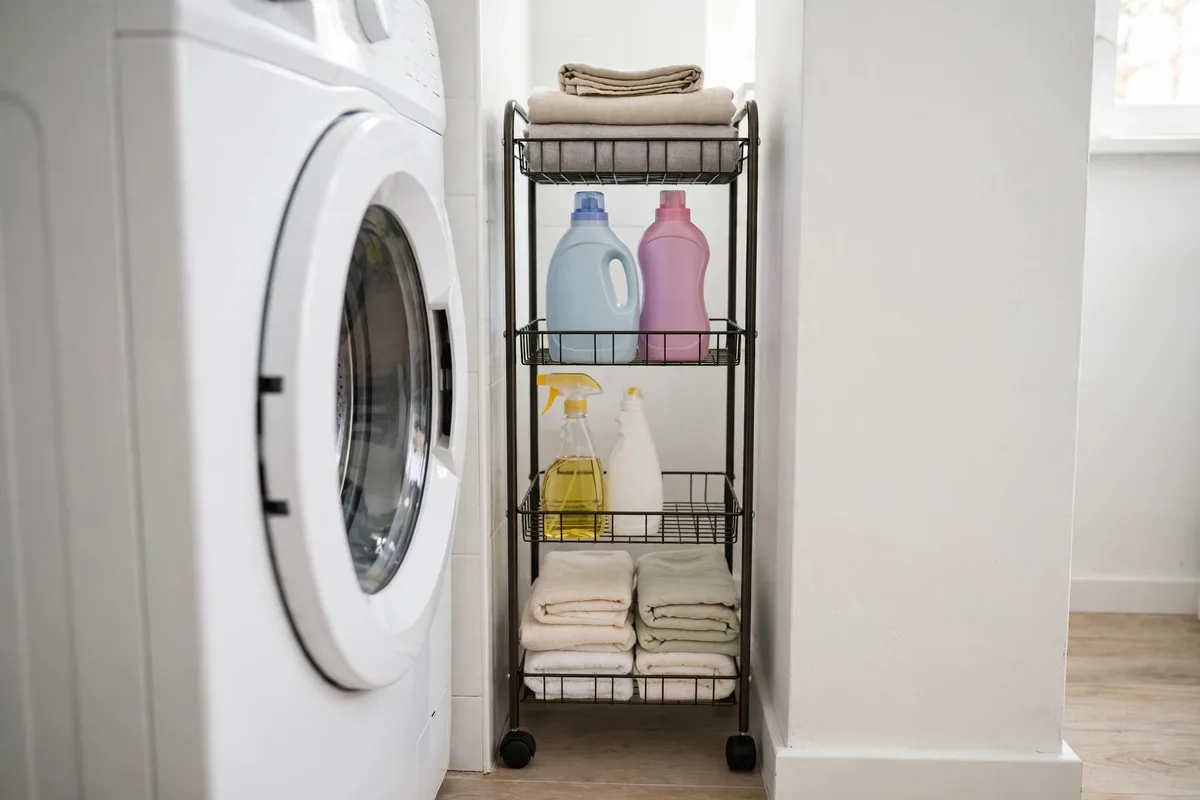
- A slim rolling cart (some are only 5 inches wide) that slides into the gap beside the washer. Use it for the things you reach for every single load: detergent pods, stain sticks, fabric softener, a small trash bag for lint and dryer sheets. Pull it out like a drawer, push it back when you’re done.
- Over-the-door organizers on the inside of the laundry room door — clear pocket organizers hold dryer sheets, spot-treatment pens, measuring cups, and the inevitable collection of single socks waiting for their partners.
- A tall, narrow pull-out cabinet for brooms, mops, and the ironing board. If you have even a six-inch gap anywhere, a pull-out unit on casters turns it into vertical broom storage that disappears when closed.
- Washer and dryer pedestals with built-in drawers. They raise front-loaders to a back-friendly height and add two deep drawers underneath — perfect for bulk detergent, extra hangers, and the iron.
- Corner floating shelves in L-shaped rooms. Corners are where clutter goes to die; two small corner shelves with labeled bins reclaim them.
Measure your gaps before you buy anything — machines need an inch or two of clearance for vibration, and you don’t want a cart that rattles itself out during the spin cycle. If your laundry corner shares a wall with the bathroom, you may find similar gap-hunting tricks useful there too; our guide to small bathroom storage covers the same philosophy of squeezing function from dead space.
A Folding Surface That Doesn’t Eat Floor Space
Here’s the classic small-laundry-room dilemma: you need somewhere to fold, but a table would swallow the only walking space you have. The answer is a work surface that exists only when you need it.
A countertop mounted directly over front-loading machines is the simplest version — it doubles as a folding station and a landing zone for the basket coming out of the dryer. But if you have top-loaders, or the machines sit in an alcove with no room above, a wall-mounted fold-down table is the real hero. It folds flat against the wall when you’re done, taking up about two inches of depth.
- Fold-down wall table with locking brackets, sized to your wall — even a 24-by-30-inch surface handles a full load of t-shirts.
- A retractable ironing board mounted inside a shallow wall cabinet or on the wall itself. It pulls out for pressing and vanishes afterward — no more ironing board permanently leaning in the corner.
- A butcher-block shelf above a utility sink that doubles as a stain-treatment station. Keep a small caddy with your stain removers right there so pre-treating happens at the sink, not on the kitchen counter.
Choose surfaces that wipe clean — laminate, sealed wood, or solid-surface offcuts. Laundry rooms are humid, and raw particleboard swells and sags within a year. A quick-dry microfiber cloth hung on a hook beside the surface keeps it perpetually ready.
Hidden Hampers and Sorting Systems That Tame the Pile
The laundry pile is the room’s natural enemy. In a tiny space, one overflowing basket on the floor makes the whole room feel chaotic — and sorting on the floor is miserable. Built-in or pull-out hampers solve both problems: dirty clothes stay hidden, and sorting happens at standing height.
- A pull-out hamper drawer under the counter or inside a base cabinet. Tilt-out or slide-out styles hold a full load and disappear behind a cabinet front.
- A three-section canvas sorter on a slim rolling frame: whites, darks, and delicates pre-sorted as clothes come off. When a section fills up, that’s your signal to run that load — no more “is it time yet?” guessing.
- Stackable ventilated baskets labeled by family member in households with kids. Each person gets a basket; on laundry day the baskets come to the machine instead of you hauling one giant load.
- A wall-mounted bag hamper that hangs flat and pops open when needed — brilliant for truly microscopic laundry closets where a freestanding hamper would block the door.
Pair your sorting system with a simple rhythm and the pile never wins. A weekly laundry routine — say, darks on Tuesday, lights on Friday — turns the hamper from a stress source into a quiet background system. Ventilation matters too: hampers with mesh or slatted sides let damp gym clothes breathe instead of going musty.
Drying and Hanging Without Losing Half the Room
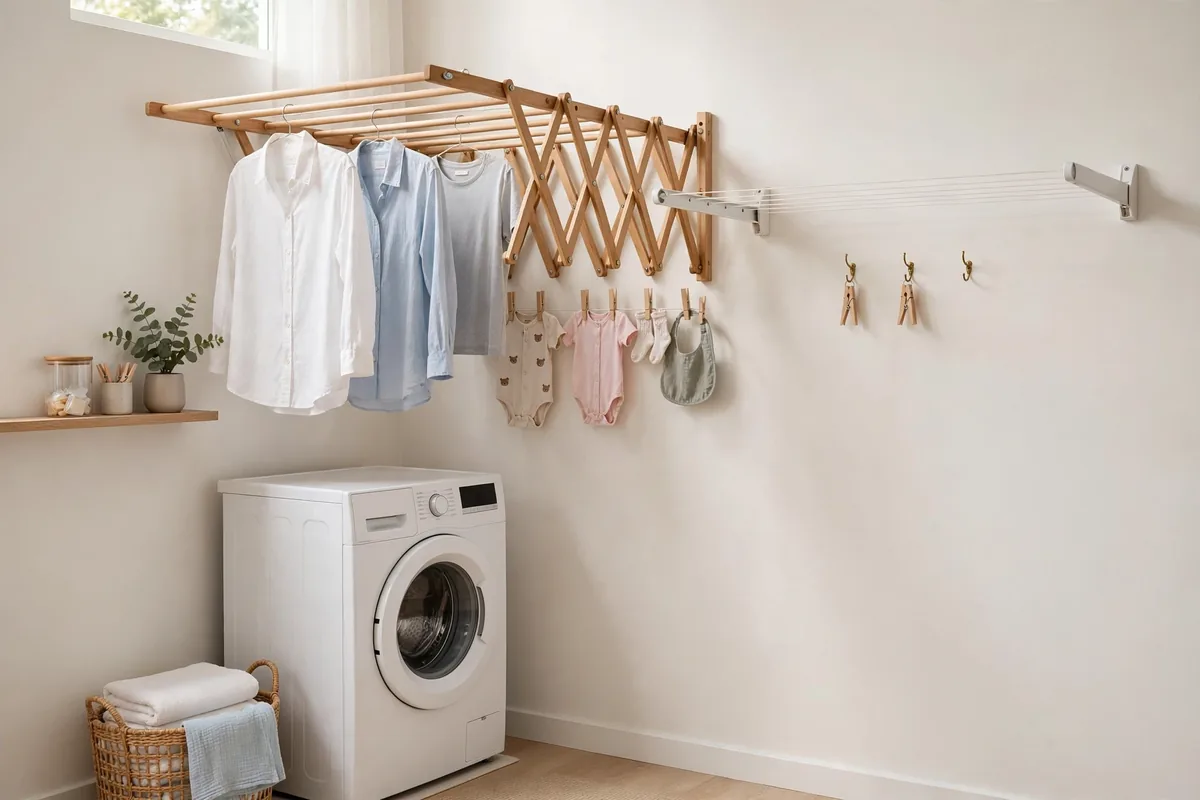
Air-drying delicates, baby clothes, and anything you don’t want shrunk in the dryer can easily eat half a small laundry room. Freestanding drying racks are the worst offenders — they sprawl. Wall-mounted and retractable options give you the same drying capacity on zero floor space.
- A wall-mounted accordion drying rack that folds flat against the wall when empty and pulls out to hold a full load of delicates. Mount it at chest height over the sink or beside the machines.
- A retractable clothesline that stretches across the room (or across the shower, if your laundry shares the bathroom) and rewinds into a small housing when done.
- A tension rod wedged between two shelves or walls for hang-drying shirts on hangers — no drilling, no damage, perfect for renters.
- Over-the-door hooks rated for damp weight, for the “wash me again” outfit, tomorrow’s uniform, or the mesh bag of delicates waiting for its load.
Keep a small lidded bin nearby for dryer lint and a basket for the odds and ends that surface during laundry — the single socks, the tissues that survived the wash, the coins from pockets. If your laundry setup borrows space from the bathroom, the same under-sink thinking applies: our under-bathroom-sink organization ideas show how to stack and zone tight cabinet space anywhere in the house.
The 10-Minute Reset That Keeps It Tidy for Good
Storage systems only work if they stay usable, and in a room this small, entropy strikes fast. The fix is a tiny weekly reset, not a big reorganization. Set a timer for ten minutes once a week — right after a laundry session is ideal — and run this checklist:
- Wipe the folding surface and the tops of the machines.
- Return every product to its labeled home; toss empties and consolidate half-used bottles.
- Empty the lint bin, the lost-sock basket, and the pocket-change jar.
- Check the floor behind and beside the machines for runaway socks and dryer sheets.
- Refill the rolling cart or caddy so next week’s loads start ready.
Two small habits multiply the effect. First, decant: transfer detergent and pods into matching dispensers or labeled bins so bulky packaging stops dictating your shelf layout. Second, enforce one-in-one-out for laundry gadgets — every new stain stick or gadget that enters means an old one leaves. Small rooms can’t absorb extras.
A tiny laundry room will never be a showroom, and it doesn’t need to be. It needs to work — to let you sort, wash, fold, and put away without a scavenger hunt or a stubbed toe. Start with the vertical space above your machines, claim the narrow gaps, give yourself a folding surface that folds away, hide the hampers, and hang your drying rack on the wall. Do those five things and you’ll wonder how the same four walls ever felt so small.