

If you love books but live in a flat, a studio, or a house where every square foot is already spoken for, you know the feeling: the pile on the nightstand grows, the coffee table disappears under paperbacks, and the bookshelf you bought “for now” gave up months ago. The good news is that small space book storage ideas are less about owning fewer books and more about storing the ones you love in smarter places. You do not need a library room or a bigger home. You need a plan that uses the walls you already have, the space under furniture you already own, and a little honesty about which books truly earn their place.
When my partner and I moved into a one-bedroom flat, our collection arrived in nine boxes and took over the living room — the wobbly tower by the sofa, the pile blocking the radiator, cookbooks balanced on the microwave. We stopped reaching for books because finding one meant disturbing a leaning tower. The fix was simple: a tall narrow shelf here, a basket there, a ruthless sort-out on a rainy Sunday. Within a fortnight, every book had a home.
Small Space Book Storage Ideas Start With a Smaller Pile
Before you buy a single shelf, sort the books you already own. No shelving system will make three hundred books fit comfortably in a room built for eighty. Set aside an hour, pull every book out of its hiding places — the nightstand drawer, the top of the wardrobe, the bag by the door — and lay them on the bed where you can see them all at once. Seeing the whole collection together is often a small shock, and that shock is useful.
Sort into three groups. The keepers: books you reread, books you lend to friends with pride, reference books you actually open, and the handful with real sentimental value. The “maybe” pile: books you have not touched in two years, duplicates, and gifts you felt obliged to keep. The easy leavers: books you did not enjoy, outdated guides, and anything damaged beyond reading. Be honest with the maybe pile — if a book has sat unread for two years where space is precious, it is taking up room a book you love could use.
One rule keeps a small-space collection stable: for every new book that comes in, one leaves. If you want a fuller walkthrough, this guide to decluttering a home library covers the same decisions step by step. Once the pile is smaller, count what remains — a paperback spine is about 3 centimetres wide, so a one-metre shelf holds roughly thirty paperbacks.
Think Up, Not Out: Tall, Narrow Shelving
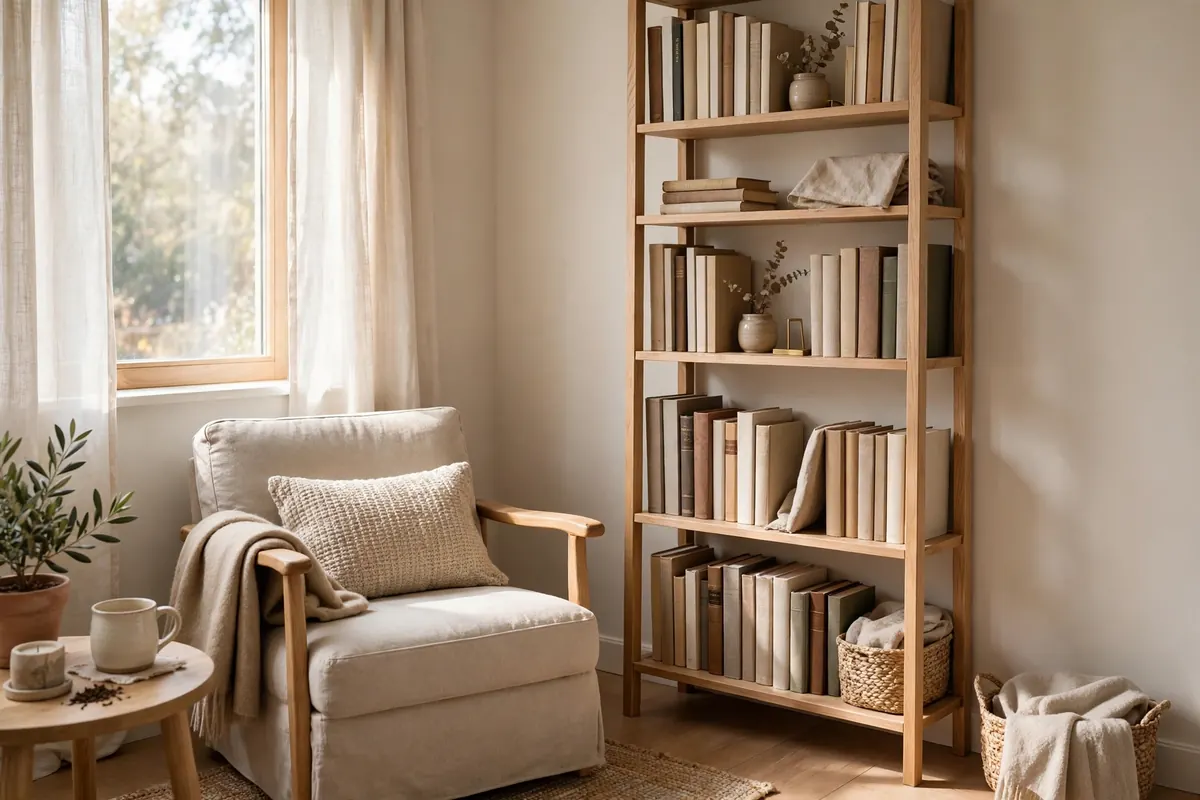
In a small room, floor space is the scarcest resource, so the best book storage goes upward. A tall, narrow bookcase — 30 to 40 centimetres wide and up to two metres high — holds as many books as a wide low unit while taking up barely more floor than a dining chair. Tuck one into the gap beside a wardrobe, at the end of a hallway, or in that awkward strip of wall between a door frame and a corner. These dead zones exist in almost every small home, and a slim shelf turns them into a library.
A few details make tall shelving work well. Anchor it to the wall, especially if you have children or wobbly floors; a top-heavy bookcase is a real hazard, and an anti-tip strap costs very little. Put the heaviest books — hardbacks, art books, textbooks — on the lowest shelves, where their weight keeps the unit stable. Reserve the top shelf for the books you reach for least, and keep a small step stool nearby rather than climbing on chairs.
Leave a little breathing room, too. Shelves packed spine-to-spine look tidy in a photograph but are miserable to use. Stack a few books horizontally to break up the rows and create a natural bookend. If your bedroom is the main reading spot, a slim shelf beside the bed holds the current reads and frees the nightstand for a lamp and a glass of water. For more bedroom-specific layouts, these bedroom bookshelf organization ideas show how to fit shelving around beds and wardrobes without the room feeling crowded.
Floating Shelves Turn Dead Wall Space Into a Library
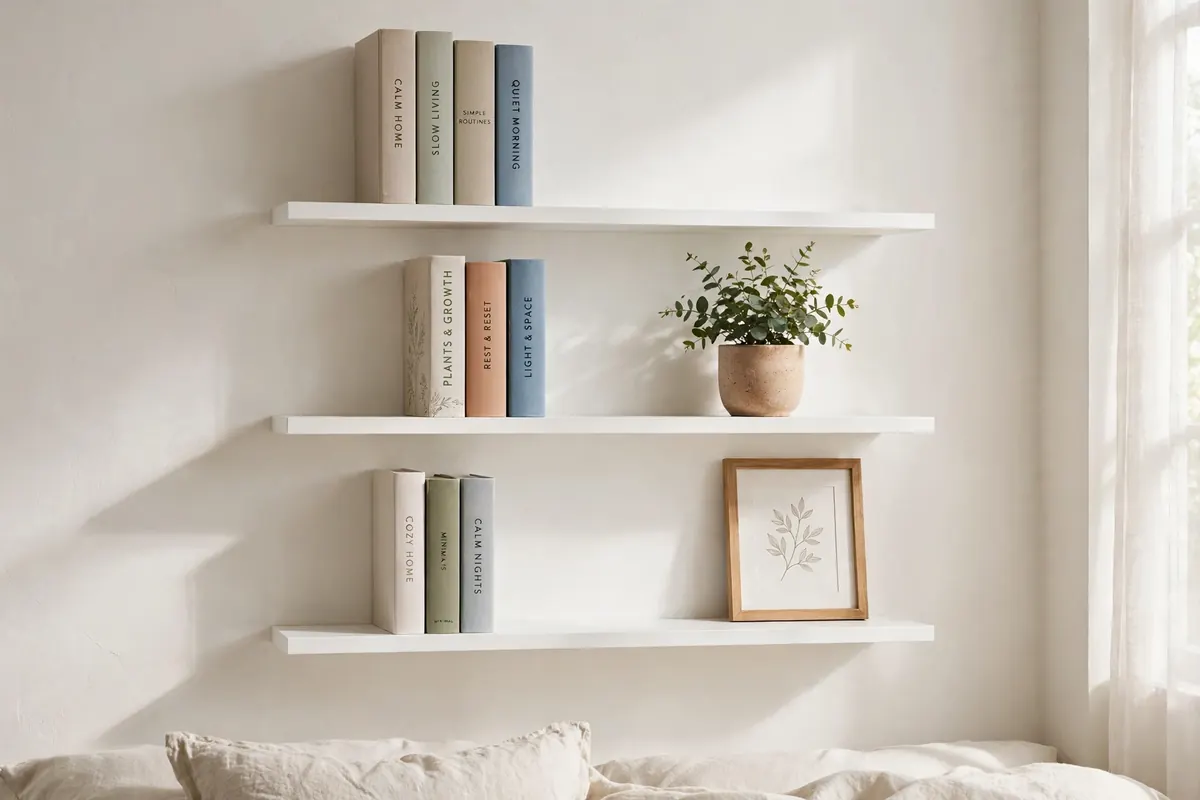
Floating shelves are the quiet heroes of small-space storage. They need no floor at all, they cost less than a bookcase, and they fit in places furniture cannot: above a desk, over a doorway, along the wall above the sofa, or in the narrow strip beside a window. A run of two or three above a desk creates a reading nook out of nothing, and a single long shelf mounted high around the top of a room can hold a whole row of books you dip into occasionally.
Placement matters more than quantity. Mount everyday shelves at a height you can reach without a stool, and reserve the highest ones for reference books and finished series. Above a sofa, hang the shelf roughly 40 to 50 centimetres above the backrest so nobody bumps their head standing up. Above a bed, keep it above head height when sitting up and fix it into studs or proper wall anchors.
Floating shelves also let you organise by use rather than by author or colour: a shelf by the front door for the book you read on the train, one in the kitchen for cookbooks, one in the bathroom for light reads. It matches how real people read — in short bursts, in specific chairs, at specific times of day. When the book lives where the reading happens, it gets read instead of gathering dust. Face a few beautiful covers outward as well; displayed like art, they make a small room feel personal and warm.
Under-Bed and Under-Sofa Storage Hides a Whole Shelf
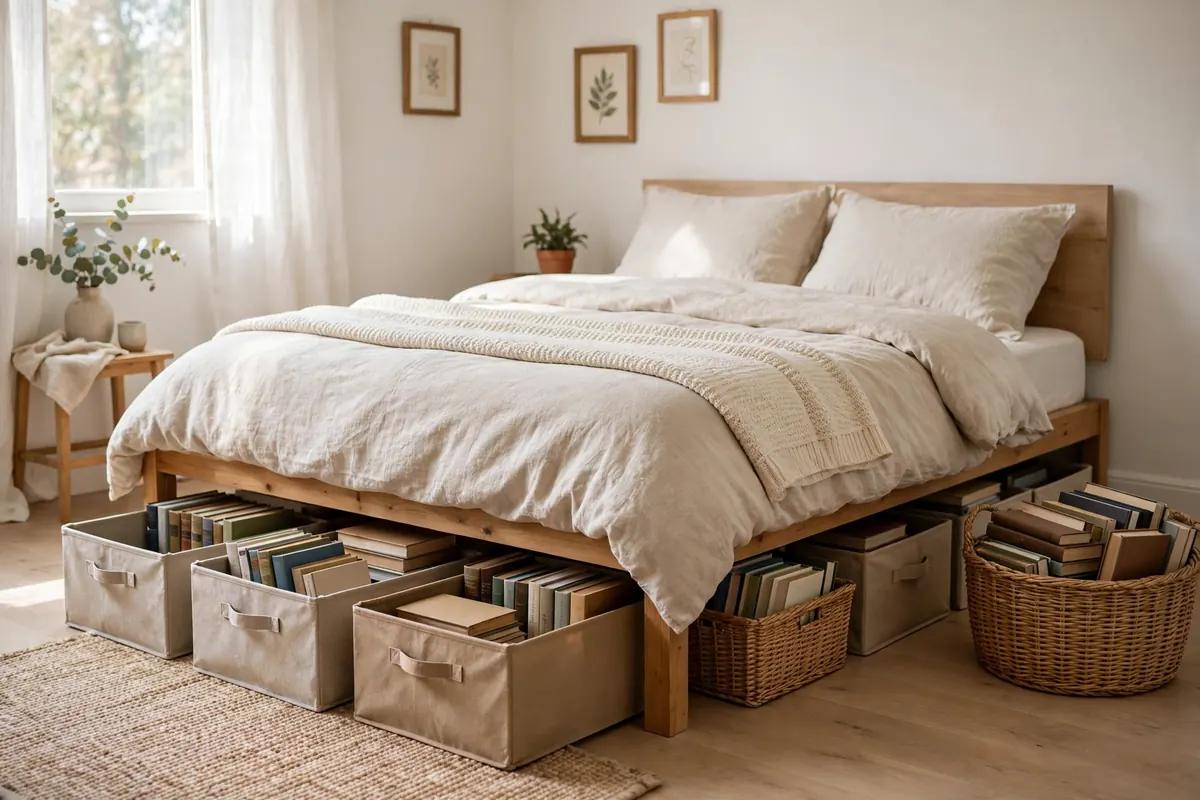
The space under a bed is one of the largest unused storage areas in a small home — a double bed hides roughly two square metres of it. Low, flat boxes on wheels, shallow fabric bins, or sturdy shallow crates slide underneath and hold dozens of books out of sight but within easy reach. This is the perfect home for books you love but do not need every day: cookbooks, reread series, and outgrown children’s books.
Choose containers you can actually pull out without a struggle. Boxes with handles on the short end work best, and clear or labelled lids save you from dragging out four boxes to find one title. Keep the boxes shallow — no more than 15 centimetres high — so they slide under a standard bed frame without catching. If your bed sits very low, bed risers add a few centimetres of clearance for very little money. Label each box — “Cookbooks”, “Series — reread”, “Kids 5–8” — and the under-bed area becomes a proper catalogue rather than a mystery cupboard.
The same logic works under a sofa, though the space is smaller and better suited to a handful of current reads. A slim tray or low basket there keeps tonight’s book and your reading glasses together, and stops books migrating onto the coffee table. Keep books away from damp, slip a silica gel sachet into each box if your room runs humid, and check the boxes every few months. For a fuller look at what fits under different bed frames, these under-bed storage ideas cover containers, labelling, and the mistakes that make under-bed storage go wrong.
Baskets by the Bed and Sofa, Plus a “Now Reading” Shelf
Not every book needs to live on a shelf. The books you are reading right now — usually two or three at most — belong in a basket, a tote, or a small tray exactly where you read them. A woven basket beside the sofa holds the novel you are halfway through, the magazine you dip into, and the library book due back on Friday. A smaller basket on the nightstand does the same job for bedtime reading. Because the basket is small, it enforces its own limit: when it overflows, something goes back on the shelf.
This is where a “now reading” shelf earns its keep. Pick one shelf — just one, at eye level, near your favourite chair — and make it the home of your current reads only: three or four books, maximum. A book moves there when you start it and leaves the day you finish it, going back to its category home or out of the house if it did not earn a second read. The main shelves are the library — organised, calm, stable — while the now-reading shelf is the active desk: small, changing, and forgiving.
- One basket per person by the sofa ends the nightly argument about whose pile is creeping across the coffee table.
- A basket on the nightstand keeps bedtime reading, a bookmark, and reading glasses together.
- A small tray on the coffee table holds only tonight’s book — everything else goes back on the shelf.
Baskets are also the kindest option for shared homes. One basket each keeps everyone’s reading separate without any extra furniture — label them with a small tag tied to the handle, or simply let each person pick their own. For the wider habits that keep shared shelves calm, this minimalist guide to decluttering bookshelves pairs well with the basket system.
Kids’ Books in Small Rooms and Renter-Friendly Fixes
Children’s books bring their own challenge: they are small, numerous, and read at floor level, which means they end up exactly there — in drifts across the carpet. In a small child’s room, skip the tall bookcase and go low instead. A forward-facing picture ledge — a shallow shelf where book covers face out — lets a child see and choose their own book, and it holds surprisingly many picture books in very little wall. Two or three ledges at a child’s eye level turn choosing a bedtime story into the easiest part of the evening.
For chapter books and the growing collection of an older child, a low cube unit or a couple of sturdy crates works better than a tall shelf they cannot safely reach. Rotate the stock: keep twenty or so books in the room and store the rest in a labelled box in a cupboard or under the bed, swapping them every month. Children love the “new” books that appear, and you never have to find wall space for all two hundred at once. A small basket by the bed holds tonight’s choice and tomorrow’s, and the nightly tidy-up takes two minutes because every book has a visible home.
Renters face one extra constraint: many landlords forbid drilling, and nobody wants to lose a deposit over a bookshelf. Almost every idea here has a no-drill version: tension-pole shelving wedges between floor and ceiling with no screws, leaning ladder shelves rest against the wall, and freestanding narrow bookcases need no fixings at all if you keep the heavy books low. Command strips hold a single light shelf or picture ledge — check the weight rating and use them only for paperbacks. If you can drill, two small screws per bracket are enough, and the holes are easy to fill when you move out.
A small home does not have to mean a small reading life. The homes where books feel most loved are rarely the ones with the most shelves — they are the ones where every book has a place and the book you want is the book you can reach. Try just one change this weekend: mount a single floating shelf, slide one labelled box under the bed, or sort one shelf with the honest three-pile method. Pick up the book you have been meaning to read, settle into your favourite chair, and enjoy it — it is right where you left it, exactly within reach.