
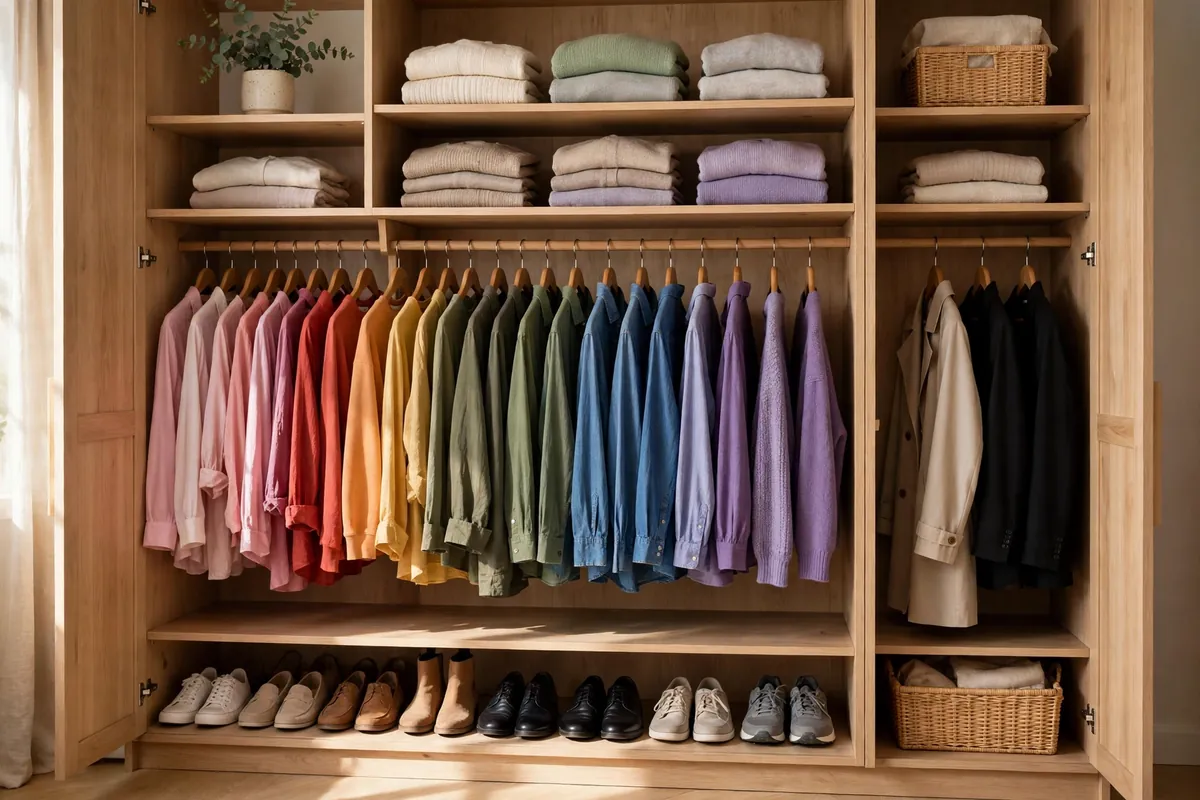

Learning how to organize a wardrobe sounds like a weekend project, but the real payoff shows up on an ordinary Tuesday morning, when you open the doors, see exactly what you own, and get dressed in five minutes without a pile of rejected outfits on the bed. Most of us do not have a storage problem. We have a visibility problem: too many clothes we never wear hiding the ones we actually love, hung in no particular order, in a space that quietly stresses us out before the day has even started. The good news is that a wardrobe you love getting dressed from is not about buying a whole new closet system. It is about making honest decisions once, arranging what stays in a way that matches how you actually live, and keeping it up with a tiny weekly habit.
Start With the Full Wardrobe Edit
Before you buy a single matching hanger or storage box, take everything out. Yes, everything. Pull every item off the rail, out of the drawers, off the shelves, and pile it on the bed. It looks dramatic, and that is the point: you cannot make clear decisions about a wardrobe you can only see in slices. Once it is all out, give the empty shelves and rails a proper wipe-down, because a clean space makes the whole job feel like a fresh start rather than a chore.
Now sort every item into four piles: keep, donate, repair, and toss. Be honest with yourself, and use questions that cut through the “maybe one day” fog. Have you worn it in the last year? Does it fit the body you have right now, not the one you hope to have by summer? Does it make you feel good the moment you put it on, or do you spend the whole day tugging at it? If an item fails two of those three tests, it goes. The stained T-shirt you sleep in is not a wardrobe item, it is a rag, and it can live in a drawer elsewhere. The dress you keep “just in case” for an event that has not happened in three years is taking up space that your favourite jumper could use.
A good rule of thumb: if you hesitate for more than ten seconds over something, put it in a “maybe” bag, seal it, and date it. If you have not opened that bag in three months, donate it unopened — this removes the fear of regret, which is the real reason most edits stall. And do not skip the repair pile: a missing button takes ten minutes to fix, and a repaired favourite is worth more than a new replacement you like less. Bag up the donations the same day and put them by the front door, or they will quietly migrate back into the wardrobe.
How to Organize a Wardrobe by Outfit, Not Just by Type
Most wardrobes are arranged by type: all the shirts together, all the trousers together, all the dresses together. That looks tidy, but it does not help you get dressed, because nobody wears a “shirt” — they wear an outfit. The single biggest change you can make is to group your clothes the way you actually wear them. Hang complete outfits together, or at least hang the pieces that go together next to each other, so your favourite top sits beside the trousers you always pair it with instead of three feet away behind a row of things you never touch.
Within each group, arrange by colour, from light to dark. It sounds fussy, but colour grouping is what makes a wardrobe look calm and makes finding things fast: your eye goes straight to the navy section instead of scanning every hanger. Keep the clothes you reach for most at eye level and within easy reach. Occasion wear, the suit you wear twice a year, and anything out of season can live higher up or further to the side. The prime real estate in your wardrobe should belong to your everyday life, not your rare events.
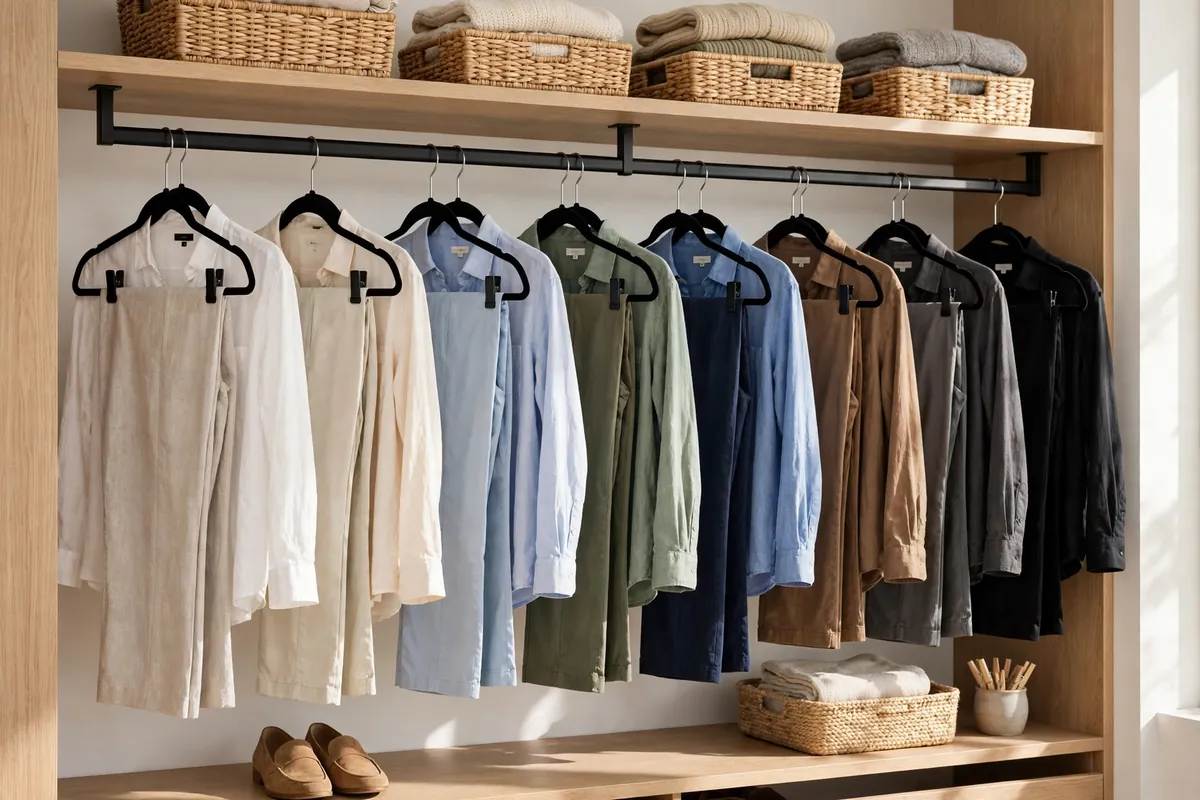
Use the same type of hanger throughout if you can. Slim velvet hangers save a surprising amount of rail space and stop silky tops sliding onto the floor, while sturdy wooden hangers are better for coats and structured jackets. Whatever you choose, consistency makes the rail look ordered and stops the visual noise of a dozen different hanger shapes competing for attention. And leave a little breathing room between items: a rail packed so tightly that you have to wrestle a shirt out is a rail you will avoid using properly.
Build a Small Capsule That Does the Heavy Lifting
You do not need a strict capsule wardrobe to benefit from capsule thinking. The idea is simple: a small set of reliable, versatile pieces that mix and match easily will carry most of your outfits, and everything else is a supporting player. Think of it as the backbone of your wardrobe — the well-fitting jeans, the white shirt that goes with everything, the knit that layers under jackets, the comfortable shoes you can walk in all day. When those pieces are right, getting dressed stops being a puzzle and starts being a choice between good options.
A practical starting point is to identify ten to fifteen core pieces you already own and love, then build around them. If you are starting from scratch or want a proper framework, read our guide on how to build a capsule wardrobe — it walks through choosing your base colours, your best neutrals, and the pieces that earn their place. The key test for any capsule piece is simple: it should work in at least three different outfits. A top that only goes with one specific skirt is not a capsule piece; it is a one-trick item, and it should not be taking up prime rail space.
Once your core is in place, be picky about additions. Before buying something new, ask which three outfits it joins and what it replaces. This one question stops most impulse buys, and it keeps your wardrobe at a size you can actually see, reach, and enjoy. A wardrobe that is too full is not generous — it is a hiding place for clothes you do not wear.
Rotate With the Seasons Instead of Fighting Them
There is no point in your heavy winter knits competing for rail space with your linen shirts in July. Seasonal rotation is one of the easiest wins in wardrobe organization: twice a year, swap the current season’s clothes to the front and move the off-season pieces into storage. The clothes you are actually wearing become easier to see and reach, and the stored pieces get a rest — and a wash — before their turn comes round again.
Store off-season clothes clean, dry, and labelled. Wash or dry-clean everything before it goes away, because a stain left for six months becomes a permanent stain, and moths love a dirty jumper far more than a clean one. Use breathable fabric storage bags or sturdy boxes with lids rather than vacuum bags for anything delicate, and pop in a cedar block or lavender sachet to keep things fresh. Our seasonal closet rotation ideas cover the full swap in detail, including a simple checklist you can run through in an afternoon.
Rotation is also a natural moment for a mini-edit. When you unpack your summer clothes, you will immediately notice the sandals that hurt your feet and the top that never quite fit. Let them go now, while you are already in decision mode, instead of hanging them up for another season of being ignored.
Give Shoes, Bags and Accessories a Real Home
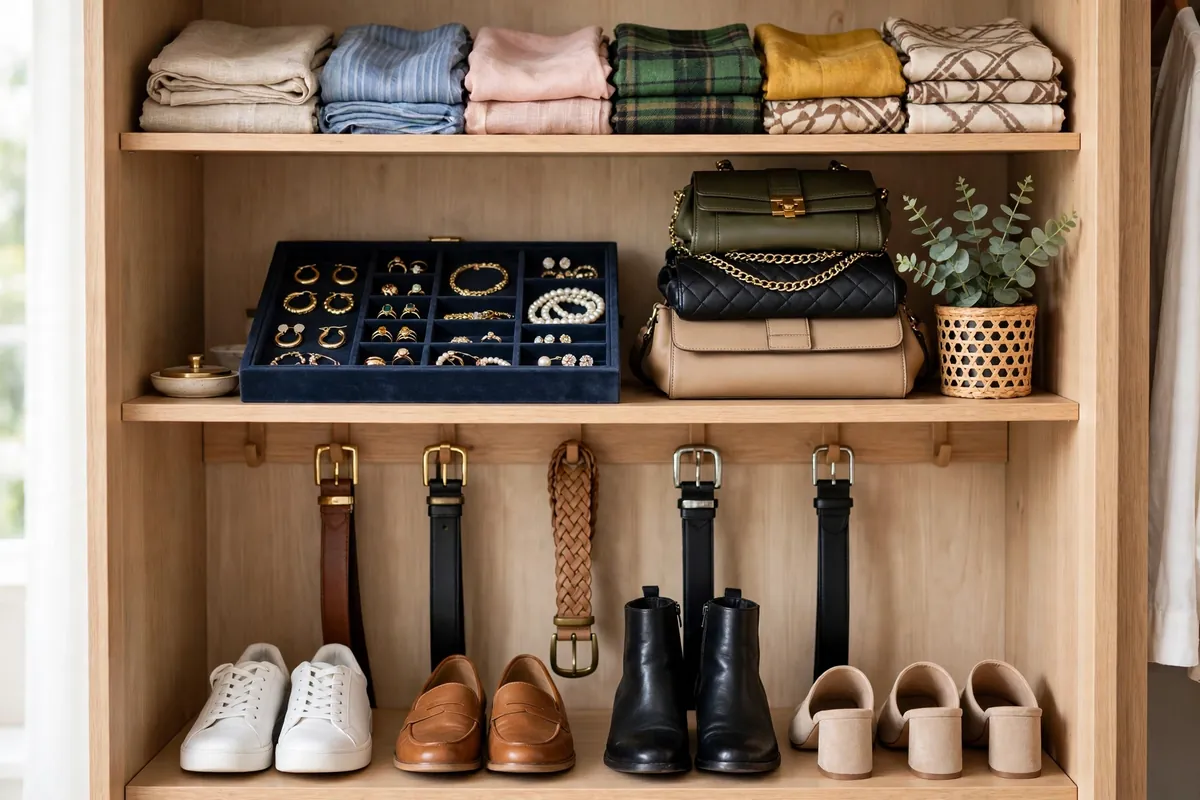
Clothes get all the attention in a wardrobe, but it is usually the shoes, bags, belts and scarves that create the mess. They end up in a heap on the floor, draped over the rail, or stuffed into the one drawer that no longer closes. The fix is to give each category a defined home, sized for what you actually own.
For shoes, a low shelf or a simple shoe rack at the bottom of the wardrobe beats a pile every time. Keep the pairs you wear weekly at the front, and store the rest — the occasion heels, the walking boots — further back or up high. If you are short on floor space, our guide to shoe organization ideas for small closets has space-saving options that work even in a single-door wardrobe. A pair of shoes you cannot see is a pair you will forget, so avoid opaque boxes for everyday pairs.
Bags do best hung on hooks or stored upright on a shelf, stuffed lightly with tissue or an old T-shirt so they keep their shape. Belts can be rolled in a drawer or hung on a multi-hook rail; scarves fold neatly in a drawer or hang over a hanger rung. Jewellery needs a small tray or a lined box, not the bottom of a bag. For the full system, see our guide to closet accessory organization — when every small thing has a spot, the whole wardrobe feels calmer, and you stop losing the belt that goes with your favourite dress.
Keep a small tray near the wardrobe for the things you take off at the end of the day — your watch, earrings, the scarf you wore to work. It stops them scattering across the bedroom, and mornings run smoother when everything is waiting in one place.
The 10-Minute Weekly Reset That Keeps It Tidy
Here is the truth nobody tells you about organized wardrobes: they do not stay organized on their own. The difference between a wardrobe that looks like a boutique and one that slides back into chaos is not the initial effort — it is a tiny, regular habit. Set aside ten minutes once a week, ideally the evening before your week starts, and run a quick reset.
Walk through these four steps and you are done:
- Rehang the strays: anything draped over a chair, hanging off the rail, or folded on top of the drawers goes back to its proper home.
- Return the floated items: shoes back on the rack, bags back on their hooks, accessories back in their trays.
- Spot-check the rail: push hangers back into colour order, and move anything you tried on and rejected back to its right place instead of leaving it bunched at the end.
- Pull tomorrow’s outfit: choose it now, while you are calm, and hang it at the front. Monday morning you will thank Sunday evening you.
Ten minutes is short enough that you will actually do it, and regular enough that the mess never builds to the point where you need another full-day edit. If you live with family, make it a shared habit — even children can rehang their own clothes once they know where things go. And if a week slips by, do not beat yourself up. Just do the reset next week. A wardrobe system that survives a missed week is a good system; a system that falls apart the moment life gets busy was never really a system at all.
A well-organized wardrobe is not really about the wardrobe. It is about starting every day a little calmer, a little faster, and a little more like yourself. When you can see what you own, when your favourite pieces are within reach, and when everything you keep is something you actually like wearing, getting dressed stops being a daily negotiation and becomes a small pleasure. So do the edit, hang your outfits together, give your shoes and accessories a proper home, and keep it all going with ten minutes a week. Your future self — standing in front of open wardrobe doors on a busy morning, dressed and out the door in five minutes — will be very glad you did.