
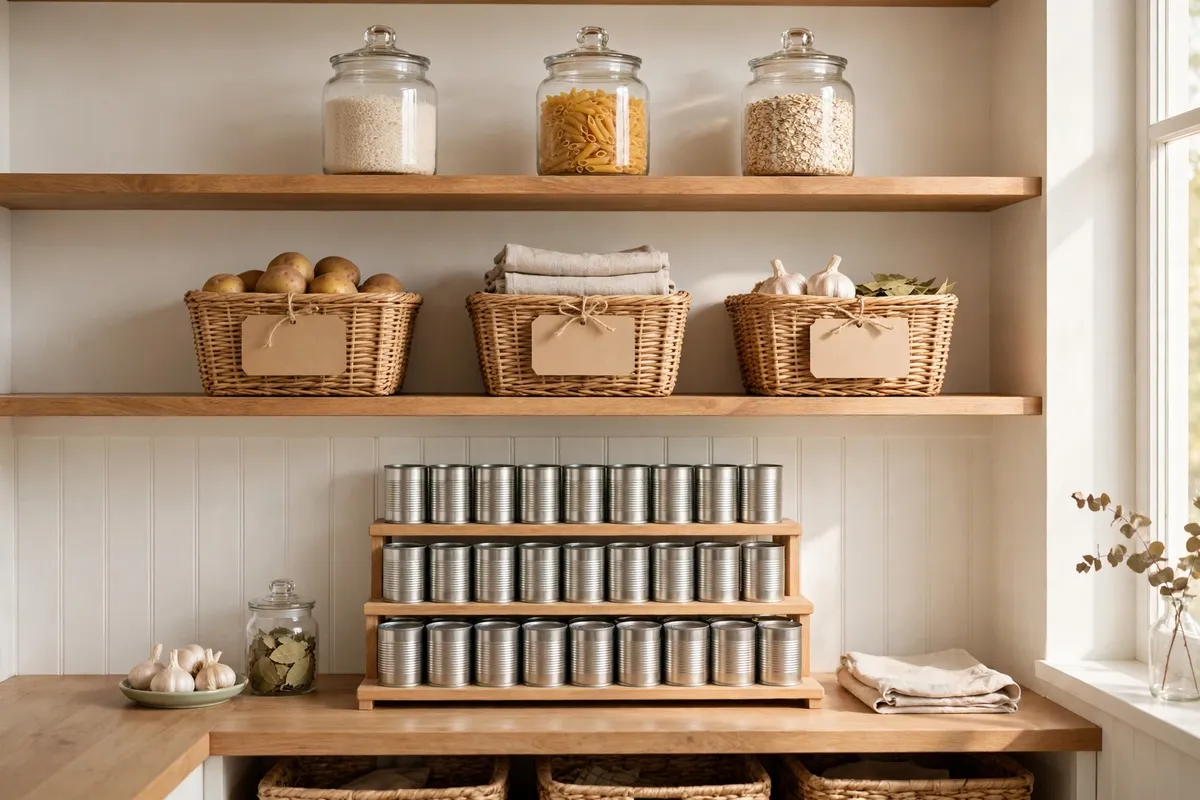

Open your pantry door right now and take an honest look. If you see three half-open bags of pasta, a tin of tomatoes hiding behind the cereal, and a spice jar you bought in 2023 that you still have not used, you are in good company. Most pantries do not become messy because anyone is lazy. They become messy because nobody ever gave them a system. The good news is that these pantry organization ideas for beginners do not require a walk-in pantry, a label maker, or a weekend of shopping. You can build a pantry that works with one afternoon and a few boxes you already own.
A tidy pantry is not about impressing anyone. It is about Tuesday evening, when you are tired and hungry and need to know in five seconds whether you have rice, tinned tomatoes, and soy sauce. When the pantry works, cooking feels easier, shopping lists write themselves, and food stops quietly expiring at the back of a shelf.
Start by Emptying the Whole Pantry
Every good pantry reset starts the same way: take everything out. Yes, all of it. Put it on the kitchen table or the worktop so you can see what you actually own. It feels dramatic, and it is meant to. You cannot organize around clutter you cannot see, and the back corners of a pantry hide more than you think. In one sweep you will probably find duplicates you forgot you bought, a bag of flour with a tear in it, and at least one jar whose label has faded beyond recognition.
Once the shelves are bare, wipe them down. A damp cloth and a drop of washing-up liquid is enough. Check for crumbs in the corners, sticky rings under jam jars, and any sign of pantry moths — tiny webs or small brown insects near dry goods. If you find them, throw out the affected packets, vacuum the shelf, and wipe it with white vinegar before anything goes back.
Now sort the pile into four groups. Be honest with yourself here, because this is the step that does the real work.
- Keep and use weekly: the things you reach for all the time — pasta, rice, cooking oil, tinned tomatoes, cereal, peanut butter, tea and coffee.
- Keep but use rarely: the special flour, the dried chillies, the Christmas pudding mix. These stay, but they do not earn a front-row seat.
- Donate: sealed, in-date food you know you will never cook with. Food banks welcome it, and it frees a surprising amount of space.
- Throw away: anything past its date, stale, rancid, or smelling off. Nuts and oils that smell like old crayons have gone bad. A bulging or deeply dented tin belongs in the bin, not on a shelf.
Most beginners throw away or donate a quarter of what comes out. That is not failure — it is the reason your pantry will feel twice as big when you are done.
Sort Into Groups That Match How You Cook
With the keepers on the table, group them by how you actually use them, not by how a shop arranges them. Think about the five dishes you cook most often, then build your groups around those. Most households end up with something like this: breakfast, baking, pasta and grains, canned goods, snacks, sauces and condiments, tea and coffee, and backstock — the spares and refills.
Keep the groups broad — eight or nine is plenty. If you split things into twenty tiny categories, nobody in the house will remember where anything goes, and the system will collapse within a fortnight. One basket labelled “Snacks” survives real life far better than five baskets labelled “Crisps”, “Biscuits”, “Dried Fruit”, “Nuts”, and “Cereal Bars”. You can always split a group later if it overflows.
While you sort, check the dates and put the items that expire soonest at the front of each group so they get used first. This simple habit, first in, first out, is the best way to stop wasting food, and it costs nothing. When new shopping comes home, it goes behind the older stock. If you want a fuller system for tracking what you have, our guide to a pantry inventory system that stops food waste shows how a simple list on the door can save you from buying a fourth jar of cumin.
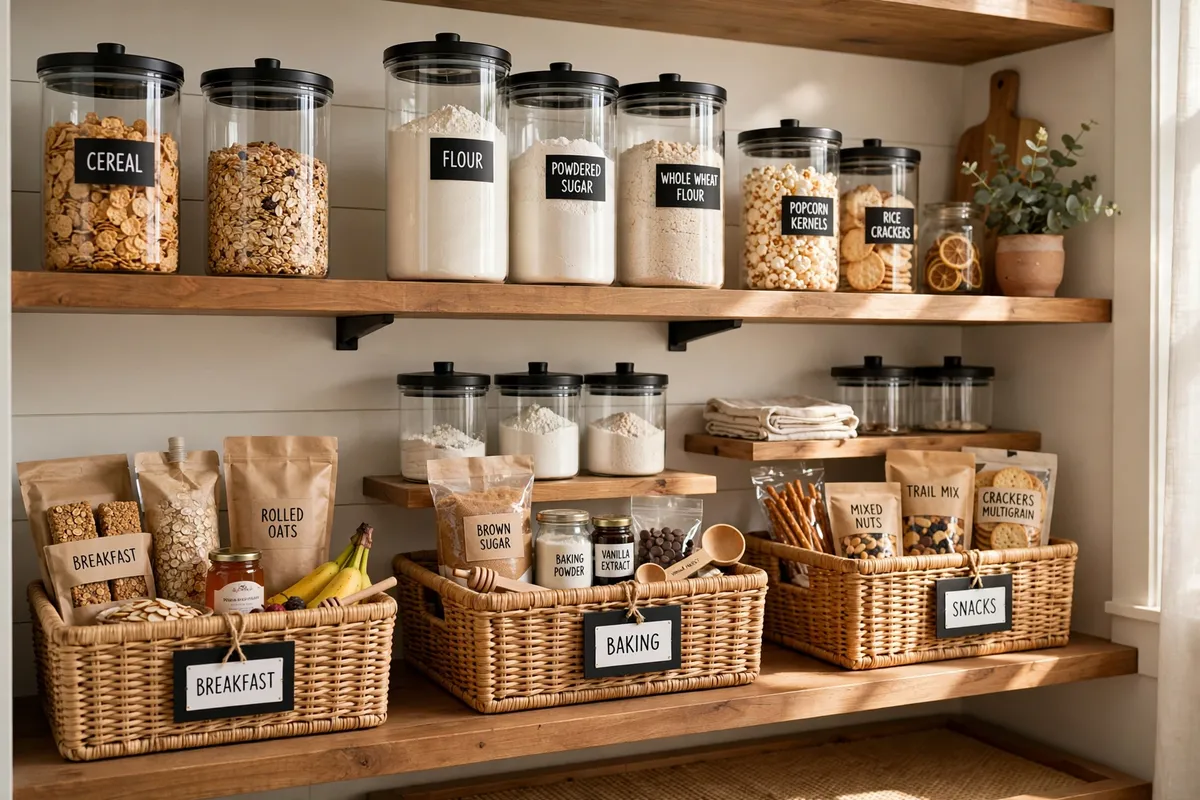
Pantry Organization Ideas for Beginners: Give Every Shelf a Job
Here is the idea that makes everything else work: every shelf gets one job. When each shelf has a single purpose, you stop shoving things in at random, and everyone in the house knows where to look.
A layout that works in most pantries looks like this. The top shelf, the hardest to reach, holds backstock and things you rarely need. The middle shelves, between waist and eye level, hold the everyday food you reach for daily: breakfast things, pasta and rice, cooking oil, and the sauces you use every week. The bottom shelf takes the heavy items — big bags of rice and flour and bottles of oil. Heavy things low down are easier to lift and safer if they slip.
Think about who reaches for what. If your children make their own snacks, give them a low shelf they can reach, with a small basket of approved snacks at their height. If your pantry is a couple of kitchen cupboards rather than a built-in room, the same rule applies — assign each cupboard a job, and treat each shelf inside it the same way. For a small space specifically, our small pantry organization ideas show how to squeeze real function out of a tiny footprint.
Before you put anything back, measure. Note the width, depth, and height between shelves and keep the numbers in your phone. Every container you buy from now on should be chosen against those numbers, because a bin one inch too wide wastes a whole shelf, and a jar one inch too tall will not fit under the shelf above it.
Choose Containers That Actually Help
Here is where most beginners go wrong: they buy the containers first. Do not. Buy the containers last, after the zones are set and you know what needs containing. A container should solve a specific problem — a loose pile of snack packets, a bag of flour that spills, a deep shelf where things vanish at the back. If a shelf already works with items standing in a row, it does not need a bin.
When you do shop, start with what you already own. Shoe boxes make perfectly good shelf bins, and large jars from pasta sauce, washed and dried, work as canisters. They let you test the layout before you spend money on matching baskets. If you want the tidier look later, swap the cardboard for matching baskets one at a time. The system matters more than the shopping.
For the things worth buying, a few types earn their keep in almost every pantry:
- Clear airtight canisters for flour, sugar, rice, oats, and cereal. They keep food fresh, keep pests out, and let you see at a glance how much is left. Square shapes waste less space than round ones.
- Open-front bins with handles for snacks, packets, and small items you grab often. A bin you can pull out like a drawer beats reaching into a deep shelf.
- A tiered shelf riser for canned goods. It lifts the back row so you can see the labels, and it stops tins from hiding behind each other. If tins are your biggest headache, our canned food organization ideas go deeper on risers, racks, and rotation.
- A turntable, or lazy Susan, for oils, vinegars, and sauces, especially in corners and deep shelves. One spin brings the bottle you want to the front.
- A basket or tray for the door. An over-the-door rack holds spices, foil, and small condiment bottles that would otherwise crowd a shelf.
Decant selectively. Flour, sugar, rice, and oats are worth decanting because they shed crumbs, go stale in open bags, and are hard to pour from a torn packet. Almost everything else can stay in its original packaging inside a bin. Decanting every single item in your pantry is a hobby, not a system, and it is the fastest way to burn out in week one. Label each canister with the contents and the date you filled it.
Label Everything — Simply
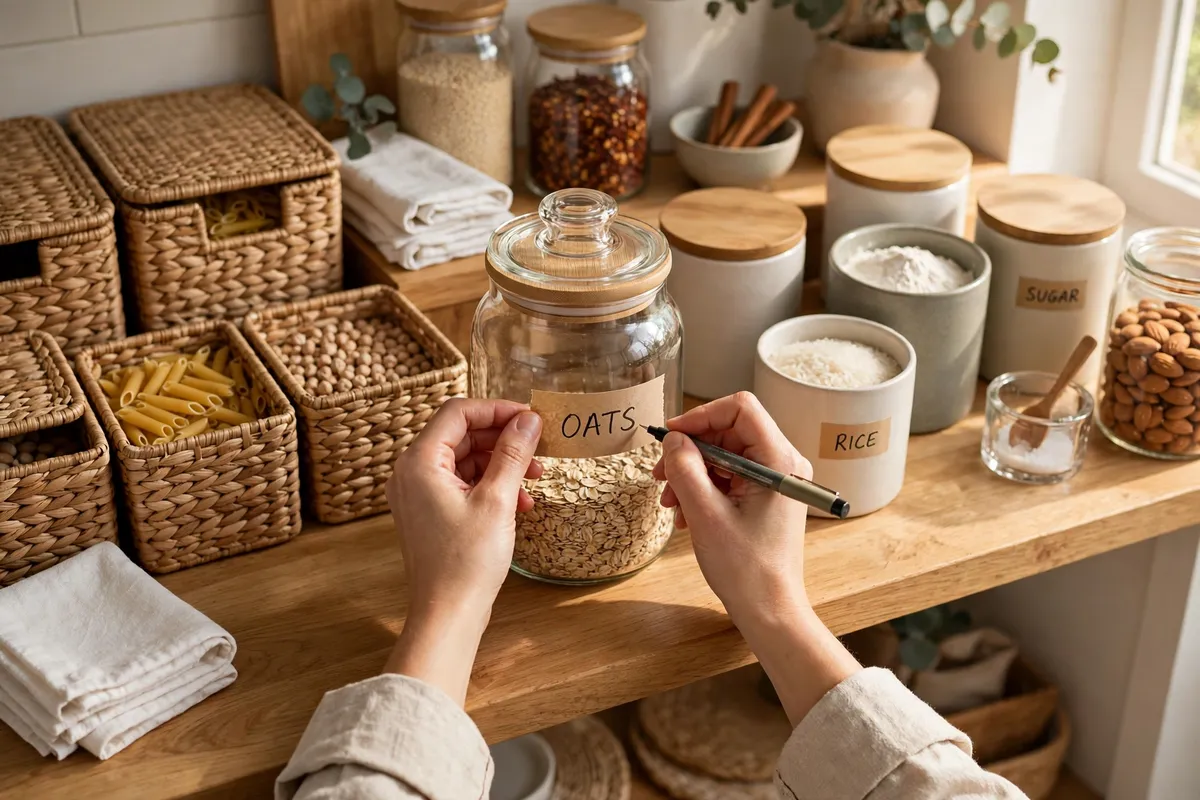
Labels are the cheapest habit that keeps a pantry tidy, and they are the reason the system survives after the first week. A strip of masking tape and a marker beats a fancy label maker for daily use. Mark every basket, bin, and jar with what sits inside it. Labels stop the slow drift where one basket quietly fills with random packets, and they help everyone else in the house put things back in the right spot.
Keep the words broad and simple. “Breakfast”, “Baking”, “Pasta”, “Snacks” — one or two words, big enough to read from a step away. Put the label on the front, low enough to see when the bin sits on the shelf, and on the top too if you stack bins. For jars, the label goes on the front and the date you filled it goes on the back. If you have young children, picture labels work alongside words so they can help put things away.
Do not label everything at once if it feels overwhelming. Start with the baskets and the decanted jars — the things that look alike from the outside. For a deeper look at decanting and labelling done well, see our pantry decanting and labels guide, which covers which foods are worth decanting and how to label so the system still makes sense six months later.
Keep It Tidy With a Five-Minute Weekly Reset
A pantry does not stay organized by itself. It stays organized because of one small habit: a five-minute reset each week. Pick a moment that already exists in your routine — while the kettle boils on a Sunday, or when you unpack the weekly shop — and use it to do three things. Put back anything that has drifted to the wrong shelf. Pull the older items to the front and the new shopping behind them. And check for anything that has expired or gone stale since last week.
That is it — five minutes. It is the difference between a pantry that stays tidy for years and one that quietly slides back into chaos by February. The weekly reset also catches problems early: the bag of rice with a small tear, the jar of jam with mould on the lid, the three half-used bags of the same pasta. Small problems are easy. Big problems are what happen when nobody looks for a month.
Every few months, do a slightly bigger review: check the dates, and ask whether the zones still match how you cook. And before you shop, glance in the pantry first — buying a duplicate of something you already own is the most common way a pantry fills up again.
Your Pantry, One Afternoon From Now
You do not need a perfect pantry. You need a pantry that answers the question “do we have it?” in five seconds, and a system simple enough that the whole household can keep it up. Empty it, sort it honestly, give every shelf a job, buy containers only where they solve a real problem, label the baskets and jars, and give it five minutes a week.
Start this weekend. Pick the afternoon when the kitchen is quiet, put on a podcast, and pull everything out onto the table. By dinnertime you will know exactly what you own, dinner will be easier to make, and the next time you open that door, everything will be where you expect it. That is what a good pantry feels like — not a photograph, but a small daily relief.