
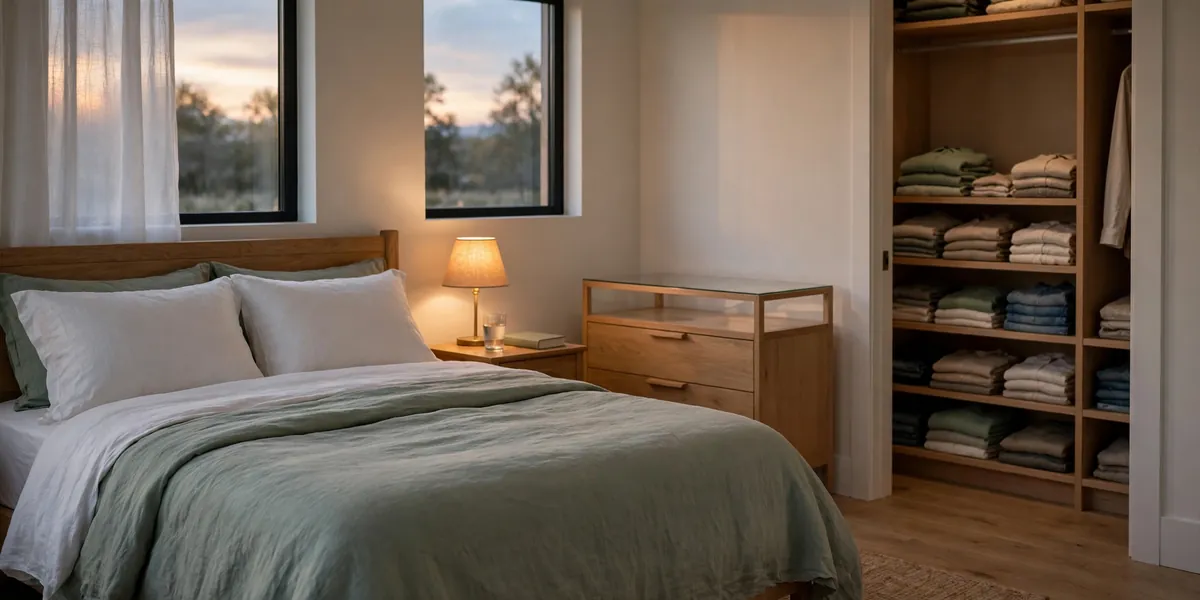

You know the feeling. You climb into bed exhausted, the lights go off, and instead of drifting away, your eyes land on the chair piled with clothes, the nightstand buried under chargers, and the laundry basket overflowing by the door. Bedroom organization for better sleep is not about having a showroom-perfect room. It is about giving your brain permission to switch off. Researchers at St. Lawrence University found that people who sleep in cluttered rooms are significantly more likely to struggle with falling asleep and staying asleep — the clutter was keeping their brains on alert. The good news: most of the fixes in this guide take under an hour, cost little or nothing, and you can start tonight.
Why a Messy Bedroom Steals Your Sleep
Clutter is visual noise. Every item your eyes land on before bed is a tiny mental notification: fold me, charge me, put me away. Your brain has to process all of that information, and that low-level stimulation keeps cortisol — the stress hormone — higher than it should be at night. High cortisol makes it harder to fall asleep and reduces the quality of deep sleep.
It is not only about what you can see. A bedroom that doubles as an office, a laundry sorting station, and a storage unit sends your nervous system mixed messages. If your laptop, your unpaid bills, and a pile of clean laundry are all within arm’s reach of your pillow, your brain cannot tell whether this room is for working or for sleeping. Sleep experts call this a problem of association: your bedroom should mean one thing, and one thing only, to your brain. When it does, drowsiness arrives faster and lasts longer. Think about the last time you slept somewhere beautifully simple — a hotel room or a holiday cottage, bed made, surfaces clear, nothing to look at except a lamp and a book. Most people fall asleep faster in those rooms, and it is not the mattress. It is the absence of unfinished business staring back at them. You can build that same feeling at home, one zone at a time.
Bedroom Organization for Better Sleep Starts at the Door
The fastest way to change how your bedroom feels is to work in zones instead of trying to tidy everything at once. Stand at the door and look at the room the way a guest would. The three zones that matter most for sleep are the bed, the nightstand, and the floor. Everything else can wait until the weekend.
Start with a fifteen-minute sweep. Grab a laundry basket and walk the room clockwise, picking up everything that does not belong in a bedroom: mugs, paperwork, kids’ toys, tools, shopping bags, that stack of magazines from three months ago. Do not sort it now. Just get it out of the room and deal with the basket tomorrow morning when you are awake and thinking clearly. Then do the same for laundry — clean clothes go in the closet or a drawer, dirty clothes go in the hamper, and anything in between gets a proper home, which brings us to the chair.
Almost every bedroom has a chair or a corner that collects clothes that are not quite dirty enough to wash. The fix is not willpower; it is a landing strip. Give those in-between clothes a dedicated spot so they stop colonizing the bed and the floor — a short wall rail with three or four hooks, a simple valet stand, or one slim hook on the back of the door. The rule is simple: if it does not fit on the rail, it gets washed or hung up properly. When you plan your zones, it helps to think about how to clear bedroom floor clutter for good, because the floor is where the visual chaos is worst.
The Nightstand Rule: Five Things, No More
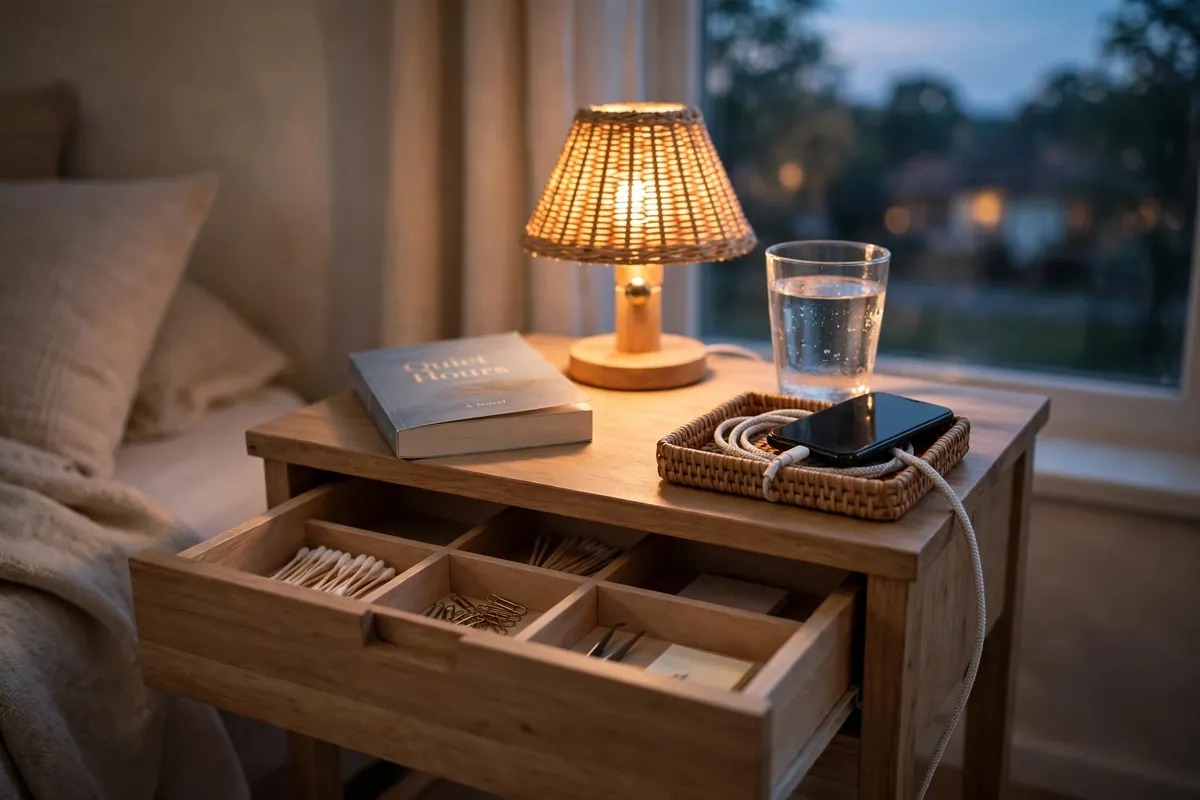
Your nightstand is the most important surface in the room, because it is the last thing you see before you close your eyes and the first thing you see when you open them. Organizers and sleep therapists agree on roughly the same shortlist of what belongs there: a lamp, a book or e-reader, a glass of water, a sleep mask or earplugs if you use them, and a phone charger — ideally with the phone face-down or, better still, across the room. Everything else is visual noise.
Here is a practical way to reset a nightstand in ten minutes:
- Empty it completely. Take everything off and out of the drawer, and wipe the surfaces clean.
- Sort into three piles. Keep in the bedroom, belongs elsewhere, and throw away or recycle. Be honest — the broken watch is not a keepsake.
- Return only the five essentials. Lamp, book, water, sleep mask, charger. Everything else that genuinely lives in the bedroom goes inside the drawer, not on top.
- Add one small tray. A shallow tray corrals the little things — lip balm, earplugs, a hair tie — so they stop spreading.
- Tame the cables. Clip the charger to the back of the nightstand so you never see a knot of wires again.
Our guide to bedroom nightstand organization ideas walks through drawer dividers, charging setups, and small-space solutions that keep the top clear for good.
Clear the Floor and Tame the Chair
Nothing makes a bedroom feel chaotic faster than a floor you cannot walk across without stepping over something. Shoes, bags, books, and laundry piles create instant visual clutter, and a genuine tripping hazard on the way to the bathroom at 3 a.m. The floor is also the surface your brain reads as “the state of the room” — clear floors signal calm, even if a drawer somewhere is still a mess.
The fix is giving everything a home that is easier to use than the floor. A shoe tray or a slim rack by the door stops the daily pile-up. A single lidded basket in the corner catches the odds and ends — the library book, the bag you need tomorrow — so they are contained instead of scattered. Under-bed storage helps too, but only if it is sealed and labelled: one flat bin for spare linens, one for out-of-season clothes, nothing loose. Loose bags under the bed collect dust and make cleaning harder, which is the opposite of what a sleep-friendly room needs.
Bedroom Organization for Better Sleep: Light, Temperature, and Sound
Once the clutter is under control, the next layer is the room itself. Sleep researchers agree on three environmental factors that matter more than almost anything else: darkness, temperature, and quiet. Organization makes them possible — blackout curtains only work when the window is not blocked by a pile of boxes.
Make it truly dark. Light is the strongest signal to your internal clock. Even dim light — a streetlight leaking around thin curtains, a phone screen face-up on the nightstand, a glowing charger — can suppress melatonin, the hormone that tells your body it is time to sleep. Research from Northwestern University found that sleeping with even moderate ambient light increased heart rate and reduced time in deep sleep. Blackout curtains or a blackout liner behind your existing drapes solve most of the problem for thirty to eighty dollars a window, and they work best when they extend a few inches past the frame on every side, because light leaks at the edges, not through the fabric. Cover the small glowing LEDs on chargers and power strips with a strip of black electrical tape.
Keep it cool. The Sleep Foundation suggests a bedroom temperature of about 65 to 68 degrees Fahrenheit (18 to 20 degrees Celsius) for most adults. Your core body temperature needs to fall by a degree or two before you can drift off, and a warm room fights that drop all night. A bedroom above 72 degrees measurably increases wake-ups and reduces deep sleep. If 65 sounds cold, remember bedding is the adjustment mechanism: keep the room cool and add a blanket, rather than heating the room and sleeping under a sheet. Set your thermostat to drop an hour before bedtime so the room is already cool when you walk in.
Keep it steady and quiet. The sleeping brain monitors for changes, not for volume — a sudden dripping tap wakes you while a steady fan does not. The World Health Organization recommends keeping bedroom noise below 30 decibels at night. A white-noise machine, a fan, or a phone app playing steady rain can mask the sharp noises that pull you out of sleep. Heavy curtains help too — dense blackout fabric dulls street noise as well as light. What matters is consistency: the same low, steady sound every night tells your brain it is safe to let go.
The 10-Minute Nightly Reset
Here is the honest truth about every organization system: it only works if you maintain it, and maintenance only happens if it is short enough to do when you are tired. That is why the nightly reset is ten minutes, in the same order, every single night. Do it while you brush your teeth, and it becomes a habit instead of a chore.
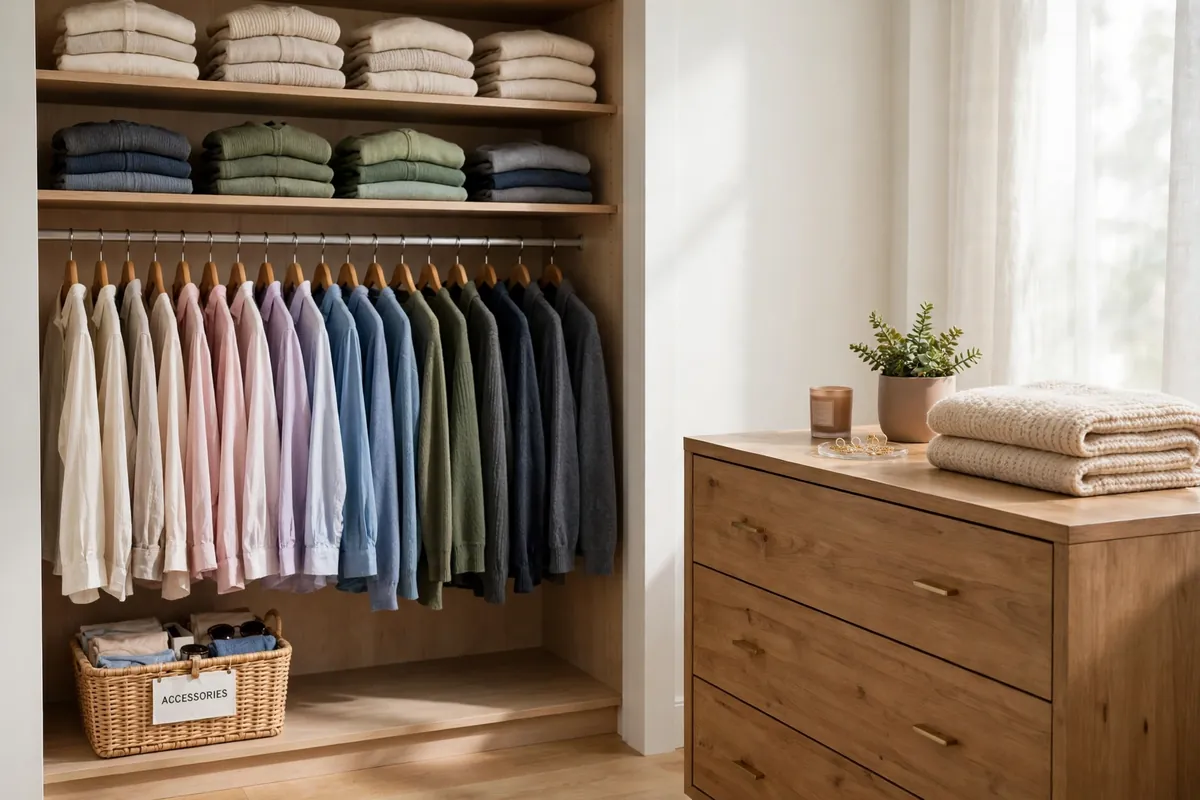
Start with the surfaces. Clear the nightstand and the top of the dresser back to their essentials — anything that wandered there during the day goes home or into the basket. Then the floor: shoes by the door, laundry in the hamper, in-between clothes on their hooks. Then the bed itself: pull the covers up, fluff the pillows, and lay out tomorrow’s clothes on the rail. That last step is a small gift to your morning self, and the moment the room stops looking like a to-do list and starts looking like a place to rest.
Fresh bedding matters more than most people realise. Crisp sheets and a pillow that actually supports your neck change how the bed feels the moment you lie down. Keep one spare set of sheets in a single labelled bin — under the bed or in the linen closet — so changing the bed is a two-minute job instead of a hunt through a cupboard. If your linen storage needs help, our guide on how to organize a linen closet shows how to fold, label, and store bedding so every set is fresh and ready when you need it.
The reset works best tied to something you already do every evening. Pair it with your wind-down routine — the same time you switch the lights low, put the phone on charge across the room, and pick up your book. Within a week, the ten minutes will feel automatic. If evenings are your hardest time to keep up, a short evening reset cleaning routine for the whole house uses the same idea, and the bedroom is the easiest room to start with.
You do not need to reorganize your entire bedroom this weekend. In fact, trying to do everything at once is the fastest way to give up by Sunday afternoon. Pick one thing from this guide and do it tonight. Clear the nightstand. Hang the blackout liner. Move the phone charger across the room. Set the thermostat to 65 degrees. Any one of those changes will make tonight measurably calmer than last night.
Then add one more change tomorrow, and one more the day after. By the end of the week, the room will look different, and more importantly, it will feel different. You will walk in, see clear surfaces, a made bed, and a dark, cool, quiet room, and your brain will get the message it has been waiting for all day: there is nothing left to do here. That is what bedroom organization for better sleep really is — not a perfect room, but a room that lets you rest.