
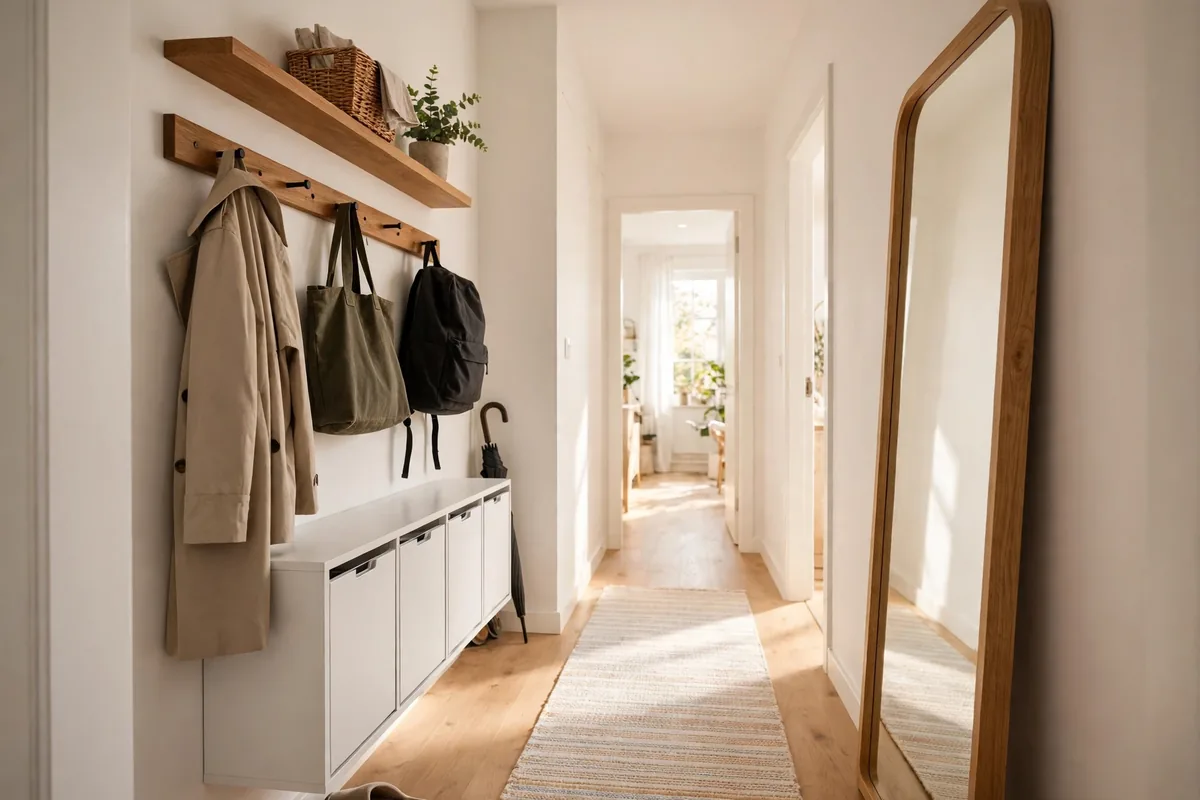

A narrow hallway has a way of defeating even the tidiest intentions. You hang a coat hook, add a shoe rack, and suddenly a 36-inch corridor feels like 24. These narrow hallway storage ideas work the other way around — they treat the walkway as sacred and earn their storage from the walls, the doors, and the air above your head instead.
I lived for four years with a hallway exactly 33 inches wide. My first attempt at “organization” was a chunky shoe cabinet that left just enough room for one person to pass sideways, holding their breath. The whole corridor became an obstacle course. Everything changed when I stopped thinking of the hallway as a room that needed furniture and started treating it like a passageway that needed to stay clear. The trick that made the biggest difference? Moving everything to the walls before bringing a single piece of floor furniture back in.
Narrow Hallway Storage Ideas That Start With a Tape Measure
Before you buy anything, measure. Width, length, and the swing of every door that opens into the hallway — the front door, the closet door, the bathroom door. A door that sweeps 28 inches across a 36-inch hallway has just told you exactly how much depth you have to work with on that wall: eight inches. Write the numbers on your phone. Every idea below works only if it respects your measurements, and the cheapest way to get storage wrong in a narrow hallway is to guess.
Here is the rule my contractor friend gave me, and it has never failed: keep a clear walkway of at least 30 inches for a main hallway, and keep any furniture under one wall. In a hallway narrower than 36 inches, that means floor furniture is essentially banned unless it is extremely slim — wall storage does all the work. Once you know your real numbers, the shopping gets surprisingly easy, because half the furniture in the store disqualifies itself.
Wall-Mounted Everything: Hooks, Rails, and Floating Shelves
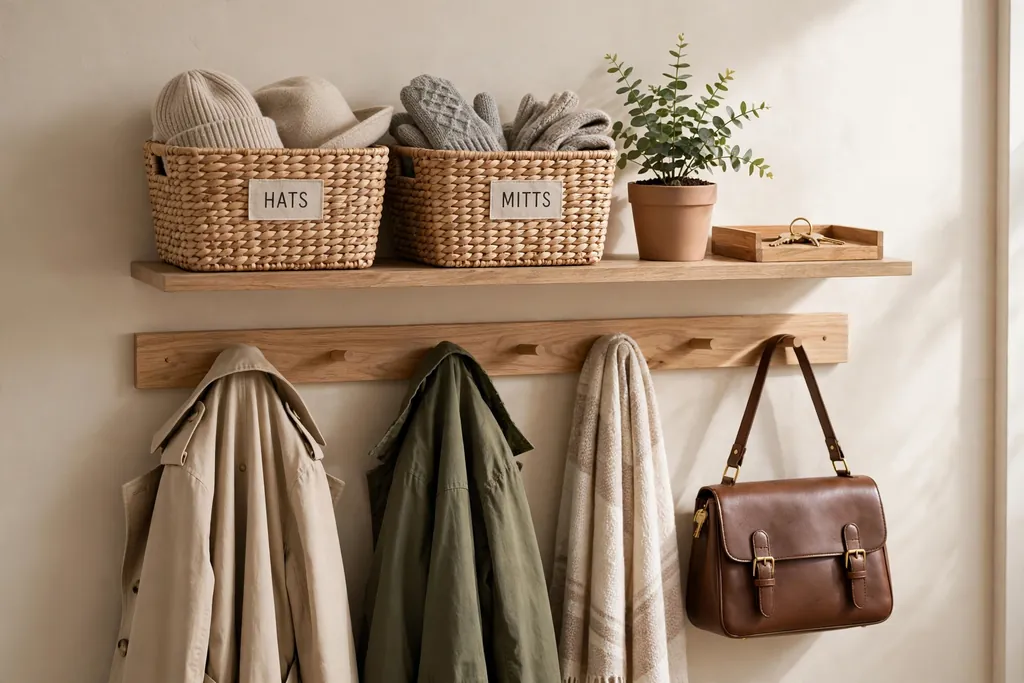
Walls are the biggest storage asset a narrow hallway owns, and most of us use them at a fraction of their capacity. A shaker-style peg rail — the kind with chunky wooden pegs on a simple board — will hold more coats, bags, and scarves than a coat stand ever could, and it eats up barely three inches of depth. Mount it at about 65 inches for adult coats, and if you have kids, add a second, lower rail at around 42 inches so they can hang up their own things without you rescuing bags off the floor every evening.
Above the rail, run a floating shelf 8 to 10 inches deep. That single shelf is your landing zone: a tray for keys and sunglasses, a basket for gloves and hats, a small plant if you want the hallway to feel like more than a tunnel. Keep the shelf shallow enough that nobody’s shoulder catches it — in a hallway under 40 inches wide, I would not go deeper than 10 inches. If the hallway runs long, repeat the rail-and-shelf pairing in two or three bays instead of one long stretch; it reads as rhythm rather than clutter.
One more wall win that people overlook: the wall space above the door. A single shelf mounted over the front door frame can hold the storage baskets you reach for once a season — guest towels, holiday garlands, the bag of reusable shopping totes you never want to forget again. It uses dead space that was never going to hold anything else, and in a small home that is pure gold. Pair these vertical habits with the principles in our guide to vertical storage ideas for small spaces, and a hallway stops being dead square footage.
The Slim-Profile Furniture Rule
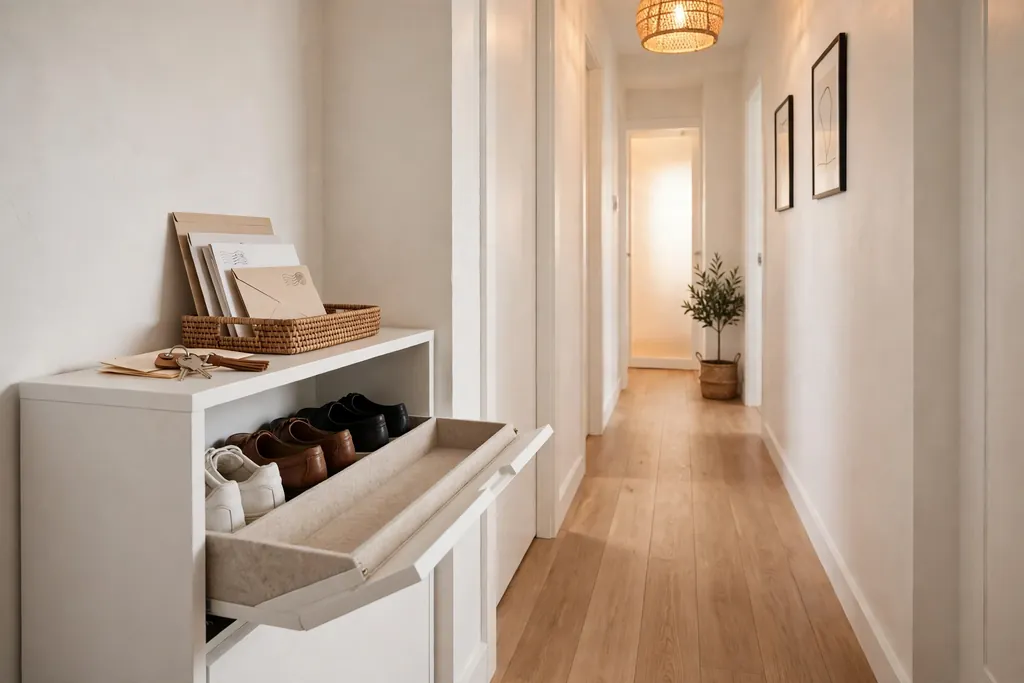
If your hallway is wide enough for furniture — call it 40 inches and up — the rule is ruthless simplicity: nothing deeper than 12 inches, and only along one wall. The hero piece here is the slim flip-down shoe cabinet. At 8 to 10 inches deep, it holds 12 to 18 pairs of shoes in compartments that fold down, and the top surface becomes your drop zone for mail and keys. Two of them side by side look intentional rather than squeezed in, and because everything is behind closed doors, the hallway still reads as calm.
Alternatives worth knowing about:
- A narrow console table with a drawer: 10 to 12 inches deep, one drawer for the junk you would otherwise pile, and a lower shelf with two lidded baskets for dog leashes, umbrellas, and the library books heading back.
- A slim bench with a lift-up lid: gives you somewhere to sit while you wrestle on boots, plus hidden storage inside for the shoe clutter that never quite makes it into the cabinet. Choose a bench under 14 inches deep or skip it.
- A ladder-style leaning shelf: its open, tapered design takes up almost no visual weight. Use it for a couple of baskets and a plant — not as your primary storage, but as the pretty layer that makes the practical stuff feel deliberate.
Whatever you choose, keep the legs visible and the profile light. A solid, floor-hugging cabinet makes a narrow hallway feel like it ends two feet sooner than it does. If your hallway has a closet at one end, make that closet pull its weight first — see our hallway closet organization ideas — before you add a single piece of furniture to the corridor.
Shoe Storage That Doesn’t Block the Path
Shoes are the number-one reason narrow hallways fail. They multiply by the door, they migrate along the wall, and suddenly you are kicking off your sneakers on top of someone else’s boots. The fix is giving every pair a home that is easier to use than the floor. The slim flip-down cabinet from the last section is the strongest option, but renters and tight budgets have good alternatives:
- Stackable slim shoe boxes: clear, narrow boxes that stack to the ceiling in a corner nobody was using. The visibility means you actually wear the shoes instead of forgetting them.
- A wall-mounted shoe rack: wire or mesh racks screwed into the wall at shin height keep shoes off the floor entirely and the floor clear for the mop.
- Over-the-door shoe pockets on the back of the front door: perfect for the shoes you wear most, plus it puts your daily pair exactly where your feet are.
- A one-pair rule: the gentlest fix of all. Only the shoes you are wearing right now may live by the door; everything else sleeps in the bedroom closet. It works best paired with one of the storage options above, not instead of them.
One honest note from experience: an open shoe rack in a narrow hallway will look like a shoe rack, no matter how you style it. If you can manage a cabinet with doors, do it. Closed storage is what lets a 33-inch hallway feel calm instead of busy. The entryway guide at small entryway organization ideas has more on taming the shoe drift if your hallway doubles as your front door area.
Doors are vertical real estate hiding in plain sight. The back of the front door can carry an over-the-door organizer with clear pockets — mail sorting at the top, sunglasses and masks in the middle, the dog’s spare leash at the bottom. Make sure the organizer hangs flat; anything that juts more than two or three inches will catch on the door frame or leave you listening to it thump every time someone comes home.
Do not forget the backs of the other doors that open off your hallway. The inside of a hallway closet door is a perfect spot for a slim organizer holding cleaning supplies or first-aid basics, and the back of a bathroom door takes hooks for the robe and tomorrow’s outfit. Every pocket you add to a door is a drawer you do not need to buy. Just test the door’s swing after you hang anything — a loaded organizer on a door that swings into the hallway eats walkway width every time it opens.
Make It Feel Wider: Mirrors, Light, and Color
Storage is only half the battle in a narrow hallway — the other half is making the corridor not feel like one. A mirror is the single cheapest widening trick there is. Hang a tall mirror on the wall opposite your hooks or on the longest unbroken stretch of wall, and it will bounce whatever light exists back down the corridor. It also gives you the last-check-before-you-leave moment, which earns its place on pure usefulness.
Light matters more here than in almost any room. Hallways are often windowless, and a single dim ceiling fixture makes narrow walls feel like they are closing in. Add a warm plug-in wall sconce at about eye level, or even a slim picture light above the mirror. Warm white bulbs — around 2700K — keep it welcoming instead of clinical. And paint: light, warm neutrals on the walls, with the ceiling painted the same color, blur the edges of the room and erase the tube effect. Save the dramatic dark color for a different room.
A runner rug finishes the job. Choose one that runs most of the hallway’s length with a few inches of floor showing on each side; the long lines draw the eye forward and make the corridor feel like it leads somewhere pleasant instead of just ending. Make sure it has a proper anti-slip underlay — a bunching runner in a narrow hallway is a trip hazard with a decorating budget.
The Weekly Hallway Reset That Keeps It Working
The cruel truth about hallway storage is that it only works if the system gets lighter, not heavier, over time. Build a five-minute weekly reset into your routine: shoes that migrated to the floor go back in the cabinet, coats that are not this season’s go to the bedroom closet, the mail tray gets emptied, and anything that landed on the shelf “temporarily” either finds a home or leaves. It takes less time than brewing coffee, and it is the difference between storage and a slightly organized pile.
Seasonal rotation earns a special mention for narrow hallways, because they have no spare inches to absorb out-of-season bulk. When the weather turns, move the heavy coats, the winter boots, and the scarves up to the over-door shelf or the highest closet shelf, and bring the current season down. The hallway only ever holds what this month needs. If your hallway doubles as a mudroom in winter, our small mudroom storage ideas cover the wet-boot logistics in more detail.
A narrow hallway will never be a big room, and that is fine — it does not need to be. It needs to move you from the door to your life without friction, and every idea above does that by respecting the walkway first and finding storage second. Start with the tape measure, put the walls to work, choose furniture that earns its inches, and give the whole corridor a light, bright finish. Your hallway will feel wider the day you finish — and it will still feel wider six months later, because the system was built for the space you actually have.