
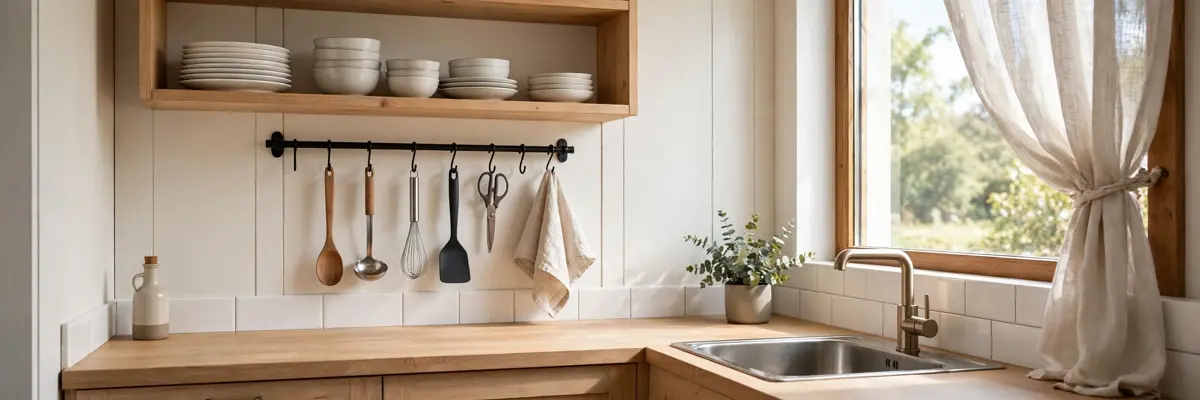

Here is the truth about small kitchen organization ideas: the matching labeled bins and rainbow container sets you see all over social media are not what make a tiny kitchen work. They look great in photos, but a kitchen that is sixty square feet of rental reality needs something far more practical. What actually transforms a cramped kitchen is a ruthless edit of what lives in the room, followed by giving every surviving item a home that matches how you really cook. I have cooked weeknight dinners in a galley kitchen so narrow that two people could not pass each other, and I have shared one with three roommates who each owned a full set of everything. The strategies below are what worked in those real kitchens, not in a showroom.
Start With a Hard Declutter: The One-Year Gadget Rule
Every small kitchen organization plan should begin with subtraction, not storage products. In a tiny kitchen, every object you keep is paying rent, and most gadgets are squatters. Pull everything out of one cabinet at a time and ask a single question of each item: have I used this in the last twelve months? The bread maker that made two loaves in 2024, the avocado slicer, the melon baller, the chipped mug collection from your college days, the fourteen spatulas you somehow own — they all fail this test.
Be honest about duplicates. If you live alone, you do not need three wooden spoons, two can openers, and a backup colander. In a roommate kitchen, do a combined audit: four people do not need four cheese graters. One survives, and the rest get donated or relocated. Renters can use the move-out test: would you pay to move this item to your next apartment? If the answer is no, it should not be occupying prime cabinet real estate today.
Sort what leaves into three piles. Donate anything in good condition, because someone else will actually use that waffle iron. Recycle or bin anything broken — cracked plastic containers with missing lids are not a storage system, they are clutter with a lid problem. The third pile is the relocation box: seasonal items like the big roasting pan you use once a year can live in a closet, on top of a wardrobe, or at a family member’s house. A small kitchen is no place for once-a-year equipment.
The payoff is immediate. Most tiny kitchens lose a third of their cabinet space to things nobody touches. Clear that out first, and the storage tricks in the next sections suddenly become twice as effective, because you are organizing thirty useful items instead of sixty random ones.
Small Kitchen Organization Ideas That Use Your Walls
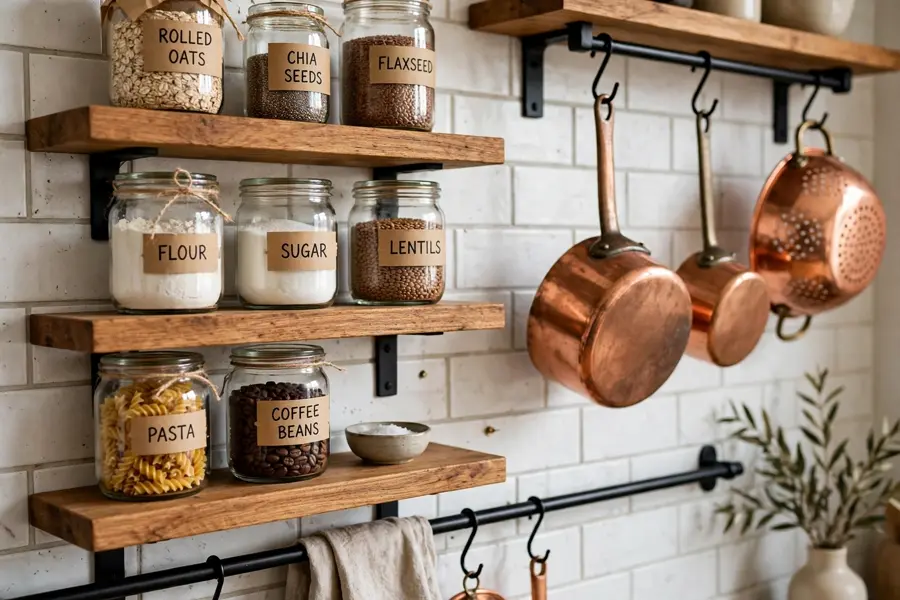
A small kitchen has one resource most people ignore: empty vertical space. Walls, the backs of doors, and the strip of wall between the counter and the upper cabinets are all storage you are not paying extra for. A wall-mounted rail with S-hooks is the single highest-impact upgrade in a tiny kitchen. Hang your everyday utensils, a couple of pans, and even mugs from it. I once freed up an entire drawer — the one that used to hold tangled spatulas and ladles — just by moving the daily-use tools onto a rail beside the stove.
The inside of cabinet doors is free real estate too. Mount a narrow rack on the door under the sink for sponges and dish soap, or stick measuring cups and spoons on the door of the cabinet nearest your prep area. A magnetic knife strip on the wall or the side of a cabinet replaces a bulky knife block that eats half a square foot of counter. If you have even eight inches of wall beside a cabinet, that is enough for a slim rail or a row of sturdy hooks.
Look up as well. A shelf mounted high over a doorway or above the upper cabinets can hold the things you reach for rarely but still need, like the holiday cookie tins or the big stockpot. Keep a small folding step stool tucked in the toe-kick space or between the fridge and the wall, and that high shelf becomes genuinely usable instead of a decoration.
The over-the-sink area deserves special attention in galley kitchens. A simple shelf or rail mounted on the wall above the sink holds dish soap, a small plant, and the scrub brushes that otherwise colonize your counter. Every item that moves off the counter and onto a wall is square footage handed back to your prep work.
Make Your Cabinets Work Twice as Hard
Once the clutter is gone, it is time to make the cabinets themselves smarter. The biggest enemy in a small kitchen cabinet is dead air: the empty ten inches above your stacked plates, the dark back corners of lower cabinets where items go to be forgotten. Shelf risers are the cheapest fix on the planet — a ten-dollar wire riser turns one shelf into two usable levels for mugs, bowls, or canned goods.
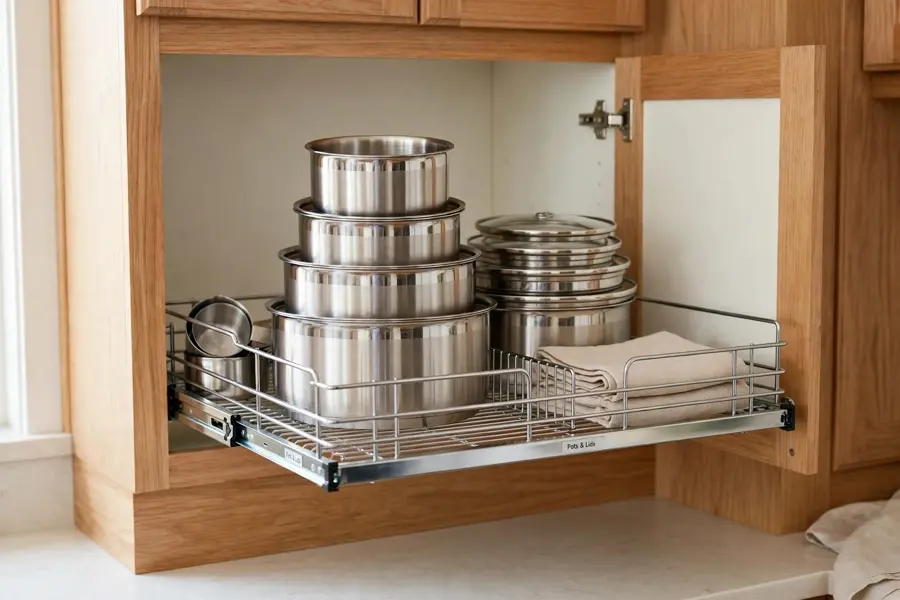
Lower cabinets need pull-outs. Reaching into a deep base cabinet on your knees, shoving aside the blender to find the food processor, is how small kitchens breed frustration. A pull-out wire organizer or even a sturdy plastic basket on a sliding track brings the entire contents of the cabinet out to you. Put your heaviest daily items — pots, the Dutch oven, mixing bowls — in the lowest, most accessible pull-out, and lighter or rarer items above and behind.
Corner cabinets are the black holes of small kitchens. A turntable, the humble lazy Susan, fixes the worst of it for spices, oils, and small jars — one spin and everything is visible. For pots and lids, a vertical lid rack mounted on the cabinet door or a simple tension-rod divider keeps lids filed upright instead of avalanching onto you. Stacking pots with a lid organizer between them protects nonstick surfaces and means you can grab the one pan you want without unstacking three others. If pots and lids are currently a war zone in your cabinets, these pot and lid storage ideas that actually work in real kitchens go much deeper on taming them.
Sheet pans, cutting boards, and baking trays should never be stacked flat — file them vertically with a simple rack or even a repurposed dish organizer. Vertical filing works for anything flat, and it turns a cabinet section that held a wobbly pile into one where you can slide out exactly the tray you need with one hand. For a full walkthrough of risers, zones, and door racks, see these kitchen cabinet organization ideas that pair well with everything in this section.
Clear Counters: The One-Corner Rule
In a small kitchen, counter space is not storage — it is your workshop. Every appliance sitting on the counter is a chunk of your prep area that no longer exists. Cooking dinner for a family in sixty square feet requires roughly two square feet of clear counter, and you cannot get that if the toaster, the coffee maker, the knife block, the fruit bowl, and the paper towel holder are all competing for it.
The one-corner rule keeps this simple: everything comes off the counters except what lives in a single designated corner. Pick one corner and make it the home base — for most people that is the coffee or tea station, since it gets used every morning. Everything else gets a cabinet home. The toaster goes in the cabinet above the counter and comes out for breakfast. The stand mixer, if you kept it through the declutter, lives on a lower shelf. It takes three seconds longer to grab, and it gives you back a foot of workspace every single day.
A few counter items earn their spot by saving space overall. An over-the-sink dish rack uses airspace instead of counter space, and it drains directly into the sink. A wall-mounted paper towel holder frees the spot where the standing roll used to live. A slim rolling cart that slides into the gap between the fridge and the counter can hold the five things you reach for while cooking, then tuck away. The goal is a counter that you could wipe clean in thirty seconds — because a counter that clear is a counter you will actually cook on. For more tactics on keeping surfaces clear, these kitchen counter organization ideas are a perfect companion to this section.
A Renter-Friendly Toolkit That Costs Less Than Takeout
You do not need to drill holes or renovate to organize a small kitchen, which matters when your landlord owns the walls. The entire renter toolkit fits in one shopping trip and costs less than a week of takeout.
Start with tension rods. A ten-dollar tension rod inside the cabinet under the sink creates a second level: cleaning bottles hang from their trigger handles on the rod while bins sit below, doubling that awkward space. Another tension rod in a deep drawer, placed vertically, becomes a divider that keeps cutting boards upright.
Command hooks and adhesive strips are the renter’s drill. They hold measuring cups inside a cabinet door, hang the dish towel where you actually reach for it, and mount a small spice rack on the side of the fridge. Over-the-door racks need no hardware at all — one on the pantry door holds wraps, foils, and plastic bags; one on the inside of a tall cabinet door holds pot lids. Stackable clear bins let you see what you have in deep cabinets, and a lazy Susan costs less than a pizza and ends the spice-avalanche problem forever.
The principle behind all of these is the same: add storage to surfaces you already have instead of buying furniture you have no floor space for. Renters who are allowed zero holes in the wall can still transform a kitchen with adhesive hooks, tension rods, and over-door racks — and take it all with them on moving day.
The Monthly 15-Minute Reset
Small kitchens drift back into chaos faster than big ones, because there is no buffer. One junk drawer fills up and suddenly it is three. The fix is a tiny recurring habit: fifteen minutes, once a month, one zone at a time. Set a timer. January is the utensil drawer, February is under the sink, March is the spice area, and so on. Fifteen focused minutes is enough to pull one zone apart, toss the expired and broken, wipe the shelf, and put back only what belongs.
Fold this into routines you already have. The monthly reset pairs naturally with a nightly kitchen reset habit — the nightly version keeps the surfaces clear, and the monthly version keeps the hidden zones honest. During each reset, re-apply the one-year rule to anything you find: the gadget you kept “just in case” six months ago and still have not touched is telling you something.
Watch the two zones that backslide fastest. Under the sink accumulates half-empty bottles and mystery sponges — keep only what you use weekly. The utensil drawer breeds duplicates and broken tools; if a drawer starts sticking, it is overfilled, not broken. A quick monthly pass on these two spots prevents the slow creep that turns an organized small kitchen back into a stressful one.
A tiny kitchen will never be a big kitchen, and that is fine — it does not need to be. It needs to be a kitchen where you can find the right pan without a excavation, chop vegetables without clearing a path first, and cook a real dinner after a long day without the room fighting you. Declutter hard, go vertical, make the cabinets earn their space, protect your counters, and reset once a month. Do those five things and your small kitchen will not just look organized — it will work hard for you every single day.