


There is a particular kind of tiredness that has nothing to do with how much you did all day. You come home, or you finally close the laptop, and instead of feeling finished, you feel scattered. The lights are too bright, the kitchen counter is covered in the evidence of dinner, your phone keeps buzzing, and your mind is still running through tomorrow. A minimalist evening routine is not about adding more tasks to that moment. It is about giving the day a clear, gentle ending, so your home and your head can both quieten down.
Most evening routines fail for a simple reason: they are too long, too strict, or built for someone else’s life. A routine that needs an hour, seven products, and perfect silence will not survive a week with children, shift work, or a small flat. The version in this article takes about thirty minutes, and on hard nights it shrinks to ten. It works because it follows the same order every night, uses what you already own, and leaves the house slightly better than it found it. No new purchases, no guilt when a night goes sideways.
Think of it as closing a shop at the end of the day. A shopkeeper does not reorganise the whole store every night. They tidy the counter, switch off the bright lights, and leave a note for the morning. Your evening can work the same way: small physical signals telling your brain that the day is done.
A good wind-down has four ingredients, and only four: a calmer home, a calmer body, a calmer mind, and a kinder start to tomorrow. If a step does not serve any of them, it does not belong in your evening, however popular it looks online. Decide in advance what your routine is not: not a second round of housework, a big decluttering project, or the time for difficult emails.
Start by choosing a wind-down time rather than a bedtime. If you want to be asleep by 10:30, your routine begins around 10:00. If you work nights or get home late, it begins whenever you get in. The clock matters far less than the sequence. After a week or two of the same order, switching on a lamp and putting the kettle on will feel restful all by itself, because your body will know what comes next. Keep the routine visible at first, a sticky note on the fridge or a short list on your phone, so a tired brain does not have to decide what to do next.
Step one: close the house, gently
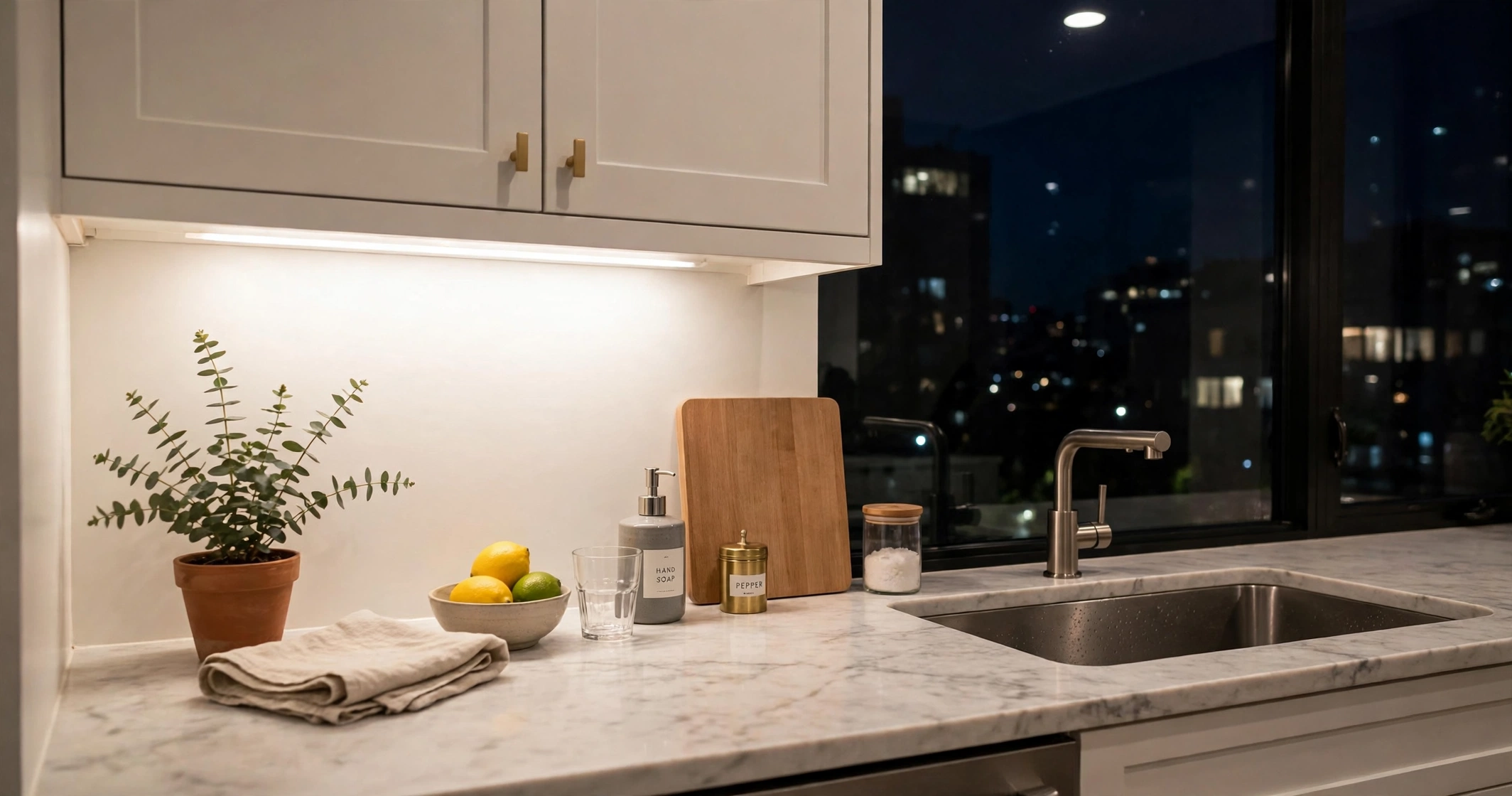
Begin with a ten-minute reset of the rooms you will see first in the morning, usually the kitchen and the living room. The goal is not perfection. It is the feeling of walking into a room that has been put to bed.
In the kitchen, do the small things that make the biggest difference: put leftovers away, load or run the dishwasher, wipe the counter once, and take out anything that will smell by morning. In the living room, fold the throw, stack the books, and clear the coffee table. If you share your home, do it together without turning it into a chore chart: one person wipes, the other tidies, and the whole thing is over before a song finishes.
Then lower the light. Switch off the overhead lights and turn on one or two warm lamps instead. Bright white light tells your body it is still daytime; soft, warm light tells it the day is winding down. If you do not have dimmers or warm-toned bulbs, a single lamp in the corner will do the job beautifully.
Finally, prepare the bedroom while you still have energy. Turn the bed down, open a window for fresh air if the weather allows, and put your phone charger where you actually want the phone to sleep. If evenings often end in a rushed tidy, a short evening reset cleaning routine can be the backbone of this step.
Step two: put the screens down, kindly
For most of us, this is the hardest step and the most important one. Screens are not the enemy. But endless scrolling, bright light, and one more video that turns into twenty are a poor way to end a day. The trick is to replace the scroll with something genuinely pleasant, not to simply forbid it and sit there feeling deprived.
Pick a screen cut-off time and make it easy to keep. Plug your phone in to charge outside the bedroom, or at least across the room, face down. If you need it as an alarm, that still works from across the room. Most messages, it turns out, are perfectly happy to wait until morning.
Then choose your replacement before the moment arrives: a paperback on the bedside table, a podcast you enjoy, or a notebook for jotting thoughts. The alternative should already be there, waiting, so you do not have to invent it while tired. The first few nights may feel strange, almost boring, but that is simply a mind finally allowed to slow down, and it passes quickly once the new habit takes hold.
If going fully screen-free feels unrealistic, try a softer version: one calming activity on a screen, brightness low, timer set. Watch one episode, not a whole season. The minimalist question is always the same: is this helping me rest, or is it just keeping me awake?
A minimalist evening routine for busy and small homes
A minimalist evening routine has to fit real life, not an ideal one. If you live in a studio flat, your reset might be one room, and that is completely fine. If you have children, it might start after bedtime stories and last only fifteen minutes. If you work shifts, your evening might be at 7 in the morning. The routine bends. The order stays the same.
- The two-minute version: clear one surface, put your keys and bag where they belong, and write tomorrow’s top three tasks on a scrap of paper. That counts, truly.
- The ten-minute version: add a quick kitchen wipe, a change into sleep clothes, and a glass of water by the bed.
- The thirty-minute version: add a warm shower, a few pages of reading, and five slow breaths before lights out.
- The shared-home version: split the reset, agree on one screen-free half hour, and keep the living room calm for everyone, not just for you.
Small homes have one hidden advantage: there is less to tidy. The danger is the opposite one, that everything is visible, so a little mess feels like a lot. The answer is the same ten-minute reset, done in one room: clear the surfaces you will see first in the morning, and leave the rest. Your home does not need to look like a photograph. It needs to feel calm enough that your shoulders drop when you walk in.
For families, build the routine around what already happens. Bath time, pyjamas, and a story are already a wind-down for children, and adults can borrow the same rhythm: warm water, soft clothes, a quiet activity, then bed. Keeping the whole home calmer in the evening is one of the simplest slow living habits for a calmer home.
Step three: warm, slow, and unhurried
Now comes the part of the evening that is actually enjoyable. A warm shower or bath, a change into soft clothes, and a warm caffeine-free drink are the classic wind-down trio for a reason. Warmth followed by cooling is a natural sleepiness signal, and the slowness of it is the point. Rushing through a relaxing routine undoes it, so give yourself permission to move at half speed.
Keep your night-time skincare or grooming simple. A minimalist bathroom shelf is a gift to your tired self: cleanser, moisturiser, toothbrush, and whatever else you genuinely use every night, and nothing else competing for attention. The fewer choices you face at 10 at night, the easier it is.

Then add one small pleasure that is only for you: a chapter of a novel, a few gentle stretches on the bedroom floor, or a cup of chamomile tea by the window. This is not a productivity task, and it does not need to improve you. It just needs to feel good. Many people skip this step because it feels indulgent, but it is the step that makes the whole routine something you look forward to, rather than another list to get through.
If your mind is busy, try a short brain dump. Take a notebook and write down everything circling in your head, without organising it: the email you forgot, the appointment to book, the worry about money. Then circle the top three things for tomorrow and close the notebook. The list will keep until morning, and your mind no longer has to hold it all night.
Step four: set tomorrow up while you are still awake
Tomorrow morning is shaped more by tonight than by any alarm. A few tiny preparations now can turn a frantic morning into a calm one, and they take almost no effort when you are already in wind-down mode.
- Lay out tomorrow’s clothes, or at least decide what you will wear, so the morning starts without a wardrobe debate.
- Put your bag, keys, and anything you need to take with you by the door.
- Check tomorrow’s first appointment, so nothing surprises you before breakfast.
- Set the coffee maker, fill the kettle, or put the breakfast bowls out, whatever makes your own mornings easier.
- Write the top three tasks for tomorrow somewhere you will see them, then stop planning.
Notice the last instruction: then stop planning. Preparation is physical and quick: clothes out, bag packed, list written. Rehearsing is mental and endless: replaying conversations, worrying about meetings, solving problems that do not exist yet. The first helps you sleep; the second keeps you awake. When you catch yourself rehearsing, write the worry down and close the notebook.
This is also where your evening routine meets your morning one. A calm night makes a calm morning possible. If you enjoy a slow start to the day, you may like pairing this routine with a minimalist morning routine that picks up where the evening leaves off. The two routines are really one rhythm, with sleep in the middle.
Keeping it going, starting tonight
No routine survives every week intact, and that is not failure. Holidays, illness, visitors, and deadlines will all interrupt it. The minimalist response is not to start again from scratch with a stricter plan. It is to return to the smallest version, the two-minute reset, and build back up when life allows.
Watch out for two common traps. The first is adding more and more steps until a thirty-minute routine grows to ninety minutes and becomes a second job. If you want to add something, take something else away. The second is all-or-nothing thinking: one missed night becomes a missed week because the routine feels broken. It is not broken. It is simply waiting for you tonight.
For the longer view, the habits that keep a home feeling effortless are rarely dramatic. They are small, repeated, and boring in the best sense of the word. These simple living habits that keep a minimalist home effortless pair naturally with an evening wind-down, because both are about doing less, but doing it on purpose.
You do not need to wait for a new year, a new home, or a calmer season of life to begin. Tonight, try just the smallest version: lower the lights, clear one surface, put the phone to charge across the room, and spend five quiet minutes with something you enjoy. That is a minimalist evening routine, already, in miniature. Over weeks, the change is quiet but real: mornings feel less frantic, and sleep comes a little easier because the body has learned the signals. Not an empty house, but a peaceful one.