
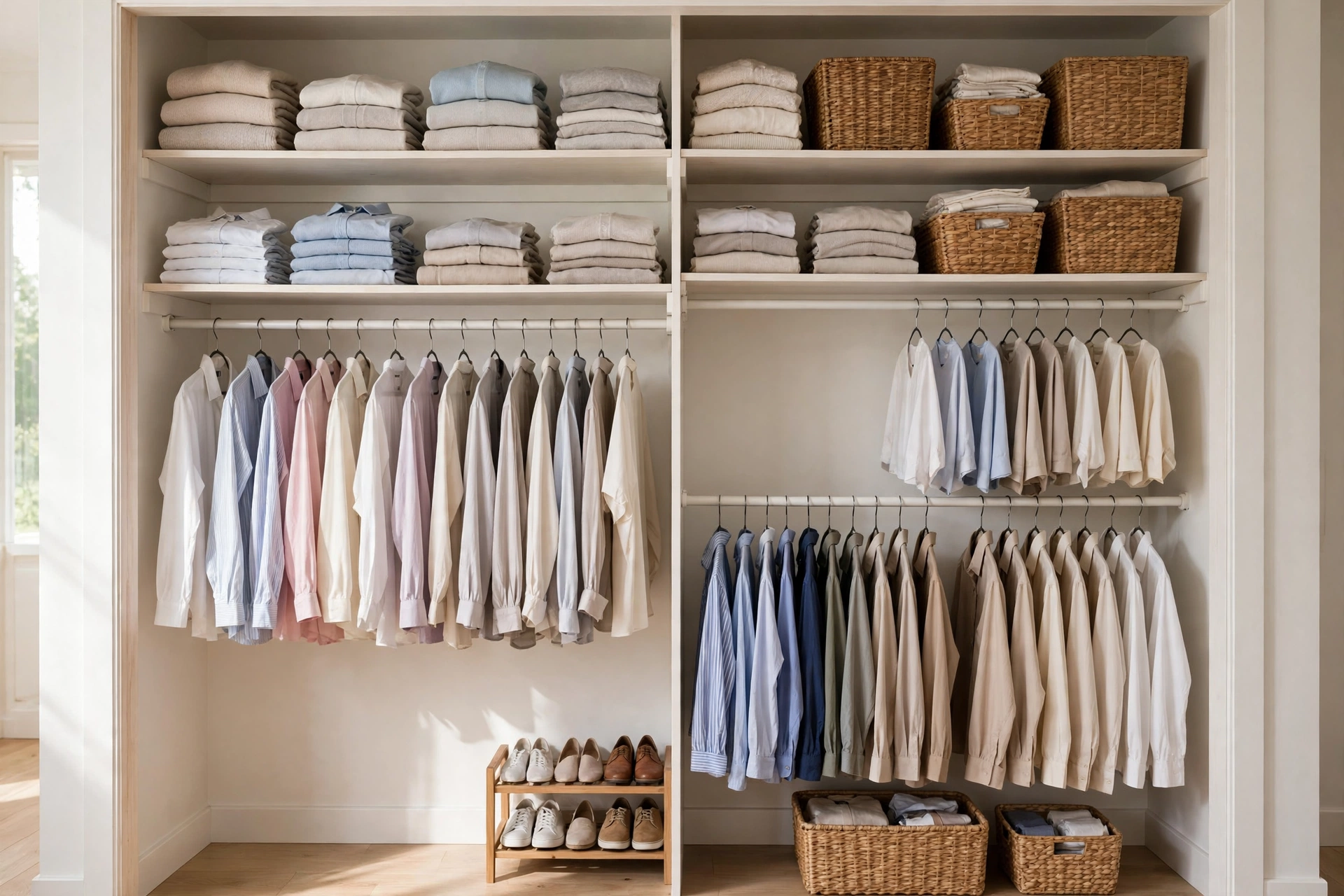

Here’s a truth nobody tells you when you move into a place with a standard reach-in closet: that five-foot-wide box with a single rod and one sad shelf is not a design flaw you have to live with. With the right reach-in closet organization ideas, that same shallow box can hold roughly twice what it holds right now — no construction, no expensive custom system, and no knocking down walls. I’ve helped friends rescue closets that looked like a laundry bomb went off, and every single time, the fix was the same handful of moves: a ruthless edit, a second rod, smarter shelves, and a plan for the spots everyone ignores.
Start With a Ruthless Edit, Not a Shopping Trip
Every closet makeover that fails does so for the same reason: someone bought beautiful organizers and then tried to organize around the clutter. Buying bins before decluttering is like buying a bigger garage for a car collection you never drive. Do the edit first.
Pull absolutely everything out. Yes, all of it — the good clothes, the “someday” clothes, the shoes with the broken strap you’ve been meaning to fix for eighteen months. Pile it on the bed and work through it in three groups:
- Keep: things you wore in the last year and would happily wear tomorrow. They fit, they’re in good shape, and they suit your actual life — not the life you imagined in January.
- Donate or sell: good-condition pieces that don’t fit, don’t flatter, or don’t match anything you own. A shirt you keep “just in case” is occupying space a favorite could be using.
- Discard or recycle: worn-out, stained, stretched, or broken beyond reasonable repair. Textile recycling programs will take most of these.
Aim to let go of at least twenty to thirty percent. That sounds like a lot until you realize how much of your closet is insurance for a personality you no longer have.
One more honest test that works wonders: turn all your hangers backward. After six months, anything still hanging backward hasn’t been worn, and out it goes. You’ll be shocked at how decisive that little trick makes you.
Double Your Hanging Space With a Second Rod
The single biggest upgrade you can make to a reach-in closet costs less than a pizza. That standard rod mounted at about sixty-six inches was designed for one layer of hanging clothes, but most of what we wear — shirts, blouses, folded trousers, skirts — only needs about forty inches of vertical space. The air below them is wasted.
Adding a second rod about forty inches below the existing one splits the closet into a short-hang section (tops and folded pants) and a full-length section for dresses and coats. In a typical five-foot-wide reach-in, this one move adds six to eight linear feet of hanging space with zero construction. You can buy an adjustable tension-style double rod kit for very little, or have a hardware store cut a simple wooden dowel and mount it on inexpensive brackets.
A few placement details that matter:
- Measure twice: mark forty inches below your top rod, then make sure shirts on the lower rod won’t drag on your shoe rack below. Forty inches for tops plus a low shoe shelf usually fits fine in a standard closet height.
- Reserve one full-length zone: don’t double-hang the entire width. Leave eighteen to twenty-four inches at one end for dresses, long coats, and jumpsuits.
- Renters, breathe easy: tension-style double rods exist that press against the side walls with no drilling, no brackets, and no deposit drama. There are plenty of renter-friendly closet organization ideas that leave zero trace behind.
The moment you hang shirts on that new lower rod and realize everything fits with room to spare, you’ll wonder why builders still install the one-rod setup in 2026.

Reach-In Closet Organization Ideas That Use Every Inch of Shelf Space
Most reach-in closets come with one shelf above the rod and about twelve inches of dead air between that shelf and whatever is stacked on it. That gap is pure wasted space — and the fix is beautifully simple.
Stackable shelf risers are the unsung heroes of small closets. They turn one shelf into two, which matters enormously when you only have two or three shelves to work with. Slide a riser onto the top shelf and suddenly your folded sweaters and jeans have a home that doesn’t involve an avalanche every time you pull out the middle one. A pack of two or three costs little and takes seconds to set up.
Clear bins for the top shelf handle everything you reach for less often — swim gear in winter, hats, spare bedding, the handbag you use for weddings. Clear matters: if you can’t see what’s inside a bin without opening it, it becomes a place where things go to be forgotten. Label them anyway, because “summer accessories” is faster to grab at 6 a.m. than squinting through plastic.
Fold in thirds, file vertically. Marie Kondo’s famous folding method earns its reputation in exactly this context. Folded items stored upright in a bin or shelf cubby — like files in a drawer — let you see every single item at once. Horizontal stacks hide everything below the top item; vertical filing means you stop buying the same black top twice because the first one was buried.
Respect the twelve-inch rule. Folded stacks taller than about twelve inches will topple. Keep stacks at six to eight items max, and if you have more of one category (yes, we all have too many t-shirts), split them across two adjacent stacks or a second bin.
And don’t forget that the shelf above the rod is prime territory for your seasonal rotation. When the weather turns, vacuum-seal your off-season bulky items and tuck them up there — a seasonal closet rotation keeps the everyday zone from drowning in coats you won’t touch for months.
Get Everything Off the Floor
The most common reach-in closet mistake is treating the floor as a storage shelf. Once shoes, bins, and bags start piling up down there, the closet stops functioning and starts collecting. Nothing kills the “I can find my clothes” feeling faster than a floor you can’t see.
A low, two-tier shoe rack is the single highest-impact floor fix. It lifts your everyday pairs off the ground, keeps them visible, and reclaims the floor space they were sprawling across. Line pairs heel-to-toe on angled shelves if you want to fit more, and keep a strict one-in-one-out rule for shoes — a new pair comes home, an old pair goes to donation. For deeper shoe collections or awkward spaces, you’ll find more approaches in our guide to shoe organization ideas for small closets.
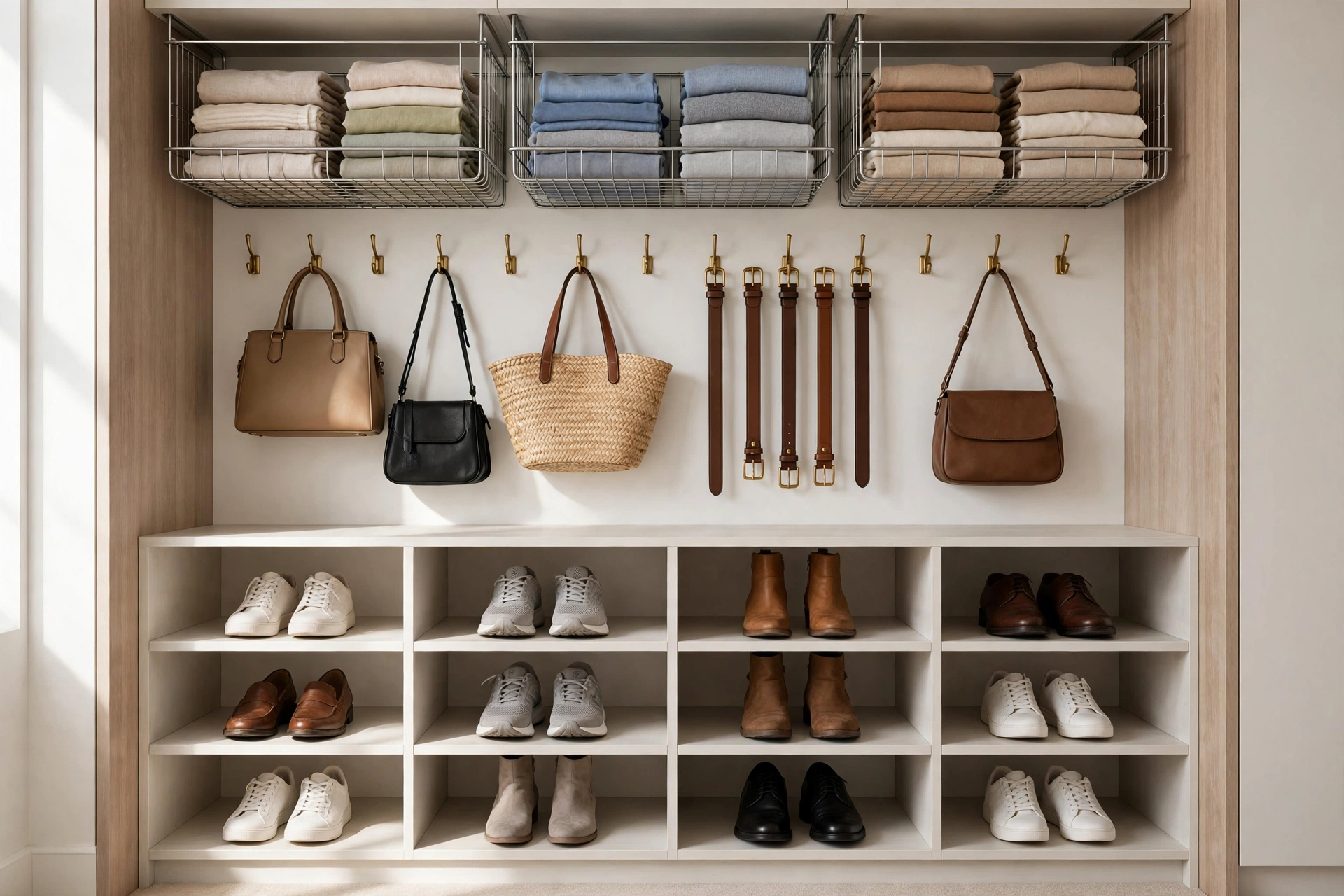
Bulky bags and backpacks don’t belong on the floor either. Hang your daily bag on a sturdy hook inside the closet — you’ll grab it on the way out and never hunt for it again. Gym bags and totes can hang from the side wall, and luggage slides flat against the wall above the shoe rack or up on the top shelf.
If you have a hamper living in your closet, give it a defined parking spot — the corner opposite the door swing — so it doesn’t migrate into the middle of the floor every laundry day.
Steal the Forgotten Spots: Doors, Walls, and That Top Shelf
Reach-in closets have more storage than they advertise. The trick is looking at the surfaces everyone ignores.
The back of the door is free real estate. An over-the-door rack can hold a dozen pairs of shoes, tomorrow’s outfit, or a full season of accessories without eating a single inch of interior space. This works beautifully on hinged doors; if you have sliding or bifold doors, the side walls are your backup plan. Hang tomorrow’s outfit on a door hook the night before and your mornings get noticeably calmer — decision fatigue is real, and it starts at 6:45 a.m.
Side walls that sit bare can suddenly hold a lot. A few well-placed hooks turn a blank strip of wall into an accessory center for handbags, belts, hats, and scarves. Our closet accessory organization guide walks through turning belts, scarves, and bags into a visible, grab-and-go display instead of a tangled pile. The key is mounting hooks where they’re easy to reach but not where they’ll snag hanging clothes — the upper corners of the side walls are usually the sweet spot.
The very top shelf — the one you need a step stool to reach — is your deep-storage vault. This is where luggage, memory boxes, out-of-season bedding, and the formalwear you wear twice a year belong. Use matching bins so it looks intentional rather than like an attic threw up in your bedroom. Because you’ll only visit this shelf a few times a year, “out of sight” is a feature, not a bug.
Add light while you’re at it. A dark closet is a messy closet — if you can’t see what’s in the back, items get lost, forgotten, or buried. Battery-powered motion-sensor LED strips or puck lights cost very little, stick on in minutes with adhesive backing, and make a reach-in feel dramatically larger and more luxurious. You’ll actually use the back of the closet once you can see it.
Keep It Organized With a 10-Minute Weekly Reset
Here’s the part nobody wants to hear: organization systems don’t maintain themselves. The good news is that a reach-in closet, properly set up, needs almost no maintenance — about ten minutes a week.
Pick a day. Sunday evening works for most people, right before the week starts. Set a timer and do these four things:
- Rehang strays: anything draped over the rod, the door, or the hamper edge goes back to its proper home.
- Refold the casualties: restack any folded piles that collapsed during the week. This takes two minutes if you do it weekly and twenty if you wait a month.
- Check the floor: shoes back on the rack, bags back on hooks, hamper back in its corner. The floor-visible test from earlier applies every week.
- Scan for exits: anything you noticed all week that you don’t actually wear anymore goes straight into a donation bag kept on the top shelf. When the bag’s full, it leaves the house.
That donation bag is the secret weapon of people whose closets stay tidy year after year. Instead of saving decluttering for one exhausting annual purge, you make tiny exit decisions continuously. Clutter never gets a chance to build up because the exit is always open.
If you share the closet with a partner, split it visibly — left and right, or top and bottom — and each of you owns your zone’s weekly reset. Shared closets only turn chaotic when ownership is fuzzy. When each person has a defined space, accountability takes care of itself, and the “who left this here” arguments quietly disappear.
Your closet is bigger than you think. A reach-in closet feels small because of how it’s laid out, not because of how much space it actually contains. The single rod, the wasted shelf gap, the cluttered floor, the ignored door — each one quietly steals square footage that was yours all along. Take them back one at a time: edit ruthlessly, double the rod, fill the vertical gaps, clear the floor, claim the forgotten spots, and protect it all with a ten-minute weekly reset.
Start this weekend with the edit — it’s the only step that costs nothing and makes every step after it easier.
[…] you are working with a smaller space, you will find plenty of ideas that scale down well in these reach-in closet organization ideas, which focus on making narrow shelves and tight corners genuinely […]