
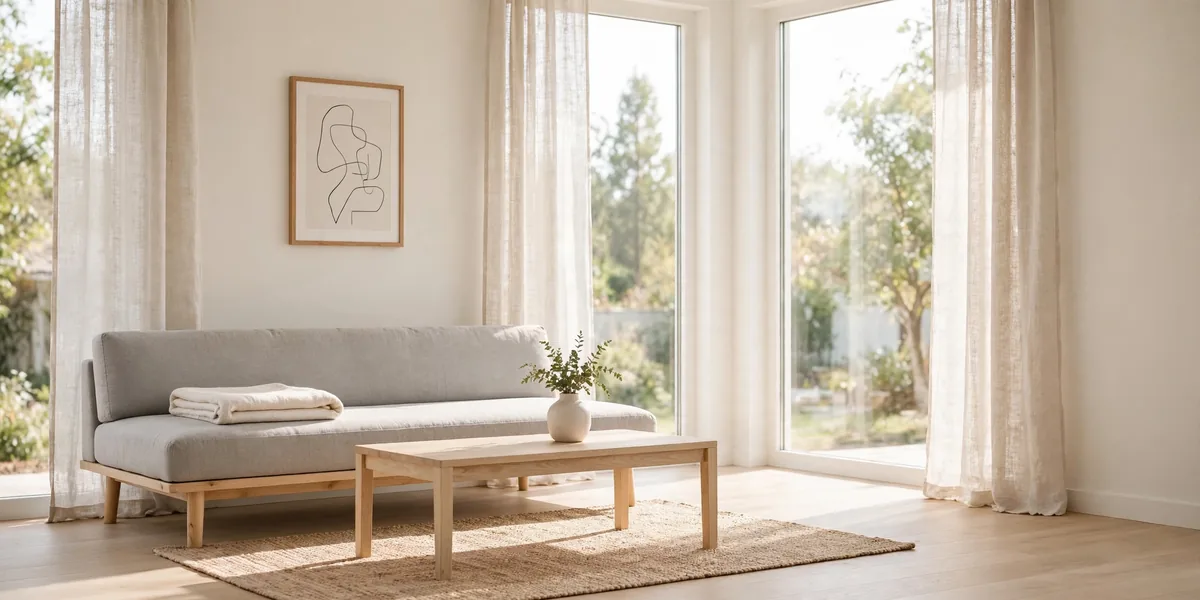

Here’s what nobody tells you about minimalist home decor ideas: they almost never start at the store. They start with the junk drawer you keep avoiding, the sideboard that’s really a graveyard for unopened mail, and that chair in the bedroom — you know the one — where clean clothes go to wait. Minimalism isn’t a shopping style. It’s an editing style. And once you get that, decorating a calm home becomes less about what you buy and more about what you let go of. These minimalist home decor ideas come from real homes and real mistakes, including a living room I once “styled” that my sister walked into and described as “waiting-room chic.” We can do better than that.
My own turning point came the winter our heating bill spiked and I spent a Saturday decluttering the living room instead of going out. By Sunday evening, nothing in the room was new — I’d bought absolutely nothing — yet the place felt twice as big and oddly peaceful. My kids noticed first. My seven-year-old flopped onto the sofa and said, “It smells like a hotel.” That’s the honest truth about minimalist home decor: the calm you’re buying is actually the calm you’re uncovering.
Minimalist Home Decor Starts With Subtracting, Not Adding
The biggest mistake people make with minimalist home decor ideas is treating them like a shopping list. You cannot buy your way to empty space. Every decor object you bring home is a small negotiation with your future self: you will dust it, move it, and one day decide whether to keep it. So before a single new cushion enters your home, do the subtraction round.
Pick one room and remove everything from it that doesn’t serve a function or genuinely delight you. Don’t reorganize. Don’t “style” around the clutter. Pull it out. You’ll know within minutes which pieces mattered — the lamp you read under every evening, the armchair your partner naps in — and which were just filling square footage. This is the same discipline behind the rule of one: when you see your duplicates side by side, the keepers announce themselves.
Then comes the part people resist: live with the emptier room for a week before buying anything. That bare wall you immediately want to fill? Sit with it. Half the time you discover the wall was fine, and what was missing wasn’t decor — it was breathing room. I lived with an empty corner of my living room for three weeks before realizing it was perfect as the spot where my daughter does her reading. The room gained a purpose; I lost a shopping impulse.
- Empty every surface completely, then return only what you use daily or love deeply.
- Photograph the bare room — the photo shows you what your eye stopped seeing.
- Box up “maybe” items for 30 days; whatever you don’t open leaves.
- Wait one full week before buying anything new for the space.
If you’re bracing for the empty feeling, remember that minimalism is a clutter-free home you actually maintain, not a showroom you visit. The habits matter more than the furniture.
Build a Warm Minimalist Color Palette (2–3 Shades, Never More)
Minimalist rooms live or die by color. Too many shades and the room looks busy no matter how few objects are in it. The fix is almost embarrassingly simple: pick two to three warm neutrals and let them do all the heavy lifting. Warm white, soft beige, and light grey cover about ninety percent of what you’ll ever need. Greige — that grey-beige hybrid — is the unsung hero of calm homes because it goes warm or cool depending on the light.
The warmth part is non-negotiable. I once painted a spare room a crisp gallery white because the photos online looked so clean. In person, with our northern-facing windows, it felt like a dentist’s office. One tin of warm white later, the same room felt like morning. Undertones matter more than the paint chip suggests, so always test a large swatch and watch it through a full day — morning blue-grey, noon bright, evening amber. A color that behaves through all three is a keeper.
Keep your palette connected across rooms, too. A house where the living room is warm beige, the bedroom dusty sage, and the hallway cold grey feels visually noisy even when every room is technically minimal. You don’t need one color everywhere — just colors that could be neighbors. When every room shares the same two or three base tones, the whole home exhales. Accent colors are fine, but limit them to one small dose per room: a terracotta pot, a deep navy cushion, a single olive throw. One whisper of color, not a conversation.
Furniture That Earns Its Floor Space
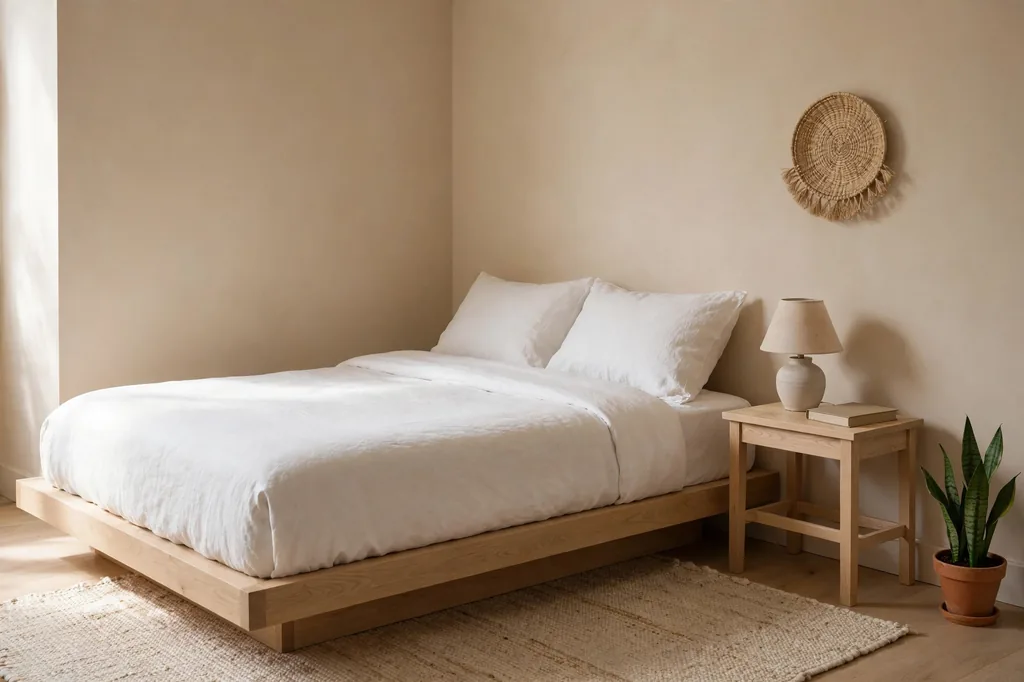
Here’s the honest math of minimalist decorating: every piece of furniture rents space from you, and the rent is paid in visual weight, cleaning time, and the nagging feeling that a room is “done.” A bulky recliner in a small living room costs you all three at once. So choose pieces that fit the room instead of dominating it — sofas with exposed legs that let the eye travel under them, coffee tables with slim profiles, storage ottomans that swallow the board games and the guilt in one lid.
The single most useful question to ask before any furniture purchase is: “What does this do that nothing else in this room does?” If you can’t answer in one sentence, you don’t need it. Your living room needs a comfortable seat, a place for drinks and books within reach, and adequate light. That’s it. Everything beyond that list is a candidate, not a requirement. Multi-functional pieces pull double shifts — a daybed that hosts guests, nesting tables that expand when friends come over — and they keep your floor plan honest.
Also respect the invisible furniture: empty space. Designers aim for at least a quarter of any room to be clear — walking paths, bare wall, an uncluttered corner. Negative space isn’t wasted space; it’s the pause that makes everything else look intentional. Leave the area around your favorite chair empty and suddenly the chair looks like a destination instead of inventory. Measure twice, buy once, and leave room for the room to breathe.
Texture Is the Secret Ingredient of Minimalist Home Decor
This is the difference between minimalist home decor that feels serene and minimalist home decor that feels sterile: texture. When you remove objects, your senses go looking for interest somewhere, and texture is where they find it. A bare room in flat white looks cold; the same room in warm white with a chunky knit throw, a nubby jute rug, and matte ceramic pots feels like a hug.
The trick is layering textures without adding objects. Swap pillow covers instead of buying pillows — a linen case, a boucle one, a cotton weave — and you’ve changed the whole sofa’s mood for the price of lunch. Drape one wool throw over the armchair instead of three folded blankets on every surface. Choose a natural fiber rug over hard floors; it softens sound, grounds the furniture, and makes bare feet happy. Wooden tones do quiet work too: one oak coffee table and a walnut picture frame add more warmth than five knick-knacks ever could.
- Linen and cotton for curtains and cushion covers — soft, breathable, never fussy.
- Jute, sisal, or wool for rugs — natural fibers age beautifully and hide crumbs.
- Matte ceramic, raw wood, and rattan for small objects — warmth without shine.
- One chunky knit throw per living space — cozy, and it photographs well too.
Limit yourself to a handful of textures per room and repeat them. The repetition is what makes a minimal room feel designed rather than accidental — linen appears on the cushions and the curtains, oak on the table and the shelf, ceramic in the vase and the plant pot. Three textures, echoed around the room, reads as calm. Ten textures reads as a craft fair.
Lighting and Greenery: The Two Decor Pieces That Do the Most Work
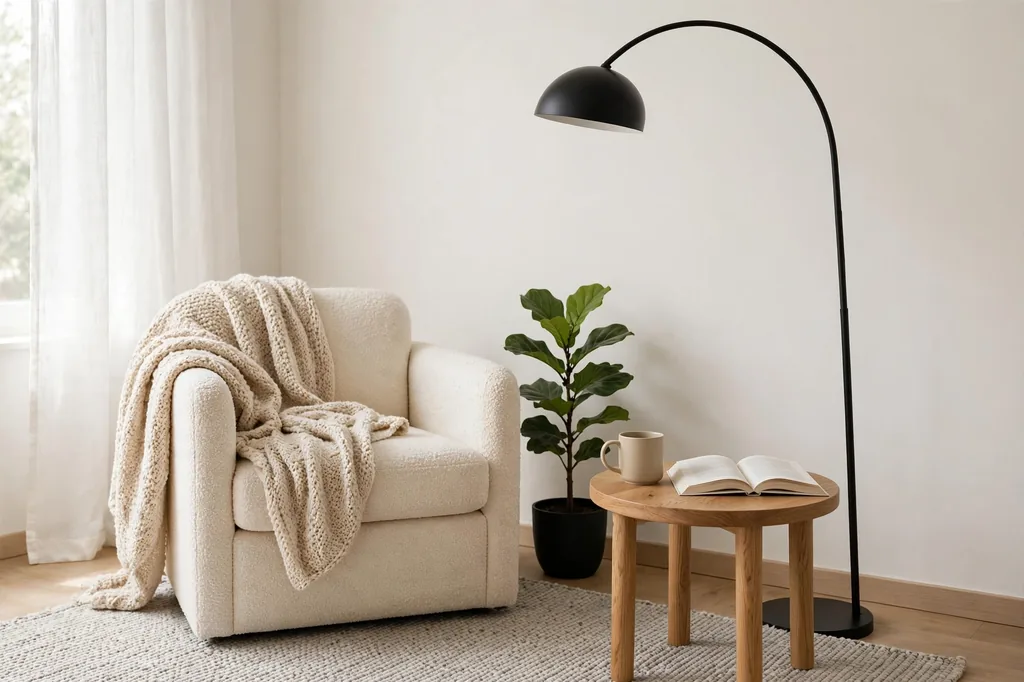
If I could keep only two decorative elements in my home, it would be good lighting and one good plant. Everything else is negotiable. Harsh overhead light can make even a beautifully minimal room feel like an office after hours, while layered light turns the same room into the place everyone gravitates to after dinner. Swap the single ceiling fixture for three layers: a dimmable floor lamp for evenings, a small task light where you read, and daylight doing the daytime work through sheer linen curtains.
Watch what light does in your rooms before you buy a single lamp. Notice which corner goes golden at five o’clock and which wall catches the morning sun — then place your reading chair and your plant where the light already wants to be. Candles and fairy lights aren’t just for December; one candle on a dark windowsill in October does more for a room’s mood than an entire shelf of decor. And never underestimate the power of dimmer switches. They’re the cheapest renovation in existence.
As for greenery: one large plant beats five small ones every time. A fiddle leaf fig or a tall snake plant in a matte pot becomes a piece of furniture — it fills vertical space, cleans the air, and costs nothing to look at. Clustered small pots read as clutter; one confident plant reads as design. If you’ve killed every plant you’ve ever owned, start with a ZZ plant or a pothos. They’re the kindest plants on earth, forgiving missed waterings and low light with equal grace.
Keep It That Way: Small Habits That Protect Your Calm Home
Here’s the part the Pinterest boards skip: a minimal home is maintained, not achieved. The most beautiful minimalist rooms I’ve visited belong to people with boring little habits, not big budgets. The one-in-one-out rule is the backbone — when a new mug enters, an old one leaves. It sounds strict until you realize it’s the reason their cabinets always close easily.
A five-minute evening reset does the rest. Before bed, return everything to its home: cushions fluffed, throw folded, remote on the tray, dishes in the dishwasher. In the morning you wake up to the calm room instead of yesterday’s entropy. If you’re trying this while the rest of the household thinks minimalism is a fad, try a no-buy month together — it resets everyone’s shopping reflex at once, and it’s surprisingly fun as a family challenge. My kids turned ours into a game: who could spot the most ads trying to sell us things we didn’t want.
Finally, give every object a home, even the tiny ones. Keys on the hook by the door, chargers in one basket, mail in one tray that’s emptied weekly. When everything has a place, putting things away takes seconds instead of decisions — and a minimal home stays minimal because tidy is the path of least resistance. Calm isn’t a destination you decorate once; it’s a rhythm you keep.
A Calmer Home Is Closer Than You Think
Minimalist home decor isn’t about owning less for the sake of it, and it definitely isn’t about a white box with one chair. It’s about making every choice in your home intentional — the color that greets you in the morning, the chair that holds you at the end of the day, the empty corner where your kid reads undisturbed. You don’t need a big budget or a big house. You need the willingness to subtract first, a warm palette, texture instead of trinkets, good light, one good plant, and a few quiet habits. Start this weekend with a single room and one empty box. I’d bet your home already has everything it needs to feel calm — it’s just been hiding under the stuff.