
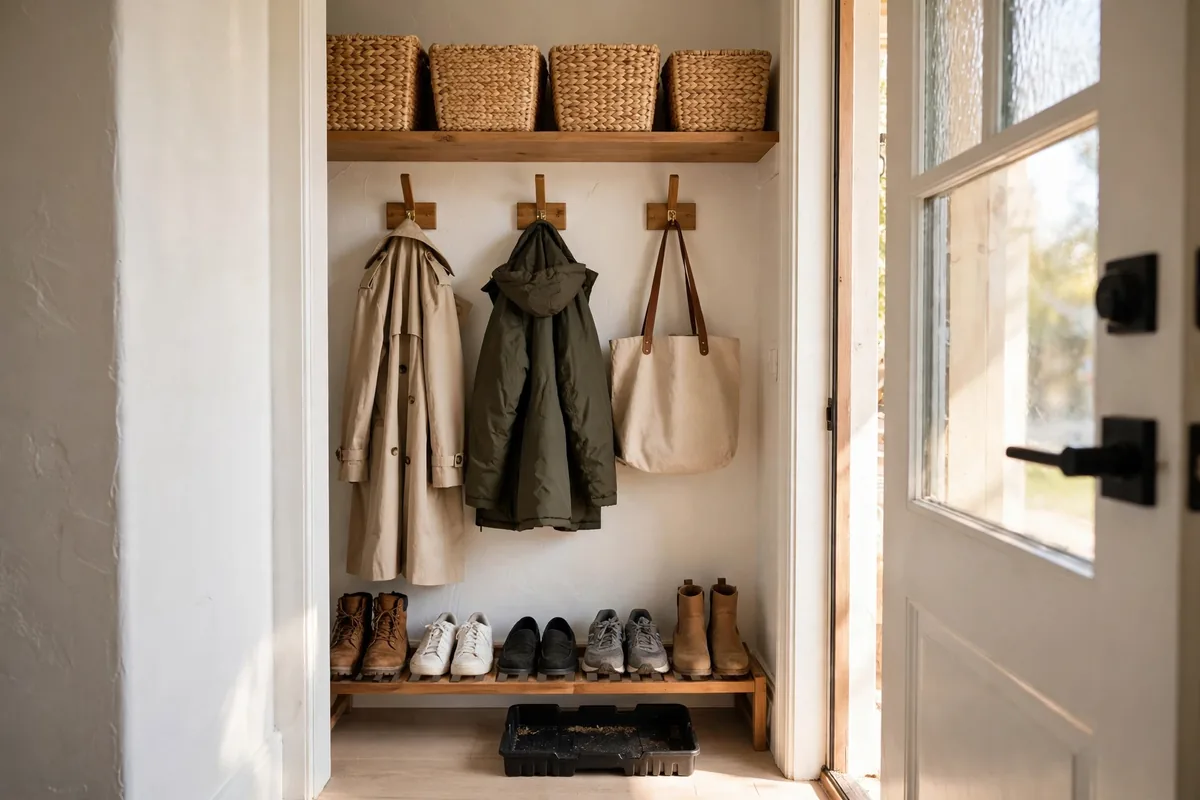

These hallway closet organization ideas were born on a rainy Tuesday in November, when I walked through my front door and found three coats draped over the stair rail, four shoes scattered like dropped breadcrumbs, an umbrella bleeding water onto the doormat, and my husband’s gym bag claiming the entire hallway for itself. The actual closet — three steps from the door — stood half empty. That’s when it finally clicked: we didn’t have a space problem. We had a system problem. Nothing inside that closet had a clear job to do, so everything that crossed the threshold just landed wherever gravity took it.
A hallway closet is a different animal from a bedroom closet or a seasonal coat closet. It’s a landing spot. Coats, shoes, bags, dog leashes, keys, the school backpack your daughter abandons the second she’s inside, the umbrella you swear you’ll remember to take back — this is the stuff of daily life, cycling in and out ten times a day. When a hallway closet works, you barely notice it. When it doesn’t, it sets the tone for your whole house in the first five seconds you walk in. The ideas below come from organizing my own narrow hallway closet — thirty inches deep, shared by a family of four and a very opinionated beagle. Nothing here requires a renovation or a big budget, just a Saturday afternoon and some honest decisions about what actually lives by your front door.
Hallway Closet Organization Ideas Start With the Great Empty-Out
You cannot organize a hallway closet while everything is still in it. Pull it all out — every coat, shoe, bag, scarf, and mysterious single glove — and pile it on the hallway floor where you can see it. Yes, it will look worse before it looks better. That’s the point. Most people are genuinely shocked by how much has migrated into this one closet. In ours, I found six coats for four people, eleven pairs of shoes, three umbrellas (one broken), two bike helmets, and a candle warmer someone gave me in 2019 that I never unboxed.
Sort the pile into four groups: daily use (worn at least three times a week), seasonal (used but not right now), belongs elsewhere (tools, candle warmers, Halloween capes), and leave the house (worn out, never worn, donations). Be ruthless with group four. A hallway closet earns its keep on turnover, not storage capacity — every inch given to a coat nobody wears is an inch stolen from the backpack your kid drops every afternoon at four. If the front door area outside the closet is part of the chaos too, it helps to declutter the entryway first so you’re designing for a calm space, not working around a mess.
One rule that saved my sanity: seasonal items don’t live in the hallway closet. They visit. Winter coats, heavy boots, beach bags — they get a dedicated bin in a bedroom closet or the top shelf of the hall closet, clearly labeled. When the season turns, you swap. This single habit cuts hallway closet volume by a third in most families, and the swap takes twenty minutes twice a year.
Give Every Person a Zone — Not Every Item a Rule
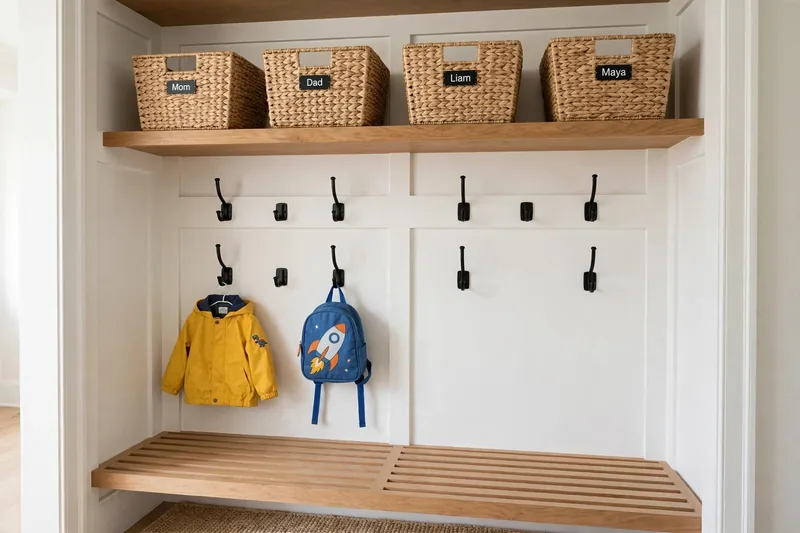
Here’s the mistake most organized-looking closets make: they’re arranged by item type. All the coats together, all the shoes together, all the bags together. That works in a catalog. In a real house with kids, it collapses by Thursday. What actually holds up is zoning by person. Give every member of the household — yes, including the toddler — their own vertical slice of the closet.
Each zone gets exactly three things: one or two hooks at the person’s height, one labeled basket or bin, and a defined shoe spot on the floor below. That’s it. When my eight-year-old comes home, she doesn’t have to decide where anything goes. Her pink basket swallows the gloves, hat, and library books. Her hook takes the school bag. Her shoes go under her basket. The whole landing sequence takes eleven seconds, and she can do it without me saying a word — which, if you have kids, you know is the actual miracle here.
- Adults: hooks at 60 to 66 inches, baskets for sunglasses, work badges, and spare tote bags.
- Kids: hooks at 38 to 44 inches so they can genuinely reach them, baskets labeled with a picture label if they can’t read yet.
- The guest zone: reserve one hook and a small empty basket, even if you rarely have visitors. Guests notice instantly whether your home has a place for them, and a visible empty spot says “you’re welcome here” better than any welcome mat.
- The pet zone: one low hook for the leash, a small basket for poop bags and treats. The beagle has her own zone now, and somehow the hallway got calmer.
Zone-by-person works because it removes every micro-decision. Nobody stands in the hallway holding a scarf wondering where scarves live. The scarf lives in your basket. Done. For families sharing tight closets, pairing this with renter-friendly storage solutions (no-drill hooks, tension rods, adhesive caddies) means you can set the whole system up in an afternoon without touching the landlord’s paint.
Hooks, Rods, and the Two-Inch Rule
If a hallway closet could talk, it would beg for better hooks. Standard wire hooks — the kind landlords install, rated for a light jacket and nothing else — are the number one reason coats slide off and end up on the stairs. Replace them with solid wood or metal hooks rated for at least fifteen pounds each. Double hooks are even better: the coat goes on the lower arm, the bag or tomorrow’s gym kit on the upper. Two items, one footprint, zero clutter.
The two-inch rule is simple: no two hanging items should be more than two inches apart at any time. If there’s a gap, you’ve got room to breathe and you probably don’t need to add anything. If coats are jammed so tight you have to wrestle one free, something needs to leave the closet — and it’s usually last season’s jacket, not today’s raincoat. This rule doubles as your built-in overflow alarm. When the spacing breaks down, that’s the closet telling you it’s time for a ten-minute edit, not a bigger closet.
Don’t forget the back of the door. It’s the most underused square footage in any home. A slim over-the-door organizer holds scarves, hats, spare masks, and the sunscreen you forget every summer — all off the walls and shelves, all instantly visible. I’ve got a shortlist of setups that work in tiny closets in our over-the-door storage ideas guide, because door-mounted storage behaves differently in a 24-inch closet than in a walk-in. And if your closet has a single sad rod, consider adding a second lower rod: tops on one level, kids’ jackets or folded bins on the other. Slim velvet hangers save another surprising chunk of space — swapping bulky plastic hangers bought back nearly four inches of rod in ours.
The Floor Is for Shoes — and Nothing Else
Be honest: what’s on your hallway closet floor right now? In most houses I visit, it’s a landfill. Bags stacked on shoes stacked on wrapping paper stacked on the vacuum attachments. The fix is blunt: the floor of a hallway closet holds shoes and nothing else. Everything else — bags, sports gear, cleaning supplies — lives on a hook, in a basket, or on a shelf. The floor stays visible, which means it stays clean, which means you actually put your shoes away instead of kicking them into a pile.
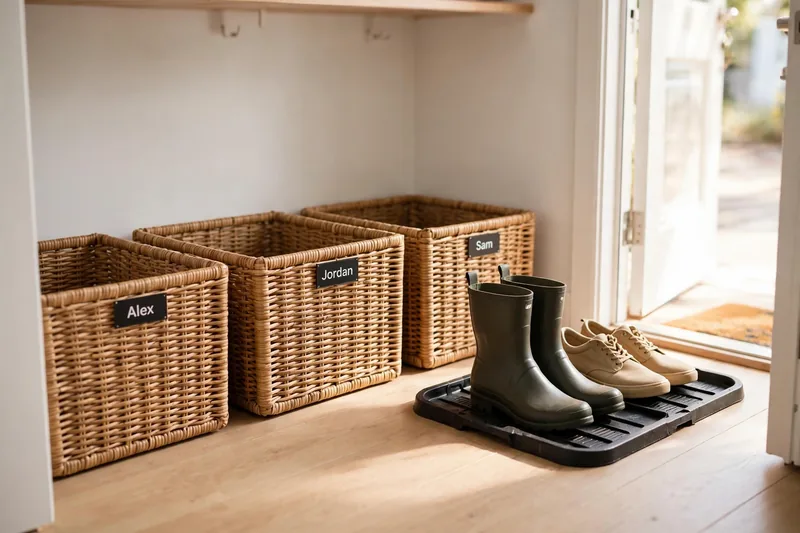
Give each person a shoe quota and hold it. For a family closet, one everyday pair plus one weather pair per person is the realistic maximum. Current-season overflow (the kids’ rain boots, your winter boots in February) goes in labeled baskets on the lowest shelf or a shallow under-shelf bin. A low boot tray at the back catches wet-weather runoff and keeps mud off the floor — during umbrella season, ours earns its keep daily. Small rubber mats or a washable rug strip work too, and they take thirty seconds to rinse in the tub.
- One basket per person on the floor keeps pairs from migrating and mixing — no more hunting for the matching shoe at 8:15 in the morning.
- Heels-up pairing (toe of one shoe to heel of the other) fits about a third more pairs in the same basket.
- A “too tight” test: if you can’t slide a hand between the baskets, you’re over capacity. Move a pair out.
If shoes are the category that keeps winning the war in your house, the dedicated shoe organization ideas for small closets guide goes deeper on racks, tilt-out cabinets, and how to handle the great kids’-shoe multiplication problem. But honestly, the quota plus the baskets solves it for nine out of ten families.
Umbrella Season and the Wet-Weather Kit
Every hallway closet in a climate with real weather needs a wet-weather kit, and almost nobody has one. I’m talking about a compact umbrella stand or a tall narrow basket lined with a plastic liner, one absorbent doormat or tray, and a dedicated “drying hook” — a hook near the closet’s edge where a damp coat or a wet dog towel hangs for an hour before going to its real home. Wet things put away wet become mildew things. Wet things given sixty minutes on a drying hook become dry things.
Keep the kit stocked seasonally: in spring, umbrellas and light rain shells; in winter, swap in spare gloves and a lint roller for the salt-stained coat hems.
One caution: don’t store umbrellas in the basket you’re reaching past daily if the basket is deep. Deep umbrella stands swallow the small folding umbrella every time. A short, wide stand or a basket with a divider keeps the one you actually grab visible. And if an umbrella breaks, throw it out the same day. Broken umbrellas have a way of living in hallway closets for three years, taking up space and silently judging you.
Keep It Running With a Five-Minute Evening Reset
The best hallway closet organization ideas in the world fail without maintenance, but maintenance doesn’t have to mean a monthly overhaul. It means a five-minute evening reset. While dinner’s in the oven or the kettle boils, walk to the closet and do four things: hang up anything that fell or got draped, return stray items to their owner’s basket, kick shoes back into their baskets, and glance at the two-inch rule. That’s the whole ritual. Five minutes, once a day, and the closet never reaches the critical mass that makes you want to close the door and pretend it doesn’t exist.
Twice a year, do the mini version of the Great Empty-Out: pull the seasonal bin down, swap what’s current, and toss the donations in your “leave the house” bag into the car. I keep a small donation bag hanging inside the closet door year-round. When it’s full, it goes.
Finally, give yourself grace on the weeks it falls apart. A sick kid, a houseguest, a project deadline — life happens, and closets are the first casualty. The difference between an organized hallway closet and a chaotic one isn’t perfection. It’s that the organized one has a system you can restore in five minutes instead of a mystery you need a weekend to solve.
Your hallway closet is the first thing that greets you and the last thing you touch before you leave. Start with the empty-out this weekend, set up zones, install hooks that can actually hold things, and try the five-minute reset for a week. You might be surprised how much calmer the whole house feels when the first five seconds of coming home are smooth.