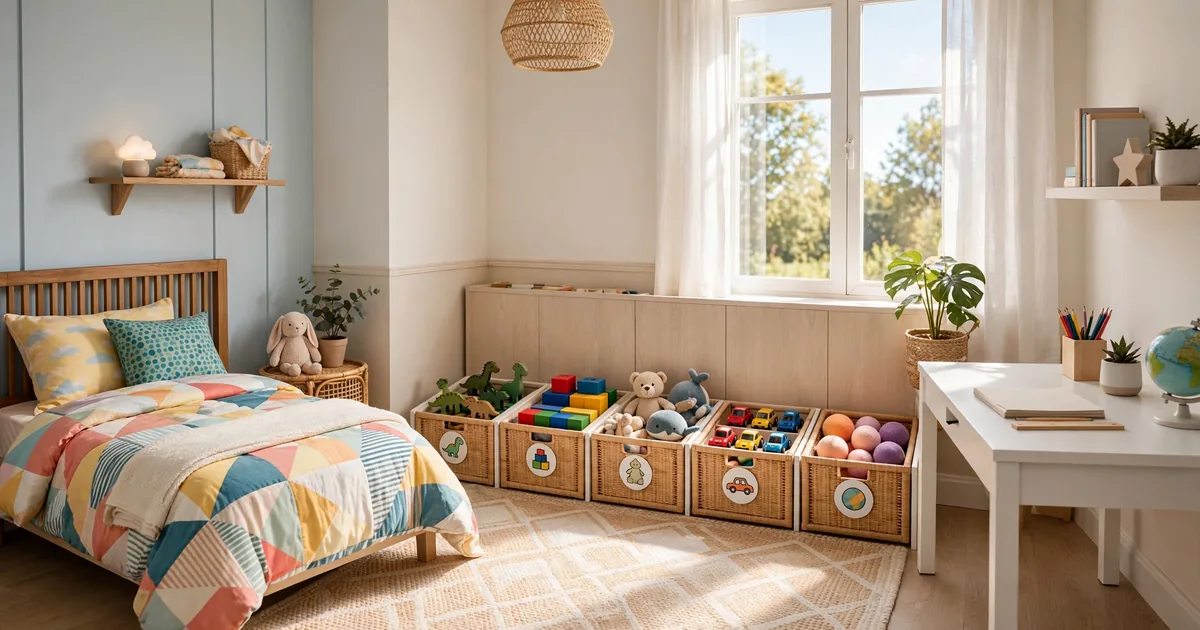

Walk into almost any kid’s bedroom on a random Tuesday afternoon and you’ll see the same scene: LEGO pieces under the bed, clean shirts mixed with dirty ones on the dresser, a stuffed-animal avalanche in the corner, and that one mysterious sock nobody can explain. If this sounds like your house, you’re not doing anything wrong. These kids bedroom organization ideas work because they’re built around how children actually think — not how adults wish they thought.
Here’s what most guides skip: kids don’t fail at organizing because they’re lazy. They fail because the system was designed for an adult body — shelves they can’t reach, bins without labels, and a “home” for things that was never actually defined. Build a bedroom that makes sense to a seven-year-old, and the daily tornado gets dramatically smaller.
This guide gives you a realistic plan: the reset that clears the chaos, the zone system that stops it returning, storage your kids will actually use, and a five-minute routine that keeps it working on school nights.
Why Most Kids’ Bedrooms Fall Apart (It’s Not Your Fault)
Before you buy a single bin, it helps to understand what’s actually going wrong. A kids’ bedroom usually fails in three predictable ways, and none of them are about your parenting.
Problem one: everything is mixed together. The room is one big undifferentiated space, so toys migrate into the reading corner, school papers land on the play rug, and clothes get draped over anything horizontal. When nothing has a defined home, “clean up” is a meaningless instruction to a child.
Problem two: storage requires adult effort. Tall shelves, lids that need two hands, drawers that stick, tiny compartments that need careful folding — every friction point is a reason for your kid to drop things on the floor instead. Children choose the path of least resistance every single time. Good organization means making the tidy choice the easiest choice.
Problem three: there’s simply too much stuff. Birthday hauls, party favors, hand-me-downs, fast-food toys, the thing they begged for and touched once. The average kid’s bedroom holds far more than the room’s storage was ever designed to hold. No system survives that, which is why the reset comes before the organizing.
The 3-Step Reset: Declutter Before You Organize
The best kids bedroom organization ideas all start the same way — with less stuff. Trying to organize a room that’s bursting at the seams is like rearranging deck chairs; it looks better for a day and then collapses again. Block out a Saturday morning, put on some music, and work through these three steps together.
Step 1: Pull everything out by category. Don’t go drawer by drawer — that just shuffles clutter around. Gather all the stuffed animals in one pile, all the books in another, all the art supplies in a third. Seeing twenty-three stuffed animals in one heap makes the scale of the problem obvious in a way that opening one drawer never will.
Step 2: Sort with your child using three boxes. Label them Keep, Donate, and Toss. Your child makes the call on each item — a system imposed on a kid who wasn’t included will be quietly sabotaged by week two. Ground rules: anything broken goes in Toss, anything they can’t remember owning goes in Donate, and a “maybe box” sealed for two weeks — if they don’t ask for it, it goes. If toys are the main mountain, our guide to decluttering kids’ toys walks through the process with scripts for the hard conversations.
Step 3: Clean the empty room. This sounds optional and it isn’t. An emptied bedroom is the only time you can dust the baseboards and vacuum under the bed — and it gives you a blank canvas to organize the room you actually have.
Divide the Room Into Zones (The Real Game-Changer)
Zones are the single most effective kids bedroom organization idea, and they’re free. The concept is simple: split the room into 3–4 areas based on what happens there — a sleep zone, a play zone, a learning zone, and a clothing zone. Everything in the room belongs to exactly one zone, and cleanup means “return things to their zone” instead of the overwhelming “clean your room.”
Here’s what each zone needs:
- Sleep zone: Bed, nightstand with a lamp, and almost nothing else. Keep this area calm and clutter-free on purpose — a serene bed area actually helps kids wind down. A small basket for the current bedtime book is fine; a toy shelf is not.
- Play zone: A washable rug, low open bins for the current toy rotation, and a small table if there’s room. This is where the mess is allowed to happen during the day, which keeps the rest of the room intact.
- Learning zone: A desk or table near the best natural light, a caddy for school and art supplies, and a small shelf for books and homework folders. Even preschoolers benefit from a “work” spot — it teaches the habit of a defined place for focused activity.
- Clothing zone: The closet and dresser, set up so your child can reach everything they need for the day. Hooks for tomorrow’s outfit on the back of the door save more morning chaos than almost anything else.
Define the zones visually so a child can read them without thinking: a rug under the play area, a different colored bin for each zone, a strip of painter’s tape on the floor for younger kids. When a toy ends up in the learning zone, your kid can see it’s wrong without you saying a word.

Kids Bedroom Organization Ideas for Storage Kids Will Actually Use
Once the zones are set, the storage rule is simple: open, low, and labeled. Anything your child has to climb for, unlatch, or think hard about will be bypassed in favor of the floor. Design for the laziest version of cleanup and you’ll be amazed what happens.
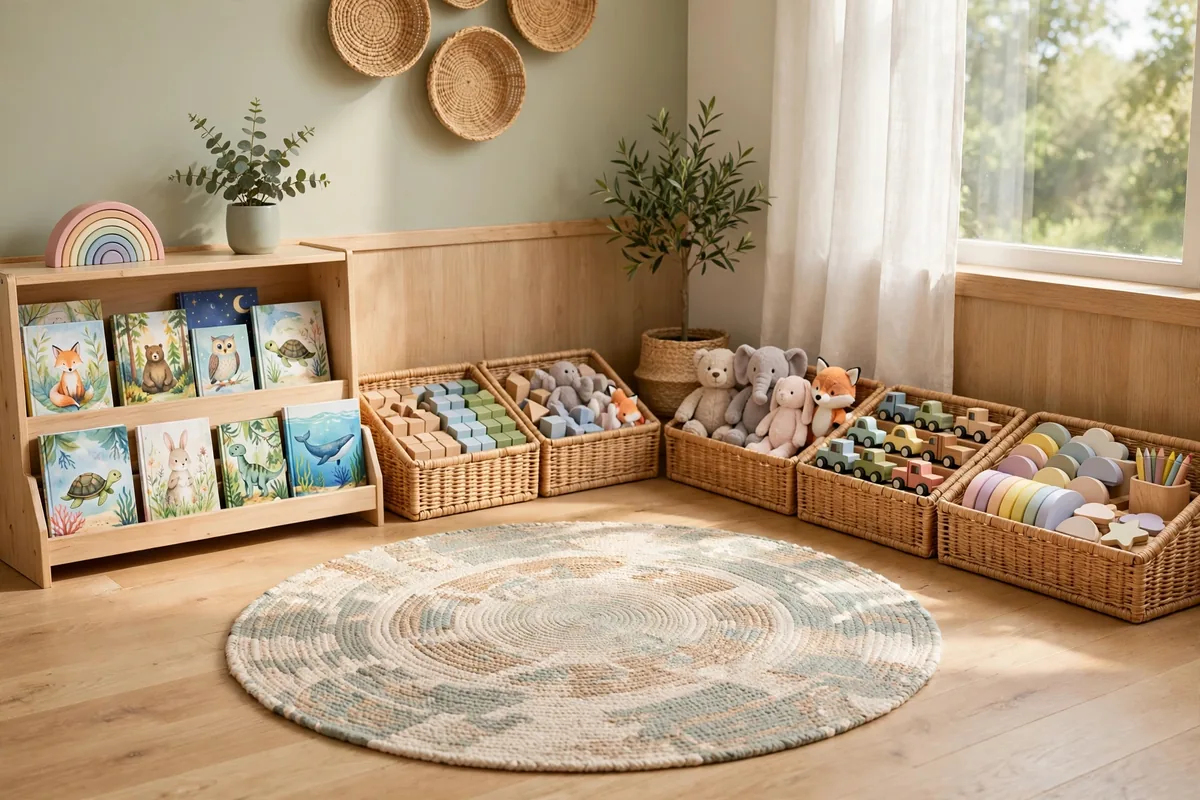
Use open bins at kid height. Lidded boxes look tidier in photos, but open bins win in real life because a six-year-old can toss a toy in with one hand. Line the play zone with three or four wide, low bins — LEGO in one, action figures in another, art stuff in the third. Broad categories beat hyper-specific ones; “cars” works, “matchbox cars sorted by color” does not.
Label everything with pictures and words. For kids under seven, a photo of what’s inside beats a written label every time. Take phone photos of the bin contents, print them cheaply, and stick them on. Older kids get written labels — let them make the labels themselves with a marker and masking tape, which doubles as buy-in.
Go vertical with walls, not with furniture. Tall bookcases in a kid’s room are just clutter you can’t reach. Instead, use the walls: floating shelves at adult height for display items and books you read together, pegboards for headphones and craft supplies, over-the-door organizers for shoes or small toys. The floor stays clear, and nothing important lives above your child’s reach. For the clothing zone specifically, these kids’ closet organization ideas show how a second low rod and a shoe shelf can double usable space.
Rotate, don’t display. If your child has more toys than bins, store half in a closet or garage and swap them every few weeks. Rotation makes old toys feel new, cuts the visible clutter in half, and gives you a natural decluttering moment each time you swap — the toys they don’t miss leave the house for good.
Clothes, Books, and the Everyday Stuff
Toys get all the attention, but clothes and paper are what make a kid’s room look chaotic on an ordinary Wednesday. A few targeted fixes handle them.
Clothes: shrink the wardrobe, simplify the system. Most kids wear the same ten outfits on rotation while the rest of the closet is decoration. Pull everything out, keep what fits and gets worn, and store or donate the rest — a capsule-style wardrobe means the dresser never overflows and mornings get faster. In the dresser, skip precise folding; file-folding (standing clothes up like files so each item is visible) takes seconds and stops the dig-through-the-pile mess. One small laundry basket inside the clothing zone, emptied twice a week, ends the floor-pile habit.
Books: one shelf, forward-facing. A single low shelf with books displayed cover-out like a bookstore works far better than a tall shelf packed spine-out. Kids pick what they can see. Keep the current favorites at eye level and box up the rest for rotation, just like toys.
Paper and art: contain the inflow. School papers and artwork multiply silently. Give them one inbox tray on the desk and one display spot — a corkboard, a wire with clips, a single frame with swappable art. At the end of each month, photograph what you want to remember and recycle the originals. The memory lives in the photo; the clutter doesn’t have to live in the room.
The 5-Minute Tidy Routine That Keeps It Working
A beautiful system dies without a maintenance habit — but “maintenance” for a kid’s room should take five minutes, not fifty. The routine that works for thousands of families is almost embarrassingly simple.
Pick one daily reset time. Right before dinner or right after teeth-brushing — whenever fits your evening. Set a timer for five minutes and everyone tidies: toys back to their zone bins, clothes in the basket or dresser, papers in the tray. When the timer rings, you’re done, even if it’s imperfect. Consistency beats thoroughness every time.
Make it a game, not a chore. Younger kids respond to “beat the timer” and cleanup songs. Older kids respond to systems — a simple checklist on the back of the door with three boxes to tick. What doesn’t work long-term is tidying for them; the habit only sticks when the child does it, however imperfectly.
Do a 10-minute weekly check. Once a week — Saturday morning works for most families — walk the zones together. Anything that migrated to the wrong zone goes home, anything broken leaves, and one drawer gets a quick sort. Ten minutes weekly prevents the slow drift that turns into a Saturday-afternoon disaster every two months.
For shared rooms, add one thing: a visible divider. A rug, a bookshelf as a room divider, or even a curtain gives each child “their” territory — you’re responsible for your zone. Sibling disputes about mess drop sharply when the boundary is physical instead of verbal.
Small Room? The Same System, Scaled Down
Everything above works in a small bedroom — just compress. A loft bed creates a play or learning zone underneath, and the dresser moves inside the closet to free floor space. Our small bedroom storage ideas cover the space-saving furniture and layout tricks that pair with the zone system, and a tidy organized nightstand keeps the sleep zone calm when the room is tiny.
As your child grows, the system grows with them: bins become drawers, picture labels become written ones, the play zone shrinks while the learning zone expands. You’re not building a perfect room — you’re building the habit of everything having a home.
A Calm Room Is a Gift to Everyone in It
Here’s what nobody tells you about organizing a kid’s bedroom: the payoff isn’t the pretty room. It’s the Saturday morning you don’t spend yelling about the mess. It’s your child finding their library book in thirty seconds instead of crying about it at 8 a.m. It’s the quiet confidence kids build when they can manage their own space — a skill that outlasts every bin and label you’ll ever buy.
Start this weekend. Do the reset, set the zones, put out the bins, and run the five-minute tidy on Sunday night. It won’t be perfect, and it doesn’t need to be. It just needs to be better than Tuesday — and then a little better the Tuesday after that.
[…] boundaries make decisions easier for everyone. If you’re already working on getting their kids’ bedroom organized, the same container-limit thinking applies […]