
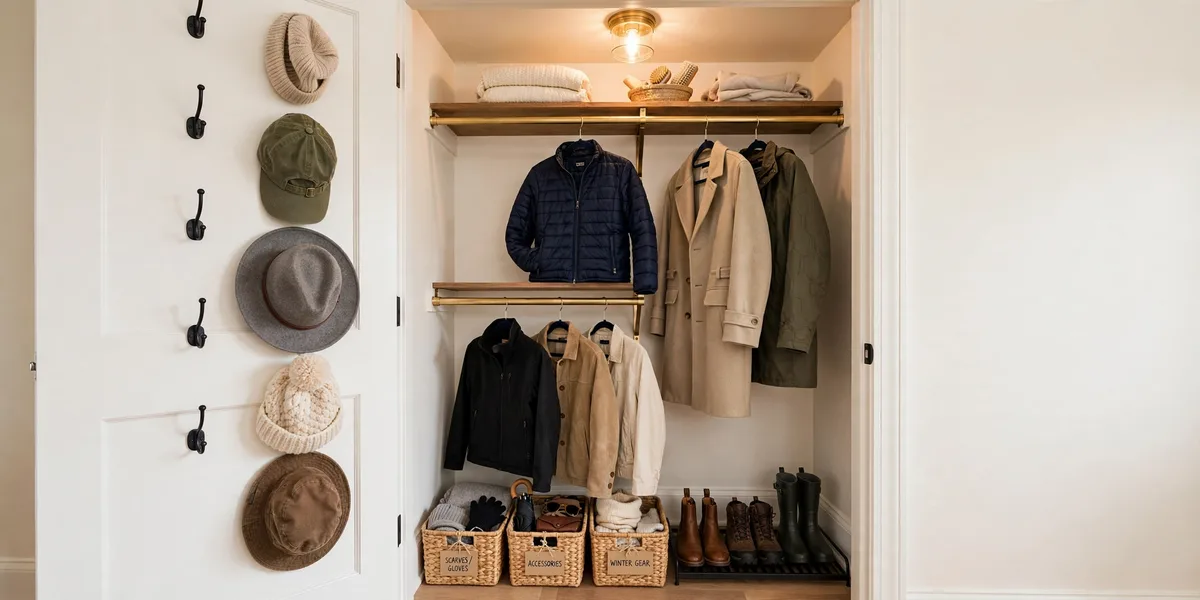

Most coat closets fail for a painfully simple reason: they were designed as a single dark box with one rod, and then real life happened. Jackets piled up, the dog leash got buried, boots multiplied, and now opening the door feels like pulling the pin on a grenade of mittens. The good news is that small coat closet organization has almost nothing to do with the size of the closet and everything to do with how ruthlessly you zone it. A well-organized three-foot closet can out-perform a sloppy six-foot one every single time.
I’ve helped friends rescue closets barely wider than a hallway door, and the pattern is always the same. First comes the honest purge, then a layout that respects three zones — the rod, the door, and the floor — and finally a system so simple that everyone in the house can follow it without thinking. Here’s how to make a tiny coat closet work harder than it has any right to.
Start With the Purge: Small Coat Closet Organization Begins Empty
You cannot organize your way around owning seventeen jackets in a closet built for six. So the first step of any small coat closet organization project is the least glamorous one: take literally everything out. Every coat, every scarf, every random tote bag, the umbrella with the bent spoke you’ve been meaning to fix since 2023. Lay it all on the bed or the couch where you can see it.
Now sort with intention. Make four piles: keep in this closet, relocate elsewhere in the house, donate, and toss. Be honest about what earns a spot by the front door. The heavy parka you wear daily from November to March? That’s a resident. The formal wool overcoat you wear twice a year? That’s a candidate for under-bed storage or a less-trafficked closet. The windbreaker with the broken zipper that you “might fix someday”? Donate or toss — the rule of one for decluttering duplicates applies beautifully here: if two items serve the same purpose, the lesser one leaves.
Count your keepers by category before you buy a single hook. How many long coats? How many pairs of shoes actually live by the door? Do you need space for kids’ backpacks, a vacuum, or pet supplies? A closet organized around real inventory always beats one organized around a Pinterest photo. This inventory list becomes your shopping list later, and it stops you from buying organizers that don’t fit your stuff.
Zone the Rod: Two Tiers Beat One Long Hang
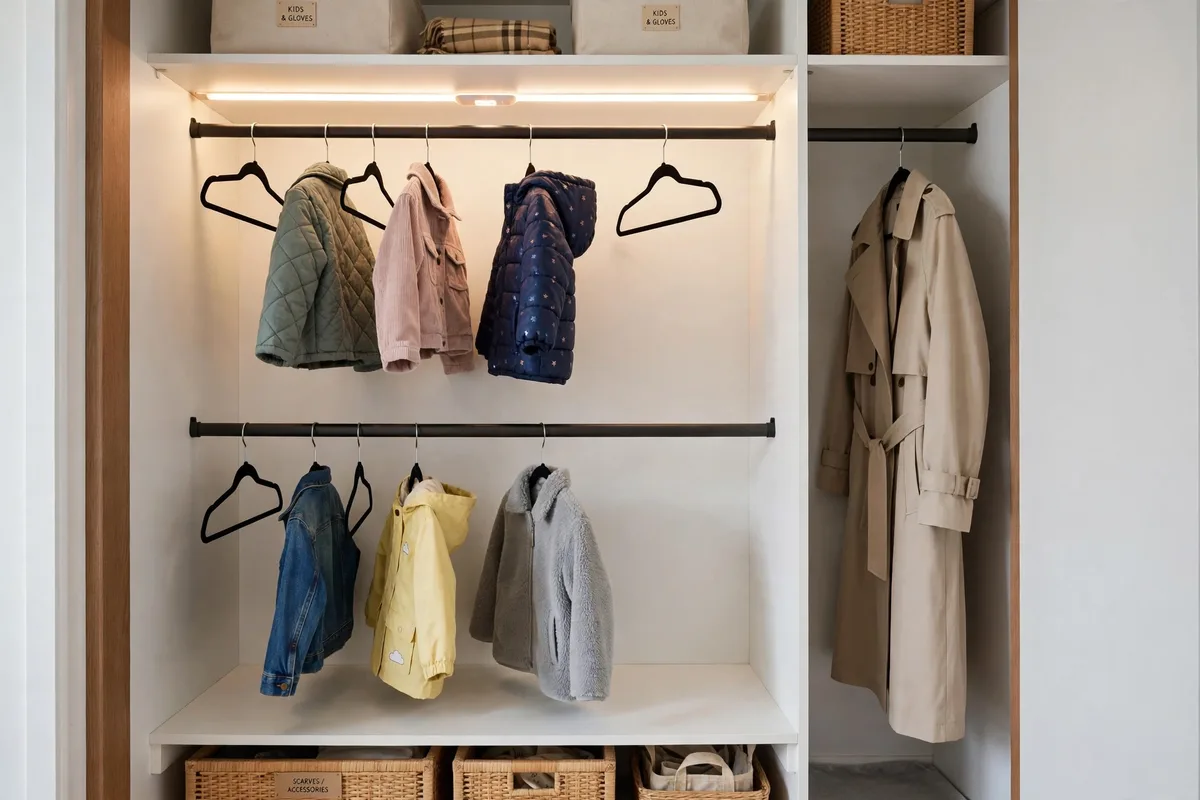
That single rod running the width of the closet is the biggest wasted opportunity in small coat closet organization. Long coats and dresses are the only garments that genuinely need full-length hanging. Everything else — cropped jackets, kids’ coats, vests, fleeces — hangs happily on a shorter rod.
The fix: split the rod into two tiers. Mount a second rod halfway down one side of the closet for short items, leaving full-length hanging space on the other side for the one or two long coats you actually own. A $15 tension rod or a screw-in closet rod does the job in under twenty minutes. Renters, take note: tension rods leave zero holes, and they’re the unsung heroes of tiny closets everywhere.
Switch to slim velvet hangers while you’re at it. Bulky plastic hangers are closet-space vampires — swapping them out recovers roughly an inch per garment, which adds up to real inches across a full rod. One more rod trick: keep an empty hanger or two available and visible. A closet crammed to the last hanger is a closet that will be on the floor by Thursday.
Turn the Door Into Prime Real Estate
The inside of the closet door is the most underused square footage in the entire house. In a small coat closet, it’s essentially a bonus wall — use it.
- Over-the-door hooks: A slim over-door rack with four to six hooks holds hats, dog leashes, reusable shopping bags, and tomorrow’s scarf without touching a single inch of rod space. Choose a flat-profile version so the door still closes.
- Adhesive hook rows: Command-style hooks along the upper door panel are perfect for sunglasses, keys, and lanyards. They pop off cleanly when you move, which makes them renter gold.
- Slim door organizers: A narrow clear-pocket organizer on the door swallows gloves, sunscreen, spare batteries, and all those little things that otherwise form a junk layer at the bottom of the closet.
- A small mirror on the door: Not storage exactly, but a full-length mirror on the inside of the door means the last “do I look okay?” check happens in ten seconds, and the mirror bounces light into the closet so you can actually see what you’re grabbing.
One caution: respect the door’s swing. Anything you mount should sit flat enough that the door closes without shoving your hanging coats. Measure the gap between the door and the rod before you buy — most organizers need about two inches of clearance.
Conquer the Floor: Baskets, Boots, and the Bottom Third
The floor of a coat closet is where good intentions go to die. It starts with one pair of boots, then a bag of donations that never left, then suddenly there’s a archaeological layer of single gloves. Small coat closet organization lives or dies on what happens below knee height.
Start by deciding what the floor is for in your closet. In most homes, the honest answer is shoes — the three or four pairs in daily rotation — plus maybe a vacuum or an umbrella stand. Give the floor a single clear job and everything else gets relocated. That dead vacuum gathering dust? If you have a small home office or utility corner with a better spot for it, move it there and reclaim the square footage.
Then contain what’s left:
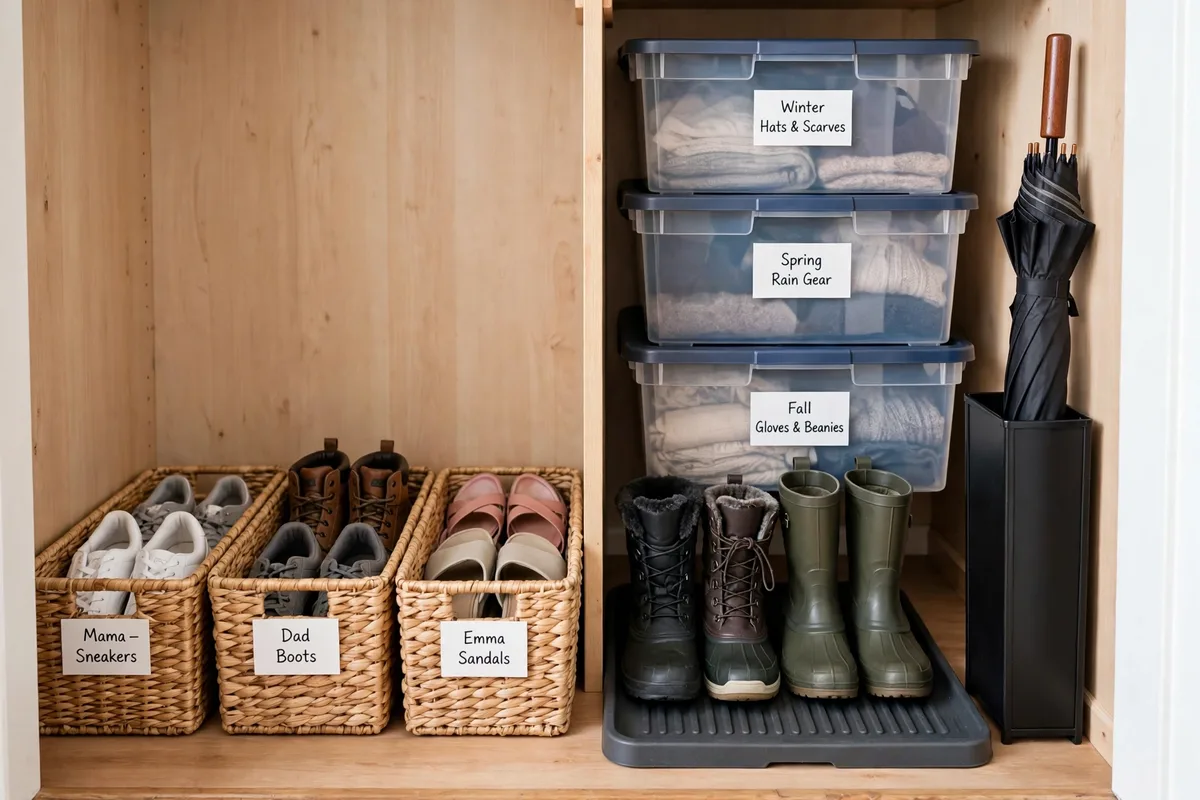
- A low, wide basket per person works better than a shared shoe pile. One basket for you, one for your partner, small ones for the kids. Shoes go in the basket, period. When a basket overflows, it’s a signal to rotate pairs out, not to start a second pile.
- A boot tray with a lip catches winter slush and keeps mud from migrating. Wipe it out weekly and the whole closet smells better.
- Stackable bins for seasonal gear. In October the bins hold sunscreen and sandals; in April they hold scarves and hand warmers. Label them, stack them two high, and the closet resets itself with the seasons.
- An umbrella stand or tall narrow bin tucked in the corner keeps umbrellas and walking sticks upright instead of avalanching every time you reach for a coat.
If your closet has a deep bottom shelf above the rod, treat it as bonus territory: lidded boxes for out-of-season accessories, the gift wrap you only touch in December, or the emergency kit. The rule is simple — shelf equals storage, floor equals daily use, and never the twain shall pile.
Light It Up and Label It: The Finishing Touches
Here’s the detail most small coat closet organization guides skip: you can’t maintain what you can’t see. Most coat closets have exactly one sad bulb, or worse, no light at all. A battery-powered motion-sensor LED strip costs less than a pizza and transforms the experience completely. Mount one under the top shelf and one along the door frame. When the light clicks on as the door opens, the closet feels twice as big and you stop grabbing the wrong jacket in a rush.
Labels are the second half of the maintenance equation. Label the baskets with names or categories. Label the seasonal bins (“WINTER — gloves/hats”, “SUMMER — sunscreen/hats”). This sounds fussy until you watch a household actually use the system: labels turn “where does this go?” into a question nobody has to ask. Clear bins work the same magic — if you can see the contents, you’re far less likely to buy a duplicate pair of gloves in November because you forgot the perfectly good pair from last year.
Finally, build in a five-minute monthly reset. First Sunday of the month, open the closet, toss expired sunscreen, relocate anything that wandered in, and check whether the seasonal bins need swapping. Small coat closets don’t drift back into chaos overnight — they drift one “I’ll deal with it later” at a time, and a five-minute reset catches every one of them.
Make the Closet Work Double Duty (Without the Chaos)
In a small home, the coat closet often moonlights as something else — and that’s fine, as long as the second job has a defined zone. The most common side hustles are cleaning supplies, pet gear, and the overflow from a small laundry room like extra detergent or the ironing board.
The trick is to give the second job the least convenient real estate and protect the prime zones for coats and shoes. Cleaning supplies go on the top shelf in a single caddy — one caddy, not a sprawling collection of half-used bottles. Pet food and supplies get one labeled bin on the floor’s far side. The ironing board slides vertically behind the door if there’s clearance, or it doesn’t live here at all.
What you must not do is let the second job expand. The moment cleaning supplies colonize the rod or pet toys take over the baskets, the closet stops being a coat closet and becomes a junk closet with coats in it. One shelf, one bin, one caddy — that’s the whole second job, and it stays fenced.
For families, consider assigning each person a “door hook + basket” combo and nothing more. Kids are remarkably good at maintaining a system that has exactly two steps: hang the coat on your hook, drop the shoes in your basket. The system fails when the steps are vague, not when the kids are lazy. Clarity is the whole game.
Your Small Coat Closet, Working Overtime
A tiny coat closet doesn’t need a renovation — it needs a plan. Purge honestly, split the rod into two tiers, recruit the door as a bonus wall, give the floor one clear job with baskets and a boot tray, add light and labels, and fence in any double-duty storage so it never takes over. Each change is small and cheap, but together they turn the most abused square footage in the house into the smoothest part of your morning.
So this weekend, pull everything out and start with step one. An hour of honest sorting beats a year of shoving things in and hoping. Your future self — the one grabbing a coat and walking out the door in thirty seconds flat — will thank you every single morning.
[…] a row of wall hooks above it for coats and bags, and a small tray for keys and sunglasses. Our small coat closet organization ideas translate well here if you do have a tiny closet to work […]