
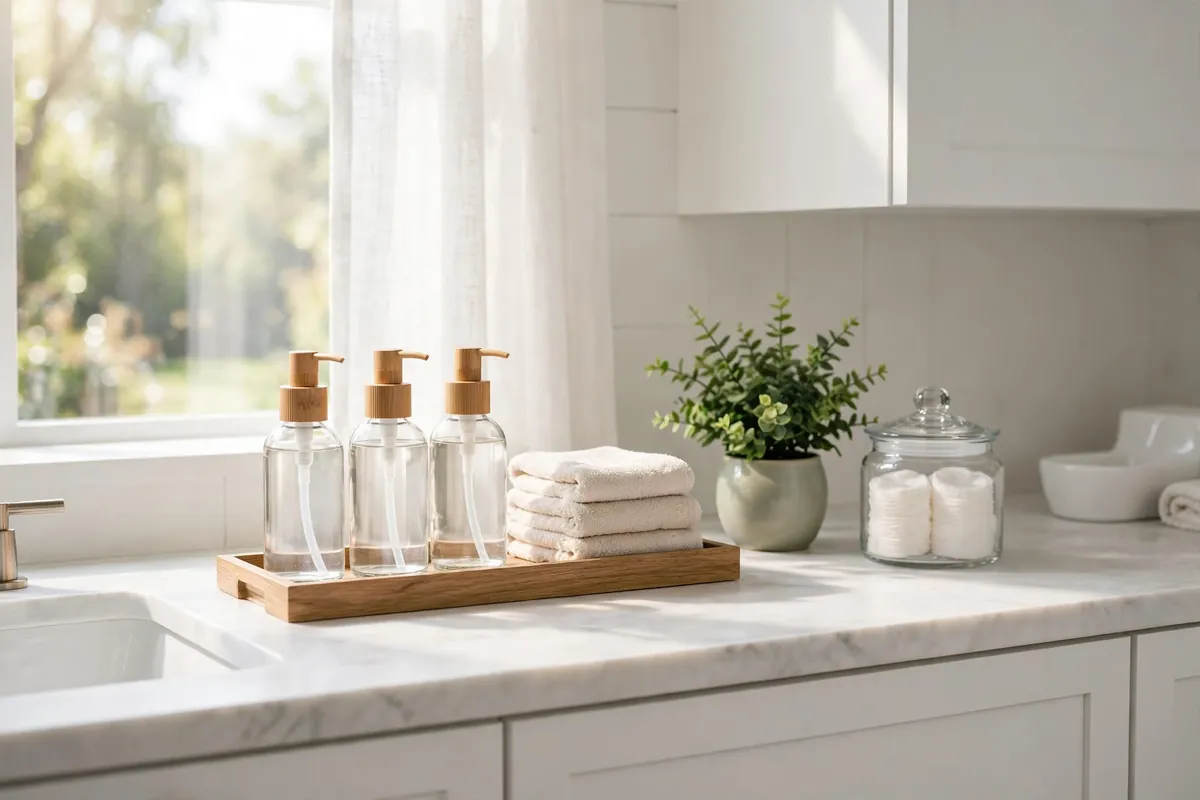

There is a special kind of morning chaos that only a cluttered bathroom counter can produce. You’re half-awake, reaching for your moisturizer, and your elbow catches a bottle of serum instead. It ricochets off the toothbrush holder and lands — lid open — in the sink. You fish it out, rinse it off, and now you’re running five minutes late with damp sleeves. If that scene feels familiar, the problem isn’t you. It’s your counter. Good bathroom counter organization isn’t about styling a vanity for a magazine; it’s about building a small, forgiving system that still works when you’re barely awake.
I learned this the slow way. For years my own counter collected everything: three half-finished moisturizers I was “trying to use up,” a tangle of hair ties, cotton pads escaping from a torn box, and a little graveyard of hotel mini-shampoos I kept just in case. Clearing it always felt like a project, so I never started. Then one Saturday I gave the whole thing twenty focused minutes — and the next morning felt like someone else’s life. Here’s exactly how to get there.
It helps to understand why this particular surface fights back. Kitchen counters get wiped down daily and desks get tidied when guests come over, but the bathroom counter is the surface we touch in the dark, at our least patient. It collects small, slippery, almost-identical bottles; it lives in steam and splash zones; and the average vanity is only about 21 inches deep. Add a typical morning routine — five to ten products, used in a specific order, in about ten minutes — and you’re hunting through clutter instead of flowing through a routine. No wonder it raises your blood pressure before coffee.
Step One: The Great Counter Clear-Out
Before you organize a single thing, take everything off the counter. All of it. Pile it on the bed or the closed toilet lid, wipe the surface clean, and sort into four groups:
- Daily essentials: the products you genuinely use every morning or evening — toothbrush, toothpaste, face wash, moisturizer, deodorant, contact case, prescription items.
- Weekly players: face masks, deep conditioner, the nail file, the fancy serum you use twice a week.
- Expired or abandoned: anything past its date, dried up, separated, or simply unused for months. Sunscreen from two summers ago absolutely counts.
- Doesn’t belong here: the phone charger, the book you read in the bath, spare keys, random receipts.
Be ruthless with the third group. Bathroom products have short lives: mascara lasts about three months, sunscreen about a year, and anything “natural” with no preservatives far less. If it smells off, changed color, or you can’t remember opening it, it’s done. Check the little open-jar symbol on the packaging — that “12M” means twelve months after opening, and most of us are wildly over that. If the thought of purging makes your palms sweat, borrow a timer and the 15-minute declutter method — it was practically designed for small, dense spaces like this one.
Now the golden rule: only the daily essentials come back to the counter. Everything else gets a home under the sink, in a drawer, or on a shelf. Counter space is for dailies only. That single rule does more for bathroom counter organization than any product you can buy.
What should I actually keep on my bathroom counter?
Hand soap, your toothbrush setup, the three to five skincare or grooming products in your everyday routine, and one small thing that makes you happy — a plant, a candle, a framed photo. That’s the whole list. When in doubt, it goes under the sink.
The Tray Method: The Heart of Bathroom Counter Organization
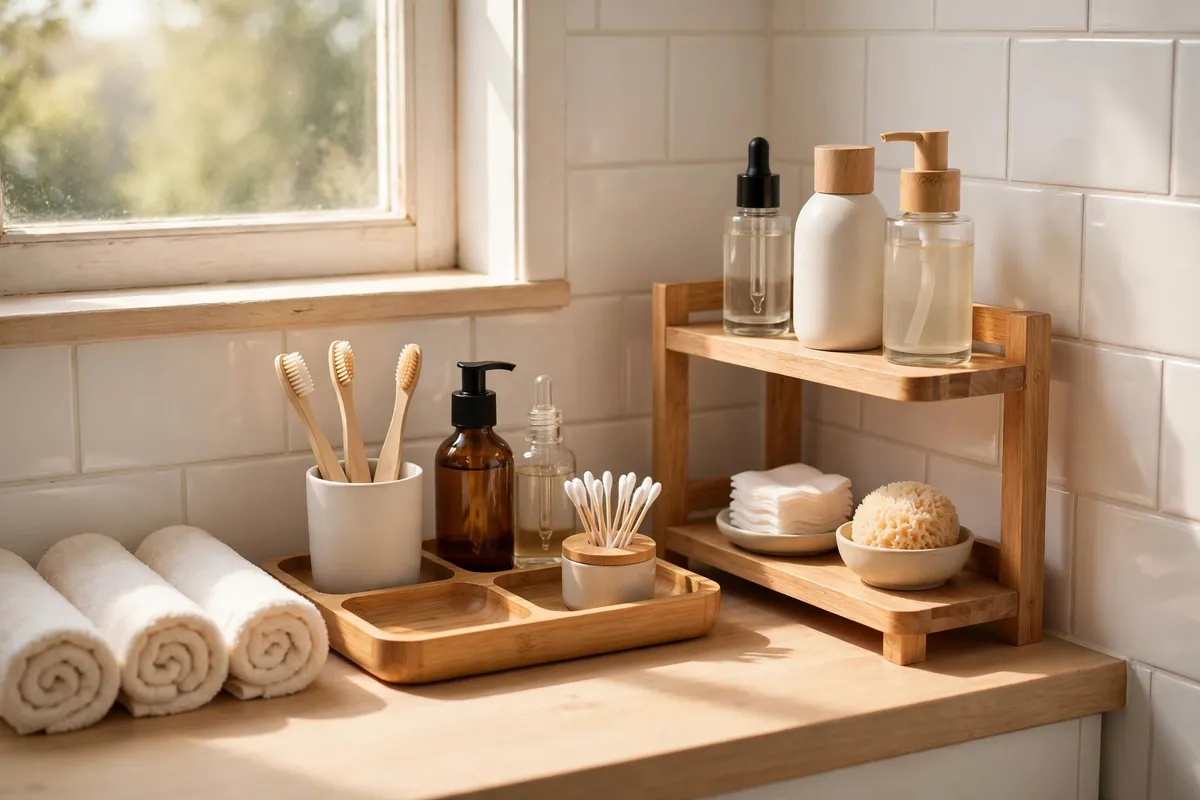
If you buy exactly one thing for this project, make it a tray. A tray turns six scattered bottles into one intentional object, and your brain stops reading “clutter” and starts reading “collection.” It’s the fastest visual upgrade in bathroom counter organization, and it costs less than a takeaway lunch.
Match the tray to your space:
- 24-inch vanities: one slim tray, 8 to 10 inches wide, tucked beside the sink. That’s your entire command center.
- Double sinks or long counters: two smaller trays — one per person — beat one big tray that slowly becomes a dumping ground.
- Materials matter: sealed bamboo, ceramic, stone, or acrylic all handle moisture. Raw wood and fabric will warp or mildew within months.
- Go shallow: a low lip keeps bottles from toppling but still lets you grab things one-handed at 6 a.m.
- Leave breathing room: if the tray is packed edge to edge, it’s too small. You should be able to lift any bottle without knocking its neighbor.
Then arrange the tray in routine order: cleanser first, then treatments, then moisturizer, then sunscreen — left to right if you’re right-handed. It sounds fussy, but once muscle memory learns the order, your mornings get noticeably faster. This corralling instinct works on every counter in the house; the kitchen counter organization ideas I put together use the exact same tray logic, because human brains love a boundary.
Go Vertical When the Counter Is Tiny
When the counter is small, the only direction left is up. The wall above your vanity is prime real estate that most of us leave completely empty, and claiming it can double your storage without touching a single square inch of counter.
- Floating shelves above the toilet or beside the mirror hold the weekly players — spare towels, backup products, the good candle — up and out of the splash zone.
- A magnetic strip inside a cabinet door or on the wall grabs tweezers, nail clippers, and bobby pins. Those tiny metal strays cause a shocking share of counter chaos.
- Adhesive hooks and small stick-on baskets hang hairdryers, brushes, and loofahs. They’re renter-friendly and come off cleanly when you move.
- A tiered corner stand on the counter itself builds a second level for cotton pads, jars, and your most-reached-for products.
- An over-the-door organizer on the bathroom door swallows the overflow: extra toilet paper, cleaning supplies, the hair tools that never had a home.
If your bathroom has zero drawers — hello, pedestal sinks and tiny rentals — pair the wall strategy with the cabinet below. A tension rod or a couple of stackable bins under the sink can absorb everything the tray doesn’t need to hold. And if the whole room feels tight, the small bathroom storage ideas roundup covers every other trick I know for making a tiny footprint work hard.
How do I organize a small bathroom counter with no drawers?
Lean on the walls and the under-sink cabinet. One slim tray for dailies, a wall-mounted toothbrush holder or shelf to free the counter surface, and bins below for everything else. A tiered stand adds a second level to a tiny counter without widening its footprint.
Decant the Loud Ones for a Calmer Look
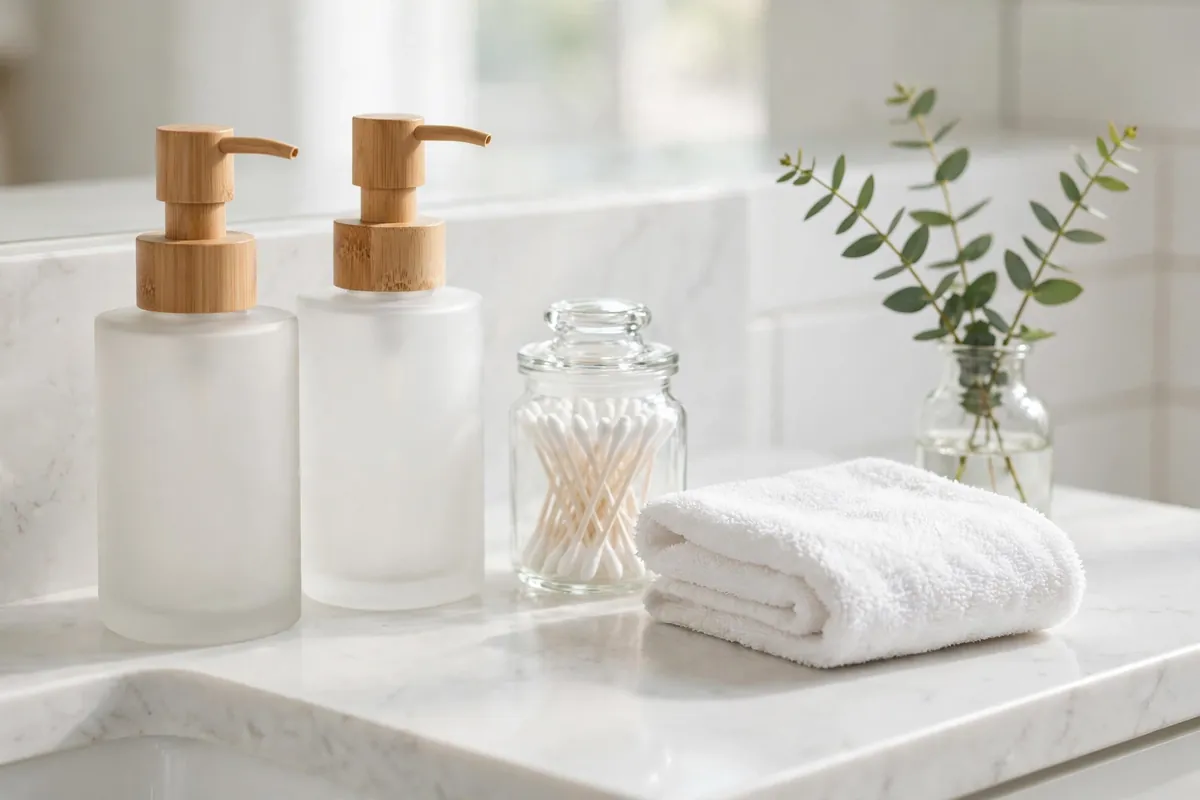
This part feels like a splurge but is actually strategy: decanting. Mismatched plastic bottles in clashing colors will always look messy, no matter how neatly you line them up. Two or three matching refillable dispensers — hand soap, lotion, maybe mouthwash — instantly make the counter look designed instead of accumulated.
You don’t need to decant everything. Start with the loudest offenders: the bright-orange drugstore shampoo, the hand soap with the cartoon label, the lotion bottle covered in fine print. Keep the originals under the sink for refills. Choose pump bottles with a small footprint, moisture-proof labels, and pumps that lock if you like doubling them as travel bottles. The dollar store and the kitchen aisle are both full of perfectly good dispensers — this doesn’t require a boutique budget.
For the small stuff — cotton pads, swabs, hair ties, bobby pins — clear canisters and lidded jars are your friends. They let you see when you’re running low (no more discovering you’re out of cotton pads mid-makeup), and a lid keeps steam and dust out. A lidded glass jar of cotton pads reads as decor; a torn-open box reads as a chore.
One honest warning: don’t let “pretty” become a new shopping hobby. The goal is fewer, better containers — not a counter full of matching jars you bought because they photographed well. If a product works fine in its own bottle, leave it alone.
Everything above assumes the counter is yours. If you share it — with a partner, roommates, kids — you need one extra layer: boundaries. Shared counters fail because nobody knows which mess is whose, so nothing ever gets put away.
Give each person their own container. A divided caddy, a labeled cup, or simply one tray per person ends the mystery of ownership overnight. Keep one shared zone for communal items — hand soap, a shared lotion — and keep personal products strictly in personal containers.
In a kids’ bathroom, a low caddy per child with their toothbrush, toothpaste, and washcloth stops the daily counter avalanche and teaches them the system by accident. Put their caddy on a low shelf or in the cabinet they can reach, not on the counter where little arms knock things into the sink.
Agree on the dailies-only rule together, and do the clear-out as a team so nobody feels ambushed. Fifteen minutes, four piles each, and a shared understanding that the counter is a workspace, not a storage unit. It sounds like a lot of negotiation for a bathroom, but it’s cheaper than resentment.
One tray each, plus one small shared tray for soap and common items. Keep personal products in personal containers, agree that anything left outside a tray gets relocated, and do the two-minute reset together at night — it becomes a habit faster when both people own it.
The Two-Minute Nightly Reset That Keeps It Clear
Every organizing system fails the same way: not all at once, but one stray bottle at a time. The cotton pads migrate. A new moisturizer gets tested and never put away. Someone’s razor appears. The antidote is a tiny nightly ritual — while you brush your teeth, run a two-minute reset:
- Put every product back on its tray, in routine order.
- Toss used cotton pads and empty packaging; wipe sticky rings with the hand towel.
- Return strays to their real homes — the charger to the bedroom, the book to the shelf.
- Glance at the tray: anything new that doesn’t belong gets relocated tomorrow, not tonight.
Two minutes. That’s the entire maintenance plan, and it’s the difference between a counter that stays organized and one that needs a rescue mission every month. Add the one-in-one-out rule — every new product that enters means an old one leaves — and do a five-minute expiry check monthly while you clean. Once a season, pull everything off and wipe the tray and the counter properly; it takes ten minutes and resets the whole system.
If you want a bigger rhythm to hang this on, the 20-minute daily cleaning routine folds the bathroom reset into a whole-house flow without it ever feeling like a project.
How do I keep my bathroom counter clutter-free long-term?
The clear-out gets you there; the nightly two-minute reset keeps you there. The other half is the one-in-one-out rule: every new product that enters the bathroom means an old one leaves. Monthly, do a quick expiry check while you clean — five minutes, and it prevents the slow creep.
You don’t need a bigger bathroom. You need a counter that holds only what your morning actually requires, corralled on a tray, backed up by wall storage, and protected by a two-minute reset. Start this weekend — clear it all off, keep the dailies, and give everything a home that makes sense — and Monday morning will feel different. Not perfect. Just calmer. And calm, at 6:45 a.m., is everything.
[…] carry the momentum into the rest of the bathroom, the same ruthless approach works beautifully for counter clutter and the forgotten back of your under-sink […]