


Your nightstand is the first thing you see in the morning and the last thing you see at night. It is also, for most of us, a small museum of clutter: a half-finished water glass, three books you will absolutely finish someday, a charger tangled with a hair tie, and receipts you have no memory of acquiring. These nightstand organization ideas will turn that little surface into what it should be — a calm landing pad for your sleep, not a junk drawer that happens to have a lamp on top.
I spent years ignoring mine. The top stayed more or less presentable, but the drawer was where good intentions went to die — old batteries, a broken watch, takeout menus from a restaurant that closed in 2023. When I finally emptied the whole thing onto the bed one Sunday, it took less than fifteen minutes to sort. The real problem was never the stuff. It was that nobody had ever told me what a nightstand is actually for.
Start With a Ruthless 10-Minute Declutter
Every nightstand organization project starts the same way: take everything off and out. Every drawer, every surface, the little shelf underneath. Pile it all on the bed so you can see the full damage. Now sort into three piles — keep by the bed, relocate, and toss.
Be honest about the “keep by the bed” pile. The test is simple: did you use it in the last two weeks, or would you reach for it tonight? A lamp, your current book, reading glasses, a glass of water, lip balm, your phone charger — those earn their spot. The novel you abandoned in March, the candle you never light, the three pens that do not write: relocate or toss. If you need a bigger framework for deciding what stays, our room-by-room decluttering checklist walks through the exact keep-or-go questions.
Wipe the empty nightstand down before anything goes back. Dust, sticky rings from water glasses, the mysterious crumbs — all of it. You are resetting the space, and a clean surface makes the “after” feel dramatically different from the “before.”
Nightstand Organization Ideas for the Top Surface: The Rule of Three
Here is the single most useful rule I have found for nightstand surfaces: three things, plus the lamp. That is it. A lamp, and three items. Maybe it is a book, a glass of water, and a small dish for your jewelry. Maybe it is an alarm clock, lip balm, and a framed photo. The exact three will be personal, but the number is non-negotiable.
Why three? Because the top of a nightstand is small, and small surfaces fill up fast. The moment you add a fourth, fifth, and sixth item, the surface crosses an invisible line from “styled” to “cluttered,” and your brain registers it every single night. Researchers have found that visual clutter raises cortisol, the stress hormone — and the last place you want a cortisol spike is the spot you stare at while trying to fall asleep.
The secret weapon for keeping the surface tidy is a tray. A small tray — wood, ceramic, marble, whatever matches your room — corrals the loose bits (watch, glasses, hand cream) into one defined zone. Items inside the tray read as “organized.” The same items scattered across the surface read as “mess.” The tray does not change what you own. It changes how your brain files it. If you are working through the rest of the room too, these bedroom organization ideas use the same tray-and-zone logic at a bigger scale.
Tame the Drawer: Dividers, Zones, and the Mini-Office Trap
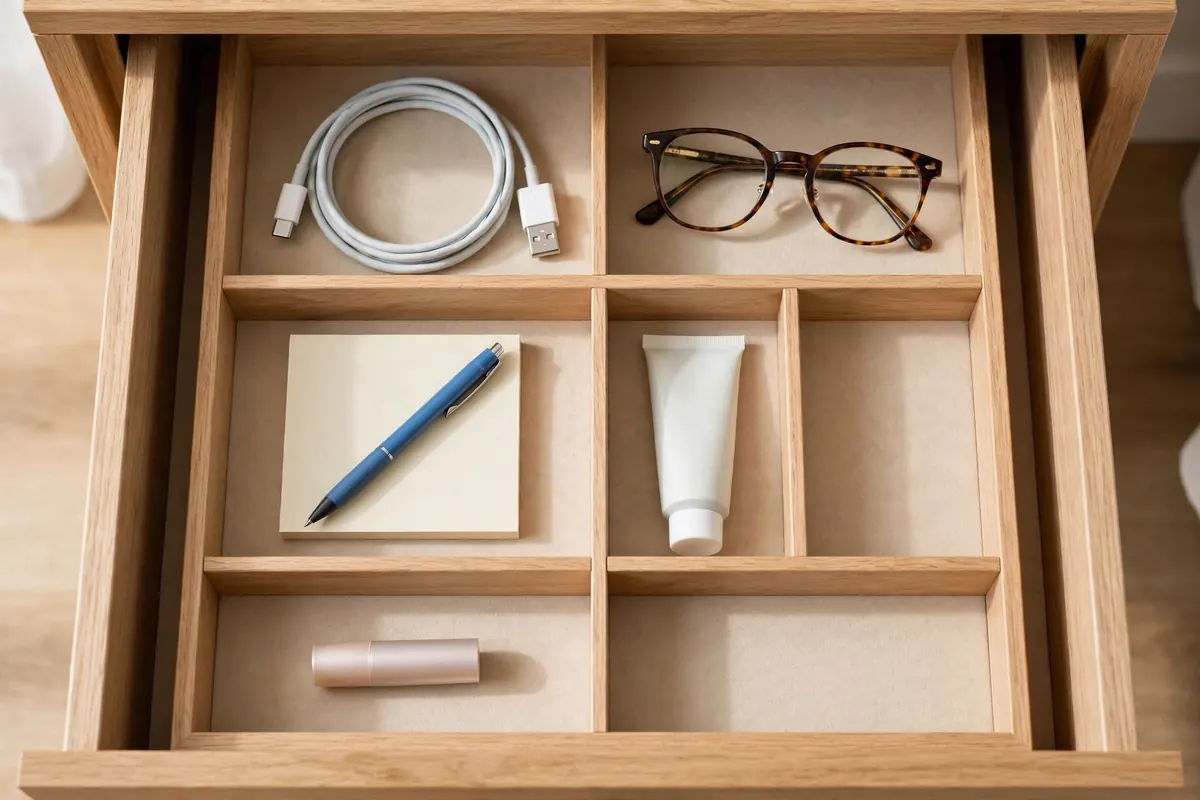
The drawer is where nightstand organization lives or dies. An empty drawer becomes a junk drawer within a month — it is practically a law of physics. The fix is dividers: small boxes, a cutlery tray from the kitchen section, or an actual drawer organizer. Give every category its own compartment and the drawer stops being a pit.
Think in zones. A typical well-organized nightstand drawer has three or four:
- Sleep zone: earplugs, sleep mask, melatonin or nighttime meds, a small notepad for the 2 a.m. thoughts you must write down or you will never sleep.
- Reading zone: current book or e-reader, reading glasses, a bookmark. One book. The five others live on the bookshelf.
- Tech zone: one charger, one cable, earbuds. Cord chaos is the number-one drawer complaint, and a short cable plus a tiny velcro tie solves most of it.
- Personal zone: hand cream, lip balm, tissues — the things you reach for half-asleep and need to find by touch.
Watch out for the mini-office trap. If you, like me, sometimes work from bed, the nightstand drawer slowly fills with pens, notebooks, sticky notes, and highlighters until opening it feels like a trip to an office supply store. Cap the office supplies at one pen and one small notepad. Everything else belongs at an actual desk — or at least in a 15-minute declutter session somewhere that is not two feet from your pillow.
Solve the Charging Situation Once and For All
Phones, watches, earbuds, e-readers — the modern nightstand is basically a power station, and nothing ruins the calm faster than a nest of cables. You have a few good options depending on how much tech you sleep next to.
The simplest fix is a short charging cable (one foot, not six) plugged into a small power strip or multi-port charger tucked behind or inside the nightstand. Short cables cannot tangle into a nest; they simply do not have the length. Route the cable through a cord clip stuck to the back edge of the nightstand so the end stays put instead of sliding behind the furniture every night.
If your nightstand has a drawer, consider a charging drawer: drill or thread the cables through a small hole in the back of the drawer, keep a compact multi-port charger inside, and close the drawer on the whole mess. Devices charge invisibly. The top stays serene. Out of sight really is out of mind here — and if you are trying to cut down on midnight scrolling, a drawer that swallows your phone is doing you a genuine favor.
One more consideration: if you charge your phone on the nightstand, the phone is the last thing you touch at night and the first thing you touch in the morning. Some people find that a charging spot across the room — even just on the dresser — improves sleep more than any organizer ever could. Worth an experiment.
Nightstand Organization Ideas That Add Warmth Without the Clutter
An organized nightstand should not feel like a hotel room — sterile and impersonal. The goal is calm with character. The trick is choosing one personal touch and letting it breathe, instead of clustering five sentimental objects on twelve inches of wood.
Good candidates: a single framed photo that makes you happy, a small bud vase with one stem, a candle you actually light, a tiny plant that survives neglect (pothos and snake plants are the usual suspects). Bad candidates: the growing stack of magazines, the souvenir shot glass collection, anything you keep out of guilt rather than love.
Lighting deserves a mention too. A harsh overhead light at bedtime fights your body’s wind-down signals. A warm, low lamp on the nightstand — ideally with a dimmer or a warm-toned bulb around 2700K — turns the last hour of the day into a genuine wind-down ritual. If your nightstand is too small for a full lamp, a wall-mounted sconce above it frees the surface entirely while giving you the same warm pool of light.

The 2-Minute Nightly Reset That Keeps It All Working
Here is the unglamorous truth about every organization system ever: it only works if there is a maintenance habit attached. The good news is that a nightstand is tiny, so the habit is tiny too. Every night, before you get into bed, spend two minutes:
- Put the water glass in the dishwasher or the bathroom sink — not “tomorrow,” now.
- Return anything that migrated during the day (the book to its spot, the charger to its clip, the glasses to the tray).
- Toss the obvious trash: tissues, receipts, the wrapper from the thing you ate at midnight.
- Close the drawer. An open drawer is an invitation to toss things in.
Two minutes. That is the entire maintenance plan. Do it for a week and it becomes automatic — the same way you lock the front door without thinking. The nightstand stops being a project and goes back to being furniture.
A calm nightstand will not fix your life. But there is something quietly powerful about ending and starting every day at a surface that is intentional instead of chaotic. It is the smallest room-by-room win there is — and small wins, stacked daily, are how tidy homes actually happen. Start tonight: empty it, keep the three that matter, tray the rest. Your mornings will thank you.