


By Tuesday evening, the kitchen table is buried under permission slips, a half-finished Lego castle and somebody’s PE kit, the laundry basket is overflowing again, and the bathroom mirror has toothpaste on it for reasons nobody will admit to. If that sounds like your house, you are not failing at housework. A cleaning routine for large families simply has to work differently from the routines written for a couple in a two-bedroom flat. More people means more mess, more laundry and more opinions — but it also means more hands. This guide builds a routine around that simple truth: spread small jobs across the week, give every person a real role, and stop saving everything for one exhausting Saturday.
Why a cleaning routine for large families has to look different
Most cleaning advice assumes one person does the cleaning, or at most two adults splitting it. In a large family, that model collapses. One adult trying to clean up after six people is not a routine, it is a full-time job on top of a full-time job — and resentment builds fast.
The math is the first thing to get honest about. A family of six produces roughly three times the laundry, dishes and floor dirt of a couple, but the day still has the same 24 hours. The work has to be shared, and broken into pieces small enough to fit around school runs, work and homework. A routine that asks for two hours every evening will be abandoned by Thursday. One that asks for ten focused minutes from everyone, most days, will still be running in March.
The second difference is traffic. Hallways, the kitchen floor and the main bathroom take a beating in a big household and need a quick pass every day. Bedrooms and spare rooms can wait a week. Sorting tasks by how fast a room actually gets dirty — rather than by a rigid room-by-room schedule — is the single biggest time-saver for large families.
A cleaning routine for large families starts with a daily rhythm
Forget the idea of a single cleaning day. The backbone of a workable routine is a short daily rhythm that everyone knows by heart, built around three anchor points: morning, after dinner, and bedtime. Each one takes ten minutes or less.
The morning reset. Before anyone leaves the house, beds get made (a lumpy bed made by a seven-year-old still counts), pyjamas go in the hamper, and breakfast dishes go straight into the dishwasher. Shoes and coats go on their hooks, not on the stairs. If mornings are frantic, keep this to the two things that matter most — beds and dishes — and let the rest go. A simple morning reset routine is a good template to build on.
The after-dinner kitchen reset. This is the one non-negotiable. Dishes loaded, counters wiped, table cleared, floor given a quick sweep. It takes about ten minutes when everyone helps, and it means you wake up to a kitchen you can actually use instead of last night’s mess. Do it before anyone sits down with a screen, or it will not happen.
The ten-minute evening pickup. Set a timer for ten minutes. Everyone grabs a laundry basket or a bag and walks through the shared rooms picking up anything out of place. Toys go back to the play zone, shoes go to the entryway, dishes go to the kitchen, and anything else goes to its owner’s room for them to deal with. Put on music and make it a race — children who would groan at “cleaning time” will happily compete to fill their basket first. This one habit alone is the reason some large-family homes look tidy most evenings. If your evenings are already stretched, a focused evening reset routine covers the same ground in a tidy little package.
- Morning (5–10 minutes): beds made, breakfast dishes away, shoes and coats on hooks.
- After dinner (10 minutes): dishes loaded, counters wiped, table cleared, floor swept.
- Before bed (10 minutes): whole-family pickup with a timer, laundry started if needed.
- Laundry touchpoint: one load a day beats a mountain on Saturday — more on this below.

Divide the work by age: a chore chart that actually works
A cleaning routine for large families only works when it stops being one person’s job. Children can handle far more than we tend to give them credit for — the trick is matching the task to the age so they can genuinely succeed without you standing over them.
Keep it short. No child should have more than two or three tasks a day, each taking under ten minutes. Tie the jobs to things that already happen: pickup before dinner, beds before school, tidy rooms before screen time. And rotate the jobs weekly so nobody is permanently stuck with the bathroom while someone else always gets the “easy” job — that is how chore charts breed resentment.
- Ages 2–4: toys into a bin, dirty clothes into the hamper, wiping a low surface with a damp cloth. They are helpers, not workers — praise the effort, not the result.
- Ages 5–7: making the bed, setting and clearing the table, sorting laundry by colour, watering plants, feeding a pet with an adult nearby.
- Ages 8–11: vacuuming a room, loading and unloading the dishwasher, taking out the rubbish, wiping down the bathroom sink, folding the easy laundry like towels.
- Ages 12 and up: cleaning a whole bathroom, mopping, running a load of laundry from start to finish, cooking a simple meal and cleaning up afterwards.
Make the chart visible — on the fridge or a hallway pinboard — with names, not just jobs. A chart that lives in a drawer is a chart that does not exist. And when a child does a job properly, say so specifically: “You got every sock into the right drawer” lands much better than a generic “good job.” If you have pets adding to the mess as well, our cleaning routine for pet owners has practical ideas for folding pet care into the same chart.
Taming the laundry mountain
Ask any parent of four or more children what part of housework defeats them, and the answer is almost always laundry. It is not the washing that is hard. It is the sorting, the folding and the putting away — the last ten feet from the dryer to the drawer, where a warm basket lands on the couch and stays there until someone needs a clean sock at 7:10 on a school morning.
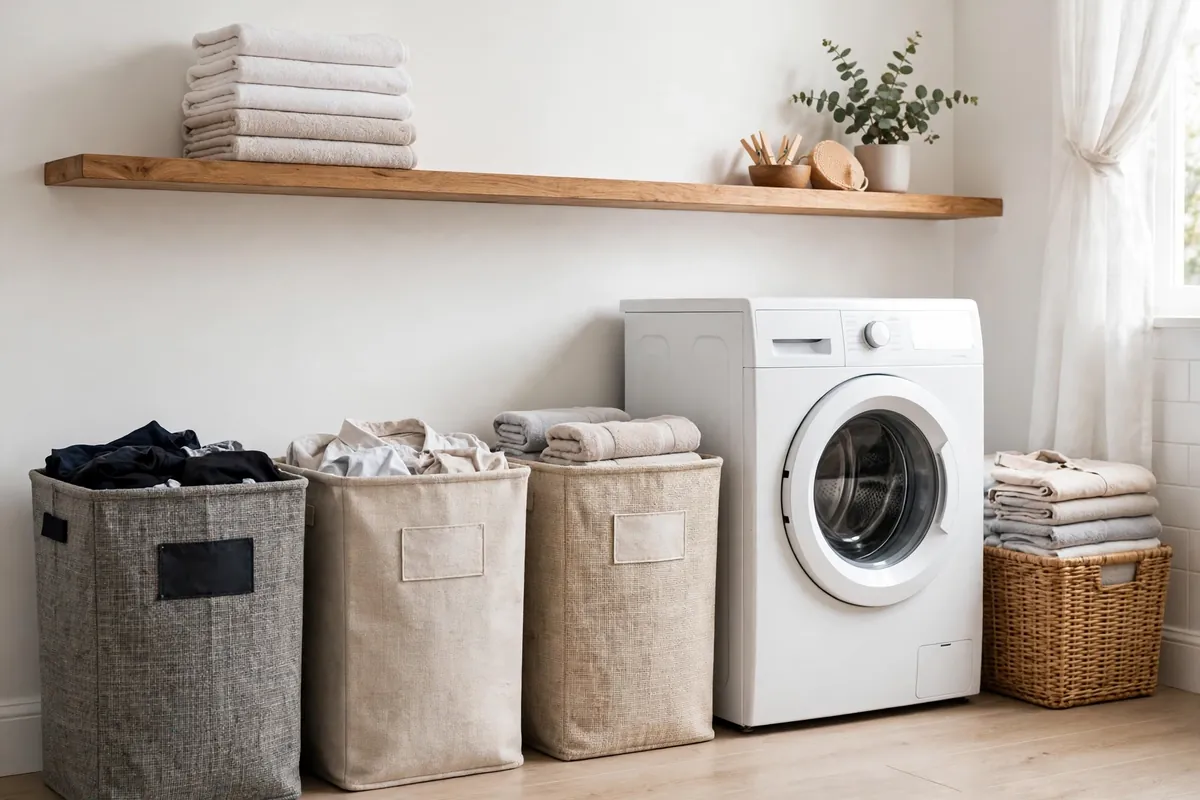
Sort where clothes come off. A three-bag sorter — darks, lights, and towels and sheets — in the hallway or laundry room means nobody sorts a pile on wash day. Each bag gets washed when it is full. If your children are old enough, give each of them their own hamper in their bedroom instead: each hamper becomes that person’s load, which also ends the mystery of whose clothes are whose. A small mesh bag in each hamper keeps socks together and shortens the folding step considerably.
Plan on one load per person per week, plus towels and bedding. A family of six lands near eight loads a week, not the dozen panicked half-loads that happen when laundry runs on crisis. One load every weekday evening, folded before bed, plus two or three on Saturday, keeps the backlog from growing. Assign laundry days by person or by category — one adult owns towels and bedding, a teenager owns their own clothes — and write it on the same chart as the chores.
Make folding a family job, not one person’s punishment. Rotate the folding role weekly, and let each family member fold and put away their own clothes once they are old enough.
A weekly plan that survives real life
Daily habits keep the house liveable. Weekly jobs keep it genuinely clean. The trick is to spread them across the week in short bursts instead of stacking them into a Saturday marathon that everyone dreads — and that gets cancelled the moment a birthday party or a football match appears on the calendar.
- Monday — Bathrooms. Toilets, sinks, mirrors and a quick pass on the shower in every bathroom. Monday works because the weekend has usually left its mark.
- Tuesday — Floors. Vacuum the busy areas and mop the kitchen and hallway. If you have pets or small children, this might need a second pass on Friday.
- Wednesday — Light day. Daily habits only. A rest day in the middle of the week is what keeps the routine alive.
- Thursday — Kitchen deep-ish clean. Wipe down the outside of appliances, clean the hob, empty and wipe the fridge shelves that need it, take out the recycling.
- Friday — Dust and surfaces. A quick dust of shelves, skirting boards and the tops of door frames — the places that collect a surprising amount of grime in a busy house. If dust is a particular problem in your home, our dust-free home cleaning routine goes deeper on this.
- Saturday — Laundry catch-up and one bigger job. Two or three loads, plus one rotating monthly task: clean the oven, wash the windows, sort a cupboard, deep-clean the fridge.
- Sunday — Off. A routine with a day off is a routine people keep.
When the week falls apart (and it will)
Sooner or later — usually in the same week — someone gets sick, a school project eats the evening, or a work deadline lands on Thursday. The routine will break. That is not a failure; it is the test of whether the routine is any good. A good routine bends. A bad one snaps and gets abandoned.
Have a minimum version ready for hard days. On a truly awful day, the only jobs that matter are three: dishes dealt with, the kitchen counter wiped, and the ten-minute pickup before bed. Everything else can wait a day. If you protect those three, the house never slides into the kind of chaos that takes a whole weekend to fix.
When a week goes sideways, do not try to catch up on everything at once. Pick the single most visible job — usually the kitchen or the main bathroom — and do that one properly. The rest can be folded into next week’s rotation. And if the whole family has had a rough week, say so out loud: “This week was hard, so we are doing the minimum and starting fresh on Monday.”
Finally, review the routine once a month, together. What is working? What job does everyone hate, and can it be swapped or shortened? A ten-year-old who outgrows their tasks needs new ones; a teenager in exam season needs a lighter load for a few weeks. The routine is a tool for your family, not a contract.
Start small, start tonight. You do not need a new set of cleaning products, a colour-coded binder or a perfect chart to begin. Tonight, after dinner, set a timer for ten minutes and do the kitchen reset together. Tomorrow morning, make the beds. By the end of the week, those two small habits will have changed the feel of your home more than any single deep clean ever could — because they will still be there next week, and the week after that.
A cleaning routine for large families is not about achieving a spotless house. It is about building a home where the work is shared, the mess is manageable and nobody — least of all the person who used to do it all — is quietly drowning in it. Start with the daily rhythm, divide the work fairly, tame the laundry, and let the weekly plan do the heavy lifting in small, survivable pieces.