
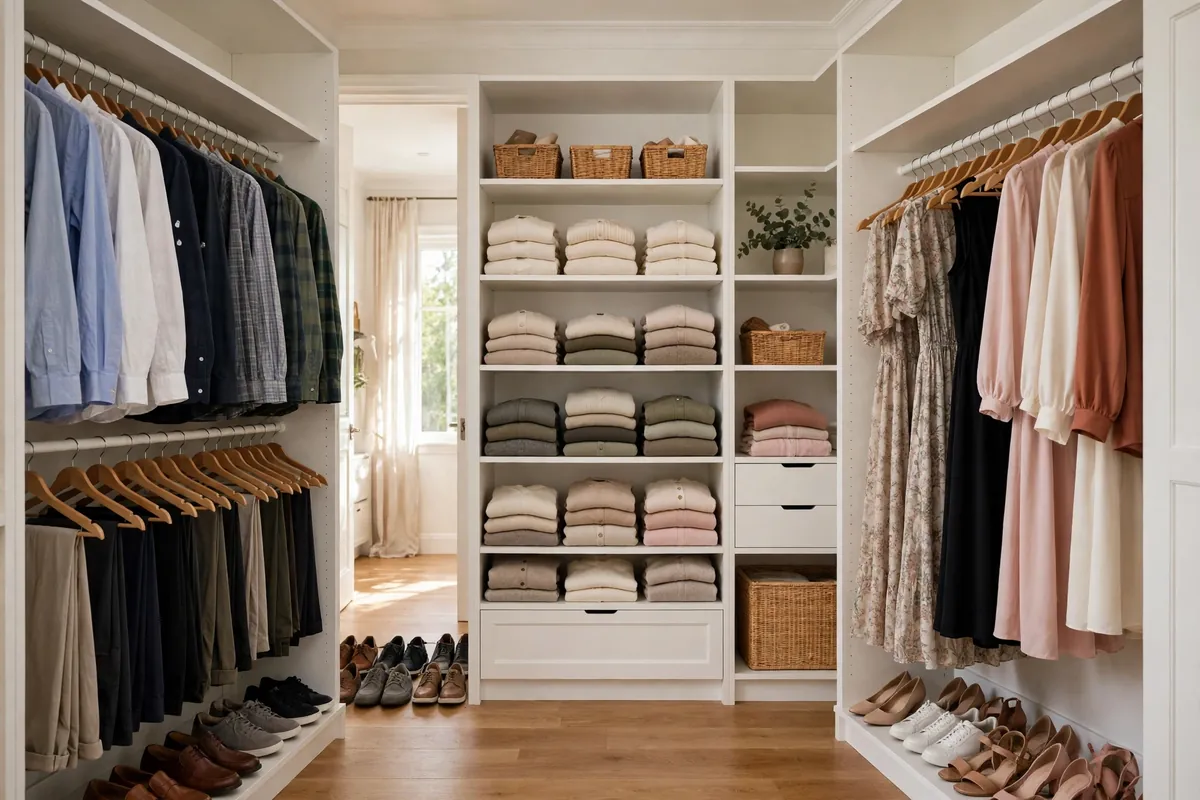

Sharing a closet with the person you love sounds simple until the first Monday morning when you cannot find your favourite shirt, your partner’s coats have quietly taken over your half of the rail, and there is a single shoe on the floor that belongs to neither of you — or maybe to both of you. These shared closet organization ideas for couples are built for that real-life mess, not for a showroom. You do not need a bigger bedroom or a custom-built wardrobe to make it work. You need a fair split, a few smart habits, and a system that both of you can actually keep up with on a tired Tuesday evening.
A shared closet works when it respects two different wardrobes and two different routines. One of you might fold everything into neat stacks; the other might live entirely on hangers. One of you gets dressed at six in the morning while the other sleeps until eight. The best shared closet is not the prettiest one on the internet — it is the one where both people can get dressed in five minutes without an argument.
Start With a Joint Clear-Out Before You Organize Anything
No shared closet organization ideas will survive a closet that is stuffed with clothes nobody wears. Before you buy a single basket or argue about who gets the left side, take everything out together. Every last hanger, every folded jumper, every pair of shoes. Yes, it will look like a bomb went off in your bedroom. That is the point — you cannot fairly divide a space you have never actually seen empty.
Sort every item into three piles each: keep, donate, and not sure. The “not sure” pile is the important one. Put those items in a bag, date it, and store it out of the way for a month. If neither of you reaches for anything in it, donate the whole bag without opening it again. Couples usually discover that a surprising amount of their closet belongs to a past version of themselves — the suit from a job you left, the dress from a wedding three years ago, the jeans that have not fit comfortably since before you moved in together.
The most common mistake couples make is drawing an imaginary line down the middle and calling it fair. It rarely is. One of you might own forty shirts that need hanging space; the other might own twelve hanging items and a mountain of knitwear that should never hang at all. A strict fifty-fifty split gives one person empty rail space and the other overflowing shelves — and that is where the creeping starts, as one wardrobe slowly colonises the other’s territory.
Instead, count before you divide. Group each person’s clothes into four categories: short hanging (shirts, blouses, folded trousers), long hanging (dresses, coats, long jackets), folded items (jumpers, T-shirts, jeans), and shoes. Then divide the closet by those numbers, not by halves. If one wardrobe is twice the hanging size of the other, a two-to-one rail split is genuinely fairer than an even one. Fair means both people can get dressed without moving each other’s clothes — not that both sides measure the same.
Match the type of space to the type of clothes, too. Long hanging space goes to whoever actually owns long garments, whichever side of the closet that happens to be. Folded storage goes to the person with the jumpers and knitwear. When you divide by need rather than by geometry, the split stops feeling like a negotiation and starts feeling like a plan. If you want a deeper look at arranging clothes by type and colour once your zones are set, our guide on how to organize a closet by color shows how a simple colour order makes both sides easier to scan in the morning.
Give Each Person a Clear Zone — With a Visible Edge
Once the split is agreed, make it visible. Each person needs a complete zone: some hanging space, some shelf or drawer space, and a place for shoes. A zone without a clear edge will not survive the week. Mark the boundary physically — a shelf divider, a different hanger colour for each person, or a small label on the shelf edge. It does not need to look clinical. A slim wooden divider on the rail or two different shades of slim velvet hangers does the job quietly.
Everything one person needs for a normal morning should be reachable from their own side: everyday clothes between shoulder and knee height, shoes on the floor below, and one shelf or drawer for the small things. Keep the top shelf for the things neither of you needs weekly — luggage, off-season clothes, spare bedding. When both people have a home base, the daily “whose is this?” question disappears.
Shared items deserve their own small zone too, rather than being squeezed into whichever side has a gap. Coats you both reach for, the ironing board, the lint roller, the steamer — give them one deliberate spot. A shared zone should be a choice, not the overflow pile that forms when the personal zones fill up. For couples lucky enough to have more room to play with, our walk-in closet organization ideas show how to turn a larger space into two comfortable zones with a shared middle.
Double the Hanging Space With a Second Rail
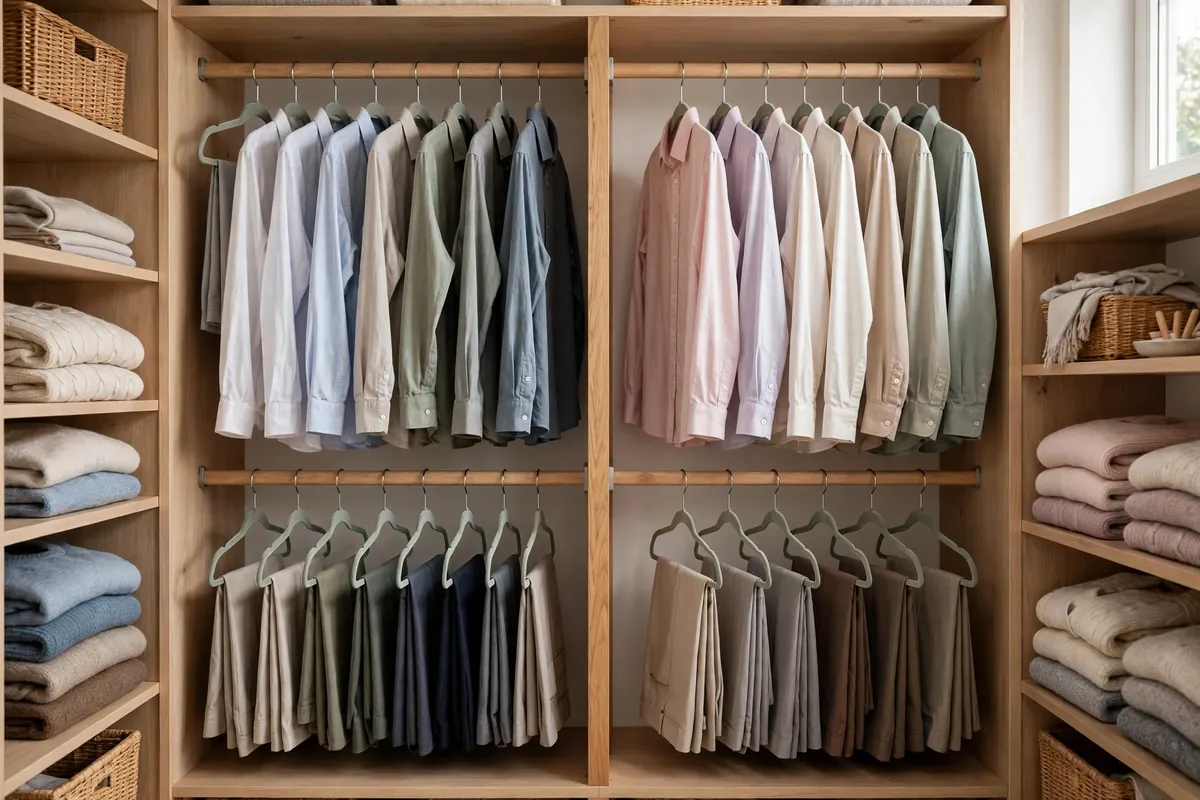
Most closets waste an astonishing amount of vertical space. A single rail with one shelf above it leaves a big empty gap below the hanging clothes, and that gap is where the floor pile begins. A second, lower rail — hung just below the first — instantly doubles the space for shirts, blouses, skirts, and folded trousers.
Give the lower rail to whoever owns more short items. Keep the full-length section intact on the other side for dresses and coats. If your closet is a reach-in rather than a walk-in, this one change can be the difference between two people fitting comfortably and one person living out of a laundry basket. Measure first: you need roughly 40 inches of clearance for a double-hang section, and the lower rail should sit high enough that clothes do not brush the floor or the shoe rack below.
While you are at it, switch to slim matching hangers. Bulky plastic and wooden hangers eat inches of rail space that a shared closet cannot spare, and mismatched hangers make even a tidy closet look chaotic. Slim velvet hangers stop clothes slipping, take up a fraction of the width, and — when both partners use the same kind — give the whole closet a calm, uniform look.
Solve the Shoe Problem Before It Takes Over the Floor
Shoes are where most shared closets fall apart. One person’s collection grows quietly, pairs migrate across the invisible border, and before long the floor is a jumble that makes reaching the hanging clothes an obstacle course. The fix is a dedicated shoe area with a clear division — one section per person, right from the start.
- Keep daily shoes at the front. The pairs you wear three or four times a week should be the easiest to grab. Occasional shoes — heels for events, hiking boots, formal shoes — go higher up or further back.
- Use a two-tier rack, one tier each. A simple two-tier shoe rack on the closet floor gives each person their own level and keeps shoes off the carpet entirely.
- Cap the collection honestly. Agree on a number of pairs that fit the space, not the number you wish you owned. When a new pair arrives, an old pair leaves. This one rule prevents the slow takeover better than any rack.
- Store out-of-season shoes elsewhere. Winter boots in July and sandals in January belong in a labelled box on the top shelf or under the bed, not on the daily rack.
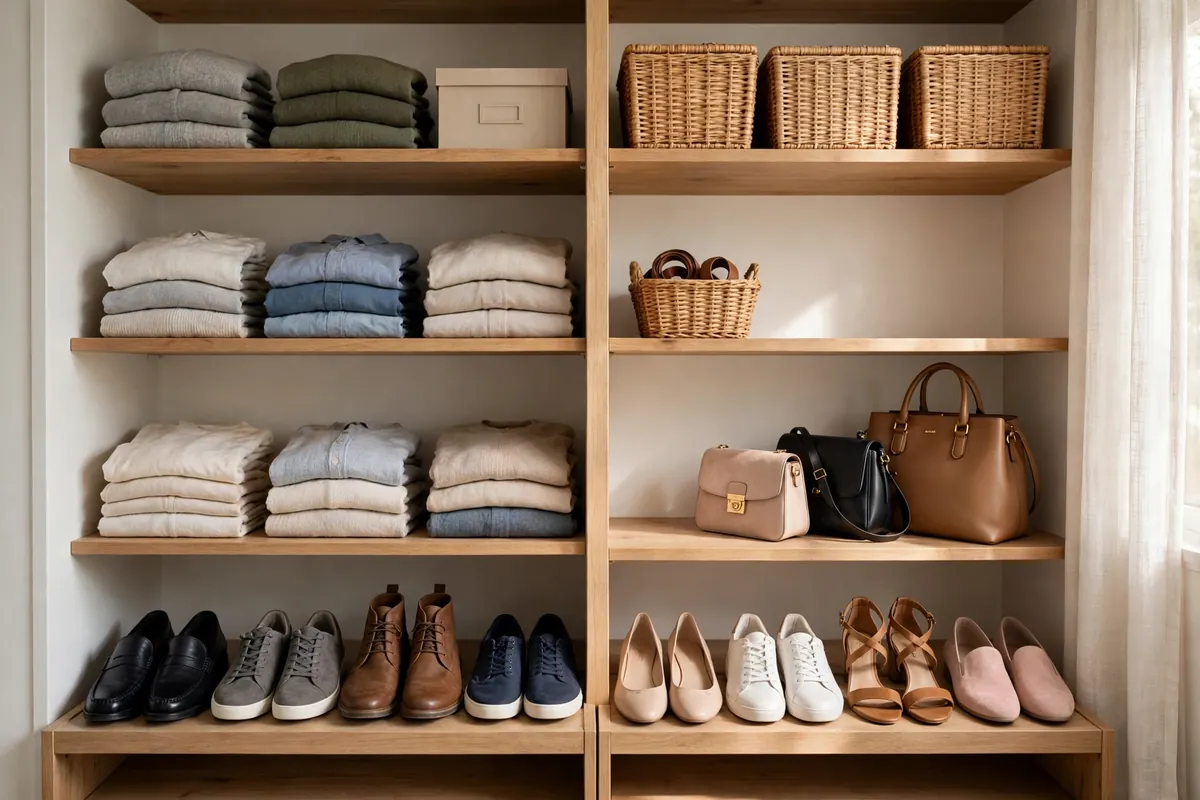
If shoes are the main source of friction in your house, you are not alone — it is the single most common shared-closet complaint. A clear cap and a divided rack turn it from an ongoing argument into a five-minute decision made once. And if the rest of your storage needs a rethink too, the principles in our closet shelf organization ideas will help you use every shelf for folded clothes, bags, and accessories without the stacks toppling over.
Make Mornings Work for Two Different Routines
A shared closet has to work at the worst time of day, not the best. If one of you rises at six and the other at eight, the early riser needs to reach their clothes without waking their partner or digging through the other person’s things. Give the earlier riser the side nearest the door and keep their everyday outfit toward the front of their zone. A small valet hook on the inside of the closet door — or a hook on the wall just outside — gives each person a place to hang tomorrow’s outfit the night before, which saves precious minutes and a surprising amount of morning grumpiness.
Think about lighting, too. A battery-powered LED strip or a small motion-sensor light inside the closet costs very little and makes a huge difference when one person is dressing in the dark. It also stops the classic mistake of grabbing a navy jumper in dim light and discovering at work that it is actually black — or the other way round.
Finally, agree on a home for the “half-worn” clothes. Every couple has them: the jeans that are too clean for the laundry basket but too worn to hang back with the fresh clothes. Without a plan, they end up on the chair, then the floor, then everywhere. One hook or one small basket per person, clearly labelled in your heads if not on the wall, solves it. Tomorrow’s outfit goes on the hook; yesterday’s jeans go on the other hook. The chair stays a chair.
Keep It Working With a Fifteen-Minute Monthly Reset
Even the best shared closet drifts. A sweater lands on the wrong shelf, a new jacket arrives without an old one leaving, and the boundary you marked so carefully starts to blur. The answer is not a bigger reorganization every six months — it is a tiny regular habit. Once a month, spend fifteen minutes together on one zone only: shoes this month, the top shelf next month, folded clothes the month after.
During the reset, return anything that has migrated to the wrong side, pull out anything worn out or unworn for a season, and check whether the split still matches your wardrobes. Wardrobes change — a new job, a new hobby, a new season — and the closet should change with them. A ratio that was fair in January might not be fair in July, and that is fine. Adjusting the split twice a year is part of the system, not a sign that it failed.
Seasonal rotation belongs in the same habit. When the weather turns, swap the off-season clothes into labelled bins on the top shelf or under the bed, and bring the current season forward. Doing it together, twice a year, takes an hour and keeps the daily closet at half its usual volume. Our seasonal closet rotation ideas walk through the swap step by step, including how to store woollens so they survive the summer in good shape.
Start with the clear-out, divide by what you actually own, give each person a visible zone, double your hanging space, tame the shoes, and protect your mornings. Do those six things and the closet stops being the place where the day starts badly. It becomes what it should have been all along: a small, calm, shared space that quietly makes both of your lives easier, every single morning.