
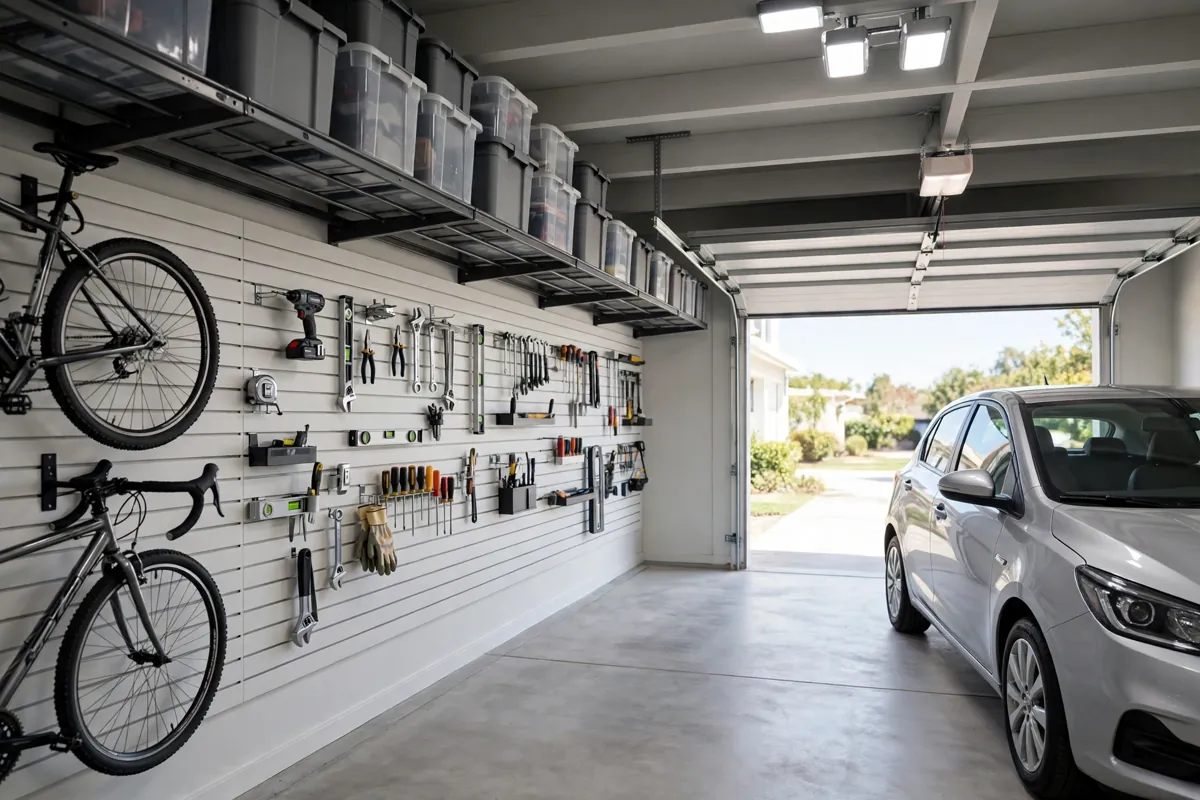

Open the garage door on a Saturday morning and what do you see? If yours looks anything like most small garages, it is a car squeezed between cardboard boxes, a bike leaning where it should not be, and a shelf of paint cans you forgot you owned. The good news is that small garage storage ideas are not about buying a bigger garage — they are about using the garage you already have far more cleverly. With a bit of planning, the same four walls can hold your tools, your sports gear, your seasonal boxes, and still leave room to actually park the car.
The secret is simple: in a small garage, the floor is the scarcest resource and the walls and ceiling are the most wasted. Once you shift your thinking from “where can I put this on the floor?” to “where can this hang, hook, or live overhead?”, the whole space opens up. This guide walks through the ideas that genuinely work in tight garages — the ones real homeowners stick with, not the ones that look tidy for a week and collapse by Christmas.
Start by Clearing the Floor — Before You Buy a Single Hook
It is tempting to rush out and buy shelving the moment you decide to organize. Resist it. Organizing clutter you do not need is just expensive tidying, and in a small garage every square foot counts double. Pull everything out of one section at a time — never the whole garage at once, or you will end up with a driveway full of boxes and a rainstorm on the forecast.
Sort as you go into four piles: keep, donate, sell, and toss. Be honest about the duplicates. Two half-empty tins of the same paint, three garden hoses with one good one among them, a broken strimmer you keep meaning to fix — these are the things eating your floor space. If something has not been used in a year and has no clear job ahead, it is a candidate for the donation pile. Our garage decluttering guide walks through this first clear-out step by step, and it is worth doing properly before you spend a penny on storage.
Once you can see the bare walls and the actual floor, measure. Note the ceiling height, the space above the garage door tracks, the width of each wall, and where the car doors swing. A quick sketch on a scrap of paper — even a rough one — saves you from buying a rack that blocks the door or a cabinet the car door smacks into every morning.
Small Garage Storage Ideas That Put Your Walls to Work
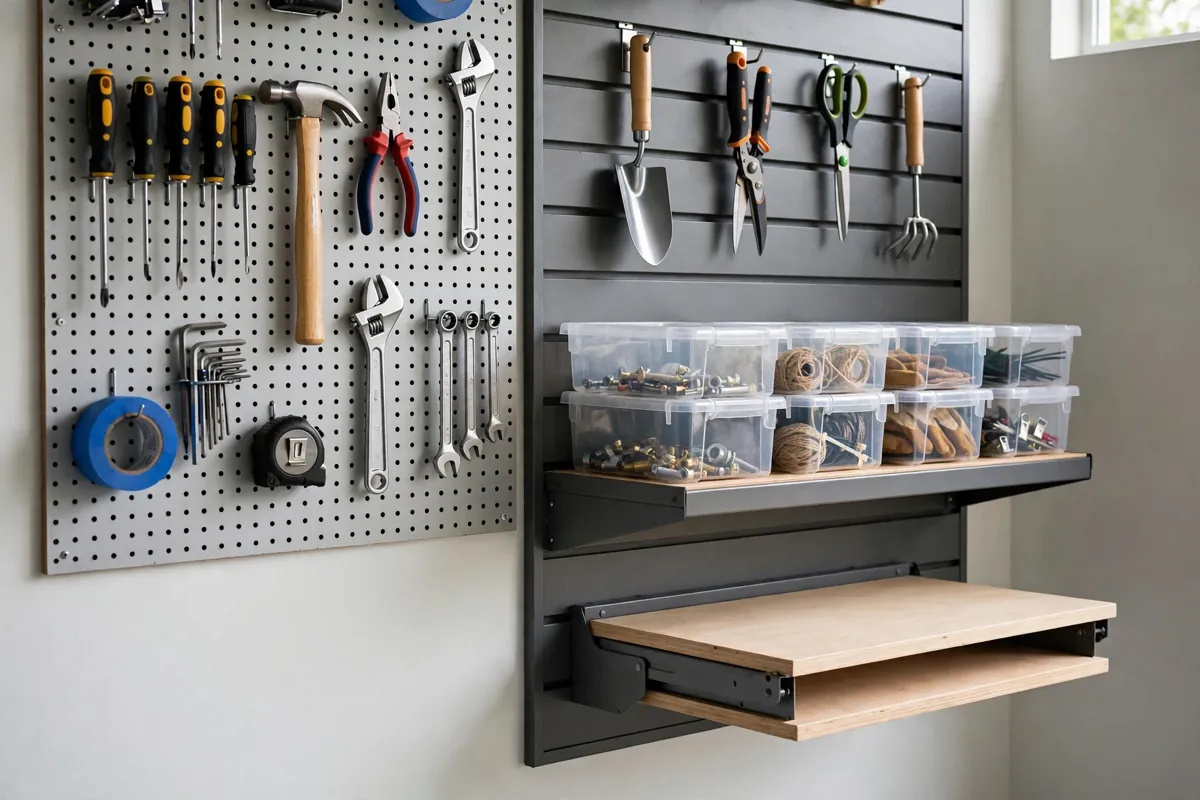
Your walls are the single biggest storage asset in a small garage, and most of them sit empty above waist height. A slatwall panel or a sheet of pegboard turns a blank wall into a flexible tool station: hooks for hammers, wrenches, and garden tools, small baskets for screws and spray cans, and a shelf or two for the things you grab weekly. The beauty of both systems is that you can move hooks around as your needs change, without drilling a new hole every time.
Think in height bands when you plan a wall:
- Eye level and above: tools, garden gear, and anything you reach for often. If you cannot see it, you will not use it.
- Waist to knee height: heavier items in cabinets or on sturdy shelves — paint tins, car-care supplies, and toolboxes.
- Floor level: only things on wheels or in daily use. Everything else hanging or shelved is floor space you have won back.
For a workbench, consider a fold-down version that mounts to the wall and folds flat when you are done. It gives you a proper surface for weekend projects without permanently surrendering two square metres to a bench you use twice a month. A rolling tool chest is another smart buy for tight garages: wheel it out when you are working, tuck it against the wall when you are not.
And do not ignore the wall above and beside the garage door itself. Slim cabinets or a row of hooks there can hold ladders, long-handled tools, and hoses that otherwise lean in corners and fall over at the worst moment.
Look Up: Overhead Storage for the Stuff You Rarely Touch
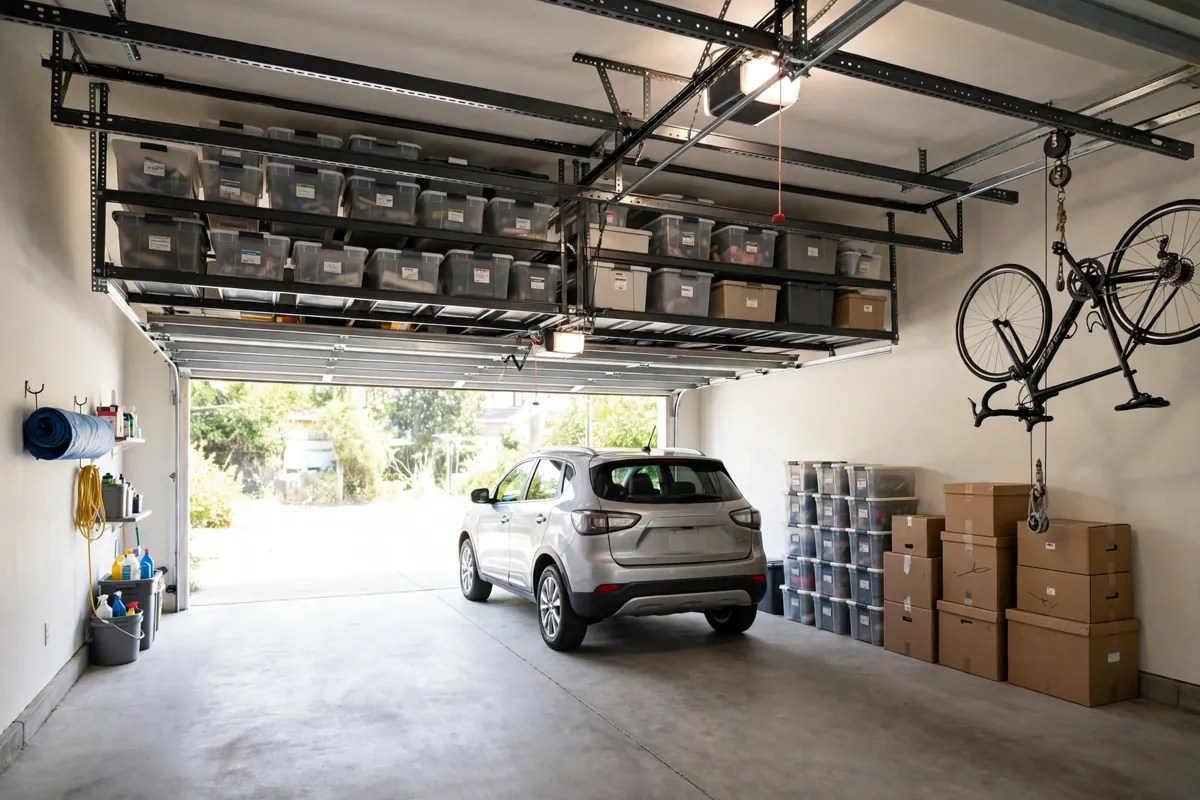
The ceiling is the most underused square footage in any garage. Overhead racks mounted into the ceiling joists can add the equivalent of a whole extra closet without touching a single centimetre of floor. They are ideal for the things you need twice a year: holiday decorations, camping gear, suitcases, and the box of winter coats that only comes down in November.
A few rules keep overhead storage safe and genuinely useful:
- Anchor into joists, never just plasterboard. A loaded rack is heavy, and a ceiling failure is dangerous as well as messy.
- Use sturdy bins with lids, clearly labelled on the side facing out. You will be looking up at them from a step ladder, so big, bold labels matter.
- Keep the weight sensible. Check the rack’s rated capacity and do not exceed it — and store the heaviest bins lowest, nearest the wall, where the structure is strongest.
- Keep a step ladder in the garage, in a fixed spot. If reaching the racks is a chore, you will stop using them and the clutter will creep back to the floor.
Bikes are another classic ceiling candidate. A simple pulley hoist lifts a bike flat against the ceiling, freeing the wall and the floor at once. In a one-car garage, hoisting two bikes overhead can be the difference between parking inside and parking on the street all winter. If ceiling height is tight, wall-mounted vertical bike hooks are the next best thing — they hold a bike by one wheel, flat against the wall, in a strip barely wider than the handlebars. For more bike-specific tricks, our small apartment bike storage ideas cover hooks, hoists, and slim racks that translate perfectly to a small garage.
Zones: Give Every Category One Home
The garages that stay tidy are not the ones with the most shelving — they are the ones where everything has exactly one home, and everyone in the household knows where it is. Divide your garage into zones by how you actually use it. A typical small garage needs only four or five:
- Car zone: the parking footprint itself, kept completely clear. Tape lines on the floor can help younger drivers park in the same spot every time.
- Tools and projects zone: the pegboard wall and workbench area, with hand tools, power tools, and hardware together.
- Sports and play zone: balls, helmets, scooters, and outdoor toys in one stretch of wall, ideally at a height children can reach themselves.
- Garden zone: rakes, spades, and pots near the door you use for the garden, so muddy boots and tools never trek through the house.
- Seasonal zone: the overhead racks and highest shelves, for everything you touch a few times a year.
Zones also stop the most common garage problem: the slow drift. When the sports gear has a home, a football does not end up on the workbench. When the garden tools live by the garden door, they do not migrate to the car zone. And when something has no zone at all, that is your signal to ask whether it belongs in the garage in the first place. Bulky items you rarely use may be better off elsewhere — if you are weighing up off-site options, our guide to decluttering a storage unit covers the same keep-or-let-go decisions on a bigger scale.
Small Garage Storage Ideas for Awkward Corners and Tight Spots
Every small garage has dead space: the narrow strip beside the door, the corner behind the car, the wall under a window. These spots are too small for a shelf unit, but they are perfect for specific jobs.
The strip beside the garage door, for instance, is ideal for a tall, slim cabinet or a row of vertical hooks for brooms, mops, and long-handled tools. Corner shelves — even simple triangular boards screwed into the studs — turn a wasted corner into a home for paint tins and car-care bottles. Magnetic strips mounted near the workbench hold screwdrivers, drill bits, and pliers in plain sight, so you stop losing the one tool you need mid-project.
Clear, stackable bins are the workhorse of small garage storage, and they deserve a proper mention. Choose one size and stick with it: uniform bins stack safely, label cleanly, and look calmer than a jumble of mismatched boxes. Transparent bins let you see what is inside at a glance; if you prefer solid bins, label the short end as well as the lid, because stacked bins show their ends, not their tops. Group bins by zone — “Camping”, “Christmas”, “Car Care” — and keep a permanent marker and a roll of tape in the garage so labelling a new bin takes thirty seconds, not a special trip.
One more underused trick: the space under the stairs, if your garage shares a wall with them, or the inside of the door to the house. A shoe rack or a row of hooks on the house door creates a mudroom-style drop zone for coats, bags, and dog leads, which keeps all of it out of the hallway and out of the car zone. If you have stairs inside the house, the same thinking applies — our under-stair storage ideas show how dead space anywhere in the home can be put to work.
Keep It Working: The Habits That Stop the Creep
Here is the honest truth about garage organization: the system is the easy part, and keeping it is the hard part. Garages are the default dumping ground of every home — the place where things go when they have nowhere else to go. Without a few small habits, even the best layout will be buried again within a year.
Build three habits and the system largely maintains itself. First, a ten-minute weekly reset: walk the zones, return anything that drifted, and sweep the floor. Second, a “one in, one out” rule for bulky items — a new bike means an old one leaves, a new tool chest means the broken one goes. Third, a donation box kept permanently in one corner, emptied once a month, so getting rid of something is easier than stacking it “just for now”. Seasonal changeovers are a natural moment for a deeper tidy: when the camping gear comes down in spring, check the seasonal bins before they go back up in autumn.
It also helps to protect what you store. Keep chemicals and paints in a locked cabinet if children use the garage, store anything pest-prone in sealed bins rather than cardboard, and keep a dehumidifier or at least good ventilation going if damp is an issue — a beautifully organized garage is no good if the boxes inside it go mouldy.
A Garage That Works as Hard as You Do
A small garage does not need to feel small. When the tools are on the wall, the seasonal boxes are overhead, the bikes are hoisted, and every category has its own zone, you get back something more valuable than storage: room to move, to work, and to park without a three-point turn around a pile of boxes. Start with the clear-out, put the walls and ceiling to work before you buy anything bulky, and keep the weekly reset sacred. Do that, and the garage stops being the room you avoid — and becomes one of the hardest-working rooms in the house.