
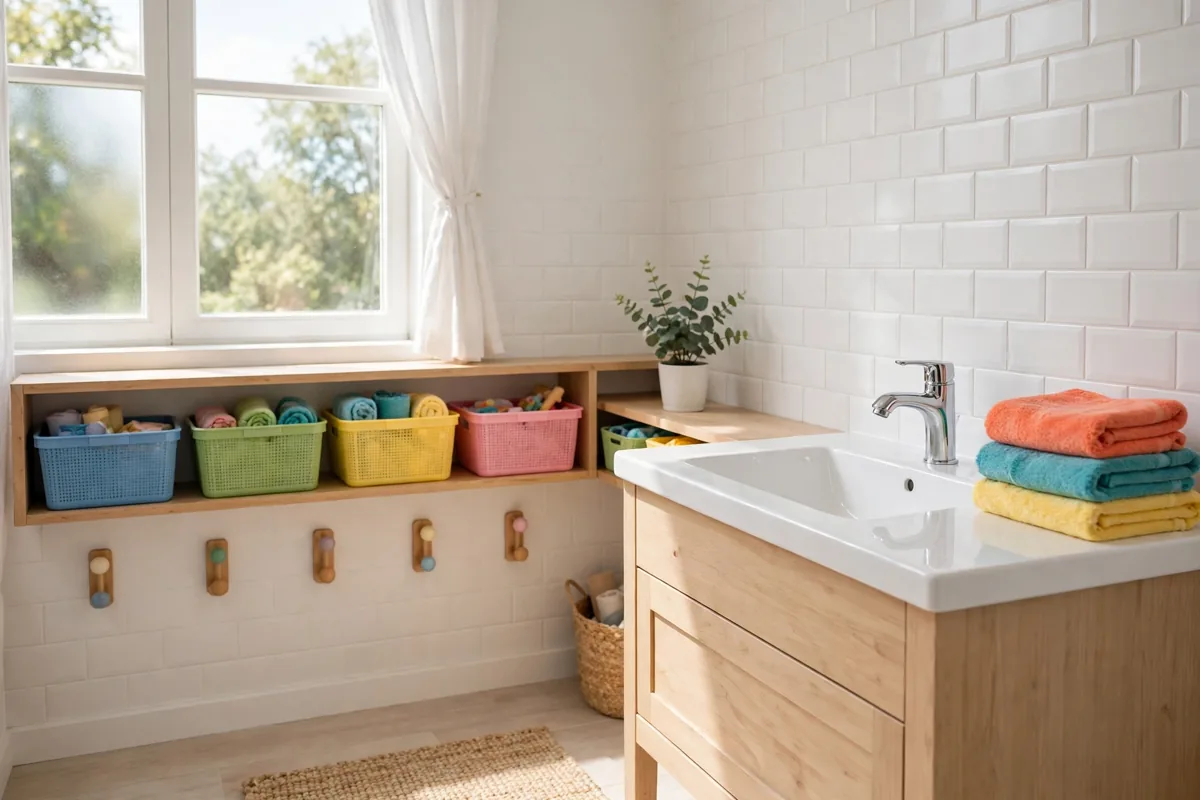

If your mornings feel like a race against a missing toothbrush, a wet towel on the floor, and a small person who insists they cannot find their socks — even though the socks are right there — you are not alone. Good kids bathroom organization ideas are not about a showroom-perfect space. They are about making the everyday stuff easy enough that a child can actually do it alone, without you standing in the doorway giving directions like a traffic warden.
When a bathroom works for children, mornings get calmer, bath time gets less chaotic, and you stop buying replacements for things that were never really lost. The trick is to design for small hands, short attention spans, and real family life: damp towels, toothpaste on the mirror, bath toys that seem to multiply overnight. Here is how to do it, room by room, habit by habit, in a way that survives a school week.
Kids Bathroom Organization Ideas That Start With Their Height
Most bathroom storage is built for adults, which is why children end up climbing counters, pulling drawers open with wet hands, and abandoning the whole system. Start by standing in your bathroom and looking at it from about three feet high. What can a child actually reach without help? That is where their things belong.
A sturdy, non-slip step stool is the single most useful purchase for a shared family bathroom, especially if you have a toddler or a younger primary-school child. Choose one with a wide base and rubber feet, and keep it in the same spot every day so it becomes part of the routine rather than another thing to trip over. Pair it with a mirror at child height if you can — a small suction-cup mirror stuck lower on the wall lets children see what they are doing when they brush their teeth, which makes them far more willing to do it properly.
Next, move their daily essentials down. Toothbrushes, toothpaste, a hairbrush, and a cup for rinsing should live in one small caddy or cup on the counter, not scattered across a shelf. If siblings share a bathroom, give each child a different coloured cup or caddy. It sounds simple, but colour-coding removes about half of all bathroom arguments in our house — nobody can claim the blue cup is theirs when it clearly belongs to someone else.
For drawers, the same principle applies. Keep the top drawer, or at least the front section of it, for children’s items, and use small dividers so hair ties, clips, and combs do not migrate into one tangled corner. If you are starting from scratch with drawers, these bathroom drawer organization ideas are a good place to borrow a layout that actually holds up once children get involved.
Make Towels and Clothes Easy to Put Away
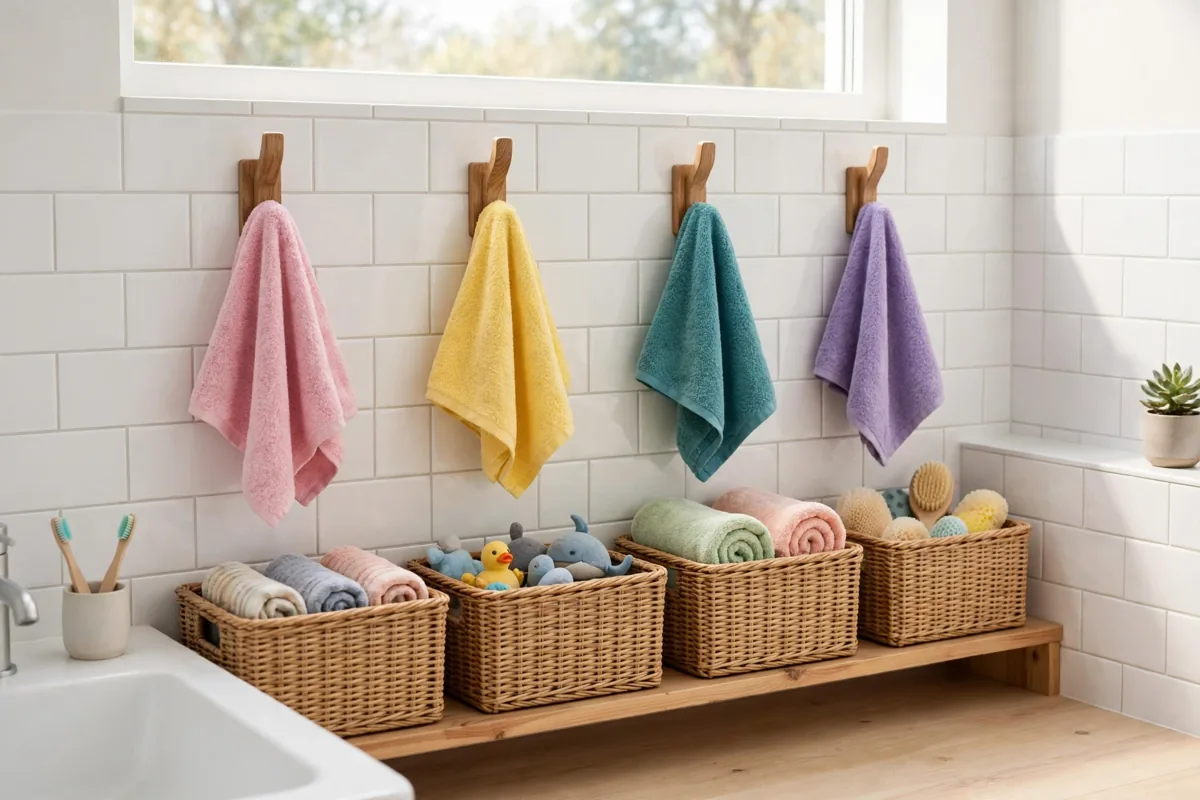
Towels are where most kids’ bathroom systems fall apart. A towel bar looks tidy, but folding a wet towel neatly onto a bar is a fiddly job for a seven-year-old, and an impossible one for a four-year-old. Hooks, on the other hand, are forgiving. A child can hang a towel on a hook in two seconds, and it will still dry reasonably well.
Install hooks at child height — roughly shoulder height for your youngest regular user — and give every family member their own hook, ideally in their own colour. Space the hooks far enough apart that damp towels are not pressed together, and keep them near the bath or shower so a wet child does not have to trail water across the room. A row of adhesive hooks works well in a rental, while screw-in hooks are sturdier for heavier bath towels.
For more towel storage inspiration that works in real, busy bathrooms, these bathroom towel storage ideas that actually work in real bathrooms cover everything from rolled towels in baskets to over-door racks that keep spares close without cluttering the room.
Clothes are the other morning culprit. If your child gets dressed in or near the bathroom, add one small hook or basket for pyjamas. A child who has somewhere obvious to put last night’s pyjamas is far less likely to leave them in a heap on the bathroom floor. Some families use a small labelled basket per child on a low shelf; others hang a simple canvas bag on the back of the door. Either way, the rule is the same: one obvious home for one category of thing.
It also helps to keep a small laundry basket or hamper inside or just outside the bathroom door. When dirty clothes have to travel down the hall to a laundry room, they rarely make it. When the basket is right there, even a reluctant child can manage the two-step journey from body to basket.
Bath Time Storage That Dries Properly
Bath toys are joyful and, left in a pile, genuinely unpleasant. They go slimy, they smell, and they hide the plug. The fix is drainage. Every bath toy needs a home that lets water escape, and that home needs to live where the toys are used — in or right beside the bath.
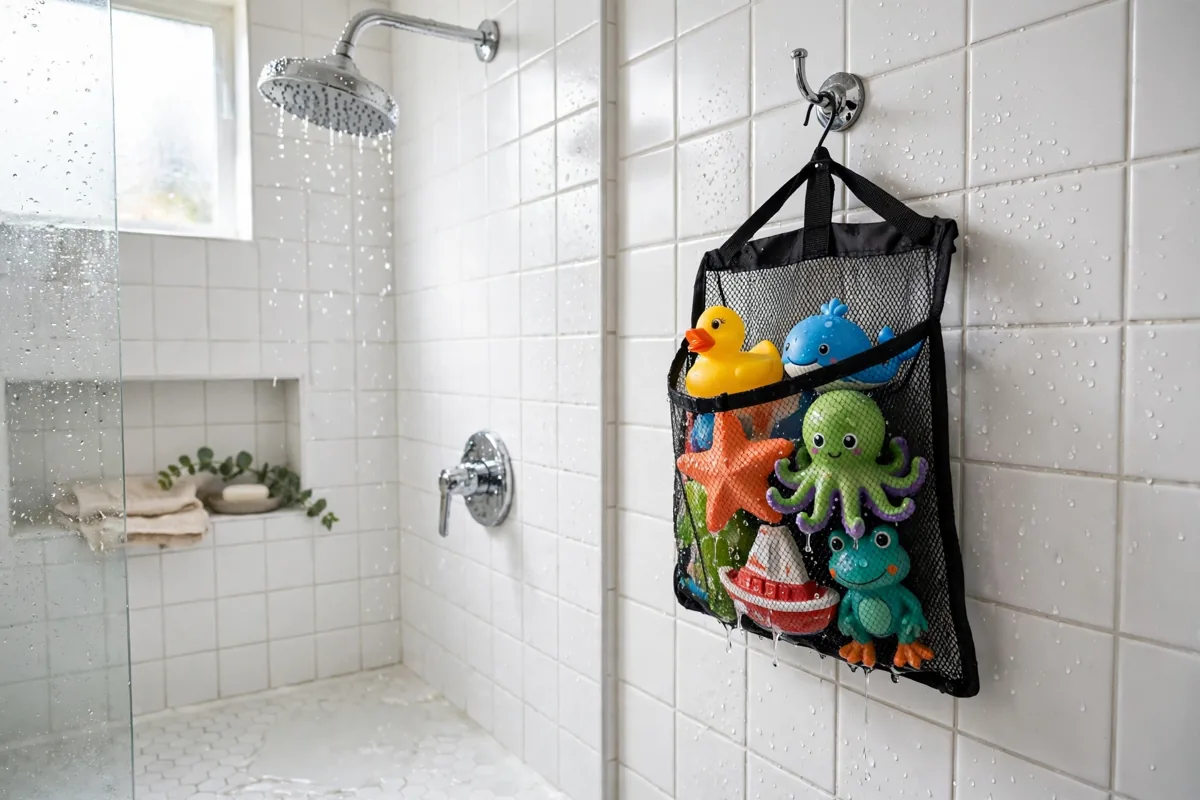
A mesh bag with suction cups is the cheapest option that actually works. Hang it on the tiled wall at the end of the bath, and make tidying up part of the bath-time routine: toys go in the bag before the water drains. A mesh organizer with separate pockets is even better if you have a lot of small toys, because it stops everything from sinking into one soggy lump at the bottom. For families with a shower rather than a bath, a hanging mesh caddy over the showerhead or a suction-cup basket at child height does the same job.
If your shower itself needs a rethink, these shower organization ideas that actually work include caddies and shelves that keep shampoo, soap, and toys off the floor and within reach, which matters just as much for children as it does for adults.
Two habits keep bath storage from turning into a science experiment. First, once a week, tip the toys out, rinse the bag or basket, and let it dry fully — a quick job while the bath is being cleaned. Second, keep the collection small. If a toy has not been played with in a month, or if it has a mouldy squeaker that will not come clean, let it go. Children rarely miss the tenth rubber duck, and a smaller collection is one they can actually tidy themselves.
For bath products, a small shower caddy or a shelf at child height lets older children wash their own hair and reach their own soap without asking for help every two minutes. Keep grown-up products — razors, strong treatments, anything you do not want little hands exploring — on a high shelf or in a closed cabinet. Safety and tidiness go together here: when children’s things are low and adults’ things are high, everybody knows the boundaries without a lecture.
Under the Sink and Behind Closed Doors
The space under the bathroom sink is often wasted on cleaning products and a tangle of pipes, but with a little thought it can hold a surprising amount of children’s overflow: spare toothbrushes, extra shampoo, nappies or pull-ups for younger children, and a small first-aid kit. The key is to keep it accessible without letting it become a dumping ground.
Start with a small turntable or a couple of stackable bins under the sink. One bin for spares, one for cleaning supplies that are safe to keep low, and nothing else. If your under-sink area is awkwardly shaped around pipes, a tension rod across the cabinet can hold spray bottles by their triggers, freeing the floor of the cabinet for bins. Keep anything hazardous — bleach, medicines, sharp items — in a high cabinet or a locked box, never under the sink where a curious toddler can reach it.
These under-sink bathroom storage ideas are worth a look if your cabinet is currently more mystery than storage, with practical layouts for pedestal sinks, vanities, and small awkward spaces alike.
Closed storage matters more in a kids’ bathroom than in an adults’ one, because children are visual creatures. If they can see ten bottles, they will want to open ten bottles. A cabinet with doors, a lidded basket, or even a simple curtain over an open shelf reduces temptation and makes the room look calmer instantly. Reserve open baskets and caddies for the handful of things children use every day, and hide the rest.
Label everything, even if you think your children cannot read yet. Picture labels work brilliantly for pre-readers: a photo or simple drawing of a toothbrush on the toothbrush bin, a towel on the towel basket. Older children can help make the labels, which makes them far more invested in using them. A label maker is nice, but masking tape and a marker do the same job for free, and children love choosing the colours.
Routines That Keep the System Working
The best storage in the world will not survive without a routine, but the routine does not need to be complicated. In fact, the simpler it is, the more likely a child is to follow it. Aim for three tiny habits, repeated at the same time every day, until they become automatic.
- Morning: brush teeth, wash face, hang towel on your own hook, pyjamas in the basket.
- After bath or shower: toys in the mesh bag, towel on the hook, wet floor wiped with the hand towel if needed.
- Evening: toothbrush back in the cup, hairbrush in the caddy, tomorrow’s clothes laid out if that is your family’s habit.
Charts help younger children, especially if they get to tick off each step themselves. A small whiteboard on the bathroom door, a printable chart with pictures, or even a row of magnets they move from “to do” to “done” turns a chore into a game. Keep the chart to five steps or fewer — a long list feels like homework, and nobody wants homework in the bathroom.
It is also worth doing a two-minute reset together once a week. On a Sunday evening, for example, you and your child can put stray items back, wipe the counter, and check whether anything has run out. Framing it as “our bathroom check” rather than “tidying up” makes it feel shared, and it catches small problems — an empty soap dispenser, a missing hair tie — before they become Monday-morning emergencies.
Finally, be realistic about what “tidy” means with children in the house. A kids’ bathroom will never look like a hotel bathroom, and it does not need to. Success is a towel on a hook instead of the floor, a toothbrush in a cup instead of the sink, and a child who can find their own things without shouting for help. That is a calmer morning, a calmer bath time, and a bathroom that works for the whole family — which is the whole point.
A Calmer Bathroom Is a Kinder Morning
Organizing a kids’ bathroom is really about giving children independence in small, manageable doses. When their towel has a hook they can reach, their toothbrush has a cup they recognize, and their toys have a bag that drains, they stop needing you for every step — and you stop starting the day frazzled. Start with one change this week, whether that is a row of low hooks or a single labelled bin, and let the habit grow from there. Small systems, kept consistently, are what turn chaotic mornings into calm ones, one toothbrush at a time.