
If you have ever dusted a room on Saturday morning only to find a fresh grey film settling on everything by Tuesday, you are not doing anything wrong. You are simply cleaning without a system. A dust-free home routine is not about marathon cleaning sessions or chasing every speck with a feather duster. It is about doing the right small things, in the right order, often enough that dust never gets a proper foothold. For anyone who wakes up sneezing, rubs itchy eyes at their desk, or hears their kids cough through the night, that kind of consistency changes daily life in a very real way.
Here is what most of us get backwards: we treat dusting as a reaction. We notice the dust, we wipe it, and we move on. But household dust is not just dirt. It is a mix of dead skin cells, fabric fibres, pollen tracked in on shoes, pet dander, and the droppings of dust mites. One thorough deep-clean a month barely dents it, because the whole lot rebuilds within days. What works instead is a short, repeatable rhythm that keeps allergens from ever accumulating to the point where your nose notices.
I learned this the hard way at home. Our dark sideboard showed dust within hours, or so I thought. Really, the problem was the ceiling fan above it, shaking a fresh grey layer down every evening while I was wiping the furniture below. Fix the order, and half the frustration disappears. That is exactly what this plan is about: order, tools that trap rather than scatter, and a weekly and daily rhythm you can actually keep.
The Golden Rule: Always Dust Top to Bottom
There is one principle that underpins every professional cleaner’s method, and it is the single biggest upgrade you can make to your dust-free home routine: always work from the highest surface down to the floor. Gravity is not optional. When you wipe a shelf, a fine cloud of dislodged particles settles downward. If you have already cleaned the floor, you will have to do it again. If the floor is still ahead of you, it simply catches everything in one pass.
In practice, a room takes this shape. Start with ceiling fans and light fixtures, then curtain rods, tops of wardrobes and bookshelves, then mid-level surfaces like desks, tables and windowsills, then skirting boards, and finish with the floor. A ceiling fan blade can hold a surprising felt-like mat of dust, and many people are amazed how much less dust appears on furniture once the fan stops redistributing it every evening.
Do the same with windowsills and vents. Air vents collect dust and release it back into the room the moment heating kicks on in autumn, so a damp wipe across vent covers once a month pays off enormously.
Dust the Right Way: Microfiber, Damp Cloths, and What to Skip
Your tools matter more than your effort. A dry cotton rag or an old feather duster is mostly a dust redistribution device: it lifts particles into the air, where they drift for a while and settle right back onto the surfaces you just cleaned. For an allergy-friendly home, that is the worst possible trade.
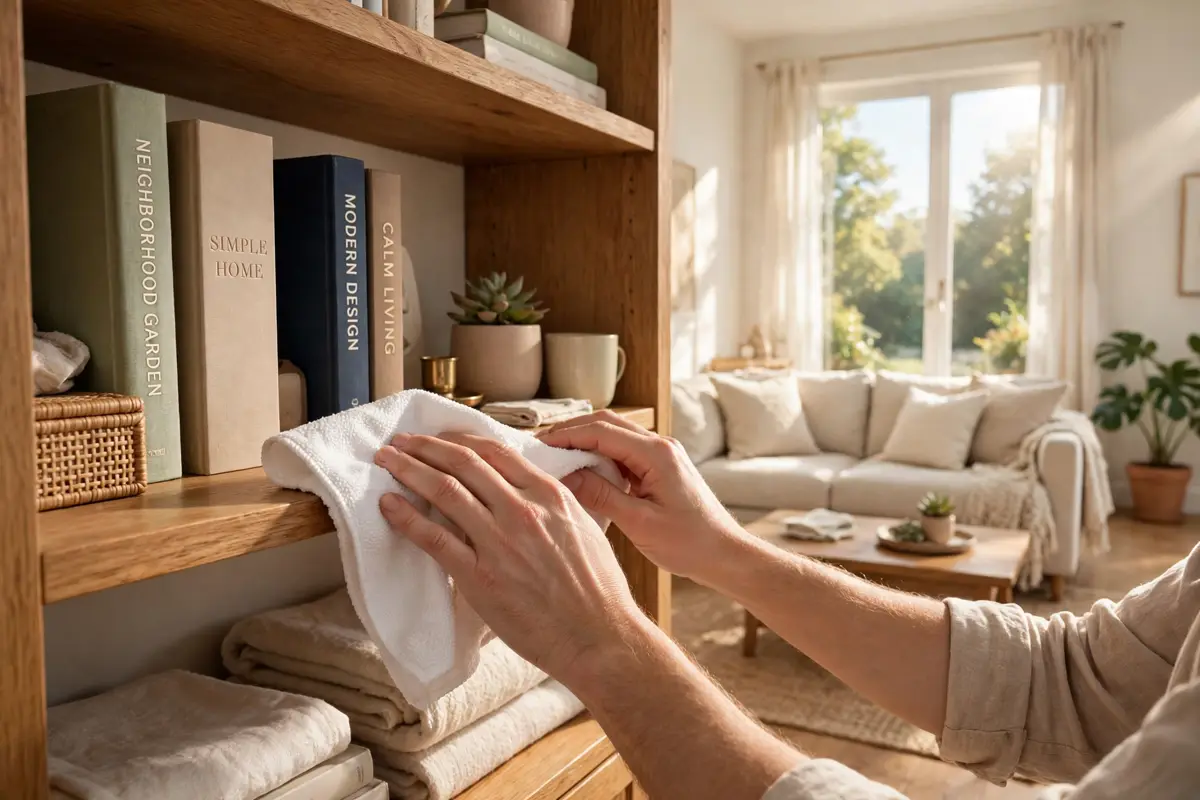
Microfiber cloths are the workhorse of any serious routine. The fibres are split so finely that they carry a slight electrostatic charge, which attracts and holds dust instead of flicking it around. Slightly dampening the cloth, wrung out so it feels barely moist, makes it even more effective at trapping fine particles. Keep a small stack of them under the sink, one for general dusting and one reserved for electronics and screens.
- Use damp microfiber for shelves, blinds, skirting boards and electronics. Dry microfiber is fine for light, fresh dust; damp is better for anything that has sat a while.
- Replace feather dusters with a lambswool or microfiber duster for hard-to-reach spots like ceiling corners and the tops of picture frames.
- Do not skip blinds and plant leaves. Horizontal slats and broad houseplant leaves are dust magnets; a damp cloth across them every couple of weeks keeps a surprising volume of dust out of the air.
- Wash your cloths properly. Rinse them after each use and launder them without fabric softener, which coats the fibres and kills the static charge. A cloth that pushes dust around is telling you it is exhausted, not that you need to press harder.
One more quiet dust source: open shelving packed with small decorative objects. Every knick-knack is another surface that needs wiping. You do not have to throw everything out, but thinning the displays and keeping the rest inside a glass-fronted cabinet genuinely reduces your weekly workload. It is also one of the reasons clearing bedroom floor clutter makes such a noticeable difference.
Vacuuming vs. Sweeping: What Actually Keeps Dust Down
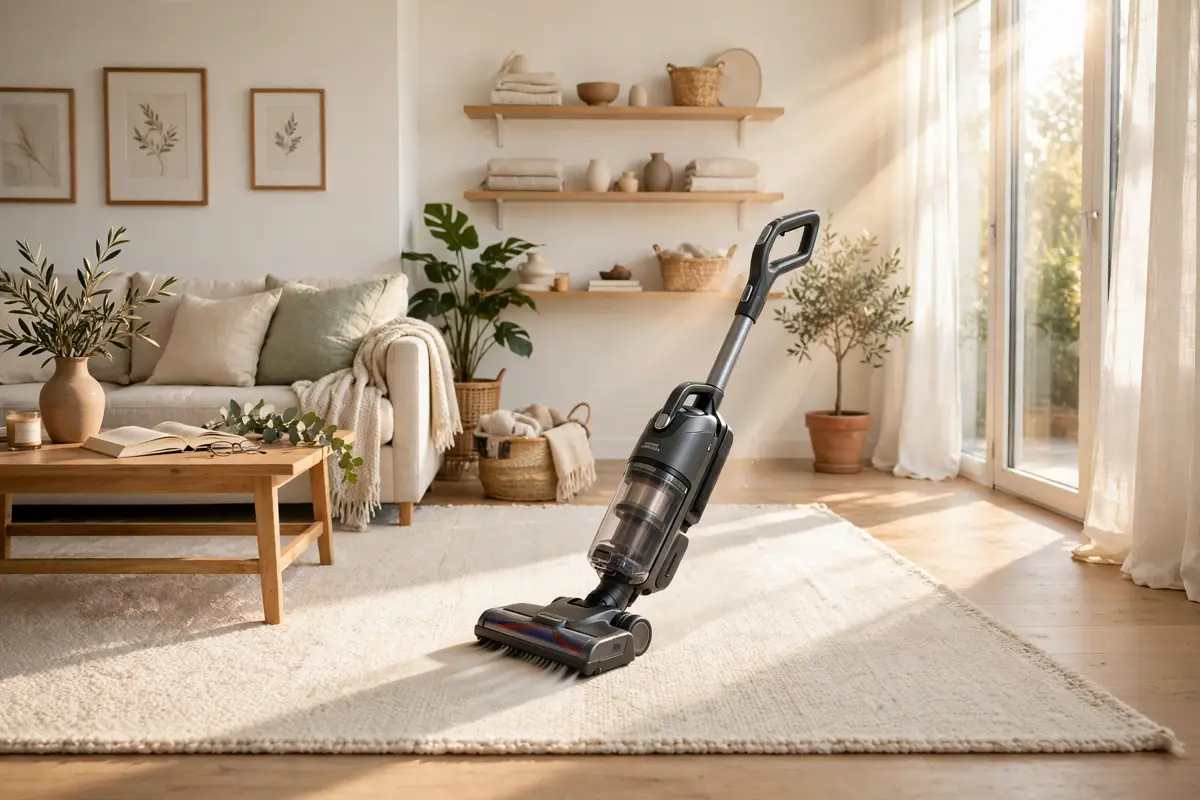
For allergy sufferers, this choice is not close. A broom sweeping a hard floor launches fine dust straight into the air, where it hangs for hours and ends up in your lungs and on your furniture. A vacuum with a proper sealed HEPA filter pulls particles out of the room and traps them, including the 0.3-micron particles that ordinary vacuums blow right back out the exhaust.
That said, technique matters as much as the machine. Move the vacuum slowly, especially on carpets and rugs. A fast pass looks impressive but leaves most of the dust seated deep in the fibres. Overlapping slow strokes, like mowing a lawn, lift dramatically more. Go over high-traffic areas two or three times a week, the rest of the house weekly, and do not forget under furniture and along the edges of the room, where dust settles in long lines that give themselves away when sunlight slants across them.
For hard floors, vacuum first with the hard-floor setting or a soft brush attachment, then damp-mop. A slightly damp mop catches the fine layer vacuuming leaves behind. Skip the dry sweep entirely as your main floor method, or use it only for visible crumbs you will immediately pick up. If you share a home with pets, a rubber-bristle broom or squeegee on upholstery and stairs picks up embedded hair surprisingly well before you vacuum.
One practical note: vacuuming briefly stirs up airborne particles, which is why people with strong allergies sometimes feel worse during the clean. If that is you, wear a simple dust mask while you vacuum, or have someone else do it and give the room twenty minutes to settle. And if your routine already includes a daily cleaning routine that actually sticks, fold one quick vacuum of the living room rug into it on alternate days rather than saving everything for the weekend.
Make the Bedroom the Cornerstone of Your Dust-Free Home Routine
You spend roughly a third of your life in bed, which makes the bedroom the highest-stakes room in the house for dust control. Dust mites thrive in warm, slightly humid bedding, and their droppings are one of the most common indoor allergy triggers there is. If your eyes are itchy and your nose is stuffed every morning but you feel fine at work, the bedroom is where your routine should hit hardest.
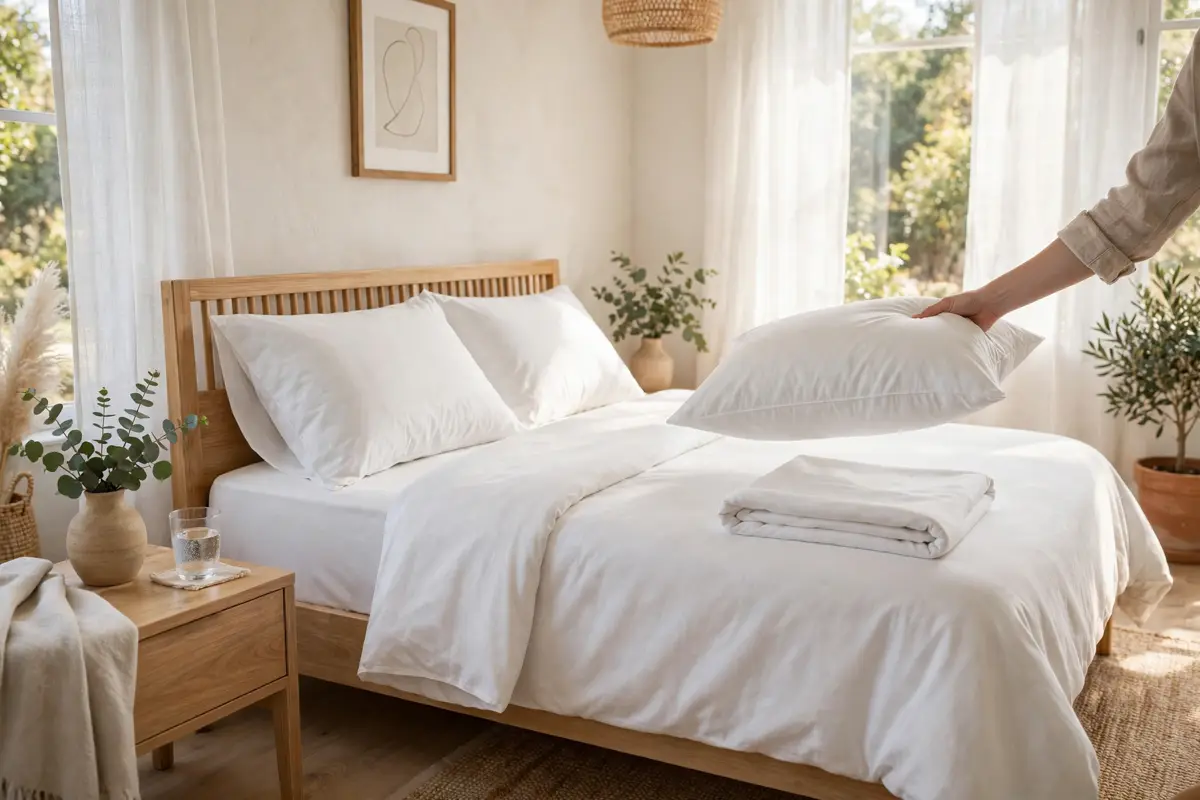
The non-negotiable habit is weekly bedding washes. Sheets, pillowcases and duvet covers go through hot water, at least 130°F (54°C), every single week. That temperature kills dust mites outright. If you can manage it, allergen-proof encasements on your mattress and pillows are one of the best investments an allergy sufferer can make: they form a physical barrier between you and the mite population living inside the mattress.
While the bedding is in the wash, use the opportunity well. Vacuum the mattress with the upholstery attachment, damp-dust the headboard and bedside tables, and vacuum under the bed where dust bunnies gather undisturbed for months. Wash the curtains or wipe the blinds monthly, since fabric near the bed collects pollen and dander fast. And try to keep the bedroom the least cluttered room in the house, which is why tidying the room first makes the ten-minute evening reset in the bedroom so effective.
Stop Dust at the Door: The Entryway Strategy
An astonishing amount of household dust is not generated inside your home at all. It rides in on shoes, coats, bags and pet paws: outdoor soil, pollen, road grime and leaf mould. The entryway is your border checkpoint, and whatever you fail to stop there gets walked, tracked and blown through every room in the house.
The simplest move is also the most powerful: take shoes off at the door. It takes a shoe tray or a small rack and about a week before it feels automatic, and it cuts the dirt entering your home dramatically. Keep a sturdy doormat on both sides of the entrance, a rough one outside for scraping and a softer absorbent one inside, and shake or vacuum both mats weekly.
Pets deserve a station of their own. A towel by the door for a quick paw wipe after walks, plus regular brushing, keeps a remarkable amount of outdoor pollen and loose dander from migrating onto your sofa. If you are already working on keeping a house clean with kids and pets, treat the entryway as the first domino: coat hooks instead of a chair piled with jackets, a lidded basket for hats and gloves, and a place for everything so dirt does not sit on a cluttered bench for days.
During high-pollen seasons, one extra step helps: change out of your outdoor clothes when you get home, and do not drape them over a bedroom chair. Pollen clings to fabric, and a coat that goes from a spring walk straight onto your bedside chair is delivering the outdoors to your pillow.
Your Daily and Weekly Dust-Free Home Routine at a Glance
Here is the part that makes it all stick: a rhythm simple enough to follow on your busiest week. Consistency is what separates a home that stays breathable from one that swings between spotless and dusty. These are the same daily and weekly layers you will find inside a weekly house cleaning schedule you can actually stick to, tuned specifically for dust control.
Every day (about 10–15 minutes total)
- Wipe kitchen counters and the dining table after meals, damp cloth, not dry.
- Quick-dust the living room’s highest-touch surfaces: the coffee table, TV stand, any shelf at arm height.
- Do the entryway once-over: shake the mat, wipe paw prints, put shoes on the rack.
- Make the bed, smoothing the covers so less skin and fibre debris collects underneath. A made bed also keeps loose bedding dust from settling on pillows during the day.
Every week (one focused session, roughly an hour)
- Dust the full room top to bottom: fan, shelves, blinds, windowsills, skirting boards, then floors.
- Vacuum all carpets, rugs and upholstery with slow, overlapping passes; damp-mop hard floors.
- Wash all bedding in hot water and vacuum the mattress.
- Vacuum entryway mats and under the main living-room furniture.
Every month (pick one weekend morning)
- Wipe air vents and change or clean the HVAC filter.
- Wash curtains, or deep-clean blinds, and wipe light fixtures.
- Move the big furniture and vacuum underneath and behind it.
- Check indoor humidity. Dust mites love damp air, so keeping it between 30% and 50%, with a dehumidifier in basements or bathrooms if needed, quietly suppresses the whole mite population.
A dust-free home routine is not really about dust. It is about mornings without the sniffles, evenings where the living room smells like nothing at all, and guests who notice the air feels fresh without knowing why. Nobody achieves this in a single weekend, and nobody needs to. The routine works because each piece is small: a damp cloth instead of a dry one, the fan before the floor, the mat at the door, the sheets every Sunday.
[…] this kit, a simple weekly pattern helps enormously, and you can build one around the ideas in this dust-free home cleaning routine without adding a single extra […]