
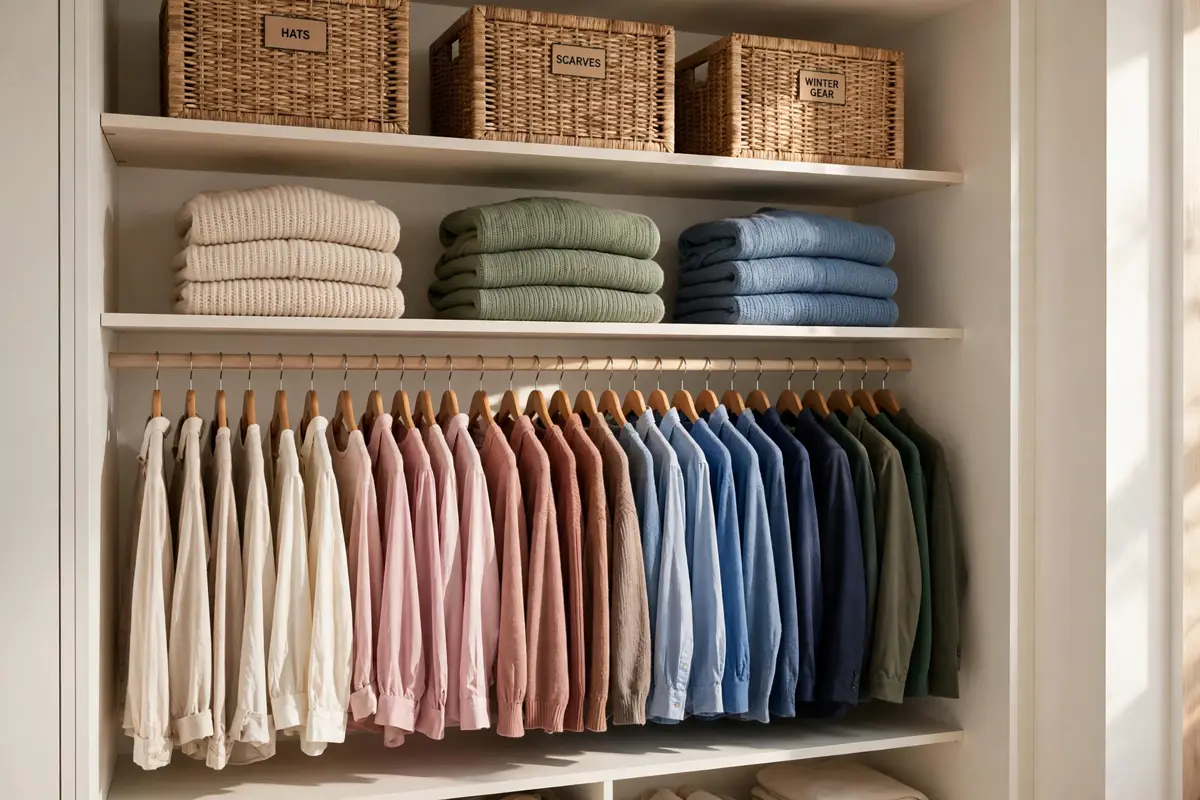

If your closet looks “organized” but getting dressed still feels like a daily battle, you’re probably making one or more classic closet organization mistakes — the same ones I see in almost every messy wardrobe, including my own before I learned better. The frustrating part is that most of these mistakes have nothing to do with how many storage products you own. They’re about how the space is used: rods stuffed past capacity, knits stretched on hangers, a layout copied from a builder’s cheapest default. The good news? Every single one has a fix, and most of them cost nothing but an afternoon. Here are the seven I see most often — and exactly how to fix each one.
Closet Organization Mistake #1: The Overstuffed Rod
The most common closet organization mistake is also the most honest one: trying to fit a whole wardrobe into a space that was built for half of it. When every hanger scrapes against its neighbor, nothing good happens. You can’t see the shirt in the back, so you buy another one just like it. Fabrics wrinkle against each other overnight, so that “ready to wear” blouse needs ironing anyway. And the whole thing sags — rods bow, hangers bend, and the closet slowly starts to feel like a storage unit instead of a place you get dressed in.
A closet works best when it’s about eighty percent full. That twenty percent of breathing room isn’t wasted space; it’s what lets you slide a hanger across the rod, spot the navy sweater behind the black one, and pull something out without a three-minute excavation. When I helped my sister redo her closet last spring, the single biggest transformation wasn’t a single new product — it was removing eleven shirts she hadn’t worn in two years. Suddenly the rod glided again.
The fix: Do a ruthless first pass before you buy anything. Pull everything off one section at a time and ask the two honest questions: Have I worn this in the last twelve months? Would I buy it again today? If the answer to both is no, it goes to donate, sell, or trash. Repeat until every hanger can move freely. Only then should you think about organizers.
Mistake #2: Hanging Everything (Including the Knits)
Here’s a closet organization mistake that quietly destroys clothes: treating every garment the same way. Chunky knit sweaters, heavy wool cardigans, and slinky silk tops all have very different needs, and jamming them all onto the rod creates two problems at once — stretched-out shoulders on your knits, and a rod that’s twice as crowded as it needs to be.
Sweaters are the worst offenders. A heavy cable-knit on a standard hanger will stretch at the shoulders within weeks, and there’s no way to undo it. Silks and satins slide right off regular hangers and pool in sad heaps on the rod. Meanwhile, every sweater you don’t hang frees up precious rod space for the things that genuinely need it.
The fix: Hang what must be hung — blazers, dresses, button-downs, trousers, blouses — and fold the rest. Knits, tees, and loungewear belong in neat stacks on shelves or in cubbies. If you want to do this properly, our guide to sweater storage ideas for a tidy closet walks through folding methods that keep knits from stretching and look genuinely good on open shelves. A folded sweater stack takes a fraction of the rod space and keeps your favorites in rotation instead of forgotten behind the coats.
Mistake #3: The Single-Rod Trap
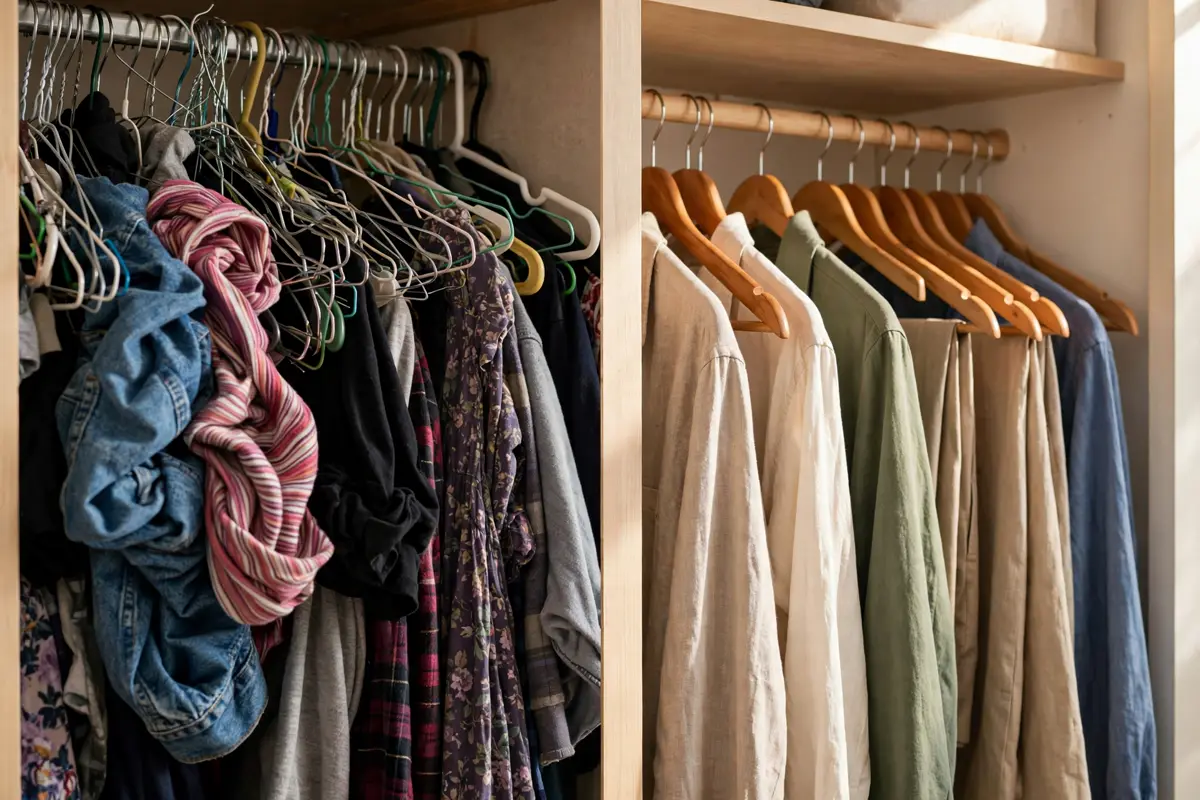
Most closets come with a tragic default layout: one long rod across the top, one lonely shelf above it, and a vast empty cavern below your hanging clothes. It’s the builder’s cheapest option, not a design decision — yet most of us organize around it for years, wondering why our “organized” closet still feels chaotic.
Do the math on wasted space. A pair of folded trousers hangs about 42 inches long. Shirts and folded pants need only 40 inches of clearance. So on a standard 8-foot wall, a single rod for mixed-length clothes wastes nearly half the vertical space below your short items. That dead zone becomes a pile — of shoes, bags, and things you’re avoiding dealing with.
The fix: Double-hang wherever you can. Two rods stacked in one section instantly double your capacity for shirts, blouses, folded trousers, and jackets. Reserve one taller section for long-hang items — dresses, full-length coats, robes. If you’re working with a standard narrow closet, our reach-in closet organization ideas break down exact rod heights and layouts that squeeze real storage out of small footprints. And don’t forget the floor below the short rod: that’s prime real estate for a low shoe rack or a rolling bin, not a junk drift.
Mistake #4: Organizing for the Life You Wish You Had
This one stings a little because it’s aspirational, and who wants to organize against their own aspirations? But think about it: if you work from home four days a week and your prime, eye-level closet real estate is occupied by a row of tailored blazers you wear twice a year, your closet is organized for a fantasy. Every morning you reach past the fantasy to get to the jeans and tees you actually live in — and every morning the space feels slightly wrong.
The same goes for sorting methods copied straight from a magazine. Organizing by color looks gorgeous in photos, but if you dress by occasion — gym, office, dinner — you’ll be hunting across six color groups every morning. The prettiest system in the world fails if it fights your habits.
The fix: Organize by frequency first, category second. The clothes you wear weekly live at eye level, in the easiest reach. Occasional pieces go higher or to the sides. Then sort within those zones whatever way matches your brain — by occasion, by outfit, by color. Test it for two weeks. If getting dressed feels easier, the system is right; if you’re still hunting, tweak it. A closet should serve your actual Tuesday morning, not your imagined one.
Mistake #5: Mismatched Hangers and Dungeon Lighting
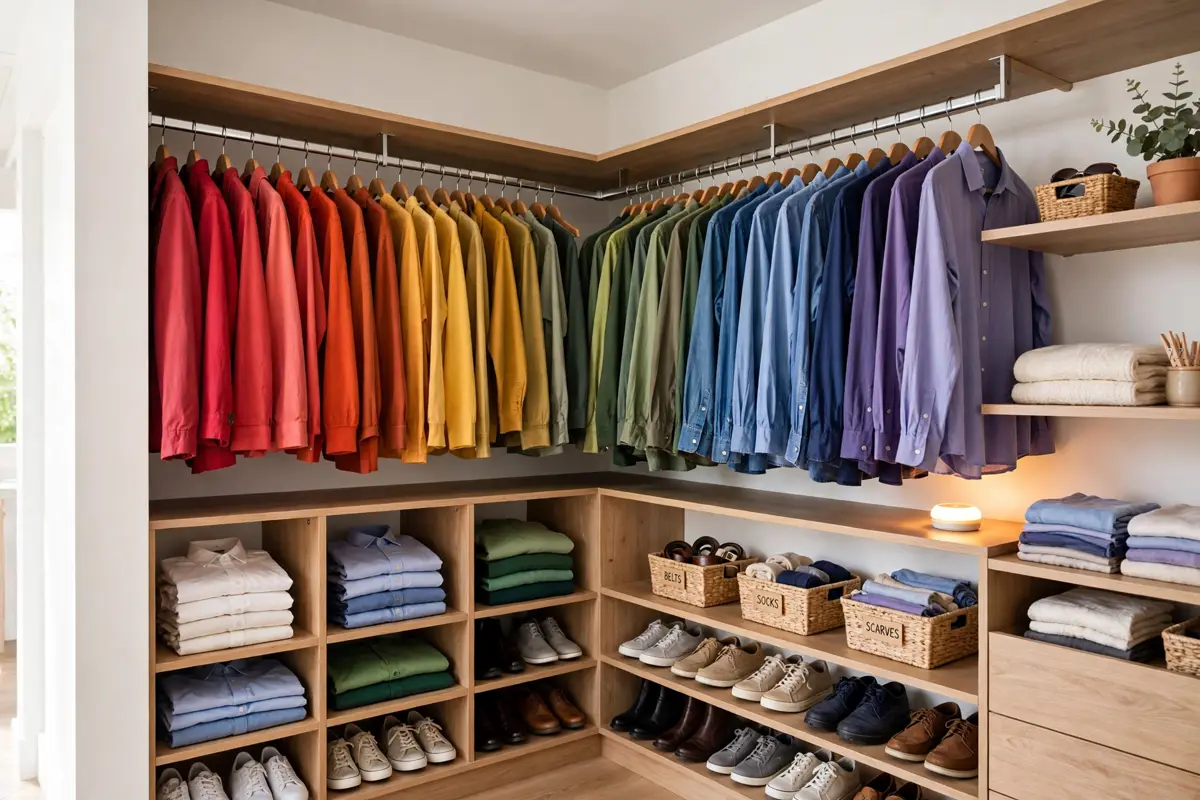
Walk into most closets and you’ll find a museum of hanger history: dry-cleaner wire, chunky plastic from a 2014 multipack, one wooden suit hanger, a velvet one with a broken hook. Clothes hang at different heights, catch on each other, and the whole rod looks chaotic even when everything technically has a place. It’s pure visual noise — and visual noise makes a closet feel messy even when it isn’t.
Then there’s the lighting, which is the closet organization mistake nobody talks about because it feels like a construction problem. One dim bulb, or worse, a bulb in the hallway outside. You can’t tell navy from black, you miss the stain on the sleeve, and the back corners become a dark zone where clothes go to be forgotten. A closet you can’t see clearly is a closet you can’t maintain.
The fix: Standardize your hangers. One type, one color — slim velvet hangers are the best bang for your buck because they grip clothes, save space, and look uniform. It sounds shallow, but a rod of matching hangers genuinely makes everything look calmer. For lighting, you don’t need an electrician: battery-powered LED puck lights or a motion-sensor strip turn a dim closet into a bright one in ten minutes. Our roundup of closet lighting ideas that make getting dressed actually easy has renter-friendly options that need zero wiring. Being able to see your whole wardrobe clearly changes how you use it.
Closet Organization Mistakes #6 & #7: Skipping Seasonal Rotation and Having No Reset Plan
These two travel together, and they’re the reason so many “organized” closets collapse by March. Mistake six is letting every season live in the closet at once — winter coats shoulder-to-shoulder with summer sundresses, all year. In any climate with real seasons, that doubles your crowding for no benefit. Mistake seven is treating closet organization as a one-time project instead of a habit. The big Saturday overhaul feels amazing, and then life happens: laundry piles up, new purchases sneak in without old ones leaving, and six months later you’re back where you started.
The pattern is painfully common. You spend a weekend making everything perfect, then feel too guilty to “mess it up,” so returns and puts-away start stacking on the dresser instead. Or you keep every season accessible because swapping feels like a chore — and pay for it with a rod that’s always full of clothes you can’t wear right now.
The fix: Build two tiny routines instead of one big one. First, rotate seasonally: when the weather turns, pack the off-season into bins or the back of the closet and bring the current season forward. Our seasonal closet rotation ideas make this a calm hour-long job instead of a dreaded weekend project. Second, run a five-minute reset every Sunday night — rehang strays, return folded stacks to their shelves, and pull one thing that’s worn out its welcome. The closet stays at eighty percent capacity by default instead of drifting back to chaos. Small maintenance beats heroic overhauls, every time.
Here’s the encouraging part: every one of these closet organization mistakes is fixable without a renovation, a consultant, or a cart full of matching bins. Most of them are free — they just need a Saturday afternoon and some honest decisions. Fix the crowding, hang only what should be hung, double up your rods, organize for your real life, unify your hangers, let in some light, and give the closet a five-minute weekly reset. Do that, and getting dressed stops being a treasure hunt. It becomes the calm little ritual it’s supposed to be.