

Here’s a confession: my home office used to embarrass me on video calls. It was the three-foot radius of chaos the camera couldn’t see. A teetering stack of unopened mail. A mug holding exactly one working pen and eleven dead ones. A drawer that had become a burial ground for cables I’d never plug in again. Every workday started with me shoving things aside to make room for my laptop, and I told myself I’d deal with it “this weekend” for about six weekends in a row. Learning how to declutter a home office the honest way changed everything — and this is the exact process I’d hand to a friend.
If any of that sounds familiar, this guide is for you. We’re not going to buy seventeen organizers first, and we’re not going to aim for a magazine-styled desk that nobody actually works at. The plan is simpler and more honest: one weekend, a clear sequence, and a room you can actually think in by Sunday evening.
Start With the Desk Surface, Not the Drawers
The biggest mistake people make when they set out to learn how to declutter a home office is starting with organizing instead of decluttering. There’s a real temptation to open a drawer, buy a tray that fits it perfectly, and feel productive while nothing actually leaves the room. Don’t do that. Start where your eyes land every morning: the desk surface.
First, grab three boxes or bags and label them Keep, Donate, and Trash — plus one extra bag for recycling, because an office generates a lot of paper waste. Set a timer for twenty minutes. Now clear the entire desk. All of it. Every paper clip, every sticky note, every half-empty water bottle, the mouse pad with the coffee ring, the stack of notebooks where you wrote three pages in the first one and abandoned the rest. Put the whole lot into a laundry basket off to the side so you’re looking at an empty desk for the first time in months.
Wiping that desk down before you put anything back is a small, satisfying reward, and it gives your brain the “this is really happening” signal it needs. From the basket, pick up each item one at a time and ask the only question that matters: do I use this for my work at least weekly? Your laptop, charger, lamp, one notebook, and one or two good pens pass. Almost everything else goes into Keep (but will live somewhere other than the desk), Donate, or Trash. The novelty candle your coworker gave you in 2023? Adorable, but it can live on a shelf — or go to someone who will actually light it.
Allow yourself one small “Undecided” box — with a hard two-week deadline. When you open it again, everything inside either gets a permanent home or leaves; without the deadline, it just becomes the new junk drawer with better branding.
How to Declutter a Home Office Paper Pile Without Drowning in It
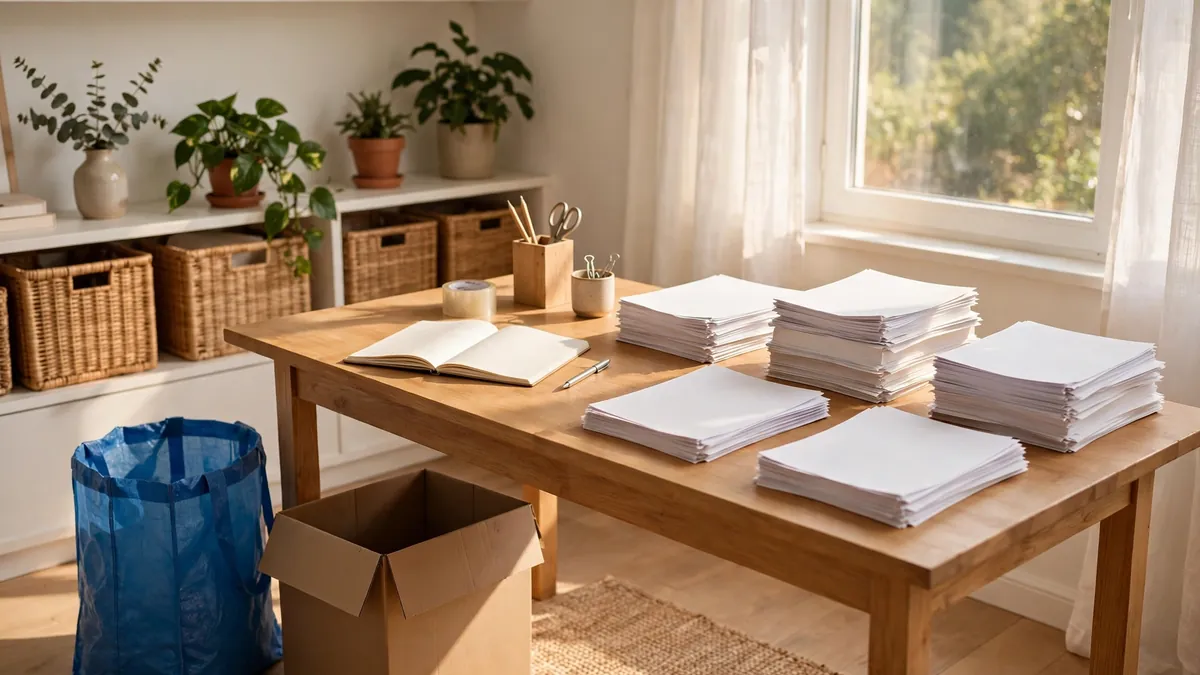
Paper is the boss level of home office clutter. It multiplies silently — a bank statement here, a warranty booklet there, school permission slips you definitely meant to sign, printed directions from a trip you took in 2021. Trying to file it all as you go is what created the pile, so we’re going to sort first and file almost nothing.
Gather every loose paper in the room into one pile. Yes, one — the under-desk stack, the papers shoved into the bookshelf, the envelopes balanced on the printer. Then work through it with four destinations:
- Action: things that require you to do something — pay it, sign it, reply to it. This pile should be tiny and goes into one inbox tray on your desk, nothing else.
- Reference: documents you genuinely need to keep and might look at again — tax paperwork, insurance policies, the lease. If the reference pile is huge, you’re keeping too much; most of it can live in a slim file box with broad labels like “Taxes,” “Home,” “Medical.”
- Digitize: manuals, receipts, kids’ artwork, old reference material — anything you’d keep “just in case” but would realistically search for on your phone. Snap a photo or scan it, name the file properly, and let the paper go.
- Recycle: junk mail, expired coupons, catalogs, duplicate insurance mailings, the instruction manual for the phone you no longer own. The recycle bag will probably be the fullest, and that’s a win.
One hard truth about papers: if you haven’t needed a piece of paper in a year, and it isn’t a tax document, a deed, or a birth certificate, you almost certainly never will. Shred anything with personal details, recycle the rest, and feel the lightness of a pile that no longer judges you. If paperwork is your particular nemesis, our guide to how to declutter paper clutter goes even deeper on taming mail, bills, and filing.
The Drawer of Mystery Cables and Other Tech Graveyards
Now, the drawer. You know the one. Open it and there’s a tangle of USB cables in three obsolete formats, a phone case for a phone you sold two years ago, earbuds with one dead side, a power strip with a missing switch, and at least one charger whose device you can’t name. Offices are where dead tech goes to retire without ever actually leaving.
Here’s the clearing protocol. Pull everything out onto the desk — yes, the whole spaghetti pile — and work through it one cable at a time. Test before you keep. Plug each cable into the device it claims to serve. If nothing in your home can use it (looking at you, mini-USB cables from 2012), it goes to electronics recycling, not the donate bag. Old phones, dead mice, the keyboard with the sticky spacebar: if it hasn’t worked in a year and you haven’t fixed it, it’s not “a backup,” it’s clutter with a story.
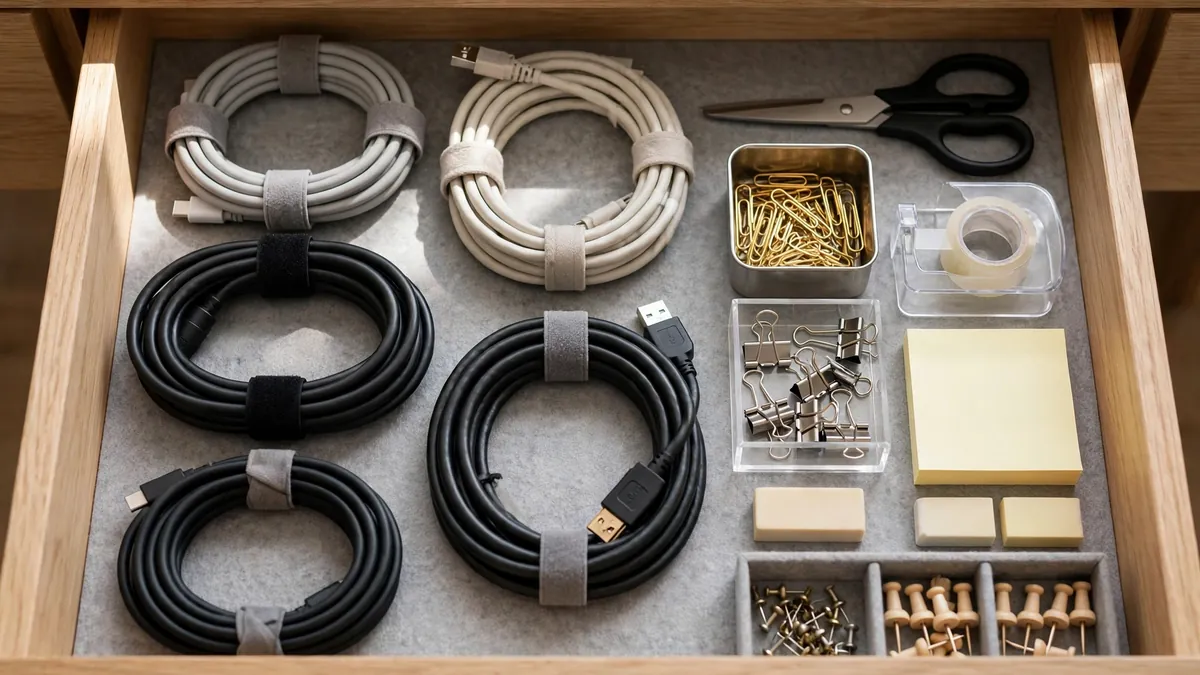
What survives should be a short list: the chargers for devices you own, one spare of each type you actually use. Bundle each with a velcro tie or a simple twist tie and label it with masking tape — “iPad,” “spare C-to-C.” Labels feel silly until you’re hunting for a charger at 11pm and find it in ten seconds.
While you’re in tech-purge mode, look at the gadgets on your shelves: the spare webcam from the job you left, the stack of blank DVDs from another era. Donate working electronics to a local school, shelter, or thrift shop, and recycle the dead ones. Your office stops feeling like a repair shop you never opened.
The Supplies Audit: Keep the 20%, Let Go of the Rest
Office supplies are sneaky because each one feels too cheap to throw away. But a drawer holding forty pens, nine highlighters, six rolls of tape, and enough sticky notes to wallpaper a bathroom is not “stocked” — it’s a retail store you accidentally opened inside your desk. Do the honest audit:
- Pens and markers: test every single one on scrap paper. Keep the five to eight that write well and ditch the rest — dead pens go in the trash, working extras go to a donate bag or a community center.
- Notebooks: keep the one you’re writing in and one spare. The half-used ones? Tear out the blank pages for a scratch pad, recycle the rest.
- Envelopes, folders, and binders: keep a small working supply — ten envelopes, a handful of folders. The rest is donation material for a school or office.
- Staplers, tape, and scissors: one of each that works. Two staplers is not a system; it’s clutter that holds papers together.
- Random promo items: branded pens, stress balls, notepads from conferences — these arrive free and multiply quietly. Keep one favorite, let the rest go.
- Books and reference material: pull everything off the shelf and keep only what you consult or genuinely love. The textbook from your 2019 certification course and the “ultimate guide” books you never opened are prime donation candidates.
Here’s the mindset shift that makes this stick: your office is a working tool, not a museum of your career. The supplies that survive should fit comfortably in one desk drawer and one small organizer — everything else was just occupying space. For staying stocked without re-accumulating, a no-buy month is a surprisingly effective way to break the “I’ll just grab one more organizer” reflex.
Give Everything That Survived a Real Home
Only now — after the desk, the paper, the tech, and the supplies are sorted — do we touch organization. This order matters. Organizing before decluttering is just rearranging clutter into neater piles, and it’s why so many “organized” offices drift back into chaos within a month.
The rule is simple: every surviving item gets a named home, and nothing lives on the desk except what you touch daily. Active paperwork gets one inbox tray — when it’s full, that’s your signal to process it, not to buy a second tray. Supplies live in one drawer with simple dividers. Cables live in a small box, each labeled. Reference papers live in a slim file box on the shelf, not in seventeen folders on your desk.
You probably already own enough containers for this — a labeled shoebox works for cables, and a cut-down cereal box makes a fine file sorter. If your workspace is genuinely tiny — a desk in a bedroom corner rather than a full room — see our small home office storage ideas that actually work for setups built for real, cramped spaces. If you’re missing something specific, buy that one thing, not a matching set of seventeen.
Resist the urge to set up an elaborate system on day one. The best system is the one you’ll maintain when you’re tired on a Thursday: obvious, simple, and requiring almost no decisions. A tray labeled “To file” and a box labeled “Taxes” beats a twenty-folder rainbow every time.
The 5-Minute End-of-Day Reset That Keeps It Calm
Here’s the uncomfortable truth about how to declutter a home office: the decluttering is the easy part. The hard part is the third week, when the mail has started stacking again and there’s a mug colony forming behind the monitor. The fix isn’t willpower — it’s a tiny ritual that becomes automatic because it’s short.
When you shut down your laptop, spend five minutes doing a lap of your office:
- Trash anything that’s trash — junk mail, wrappers, the notes you no longer need.
- Put every item back in its named home — pens in the drawer, cables in the box.
- Glance at the inbox tray: if there are fewer than five things, leave them; if it’s overflowing, process the oldest two right now.
- Wipe the desk. It takes thirty seconds and makes tomorrow morning feel like a fresh start.
Do it while your brain winds down — while a song plays or the kettle boils. Pairing the reset with something pleasant turns it into a habit instead of a chore. Our evening reset routine uses the same principle for the whole house, if you want to extend the calm beyond your office door.
One last habit: the one-in-one-out rule for office supplies. New notebook in, old finished one recycled or archived. New gadget on the desk, an old one donated. It takes zero extra time and it’s the single best defense against slow re-cluttering.
By Sunday evening, your office will look different — but the real change is how it feels to sit down there on Monday morning. No shoving, no excavating, no low-grade guilt humming in the background while you try to focus. Visual clutter competes for your attention, and removing it genuinely frees up mental space for actual work.
So block off the weekend, grab your boxes, and give yourself a workspace that works as hard as you do. Your calm, clear-headed Monday self will thank you for it.
[…] — one shelf at a time, honest questions, a home for everything — are exactly the habits in how to declutter a home office, and the two rooms often improve […]