
My first apartment after college was a 480-square-foot box where the “living room” was just the stretch of floor between the front door and the kitchen. My coffee table doubled as my desk, my books lived in stacks against the wall, and every Sunday I’d spend an hour shoving things into the coat closet so the place looked passable. If you’re hunting for small living room storage ideas right now, you know exactly what that feels like: the one room where everything lands because there’s nowhere else for it to go.
Here’s what that tiny apartment taught me the slow, stubborn way: a small living room doesn’t need more square footage — it needs smarter square footage. The difference between a cramped room and a calm one is almost never how much you own. It’s whether everything you own has a home. This guide walks through the storage strategies that genuinely work in small living rooms, from furniture that earns its footprint twice over to the hidden zones most people never think to use. Nothing here needs a renovation, a contractor, or a big budget. Just a fresh look at the room you’ve already got.
Start With a Ruthless Sort: Small Living Room Storage Ideas Begin With Less
I know — you came for storage tips, not a decluttering lecture. But no basket, shelf, or organizer can fix a room that’s holding more than it was built to hold. Every small living room storage idea in this guide works ten times better once the excess is gone. So before you buy a single thing, spend one evening on a ruthless sort.
Don’t try to do the whole room at once — that’s how people burn out and quit. Work one surface at a time: one shelf, one drawer, the top of the coffee table. Pull everything off that single surface, and run each item through a brutally simple test: would I buy this again today? If the answer is a shrug, it’s gone — donated, recycled, or relocated to wherever it actually belongs.
Living rooms collect a specific set of squatters:
- Dead electronics and their cables: remote controls for devices you no longer own, chargers for phones you traded in years ago, that tangle of mystery cables behind the TV stand. If you can’t name what it charges, recycle it.
- Decorative guilt: the vase you never liked but keep because someone gave it to you. Your living room should hold things you chose, not things you’re storing out of obligation.
- Throw pillow overpopulation: be honest — does your loveseat really need seven pillows? In a small room, two or three is plenty.
- Paper drift: mail, receipts, kids’ school papers. Give paper one small home — a single tray or folder — and route everything else out the same day it arrives.
This single evening of sorting will do more for your room than any purchase. Once the freeloaders are gone, the storage you add afterward has actual room to work.
Buy Furniture That Works Two Jobs at Once
In a small living room, every piece of furniture should earn its floor space at least twice. A pretty side table that holds nothing is a luxury a tiny room can’t afford. When you’re choosing pieces — or reassessing the ones you have — ask one question: what does this store?
The single best swap is ditching a traditional coffee table for a storage ottoman. It holds throw blankets, board games, and remotes inside, gives you extra seating when guests come over, and with a tray on top, it becomes a perfectly good coffee table. One piece, four jobs. If you need a real work surface, a lift-top coffee table is the other great option: the top rises toward you for laptop work or dinner in front of the TV, and the hollow base swallows clutter whole.
A few more double-duty champions worth considering:
- A sofa with built-in storage: many loveseats and sectionals now come with under-seat compartments or a storage chaise. Blankets, off-season cushions, and wrapping paper all disappear inside.
- A slim console table behind the sofa: if your sofa floats in the middle of the room, the six inches behind it are wasted space. A narrow console table there holds books, a charging station, and a lamp — a whole extra surface from thin air.
- A closed-front TV stand: open shelving around a TV becomes a dust-collecting display of cables and gadgets. A credenza with doors hides the electronics and controllers, and the room instantly looks calmer.
One caution before you buy anything: measure twice. In a small room, a piece that’s two inches too deep can turn a walkway into an obstacle course. Mark the footprint on the floor with painter’s tape and walk around it for a day. If you keep clipping it with your hip, it’s too big — no matter how much storage it promises.
Vertical Small Living Room Storage Ideas: Take the Walls Up, Not Out
Here’s the math most people miss: a small living room might have 120 square feet of floor, but it has 300+ square feet of wall. The floor is crowded; the walls are practically empty. Going vertical gives you the biggest storage gain for the smallest cost — and you don’t need to drill a single hole if you’re renting.
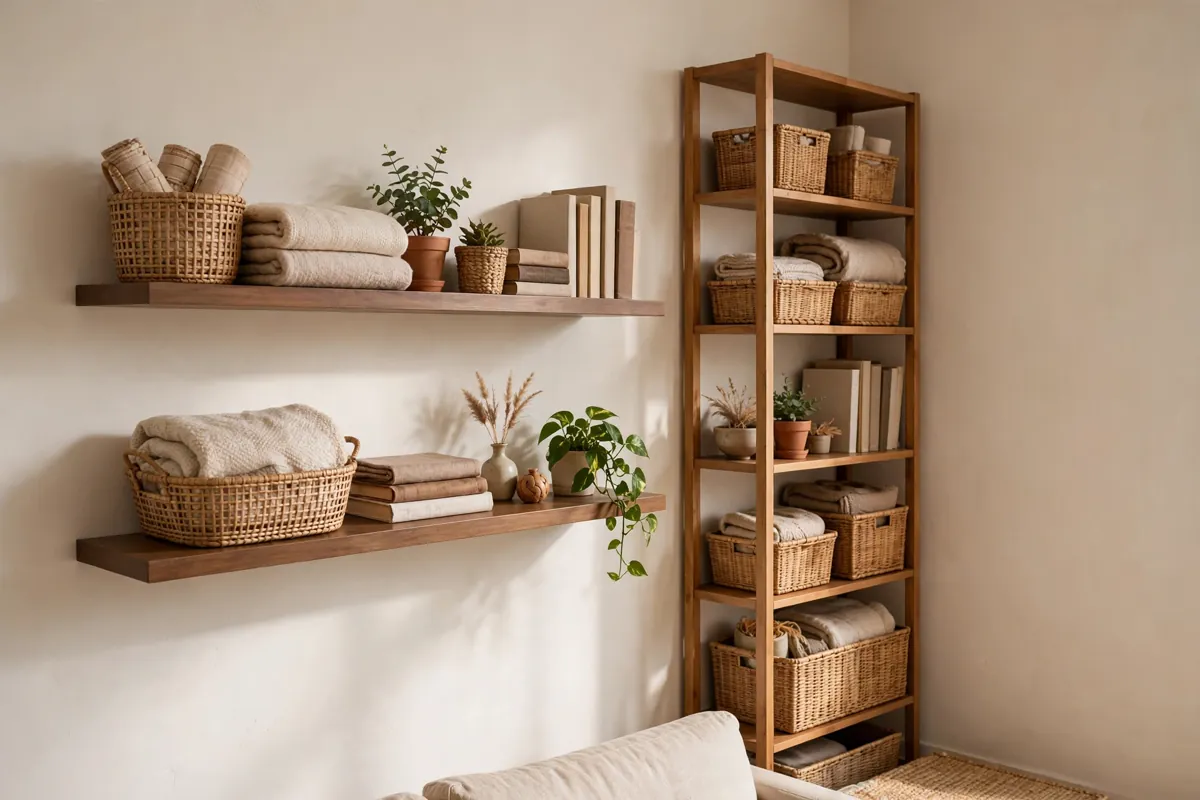
Start with the wall above your sofa. Two or three floating shelves staggered at slightly different heights turn that dead air into a home for books, framed photos, and small plants. Keep them shallow — 8 to 10 inches is plenty — and stick to one material and color so the arrangement looks intentional. White shelves on a white wall practically disappear; warm wood adds character without visual weight.
If you have one awkward corner, a tall, narrow bookcase is the highest-capacity storage you can fit into two square feet of floor. Use baskets and bins on the lower shelves for the messy stuff (chargers, toys, craft supplies) and reserve eye level for books and things that look good. Bottom half contained, top half curated — it reads as furniture, not clutter.
Renters and drill-shy folks have great options too:
- Picture ledges: those narrow IKEA-style ledges hold books, records, and art without the bulk of a shelf. Mount two or three in a vertical stack in a dead corner and you’ve built a bookcase from ledges.
- Hooks and rails on side walls: a row of sturdy hooks by the door holds bags, headphones, and the dog leash. A wall-mounted rail with S-hooks in a reading corner holds throws and tote bags.
- The shelf above the doorway: most living rooms have a foot of forgotten space between the door frame and the ceiling. One properly secured shelf up there holds board games or seasonal decor you reach for twice a year.
- Wall-mounted lighting: this isn’t storage, but it enables storage. Swapping a floor lamp for a wall sconce frees up the two square feet the lamp’s base was eating — room for a basket, a plant, or just breathing space.
One design rule keeps vertical storage from looking chaotic: pick one or two materials and repeat them. Wicker baskets next to plastic bins next to metal crates looks like a storage unit. All-natural baskets with wood shelves, or all-white bins with white shelving, looks like a plan.
The Hidden Zones: Behind, Under, and Between
Every living room has storage zones hiding in plain sight — the inches of space behind, under, and between your furniture that never got assigned a job. Once I started hunting for these, my little apartment gained what felt like an entire extra closet.
Walk your room slowly and check each of these hiding spots:
- Behind the sofa: if there’s a gap between the sofa back and the wall, slide in a slim rolling cart (the 6-inch-wide kind made for kitchen gaps works beautifully). It’s perfect for remotes, notebooks, reading glasses, and chargers — the things that otherwise live on the coffee table.
- Under the sofa: most sofas have 4 to 6 inches of clearance underneath. Flat under-bed-style bins slide right in and hold wrapping paper, spare throw blankets, or off-season cushions. Out of sight, fully usable.
- Between furniture and the wall: that awkward 8-inch strip between the bookcase and the wall, or beside the TV stand, fits a narrow pull-out tower for game cases or craft supplies.
- The side of the bookcase: two hooks on the side panel hold headphones or a tote bag. Zero floor space used.
- Behind a door: if your living room has a closet door, an over-the-door hook rack holds bags, jackets, and umbrellas without touching the closet rod. It’s the same trick that makes entryway organization work — give arrivals a landing spot and clutter never gets a foothold.
Hidden zones add capacity without adding visual noise — nobody sees the bins under the sofa, they just feel the room get calmer.
Keep It Calm: Containment Habits That Make Storage Stick
Here’s the part nobody tells you about small-space storage: the containers aren’t the system. The habits are. I’ve seen tiny living rooms with three baskets stay tidy for years, and bigger rooms with a wall of shelving descend into chaos in a month. What separates them is a handful of small, boring habits.
The most powerful one is the one-basket rule: every category of stuff gets exactly one container. Throws get one basket. Remotes get one caddy. Kids’ toys get one bin. When the container is full, something has to leave before anything new comes in. This single rule puts a hard ceiling on every category — the only thing that truly protects a small room from slow, invisible growth. It’s the same containment-first thinking behind bedroom storage that stays under control.
The second habit is a five-minute evening reset. Before bed, walk the room once: remotes back in the caddy, throws folded into their basket, cushions plumped. Five minutes, timer on. A room that gets reset nightly never reaches the tipping point where mess feels overwhelming. If you want a slightly more structured version, a short evening reset routine covers the whole house in the same spirit.
A few more habits that quietly do the heavy lifting:
- Closed storage for the ugly, open for the pretty: everyday clutter — chargers, remotes, dog toys, mail — lives behind doors and inside drawers. Open shelves are for things that look good: books, plants, framed photos. The moment an open shelf starts holding random stuff, the whole room looks messier.
- One landing pad by the entrance: keys, wallet, sunglasses, and today’s mail need a single small tray near wherever you enter. Without it, those things colonize the coffee table within hours — it’s the same clutter-free home habit that keeps the whole house tidy.
- Corral the cables: a small charging station with a cord box replaces the octopus of chargers sprawling across the side table. One power strip, one box, done.
None of these habits take real effort once they’re automatic. They’re just tiny course corrections — the difference between a room that drifts toward chaos and one that holds its shape week after week.
A Small Room Done Right Feels Bigger Than It Is
The best small living rooms I’ve ever been in weren’t the ones with the cleverest gadgets. They were the ones where someone had made a hundred small decisions — a basket here, a shelf there, a habit of putting the throw back — until the room simply worked.
That’s the real goal of every small living room storage idea: not a room that impresses people with its organization, but a room that lets you forget about organization entirely. Sort the excess, give your furniture second jobs, take the walls vertical, claim the hidden zones, and let a few quiet habits hold it all together. Your square footage hasn’t changed — but the way it feels will.
[…] A matching storage ottoman works the same way on a smaller scale. If floor space is tight, these small living room storage ideas show how the same thinking applies to the rest of the […]