
Here’s a truth nobody tells you when you move into a place with a small closet: the closet isn’t the problem. What’s in the closet is the problem. I’ve organized closets the size of phone booths that worked beautifully, and walk-ins that were disaster zones. Size matters far less than system.
The good news: you don’t need a renovation, a custom closet company, or a bigger bedroom. You need about $40 of supplies, one free afternoon, and the ideas below.
First: The Brutal Edit (30 Minutes)
Before organizing anything, empty the closet completely. Every hanger, every shoe, every mysterious box on the top shelf.
Now sort into three piles with zero sentimentality:
- Keep: worn in the last 12 months, fits right now, in good condition.
- Donate: good condition but unworn, wrong size, or “not me anymore.”
- Trash: stained, stretched, missing buttons you’ll never sew back on.
The average person wears 20% of their wardrobe 80% of the time. Be honest about which 20% is yours. A small closet holding only clothes you actually wear feels twice as big as a large closet stuffed with maybes.
One rule that helps: if you have to talk yourself into keeping it (“well, it might come back in style…”), it goes.
1. Double Your Hanging Space Overnight
Most closets have a single rod with a vast empty space beneath it. That’s wasted vertical real estate.
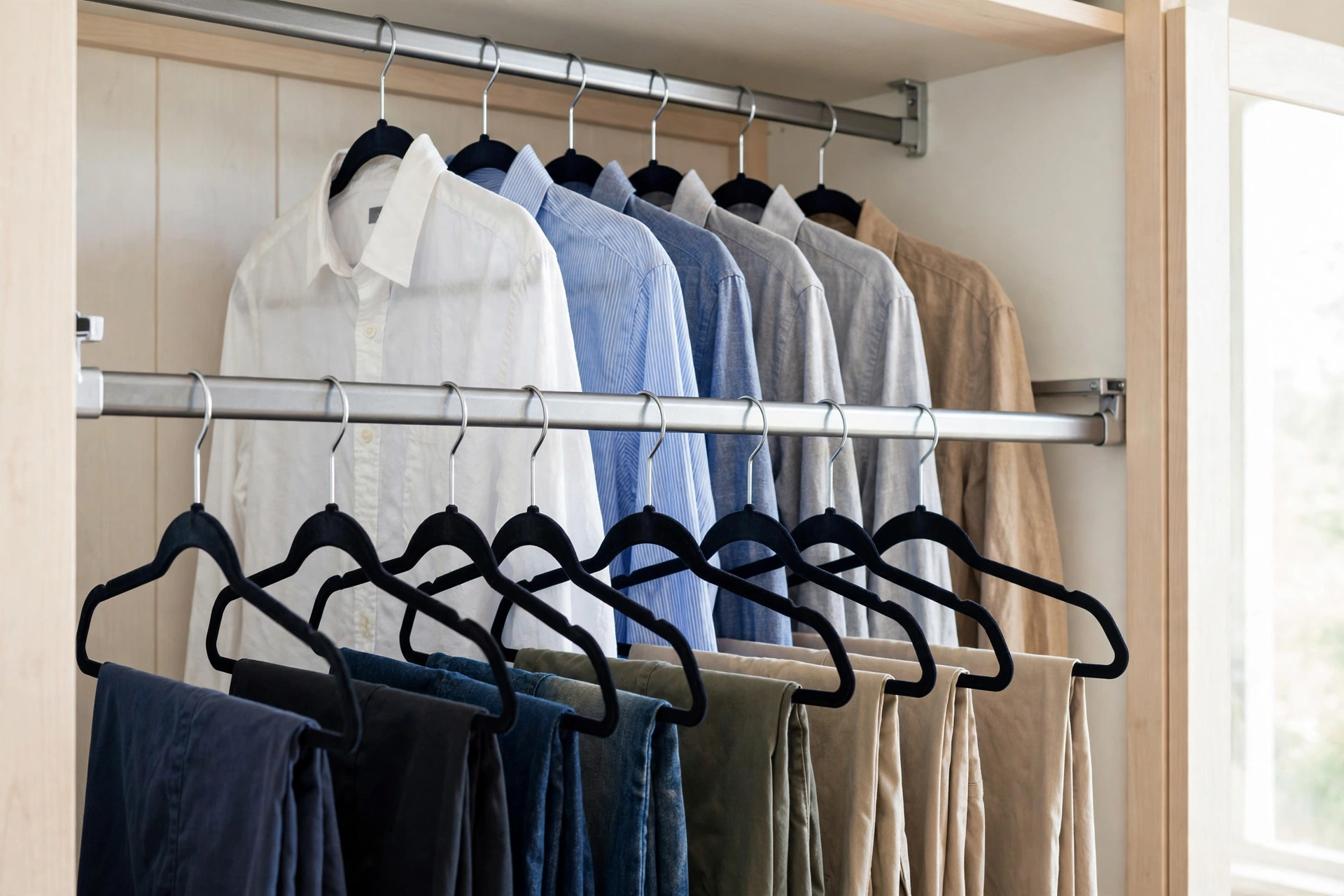
Install a second tension rod (no drilling needed) or a hanging rod extender below the main rod. Suddenly you have two levels: shirts and jackets up top, pants and skirts below. This one change roughly doubles hanging capacity in a standard small closet.
Use slim, matching hangers — velvet or thin plastic. Bulky wooden hangers eat inches; in a small closet, inches are everything. Switching hanger types alone can free up 20–30% more rod space. It also just looks calmer, which makes the closet feel bigger.
2. Claim the Top Shelf (Properly)
The top shelf in small closets is usually a graveyard of random boxes and things shoved up there in a hurry. Reclaim it:
- Use uniform bins or baskets, labeled, for out-of-season clothes and rarely-used items (formal wear, heavy winter gear in summer).
- Vacuum-seal bags compress bulky sweaters and coats to a fraction of their size.
- Keep a small step stool nearby — if the top shelf is hard to reach, you’ll never use it properly.
Rule: top shelf is for things you touch less than once a month. If you’re climbing up there weekly, it doesn’t belong up there.
3. The Floor Is Storage Too (Use It Right)
The closet floor tends to become a shoe avalanche. Fix it:
- A simple two-tier shoe rack holds 8–12 pairs in the footprint of 4.
- Clear stackable shoe boxes let you stack pairs vertically without crushing them — and you can actually see what’s inside.
- For boots, use boot shapers or pool noodles cut to size so they stand upright instead of flopping over.
Leave the center of the floor clear. When you can step into your closet instead of reaching into it, everything gets easier.
4. The Back of the Door Is Free Space
An over-the-door organizer is the highest-ROI purchase for a small closet:
- Clear-pocket organizers hold accessories, scarves, belts, sunglasses, and small bags — all visible at a glance.
- Over-door hooks hold tomorrow’s outfit, a bathrobe, or bags.
- A narrow over-door mirror saves wall space elsewhere in the bedroom.
Just check the door still closes fully. A door that won’t latch because of an organizer is worse than no organizer.
5. Shelf Dividers Stop the Avalanche
Folded clothes on shelves have one enemy: gravity plus time. Neat stacks become leaning towers within a week.
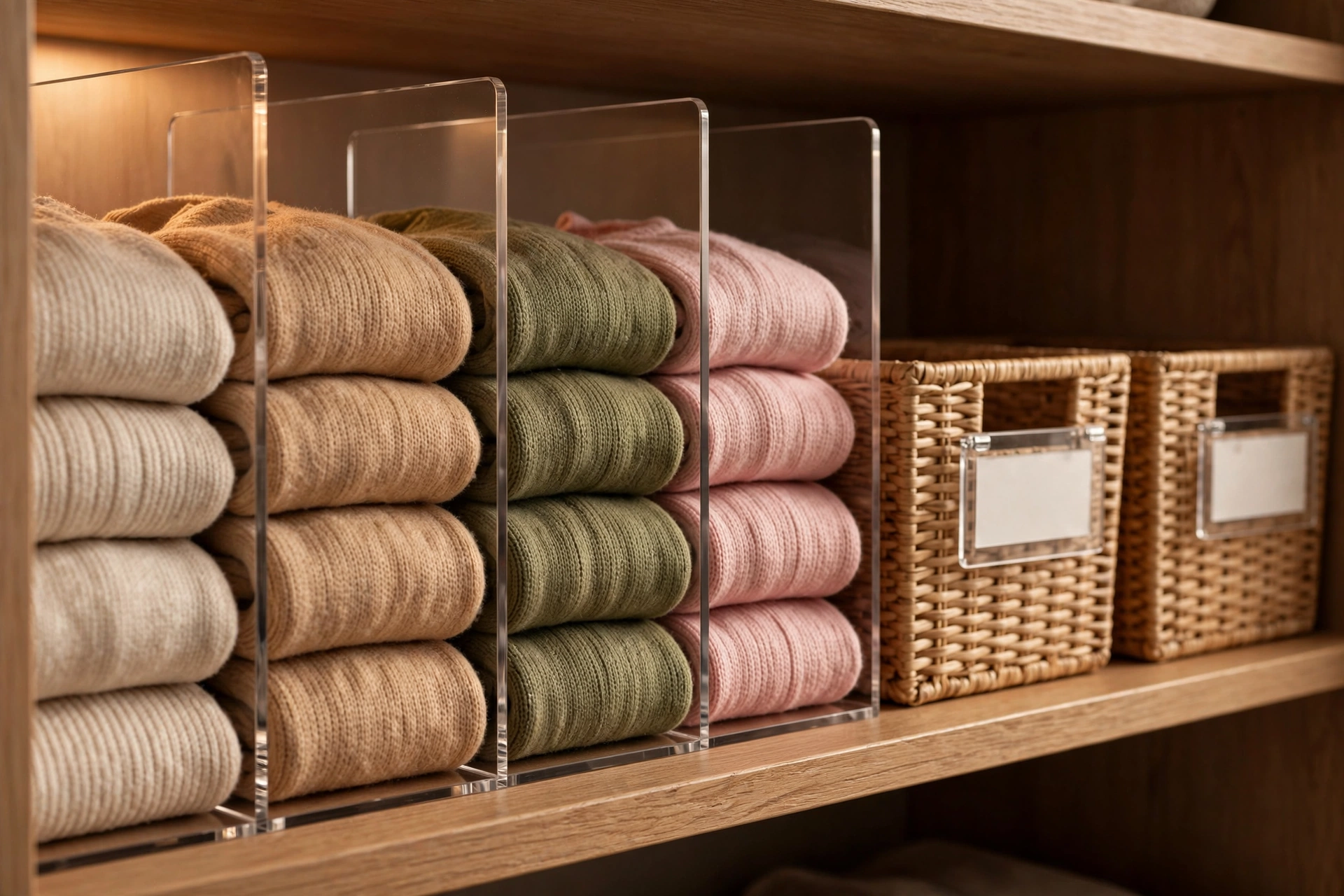
Shelf dividers — simple vertical panels that clip onto the shelf — keep stacks separated and upright. Suddenly you can pull one sweater from the middle without the whole stack collapsing. They’re cheap, need no tools, and they work on any shelf deeper than about 10 inches.
Alternative: file-fold clothes vertically in a drawer or bin so you can see every item at once, instead of stacking them where only the top one is visible.
6. Light It Up
Small closets are often dark, and dark closets feel smaller and get messier — you can’t organize what you can’t see.
Stick-on LED puck lights or a motion-sensor LED strip costs very little and takes five minutes. A lit closet feels twice as big and you’ll actually put things back properly because you can see where they go. This is the most underrated closet upgrade there is.
7. Create Zones (Even in 3 Feet of Space)
Divide your small closet into zones so everything has a home:
- Left: tops and shirts
- Center: pants, skirts, dresses
- Right: accessories, bags
- Top shelf: out-of-season and occasional
- Floor: shoes only
It doesn’t have to be complicated. The point is that getting dressed becomes automatic — you reach for the zone, not hunt through the chaos. And when everything has a zone, putting laundry away takes minutes instead of becoming a chair-drobe situation.
The One-Week Test
After reorganizing, give it one week. Notice what annoyed you: the rod that’s too high, the bin you never opened, the shoes that migrated back to the floor. Adjust once. A closet system that survives contact with your real life is better than a perfect one that doesn’t.
Mistakes That Shrink Your Closet
- Keeping “aspirational” clothes. The jeans from five years ago, the “when I lose weight” dress. They don’t motivate — they guilt-trip you every morning. Let them go.
- One giant “miscellaneous” bin. It becomes a black hole within a month. Every bin needs a specific category.
- Storing non-clothes in the closet. Old electronics, gift wrap, cleaning supplies — they eat clothing space. Find them a real home elsewhere.
- Ignoring the seasonal swap. Twice a year, rotate: current season front and center, off-season up top or in storage. A small closet can’t hold four seasons at once, and it shouldn’t have to.
A Realistic Budget Breakdown
You don’t need to spend much. Here’s what actually matters, cheapest first:
- Slim hangers (pack of 30–50): the single biggest space win
- Over-the-door organizer: instant accessory storage
- Shelf dividers (set of 4–6): ends stack collapse
- Two-tier shoe rack: tames the floor
- LED puck lights: makes it all visible
- Matching bins for the top shelf: hides the chaos uniformly
Skip the fancy matching everything unless it genuinely makes you happy. Function first, aesthetics second — though in a closet this small, function looks good.
Frequently Asked Questions
How do I organize a small closet with no shelves?
A hanging closet organizer (the fabric kind with cubbies) instantly creates shelf space from a bare rod. Add an over-door organizer and a shoe rack, and you have a full system with zero drilling.
How many clothes should fit in a small closet?
There’s no magic number, but a good test: you should be able to slide hangers freely without forcing them. If hangers are jammed shoulder-to-shoulder, you have too many — no organizer fixes overcrowding. Edit first, organize second.
What’s the best way to store out-of-season clothes?
Vacuum-seal bags or lidded bins on the top shelf or under the bed. Clean everything before storing, and add a lavender sachet or cedar block to keep things fresh.
How do I keep my closet organized long-term?
The one-in-one-out rule applies here more than anywhere: new shirt in, old shirt out. Plus a 5-minute weekly reset — rehang strays, refold one stack. Small closets stay tidy with tiny maintenance, not big overhauls.
A small closet isn’t a storage problem — it’s an editing and zoning problem. Empty it, keep only what you wear, double the hanging space, light it up, and give everything a zone. No renovation required, one afternoon of work, and getting dressed gets noticeably easier starting tomorrow morning.
Pair this with our wardrobe decluttering system when you’re ready for the deeper edit.