
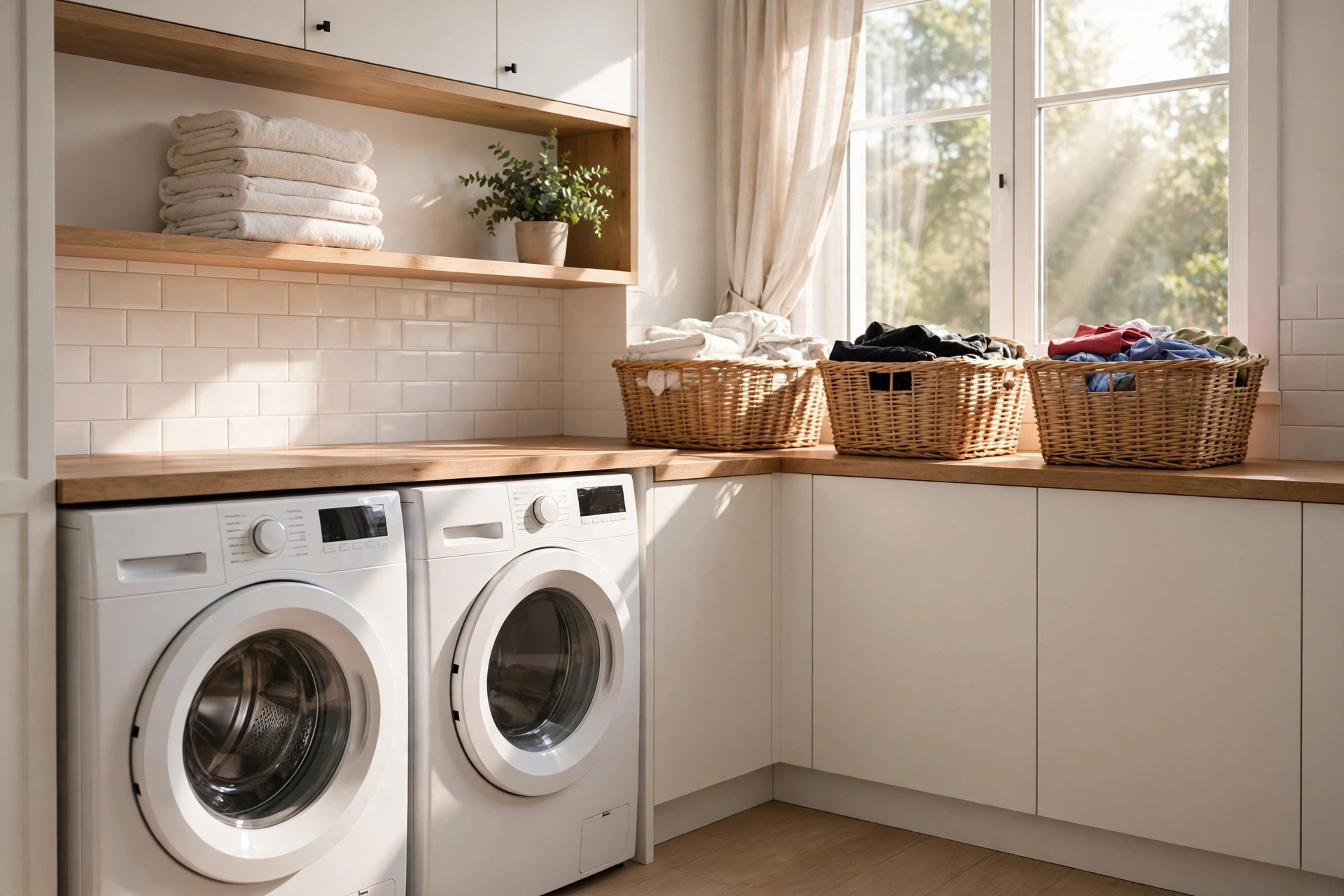

Here’s what finally changed things for me. One Tuesday evening, buried in an avalanche of half-sorted clothes, it dawned on me that the problem was never the amount of laundry. My household generates roughly the same volume every week — two adults, two kids, one dog who sheds like it’s his job. The real problem was the batching: I let everything accumulate until the pile was too big to finish in a single sitting. A good weekly laundry routine doesn’t shrink the pile. It spreads it so thinly you barely notice it.
Why the One-Big-Laundry-Day Approach Keeps Failing
Most of us were raised on the idea of “laundry day.” One day a week, you power through it: sort, wash, dry, fold, put away. In theory it’s efficient. In practice it collapses under its own weight, because laundry isn’t really one task — it’s a chain of five, and the chain breaks at exactly the points you’d expect.
Think about it. Washing is easy; you press a button. Drying is easy; the machine does it. But sorting forty pounds of mixed clothing takes real decision-making, folding an entire household’s worth of clothes takes genuine stamina, and putting everything away requires every closet and drawer to have room. By hour four of a laundry marathon, you’re folded over the couch with a wrinkled t-shirt in your hands wondering where your life went wrong. So the folding gets postponed. Then the putting-away gets postponed. And by Friday, you’re fishing “clean” shirts out of the dryer basket again.
There’s also the rewash tax. We’ve all forgotten a wet load overnight and had to run it again for that musty smell. On a marathon day with eight loads cycling through, the odds of losing track of one are high. Smaller, more frequent loads are simply harder to lose — a single forgotten load is noticeable, unlike load number six of eight.
And then there’s the mental weight. A towering pile of dirty laundry sitting in the corner all week is a constant low-grade reminder of unfinished business. It makes the house feel behind even when everything else is clean. Once I spread my washing across the week, something unexpected happened: my house started feeling calmer. Not because of less work, but because the work was never looming.
The Weekly Laundry Routine: A Simple Five-Day Rotation
The version of this system that worked for my family is almost embarrassingly simple: one load a day, five days a week, with weekends gloriously free. Each day has a theme, which removes all decision-making. You don’t sort the whole week’s pile on Monday morning — you sort one day’s worth, and you know exactly what it is before you even open the hamper.
Here’s the rotation:
- Monday — Darks and jeans. Jeans, dark tops, and dark trousers wash cold; starting the week with the heaviest load gets them back in rotation when you need them.
- Tuesday — Lights and everyday clothes. Whites and light-colored shirts wash warm to stay bright, and doing them early in the week keeps your work wardrobe stocked.
- Wednesday — Towels. Bath towels, hand towels, kitchen towels, washcloths — hot water, no fabric softener (it coats the fibers and makes them less absorbent). Towels are the one load where you can genuinely set the machine and walk away.
- Thursday — Sheets and bedding. Strip the beds in the morning, wash during the day, and remake them in the evening. Few things beat sliding into fresh sheets at day’s end.
- Friday — Delicates and catch-up. Bras, lace, silk blouses, wool sweaters in mesh bags on a gentle cycle — plus anything you missed during the week. Friday is the safety net that keeps the system forgiving.
Saturday and Sunday are free. That’s not a loophole — it’s the design. The system works precisely because it doesn’t ask for seven days of effort. If you’d rather shift the whole rotation (some families prefer Sunday through Thursday so Friday is free), do it. The days don’t matter; the rhythm does. This rhythm also slots neatly into a broader weekly cleaning schedule, so laundry stops competing with dusting, floors, and bathrooms for your attention.
Sort As You Go: The Hamper Setup That Removes Sorting Day
The fastest laundry routine is the one where sorting takes zero extra minutes. The trick is sorting at the moment clothes leave your body, not when the basket is full. I know that sounds like one of those tips that only works for extremely organized people, but it’s honestly just a hardware problem: give dirty clothes the right place to land, and they’ll sort themselves.
What works best is a hamper with divided sections — lights, darks, and a third section for towels or delicates. You can buy a three-compartment sorter, but two or three separate baskets in the laundry room or bedroom corner work just as well. The label matters less than the location: put the hamper where people actually undress. A beautiful sorting system in the garage will be ignored; a simple one in the bedroom gets used. If your kids’ clothes end up on the bathroom floor, put a small basket in the bathroom. Follow the behavior instead of fighting it.
Two small accessories make the system dramatically smoother. First, mesh laundry bags — one for delicates, one for socks if your house is plagued by the mysterious disappearing-sock phenomenon. Socks go in the mesh bag, the bag goes in the wash, socks come out together. It’s a tiny change that eliminates one of laundry’s most irritating mysteries. Second, a stain stick or spray that lives right next to the hamper. The rule in our house: whoever takes off a stained item treats it immediately. A squirt of stain remover the moment the spaghetti sauce hits the shirt works ten times better than the same treatment three days later.
One more habit worth building: check pockets at the hamper. Tissues, receipts, and the occasional pen cause more laundry disasters than anything else. A quick pocket check while you’re tossing clothes in takes five seconds and saves you from the dreaded tissue confetti explosion — if you know, you know.
Fold, Hang, and Put Away on the Same Day
Here’s the part nobody wants to hear: the load isn’t done when the dryer stops. The most common place a weekly laundry routine falls apart is the gap between “clean” and “put away.” Clean clothes sitting in a basket are still laundry you haven’t finished, and after three days in a heap, they’re wrinkled enough to need rewashing anyway.
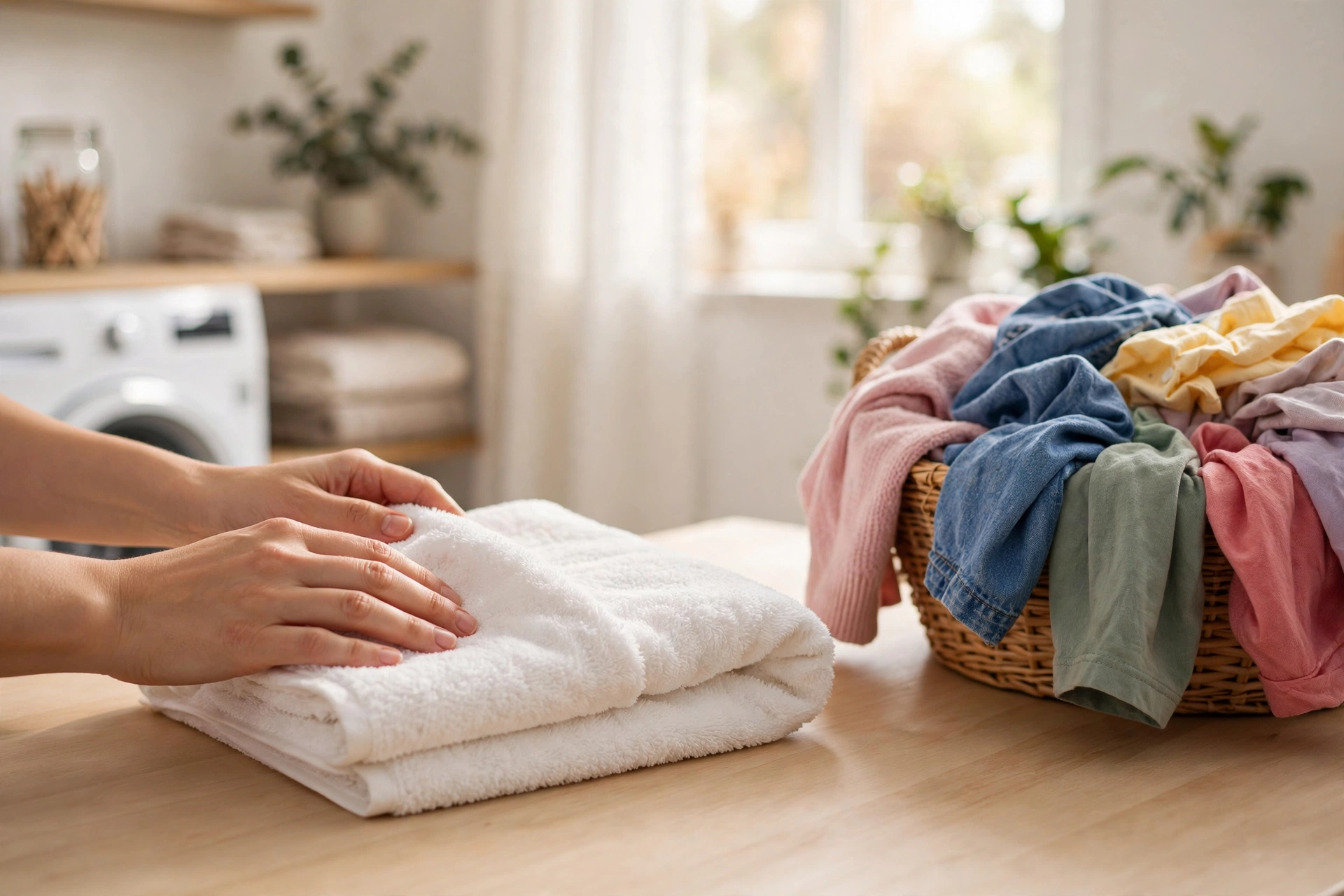
The fix is a simple rule: nothing gets folded later. Not “after dinner,” not “during the football game on Sunday” — now, or at the first natural pause. I fold laundry in the laundry room itself, straight out of the dryer while the clothes are still warm. Warm fabric folds more easily, wrinkles fall out, and a single daily load takes about ten minutes — a podcast segment or two songs. Keep a clean basket or flat surface next to the dryer as your folding station and the habit builds itself.
Not everything needs folding, by the way. T-shirts, underwear, socks, pajamas, and kids’ clothes can live perfectly happily in divided drawers with a casual roll-and-toss method. Reserve careful folding and hanging for the things that genuinely need it: work shirts, blouses, dresses, and trousers. Deliberately lowering your standards for pajamas is not laziness — it’s how you protect your energy for the things that matter.
The final step is putting things away, which only works if your closets and drawers have room to receive them. If clean clothes linger in baskets because there’s nowhere to put them, the problem isn’t your laundry routine — it’s your storage. A quick refresh of your closet organization and your bedroom organization makes the last five minutes of the laundry cycle frictionless, and frictionless is what keeps a habit alive.
Adapting the Routine to Real Life
No laundry system survives contact with reality unchanged, and the five-day rotation is a template, not a law. Here’s how to bend it for the most common situations:
- Tiny washing machine or shared laundry room. If you use a shared apartment laundry room or laundromat, batching makes more sense. Do the rotation across two sessions instead of five — darks plus towels on Wednesday, lights plus sheets on Saturday — and keep the same daily themes. The order matters more than the frequency.
- Kids who generate mountains of clothes. Give each child one dedicated laundry day instead of folding their clothes into your rotation. One person’s clothes are far simpler to fold than a family’s mixed load, and older kids can learn to wash, dry, and fold their own — one of the most useful life skills you can hand them.
- Work uniforms or gym clothes. Things that must be washed after every wear don’t wait for their theme day. Run a small quick-wash cycle every other day for gym gear and uniforms, and keep the rotation for everything else. Workout clothes especially should be washed cold and hung to dry — the heat of a dryer breaks down elastic over time.
- Pets. Pet blankets, couch throws, and pet beds go in with the towels on Wednesday (hot water handles both). A lint roller station near the laundry room door keeps fur off clean clothes during the fold.
- Babies. A warm wash every two or three days with gentle detergent does it; their laundry is small enough to piggyback on any rotation day.
The underlying principle stays the same in every variation: small loads, done completely, on a predictable rhythm. As long as each load is washed, dried, folded, and put away in one continuous flow, the system holds.
Two Small Habits That Keep the Whole System Running
Between the schedule and the sorting setup, the routine needs only two maintenance habits to run indefinitely.
First: never let a wet load sit. Set a timer on your phone the moment you start the washer — most machines take 45 to 60 minutes, which is exactly long enough to forget. A phone reminder is the difference between a system that hums and one that produces musty loads that need rewashing. If you work from home, start a load on your lunch break and transfer it when you return to your desk; the break becomes the reminder.
Second: do the “one empty hamper” check on Sunday evening. Walk to the hamper and look. If it’s basically empty, your system worked and you can start Monday with a clean slate. If there’s a small pile, you know exactly what it is — Friday’s catch-up probably left a few items, or someone skipped their sort. Handle it in ten minutes and move on. This quick check folds laundry naturally into a daily cleaning routine mindset: small, frequent maintenance beats occasional heroics every time.
The beauty of this routine is that it’s boring: one load a day, sorted as you go, finished completely. After a month, you won’t think about it anymore. The hamper won’t loom, the dryer won’t become a second wardrobe, and laundry day will stop ruining your weekend.
[…] river, not a lake — it never stops flowing. One load a day keeps it from becoming a mountain. Our weekly laundry routine system shows how to make it nearly […]