

It usually happens mid-recipe. You are standing at the stove, the pan is sizzling, dinner is forty-five seconds from perfect, and you cannot find the smoked paprika. You push past the oregano, squint at a jar that might be cumin or might be coriander, and by the time you finally spot the paprika buried behind the baking soda, the garlic is threatening to burn. Sound familiar? These spice organization ideas will make sure that never happens again — because a cook who can grab any jar in seconds is a cook who actually enjoys cooking.
The average home cook keeps somewhere between 20 and 40 spices, yet most of us store them like we are hiding evidence: shoved into a deep cabinet, stacked three deep, labels facing whichever way they landed. Spices are also one of the few things in the kitchen where disorganization genuinely costs you money — an unopened duplicate of something you already own, or a jar that went stale because it was forgotten in the back for two years. Let us fix that, one shelf at a time.
Start by Taking Every Spice Out at Once
This is the least fun part and the most important part. Pull every single spice out of every cabinet, drawer, and mystery shelf where they have accumulated. Yes, including the two jars of cinnamon (one from before you moved, one from last month) and the half-empty bottle of cajun seasoning someone brought you three Christmases ago.
Line them all up on the counter and do a quick triage:
- Keep — anything you use at least a few times a year, with flavor still intact.
- Combine — duplicate jars of the same spice get merged into one jar, freshest on top.
- Toss — anything you cannot identify by smell, or that smells like dusty cardboard. Ground spices lose their punch after about a year; whole spices last closer to three or four.
While you are at it, sniff-test your regulars. Rub a pinch between your palms — if the aroma is weak, the spice is spent and it is time to replace it. This purge usually shrinks a collection by a third, which instantly makes everything else easier — you cannot organize clutter you should not be keeping in the first place.
Spice Organization Ideas That Actually Fit Your Kitchen
There is no single “best” spice storage system — there is only the one that matches how you cook and where you have space. The professional organizers who do this for a living tend to agree on one thing: store spices at point of use, meaning near the cooktop or prep area, not in some far-off corner you never open.
The drawer method: fastest to use, easiest to maintain
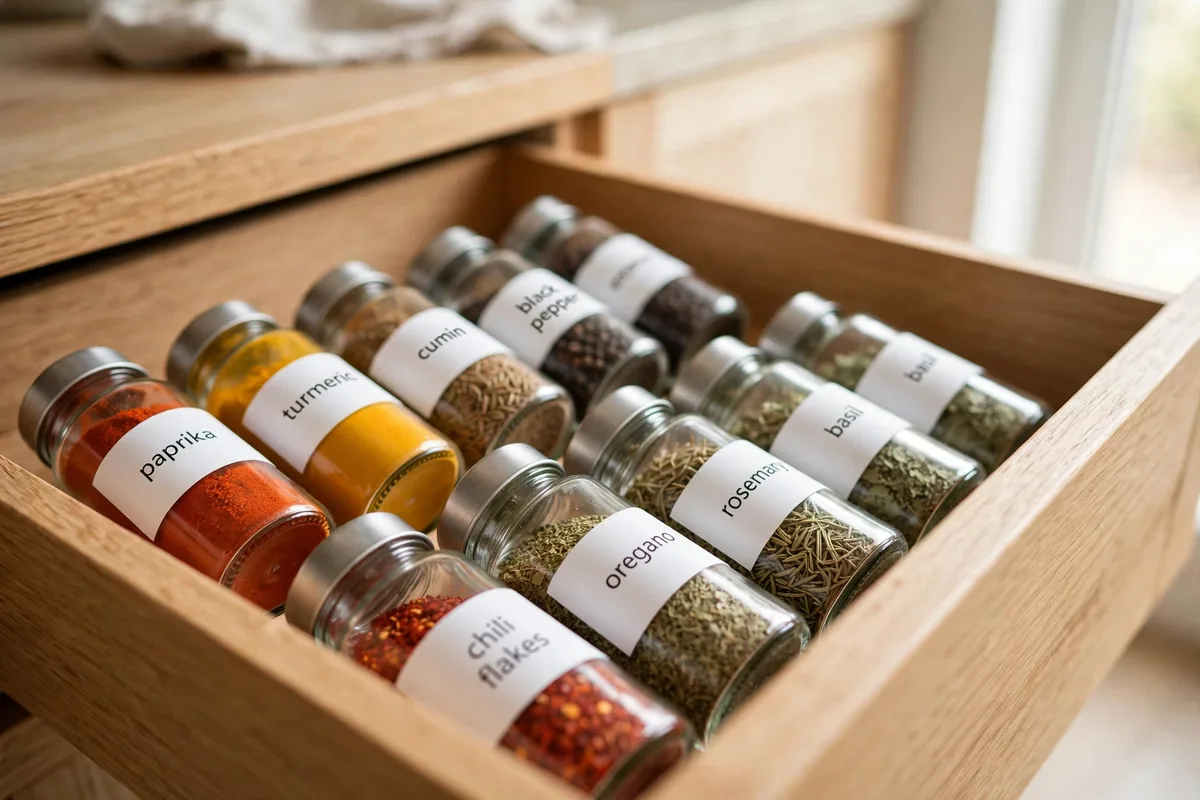
A dedicated spice drawer is the gold standard for busy cooks, and for good reason. Jars lie at a gentle slant or stand upright with labels facing you, so one glance shows the whole collection. No stacking, no reaching past jars, no door to open. If you already have a drawer near your stove sitting half-empty, this is your winner.
Buy a simple drawer insert — bamboo ones are affordable and look great — and arrange jars in neat rows. If the jars stand upright, add labels to the lids as well as the fronts, so you can identify everything without lifting a single jar. For more inspiration on making drawers work harder, our kitchen drawer organization ideas cover inserts and dividers for every drawer in the room.
The cabinet method: tiered risers and turntables
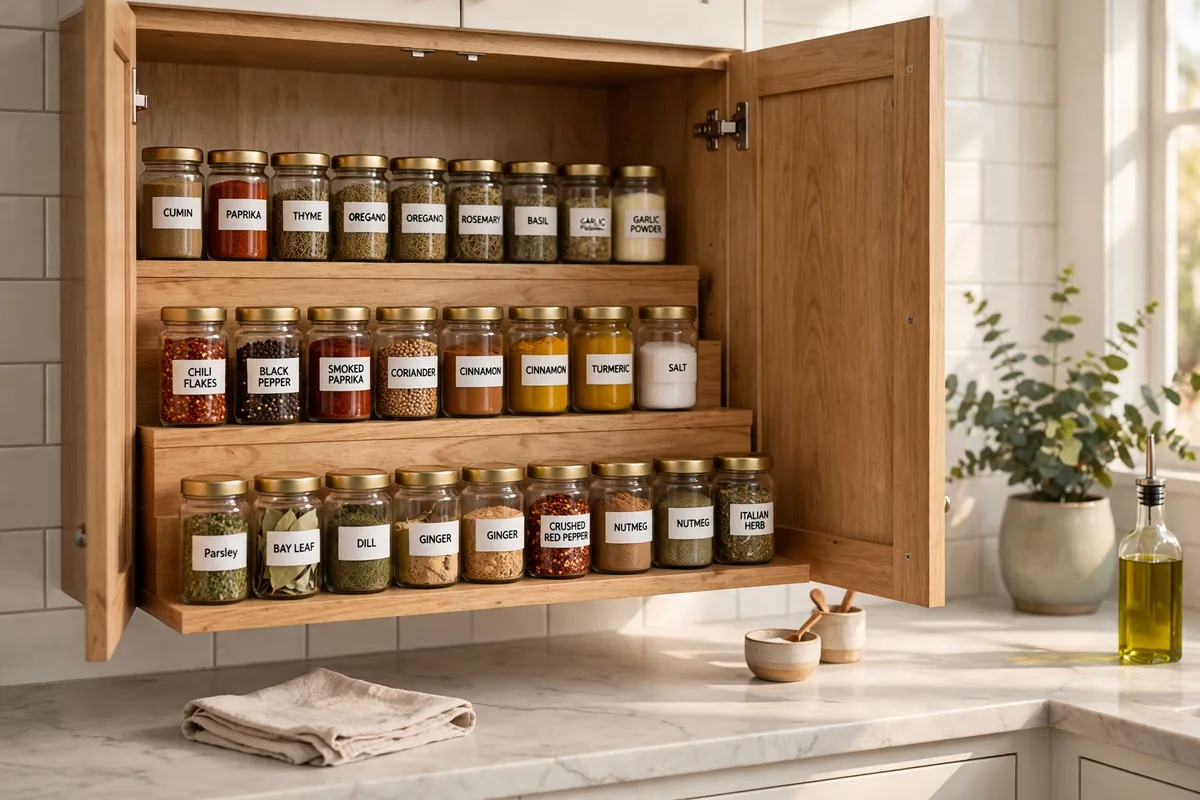
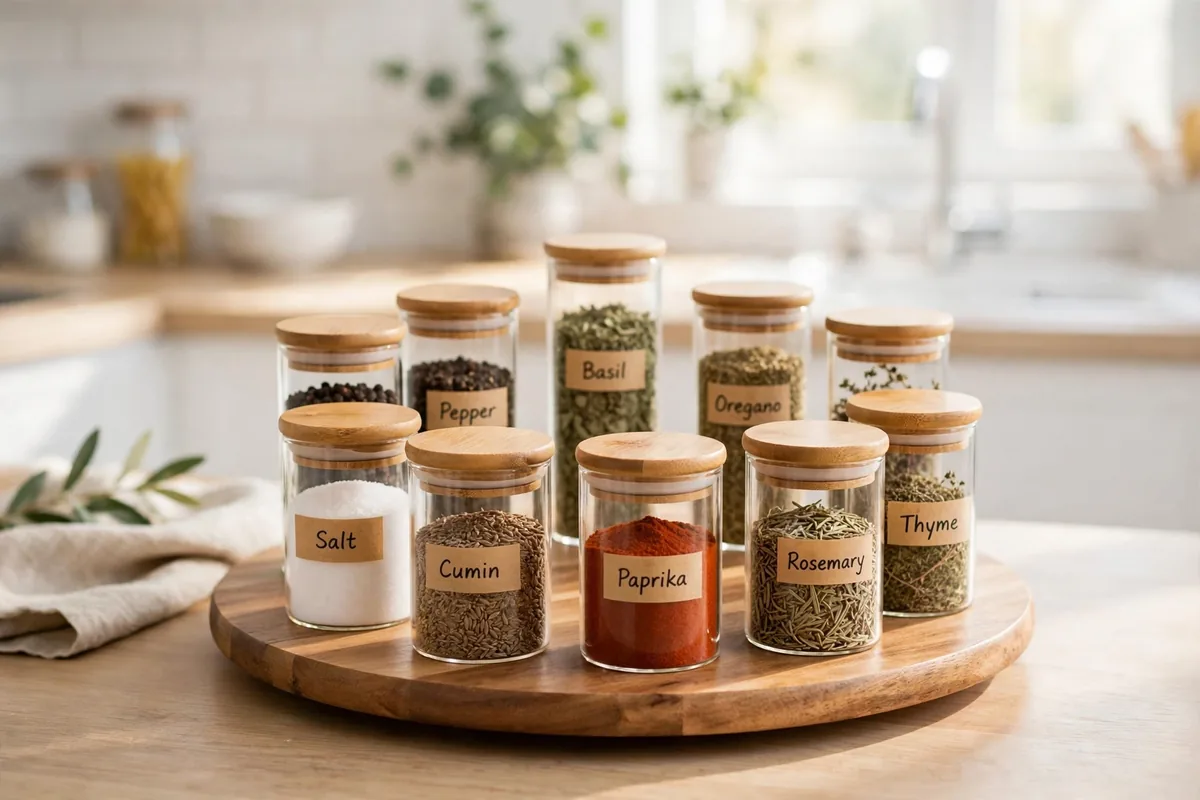
Not everyone has a spare drawer. In a cabinet, a tiered shelf riser (those little stadium steps) makes every row of jars visible at once — the single biggest upgrade you can make to a chaotic cabinet for under twenty dollars. Alternatively, a turntable or lazy Susan lets you spin the whole collection into view; just make sure the cabinet is deep enough for the turntable to rotate freely.
One rule for cabinet spice storage: nothing goes behind anything. The moment a jar is hidden, it stops existing in your mind, and you will buy another one. Risers, turntables, or shallow rows are how you enforce that rule. A full guide to organizing kitchen cabinets will help you apply the same thinking to the rest of your shelves.
The wall and door method: magnetic tins and slim racks
Magnetic spice tins stuck to a steel board on the wall, or a slim rack mounted on the inside of a cabinet door, free up an entire shelf elsewhere. These look fantastic and keep everything in plain sight — perfect for cooks who season by instinct and want everything within arm’s reach.
The one caveat: keep tins and racks away from direct heat and steam. Spices hate warmth, light, and moisture, so the wall right above the stove is actually the worst spot in the kitchen. Mount them beside the stove or on a pantry wall instead.
The counter method: a dedicated spice caddy
If your most-used spices never leave your side, gather them into a small handled caddy or a neat countertop rack that holds just your daily lineup — salt, pepper, garlic powder, chili flakes, whatever you reach for constantly. Everything else lives in the drawer or cabinet. The caddy moves to the stove while you cook and goes home in one step. Just keep it compact so it never crowds your prep space; our kitchen counter organization ideas show how to keep surfaces clear even with a caddy in the mix.
Decant Into Uniform Jars (It Changes Everything)
This is the trick behind every beautiful spice photo you have ever seen, and it is not just for looks. Store-bought spices arrive in a dozen different bottle shapes and sizes — tall, short, square, round, lids that crack. Uniform jars turn that chaos into a grid where every jar takes up the same footprint, rows line up perfectly, and labels sit at the same height on every container.
You do not need fancy jars. A set of small glass jars with shaker-and-pour lids is the most practical choice — glass does not absorb odors, and you can see how much is left at a glance. Transfer spices with a folded paper funnel, and work over the sink, because turmeric stains and paprika dust get everywhere.
A few decanting rules that keep the system working:
- Label before you fill. An unlabeled jar of brown powder is a mystery nobody wants. Include the spice name and the date you opened it.
- Only decant what fits. Keep bulk refill bags in a separate bin elsewhere — a labeled tub in the pantry works perfectly. This also pairs naturally with budget pantry organization, since buying in bulk and decanting is the cheapest way to stock spices.
- Match jar size to usage. Everyday spices get big jars, rare ones get small ones. No sense giving your saffron the same real estate as your black pepper.
- Write the expiry on the label. Ground spices: about a year. Whole spices: two to three years. When the date passes, sniff-test before you toss.
Arrange by How You Actually Cook, Not by the Alphabet
Alphabetical order sounds logical, but most cooks do not think in alphabetical order — they think in recipes. Professional organizers recommend sorting spices by cuisine or frequency of use, and after trying both, I agree.
Group by cuisine: keep Italian herbs (oregano, basil, thyme, rosemary) together, Indian spices (turmeric, cumin, coriander, garam masala) together, Mexican seasonings (chili powder, cumin, smoked paprika, oregano) together, and baking spices (cinnamon, nutmeg, cloves, ginger) in their own zone. When you are making tacos, everything you need is in one cluster instead of scattered from C to S.
Group by frequency: split your collection into daily, weekly, and occasional. Daily spices get the most accessible spot — front of the drawer, top of the turntable. Occasional ones (that specialty blend from the farmers market, the pickling spice you use once a summer) go higher up or further back where they are out of the way.
You can also color-code labels by group — green for herbs, red for peppers, yellow for baking — which makes the right cluster jump out visually. A $10 label maker or a pack of chalkboard labels is all you need, and the result looks remarkably polished.
Smart Extras That Take You From Organized to Effortless
Once the core system is in place, a few small upgrades make it genuinely effortless to maintain.
Keep a refill bin, not a refill pile
Those bulk bags and half-empty backup jars are what unravel an organized spice collection. Give them a home: one small bin in the pantry, labeled by section (herbs, blends, baking, refills), with bags standing upright like files. When a jar runs low, you know exactly where the refill lives — and you stop buying duplicates.
Seasonal and bulk spices get their own zone
Not every spice deserves kitchen real estate. Whole nutmeg you use twice a year, the big bag of chili you bought at the warehouse store, the specialty rubs from holiday gifts — these belong in a higher cabinet or a pantry corner, not in your daily lineup. Your everyday spices should never have to compete for space with the ones you barely touch.
Do a two-minute monthly reset
Organization systems fail slowly: one jar put back wrong, one new spice tossed in the front. Once a month, while you are waiting for the kettle to boil, spend two minutes straightening rows and checking for anything past its prime. That tiny habit is the difference between a system that lasts years and one that collapses by Thanksgiving.
Match the system to small spaces
In a truly tiny kitchen, combine methods. A slim door-mounted rack for daily spices, magnetic tins on the fridge side for herbs, and the drawer for everything else. Vertical thinking — stacking up, not out — is what saves small kitchens, and spice storage is one of the best places to apply it.
The Payoff: Cooking Feels Different Now
There is a particular pleasure in opening a drawer or cabinet and seeing every spice in its place — uniform jars, clear labels, everything findable in seconds. Recipes come together faster. You stop buying duplicates. Food tastes better because your spices are actually fresh. And there is an unexpected side effect: when seasoning is easy, you season more boldly. Dishes get more interesting.
Start with the purge this weekend. It takes about an hour from chaos to clean, and most of that is deciding which of your three half-empty oreganos survives. Pick one storage method that fits your kitchen, decant your daily spices first, and let the rest follow. Within a week, you will wonder how you ever cooked the old way.