
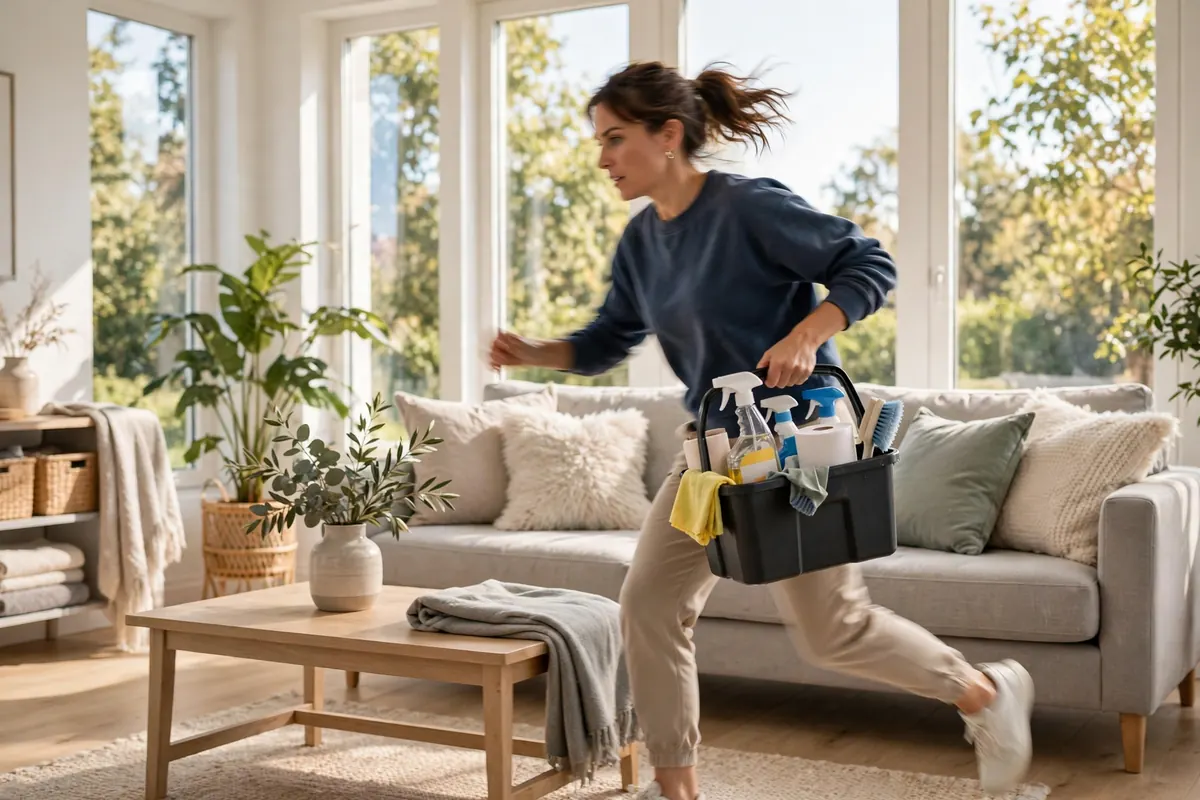

The text comes at 4:40 p.m.: “Running early — be there in 20!” Your house looks like a laundry basket exploded in slow motion. Here is the good news: speed cleaning your house in 30 minutes is absolutely possible, and it does not require superhuman effort. It requires a timer, a plan, and the discipline to clean what guests will actually notice instead of what your anxiety says you should.
I learned speed cleaning the hard way, as the friend who always hosted last-minute dinners in a too-small apartment. Over time I figured out the uncomfortable truth: guests notice about ten percent of your house. They notice the entryway, the bathroom, the kitchen counters, and whether the living room feels calm. They do not notice your sock drawer. This guide is built around that ten percent.
The Ground Rules: Timer, Caddy, and the Laundry Basket Trick
Before the timer starts, gather your weapons. A cleaning caddy — a bucket, tote, or actual caddy — stocked with all-purpose cleaner, microfiber cloths, bathroom disinfectant, glass cleaner, and trash bags. Carrying everything with you beats the twenty trips back to the sink that quietly eat half your cleaning time.
Then grab the two most important speed-cleaning tools in existence: a laundry basket and a trash bag. The basket is for clutter triage — everything out of place goes in the basket, and the basket goes in a closet when the doorbell rings. You are not organizing; you are relocating. The trash bag is for the obvious garbage: junk mail, empty boxes, the mysterious sticky thing. Set a timer for 30 minutes, put on music with a beat, and go. The timer is not decoration — racing the clock is what keeps you from reorganizing a drawer when you were supposed to wipe a mirror.
If you live with other people, draft them. Speed cleaning is dramatically faster with two or three people, and the timer makes it feel like a game instead of a chore. Assign zones — one person takes the kitchen, another takes the bathrooms, a third runs the clutter sweep — and race the clock together. Kids as young as six can handle the laundry-basket sweep or shake out rugs. Even ten minutes of help from one other person effectively gives you forty person-minutes of cleaning inside a thirty-minute window.
One more rule: top to bottom, back to front. Dust falls down, so you clean high surfaces before floors. And you move through the house in one direction so you never re-dirty a finished room. If you want a standing weekly version of this system, our weekly cleaning schedule spreads the same logic across seven days.
Speed Cleaning Your House: Minutes 0–5, the Clutter Sweep
Do not start with a room. Start with the whole house. Carry the laundry basket and trash bag through every room you will clean, tossing trash and collecting everything that does not belong. Shoes by the couch, dishes on the desk, toys on the stairs — into the basket. This pass is purely visual: you are removing the evidence of life, not sorting it.
Five minutes, whole house, no decisions. If you hesitate over an item for more than three seconds, it goes in the basket. Decision-making is the enemy of speed. The basket gets stashed in a bedroom closet at the end — you will put everything away properly later, when no one is about to ring your doorbell.
Open a few windows or light a candle while you sweep. Fresh air and a good scent do an unreasonable amount of psychological work — a house that smells clean reads as clean even if you skipped a baseboard. This is not cheating. This is strategy.
Minutes 5–15: The Kitchen Blitz (10 Minutes)
The kitchen gets the biggest block because it is the room guests judge hardest. But you are not deep-cleaning — you are doing the five things that make a kitchen look clean:
- Clear the counters. Everything off, wipe down, then put back only what lives there permanently. Small appliances you use daily stay; the bread maker you used in 2024 goes in a cabinet.
- Dishes handled: dishwasher loaded and running, or hand-wash the visible few and stack the rest neatly in the sink with hot soapy water. A sink of soaking dishes reads as “cooking happened.” A sink of crusted dishes reads as “help.”
- Stovetop and sink wipe: thirty seconds with all-purpose cleaner on the stovetop, then shine the faucet. Polished metal catches light and signals “clean” to the lizard brain.
- Microwave: damp cloth, thirty seconds. Nobody opens it, but the splatter is visible through the door.
- Trash out, fresh towel hung. Take the kitchen trash out now — a full trash can undoes all your work the moment someone tosses something in.
If your kitchen counters are a chronic disaster zone rather than a one-time emergency, the 20-minute daily cleaning routine keeps them at a baseline where a 10-minute blitz is genuinely enough.

Minutes 15–20: The Bathroom Refresh (5 Minutes)
Guests will use your bathroom. There is no skipping it. But a guest bathroom does not need to be deep-cleaned — it needs to feel hygienic. Five minutes, in this order:
- Toilet: quick swish of the bowl with the brush, wipe the seat and handle with a disinfecting wipe. The handle matters — it is what guests touch.
- Sink and mirror: clear the counter (toiletries into a drawer or basket), wipe the sink and faucet, one spray-and-wipe on the mirror. A streak-free mirror is weirdly persuasive.
- Towels: hang a fresh hand towel. This single swap makes a bathroom feel twice as clean. If the bath mat looks rough, shake it out or swap it.
- Trash: empty the little bin. An overflowing bathroom trash is one of those details guests remember.
- Restock: check toilet paper. Running out is the one true bathroom emergency.
Close the shower curtain or glass door — whatever is behind it instantly becomes invisible. You are not hiding mess; you are directing attention. There is a difference, and the difference is a closed curtain.
Minutes 20–27: Living Room and Bedroom Sprint (7 Minutes)
Living room (4 minutes): Fluff the couch pillows and fold the throw blanket — this alone transforms a couch. Wipe the coffee table. Corral remotes into one spot. If there are dishes, they go to the kitchen sink on your way past (you are already moving). Dim the overheads and turn on a lamp or two; warm lighting is the cheapest cosmetic upgrade a room can get.
Bedroom (3 minutes): If guests might see the bedroom, make the bed. A made bed makes an entire bedroom look intentional — it is the highest-ROI three minutes in all of cleaning. Scoop clothes into the hamper, close closet doors, clear the nightstand to its essentials. Nobody is inspecting; they are absorbing an impression. For the full bedroom system, our room-by-room decluttering checklist covers what to do when you have more than three minutes.
Minutes 27–30: Floors and the Final Walk-Through
Last three minutes: floors and a victory lap. Vacuum or sweep only the high-traffic, high-visibility areas — the entryway, the path from the front door to the living room, the kitchen floor in front of the counters. Nobody’s guests inspect under the bookshelf. Hit any visible crumbs or pet hair and call it done.
Then do a final walk-through at guest speed — literally walk from the front door the way a visitor would. Your eyes will catch the things you missed: the shoes by the door (toss in the closet), the pile of mail (into a drawer), the bathroom door left open on chaos (close it). Stash the laundry basket of relocated clutter in a closet, take a breath, and answer the door like a person who definitely did not just sprint around their house.

When 30 Minutes Is Not Enough: What to Skip and What Never to Skip
Sometimes the house is beyond a 30-minute save — post-party, post-travel, post-life-falling-apart. In that case, triage harder, not longer:
- Never skip: bathroom toilet and sink, kitchen counters, trash out, entryway clear, something smelling good. These five cover ninety percent of the guest impression.
- Always skippable: inside the oven, baseboards, windows, organizing closets, dusting high shelves, the garage. No guest has ever opened your oven. Ever.
- The nuclear option: if one room is truly hopeless, close its door and put a “do not disturb” spin on it — “oh, that is the office, it is a disaster zone, do not go in there.” Said with a laugh, it is charming. Said with panic, it is suspicious. Commit to charming.
And here is the mindset shift that makes all of this sustainable: speed cleaning is not a lesser version of “real” cleaning. It is a different skill entirely — the skill of prioritization under pressure. The deep work still matters, and when you have a free Saturday, the deep cleaning checklist is waiting. But most of life is not a free Saturday. Most of life is a text that says “be there in 20.” Now you are ready for it.