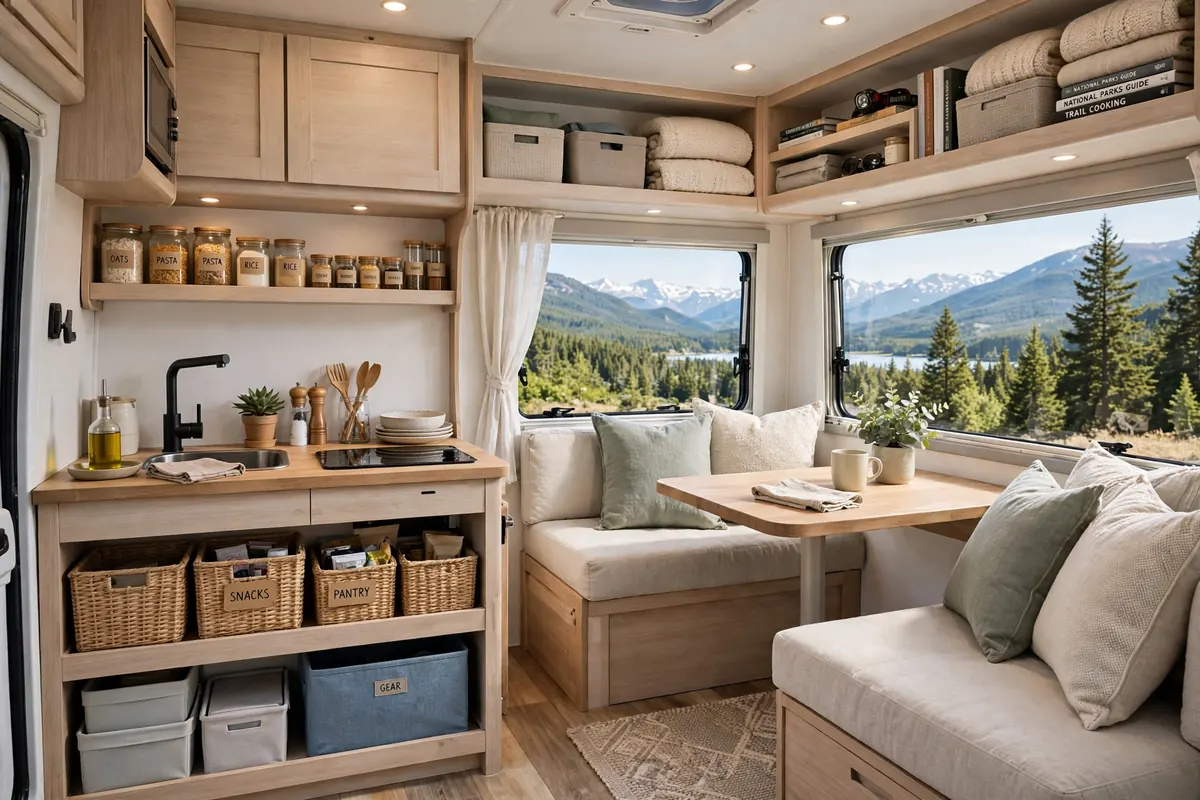

The first time I spent a week living in a camper, I learned a humbling truth: an RV gives you the whole open road, and about as much storage as a large closet. Every mug, every pair of shoes, every can of beans has to earn its place. That is exactly why good RV storage ideas matter so much. They are not about buying more bins. They are about making a small, moving home work the way a real home should — calm, easy to use, and free of the low-level clutter that makes a tiny space feel even tinier.
Living on wheels is different from living in a small apartment. Your kitchen is also your hallway, and your bed is also your storage room — and everything you own has to survive bumps and sharp turns without sliding across the floor. Once you understand the odd-shaped cabinets, the wasted vertical space, and the dead corners, you can squeeze a surprising amount of order out of a camper.
Start by Measuring: The RV Storage Ideas That Actually Fit
Before you buy a single organizer, grab a tape measure — skipping this step is why so many RV owners end up with bins that fit nowhere. RV cabinets are not standard sizes. One might be twelve inches deep and the next one fourteen, and a shelf that looks generous can be blocked by a wheel well or a pipe. Measure the width, depth, and height of every cabinet, drawer, closet, and under-bed compartment, and keep the numbers in your phone.
Then empty everything out. Pull every item out of the camper and sort it on a picnic table outside. You will be shocked at how much you carry that you never use — the third spatula, the board games nobody has opened since last summer. If you have not used something in two trips, it does not belong in the RV. Keep what you reach for daily, box the seasonal extras at home, and let the rest go.
Once you know what is staying, group it by where it will live. Cooking things near the stove, clothes near the bed, cleaning supplies near the door. When every item has a sensible home, putting things away takes seconds. The same thinking works in any small home — the clever tricks in our guide to tiny house storage ideas that make every inch count translate beautifully to life on wheels.
- Measure every cabinet, drawer, and nook before buying any organizer.
- Empty the whole RV once a season and sort everything outside.
- Remove duplicates and anything unused on the last two trips.
- Assign every item a home based on where you actually use it.
Use the Doors, Walls, and Every Vertical Inch
In an RV, the walls are prime real estate. The space behind a door, the strip of wall beside the bed, the inside of a cabinet door — all of it is storage waiting to happen. Over-the-door organizers are the single easiest win in any camper. A clear-pocket shoe organizer hung on the bathroom door holds toiletries, sunscreen, chargers, and dog treats, while one on the bedroom door takes socks, underwear, and accessories.
Command hooks and removable adhesive strips are your best friends here, especially if you rent your RV. They hold towels, hats, leashes, and keys without a single screw hole. A small rack inside a cabinet door keeps foil and spice packets upright and easy to grab. A magnetic strip works wonderfully for knives and small metal tools.
Think in layers. Stackable shelves inside tall cabinets double the usable space overnight. A tension rod fitted across a cabinet keeps bottles and jars from sliding around while you drive. Small baskets mounted on the wall beside the dinette hold books, tablets, and sunglasses.
RV Storage Ideas for the Kitchen: Zones and Nesting Cookware
The RV kitchen is where most clutter is born. It is small, busy, and everything in it is needed at once. The fix is zones. Give the kitchen three clear jobs — a prep zone, a cooking zone, and a wash-up zone — and store things where the job happens. Knives, cutting boards, and mixing bowls live near the counter where you chop. Pots, pans, and oil live beside the stove. Dish soap, sponges, and drying towels live by the sink.
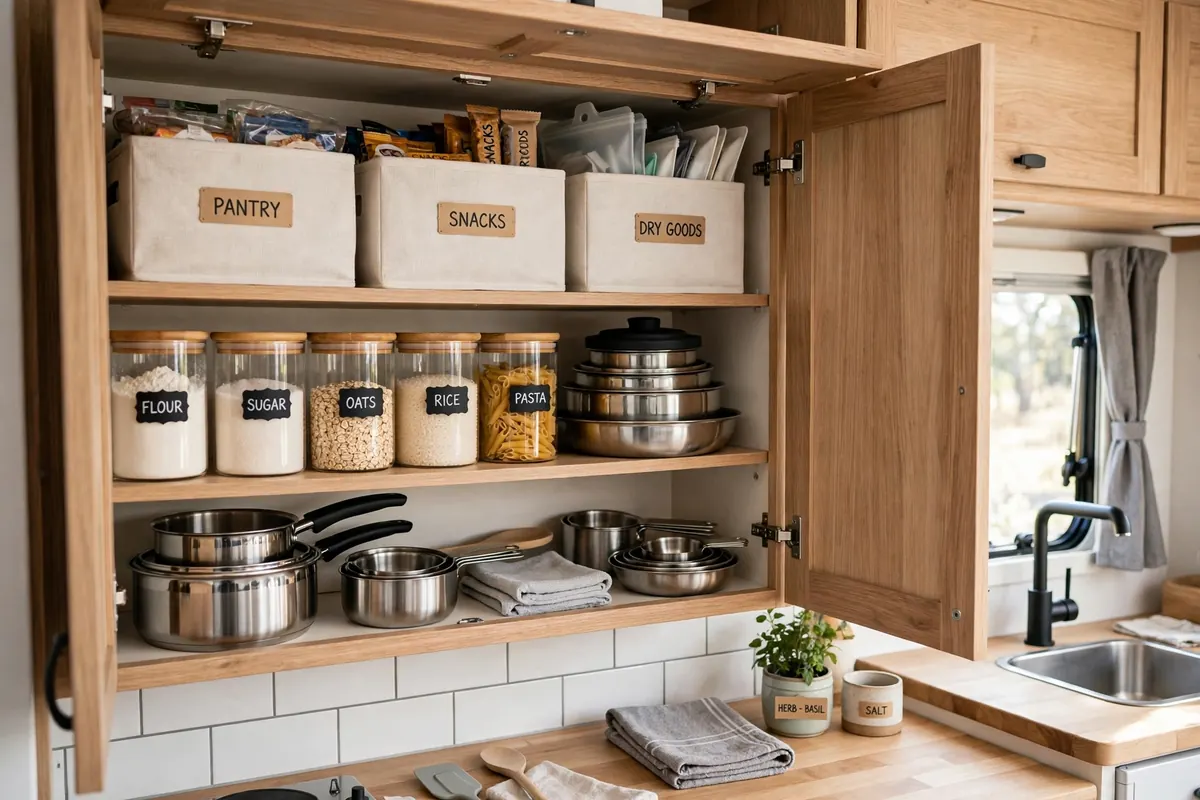
Nesting cookware is the quiet hero of RV kitchens. A set of pots that stack inside each other, with one detachable handle shared between them, takes up a third of the space of a normal set. The same goes for bowls, measuring cups, and collapsible items: a folding colander, a collapsible dish rack, and a silicone kettle that squashes flat can free up an entire shelf. Choose pieces that do two jobs, like a cutting board that fits over the sink for extra counter space.
Inside the cabinets, use small bins to stop the avalanche. One bin for canned goods, one for dry pasta and rice, one for snacks. Decant dry goods into square, stackable containers with tight lids. Square containers waste far less space than round ones, and clear sides mean you can see at a glance what is running low. Keep everyday items at eye level and push rarely used things to the highest shelf.
Counter space is precious, so guard it fiercely. A dish drying mat that rolls up and a small tray that corrals the coffee maker, sugar, and mugs into one neat corner will make the kitchen feel twice as big. The same zone thinking helps with bulky outdoor gear too — see our small apartment bike storage ideas for hooks and a dedicated spot by the door.
Clothes, Shoes, and the Entryway
Clothes are the sneakiest space thieves in an RV. A closet that looks fine on day one is overflowing by day three, because folded stacks slide, hangers tangle, and clean clothes end up mixed with dirty ones. File folding changes everything. Instead of stacking clothes flat, fold each item into a small rectangle and stand it upright in a shallow bin, like files in a drawer. Nothing gets buried, and pulling one item out does not disturb the rest.
Limit hangers to a handful of items that truly need them — a jacket, a dress, maybe a work shirt. Everything else goes in bins: one per person, or one per category. Hang a small laundry bag inside the closet so dirty clothes never land on the bed.
Shoes deserve a system of their own, because nothing makes a camper feel messy faster than a pile of shoes by the door. A shallow tray just inside the entrance catches dirt and keeps pairs together. Limit each person to two pairs inside the RV — the ones on your feet and one spare — and store the rest in a bin in an outside compartment or under the bed. A hanging shoe organizer on the back of a door holds sandals and slippers without taking floor space. Our dorm room organization ideas have more small-space shoe and closet tricks that work in a camper too.
- File-fold clothes upright in shallow bins so you can see every item.
- Keep hangers to a minimum — a few jackets and dresses only.
- Hang a laundry bag inside the closet for dirty clothes.
- Use a shoe tray at the door and limit each person to two pairs inside.
Under-Bed and Bench Storage: The Hidden Gold Mine
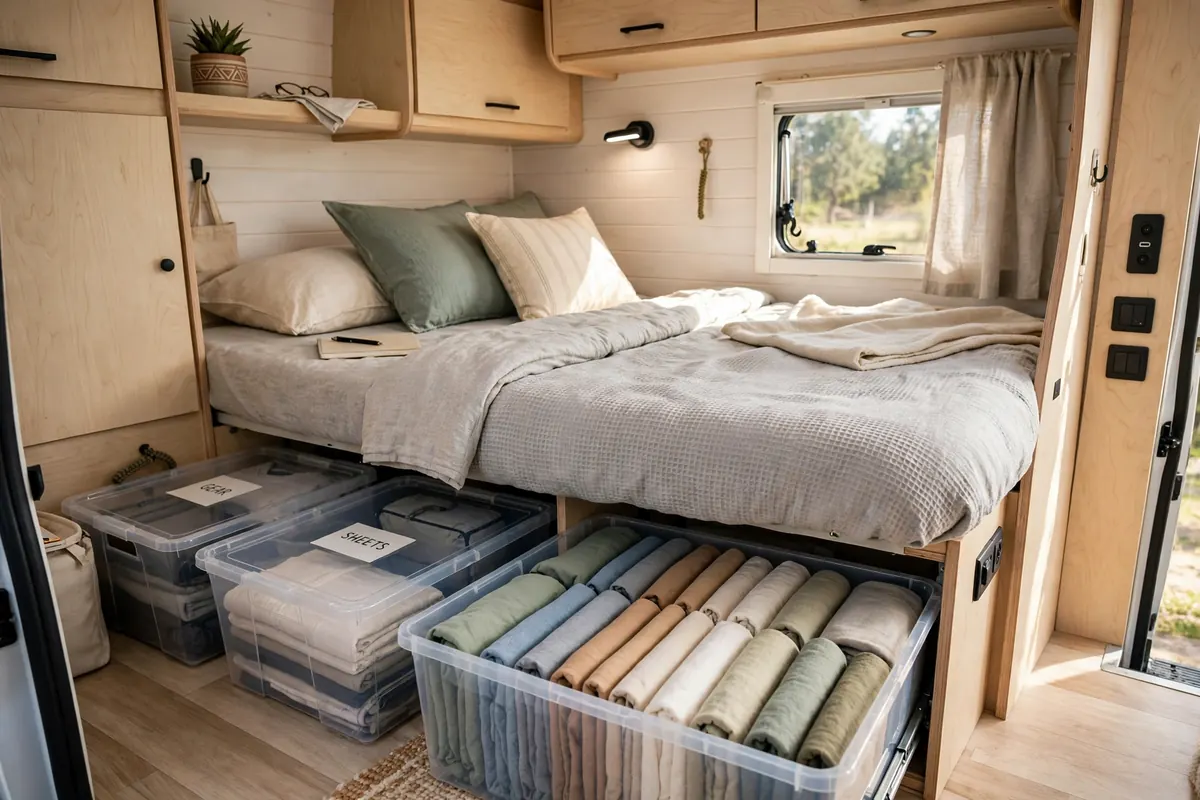
The biggest storage space in most RVs is the one you sleep on. Under the bed there is usually a large, awkward compartment that swallows things whole. The trick is to divide it. Low, flat bins with lids slide in and out easily, each holding a category: bedding, towels, games, tools, or off-season clothes. Label the end of each bin so you can find what you need without pulling them all out.
Dinette benches hide the same opportunity. Most bench seats lift up to reveal deep storage, but things sink to the bottom and disappear. Use bins or fabric cubes inside the benches to create layers, with the things you need most on top. One bench can hold the kids’ toys and games, the other table linens and the outdoor tablecloth.
Do not forget the awkward corners — the gap beside the water heater, the shelf above the cab. Our under-bed storage ideas cover bins, labels, and layouts that fit an RV perfectly.
Secure Everything Before You Drive — Plus a Departure Checklist
A tidy RV at a campsite can become a disaster zone after twenty minutes on a bumpy road. Every shelf, drawer, and cabinet needs a travel plan. Start with the basics: childproof latches or small bungee cords on cabinet doors, non-slip shelf liner under everything, and tension rods across open shelves to stop items sliding out. Drawers should have dividers or small bins so contents cannot shift and jam. The fridge needs a tension rod or fridge bar across the shelves, with heavy items sitting low, never on top.
Weight matters as much as order. Every RV has a cargo carrying capacity, and overloading it is unsafe. Weigh your loaded RV at a public scale at least once, and keep heavy items low and near the axle. Water is heavy — a full fresh-water tank adds hundreds of pounds — so travel with only as much as you need and fill up at your destination.
Loose items are a hazard in a sudden stop. Nothing heavy should sit on a high shelf, on the dashboard, or on top of the bed. Secure the television, the microwave door, and anything glass. Keep bungee cords and Velcro straps handy so securing things becomes a habit. After your first few trips, you will know exactly which cabinet pops open and which drawer slides — fix those two first.
Toiletries deserve a special mention, because the RV bathroom is the smallest room of all. A hanging caddy over the shower head holds shampoo and soap without drilling, and small suction baskets hold toothbrushes and razors. Keep only what you use daily in the bathroom itself, and store the spares in a labeled bin under the bed. Renters can do all of this with removable hooks and suction baskets — no drilling, no marks.
A short checklist on the fridge turns departure into a calm ten-minute routine. Walk through in the same order every time:
- Close and latch all cabinet doors, drawers, and the fridge.
- Stow loose items: mugs, remotes, books, and anything on a counter.
- Secure the TV, the dinette table, and anything on a high shelf.
- Retract the awning, slide-outs, steps, and leveling jacks in order.
- Check water, gas, and electric hookups are disconnected and stowed.
- Lock outside compartments and check the hitch, lights, and tires.
- Do a final walk-around, checking the roof, windows, and under the RV.
The real secret is habit: put things back the moment you finish with them, and do a five-minute tidy every evening. A small space forgives almost nothing, but it rewards consistency beautifully. Kids love being checklist captains — giving them a real job makes departure faster and more fun.
Your RV is small, but your life in it does not have to feel small. With a tape measure, a few good bins, and a little honest editing, every inch can work harder for you — start with the kitchen zones or the under-bed bins this weekend. Happy travels, and may your shelves stay tidy and your roads stay smooth.