
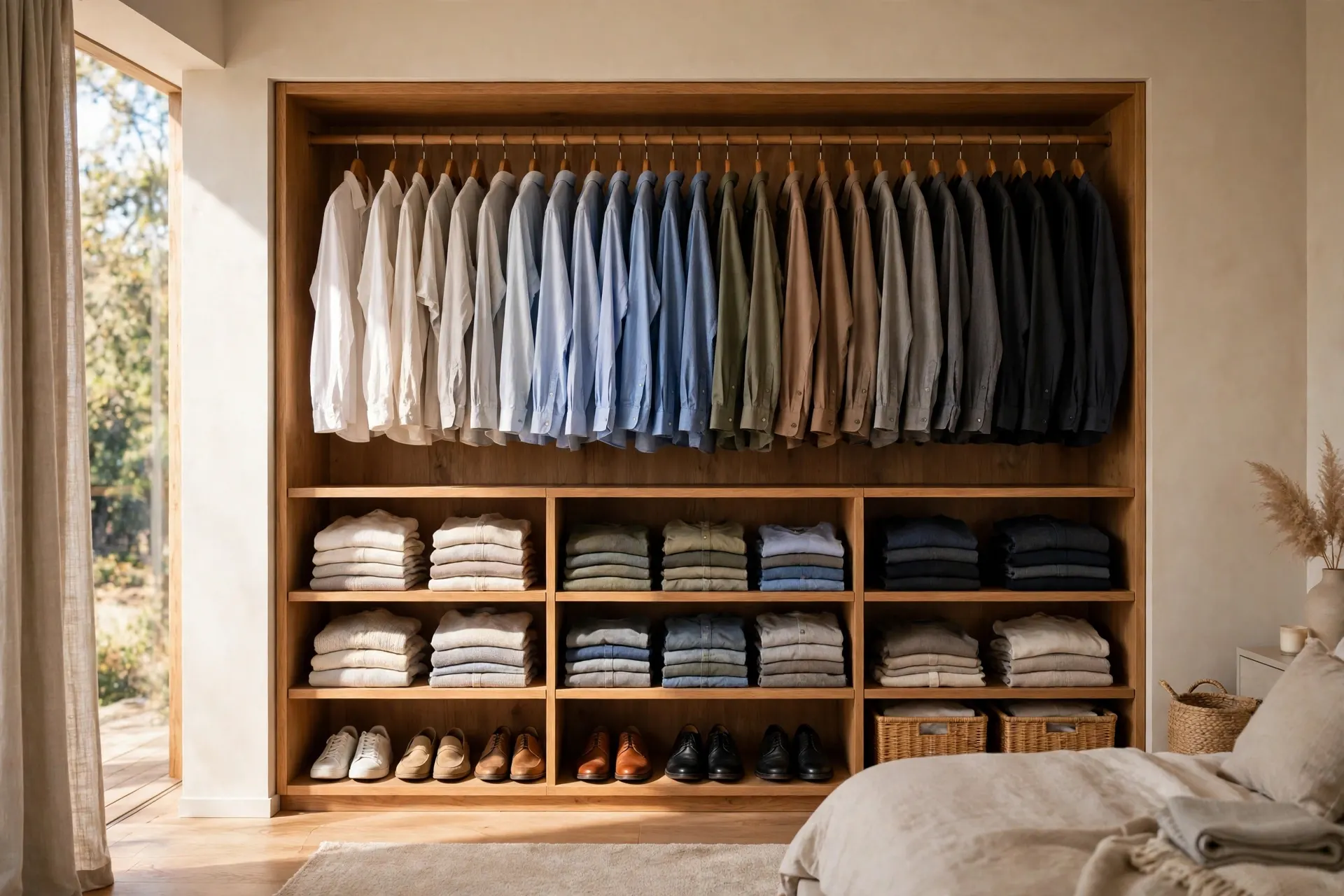

Most men do not have a storage problem. They have an editing problem. Open a typical men’s closet and you will find the same story every time: three good shirts buried under twelve you never wear, a drawer of socks with no pairs, belts draped over a chair, and shoes piled in a corner like they fell there. The good news is that the fix is simpler than you think. These men’s closet organization ideas work because they start with what you actually own, not with buying more boxes and hoping for the best.
A well-organized closet does more than look tidy. It saves you ten minutes every morning, stops you buying a fifth navy jumper because you forgot you already owned four, and makes the clothes you love last longer because they are hung, folded, and stored properly instead of crushed. You do not need a walk-in wardrobe or a big budget. You need a clear plan, an honest clear-out, and a system you can keep up in five minutes a day.
Start by Editing: Keep Only What You Actually Wear
Before you buy a single hanger or shelf, take everything out. It sounds dramatic, because the only way to see what you really own is to see it all at once. Lay it on the bed, sort it into piles, and be honest with yourself about each piece.
The one-year rule is the simplest test there is. If you have not worn it in the last twelve months, and it is not a suit for weddings and funerals or genuine seasonal kit, it goes. That shirt with the frayed collar you keep meaning to replace? Replace it or let it go. The jeans that have not fit since 2023 are not motivation; they are clutter taking up a hanger that a shirt you love could use.
As you sort, make three piles:
- Keep and love: clothes that fit well, feel good, and you reach for regularly.
- Repair or tailor: good pieces with a missing button, a loose hem, or a fit that a tailor could fix for less than a replacement costs.
- Let go: worn-out, stained, ill-fitting, or simply never-worn items. Donate what is clean and usable, recycle the rest.
Most men can let go of a third of what they own without missing a single item. That empty space is the whole point. An organized closet is not a full closet; it is a closet with room to breathe, where every hanger moves freely and you can actually see what you have.
Men’s Closet Organization Ideas That Start With a Simple Sort
Once you know what is staying, sort it by category first, then by colour. This is the single change that makes the biggest difference to how your closet looks and how fast you can get dressed. Categories are simple: suits together, dress shirts together, casual shirts together, T-shirts together, jumpers together, trousers together. Within each category, arrange from light to dark. White shirts on the left, then blues, then greys, then darks. It sounds fussy, but the result is instant calm — and when you are half awake at seven in the morning, you can find the exact shirt you want without rifling through the rail.
Fold what should be folded and hang what should be hung. Tailored shirts, jackets, blazers, suits, and trousers belong on hangers. Knitwear, T-shirts, and gym kit belong folded on shelves or in drawers, because hanging stretches them out of shape. Heavy jumpers on a hanger will develop shoulder bumps within weeks, and nobody wants to iron a jumper back into shape.
Keep your everyday outfits at eye level and your rarely worn pieces higher up or further to the side. The clothes you wear to work five days a week should be the easiest to reach. The suit you wear twice a year can live at the far end of the rail.
Switch to Matching Hangers
It is a small detail that changes everything. A rail full of mismatched hangers — wire ones from the dry cleaner, thick plastic ones, a wooden one from a hotel — looks chaotic no matter how neat the clothes are. Matching hangers, all the same slim wooden or velvet style, instantly make a closet look calm, intentional, and twice as spacious.
Slim velvet hangers are the best value choice for most men’s closets. They grip clothes so shirts do not slide off, they are thin enough to free up real rail space, and they look uniform. Wooden hangers are sturdier and better for heavy jackets and suits, where the broad shoulder keeps the shape. Pick one type for shirts, one for jackets, and stick with it.
A few hanger rules that pay off every day:
- One garment per hanger. Doubling up shirts saves space on paper and creates wrinkles in practice.
- Hang shirts buttoned at the top button so they keep their shape on the rail.
- Use trouser hangers with a clamp or a bar, and hang trousers so the crease falls straight.
- Keep a few spare hangers at the end of the rail so clean laundry has somewhere to go immediately.
If you want a fuller picture of how a coordinated hanging system looks when it all comes together, these walk-in closet organization ideas show how the same principles scale up beautifully in a larger space.
Double Your Space With a Second Rod
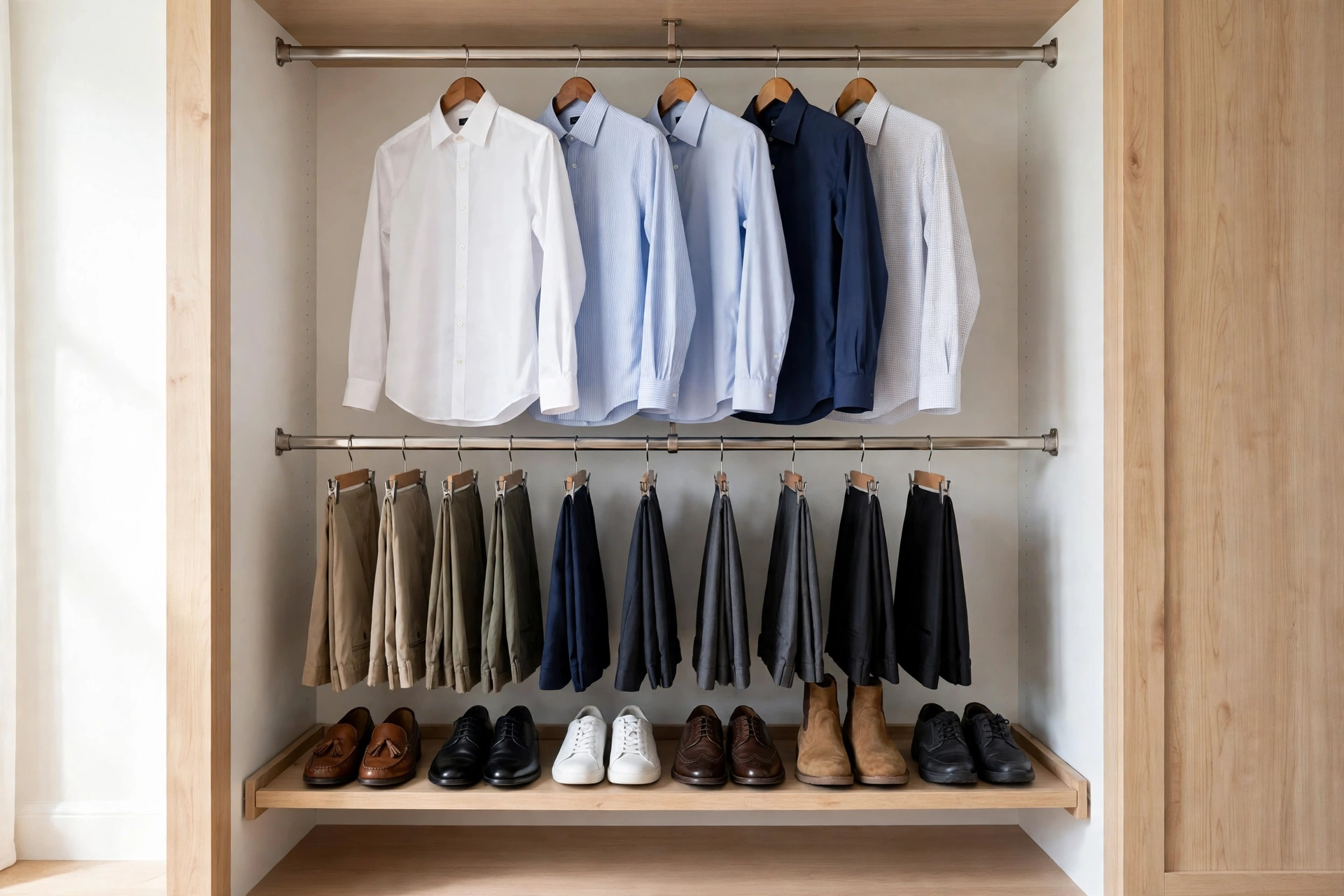
Most closets waste half their vertical space. A single rail hung at chest height leaves a dead zone below it where shoes pile up and nothing useful happens. The fix is a double-hang rod: a second rail installed about halfway down, so shirts hang on top and trousers hang below. Overnight, you have doubled your hanging space without knocking down a single wall.
A double-hang setup works best for shirts, folded trousers, and shorter jackets. Keep your long items — overcoats and full-length suits — on a separate single-hang section so they do not bunch on the floor. Measure before you buy: you need roughly 100 centimetres of clearance for the upper rail and the same below it, and the lower rail should sit high enough that trousers clear the floor or a shoe shelf beneath.
If your closet is rented or you cannot drill, a freestanding double-hang rail or a tension rod system gives you the same result without a single screw. A small closet is not a lost cause either; it just needs stricter rules. Use the door with an over-door hook rack for tomorrow’s outfit, use the side wall for a couple of hooks, and use the height — a shelf above the rail and a shoe rack below turn one rail into three storage zones. Think in layers: hanging rail at the top, shelves in the middle, drawers or shoes at the bottom. Each layer has one job, and nothing drifts between layers.
Drawers, Dividers, and the Small Stuff
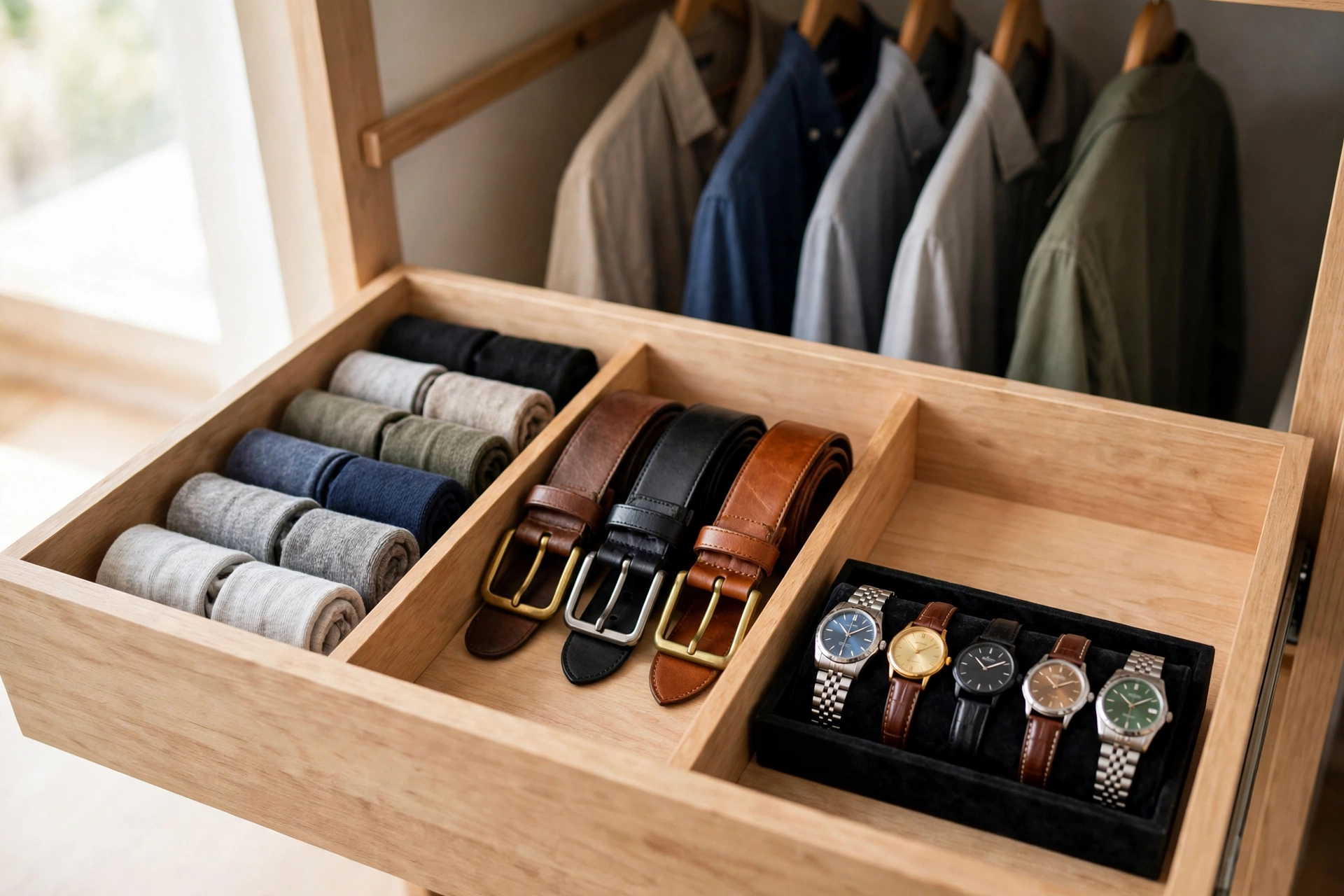
Drawers are where men’s closets quietly fall apart. Socks, underwear, and T-shirts go in as neat piles and come out as a tangled mess within a week. The answer is not more willpower; it is dividers. A simple set of drawer dividers or small fabric boxes turns one big drawer into six tidy compartments, and suddenly everything has a place.
Roll, do not fold, the small stuff. Rolled socks and underwear take up less room, stay in their compartments, and are easy to see at a glance. File-fold T-shirts upright in a drawer so you can see every colour at once instead of only the one on top of the pile. It takes thirty seconds longer to put laundry away this way, and it saves you the daily dig through the drawer every morning.
Accessories deserve the same treatment. Belts should hang on hooks or a belt rack, never coiled in a drawer where they crease and tangle. Ties belong on a tie rack or rolled in a drawer divider, not draped over a chair. Watches, cufflinks, and sunglasses look after themselves best in a small tray or valet box on a shelf. If you want your accessories to stay visible, unwrinkled, and easy to grab, these tie and belt organization ideas show exactly how to display them so they stay in good shape.
One drawer or shelf should be your everyday-carry zone. Wallet, keys, watch, sunglasses, and the belt you wear most days all live in one spot, so you can grab them in one motion and — just as importantly — put them back in one motion when you get home. A small tray on a shelf or a valet rod on the side wall does this job perfectly.
Shoes, Seasonal Rotation, and the Everyday Drop Zone
Shoes are the final piece of the puzzle, and they need a real home. Trainers, work shoes, boots, and casual pairs should live on a shelf or rack, never in a heap on the floor. A simple two-tier shoe shelf inside the closet keeps pairs together and stops you stepping on a shoe you forgot was there in the dark.
Keep only the shoes you wear regularly in the closet. Out-of-season boots and the formal pair you wear twice a year can live in boxes on a high shelf. A boot tray underneath catches dirt and keeps the closet floor clean, which matters more than it sounds — a clean floor makes the whole closet feel finished.
Seasonal rotation is the habit that keeps all of this working year-round. Twice a year, in spring and autumn, swap the seasonal kit. Heavy jumpers, coats, and boots go into labelled boxes on the top shelf, and the lighter layers come down. While you are doing it, repeat the one-year rule on anything you did not wear last season. Fifteen minutes, twice a year, and your closet never slides back into chaos.
If jeans are taking up too much rail space, they are better folded. A stack of folded jeans on a shelf, arranged by wash from light to dark, is easy to browse and does not crease the way hanging can. For a closer look at keeping denim neat and easy to find, these jeans organization ideas cover folding, stacking, and shelf layouts that work in even the smallest closet. And if your shelves are deep, keep a small basket at the back for the things you reach for least, with everyday items at the front — these closet shelf organization ideas show how to lay out shelves so nothing gets lost at the back.
The best closet system is the one you can maintain without thinking about it. Build two tiny habits and the closet will more or less look after itself. First, the one-in, one-out rule: every time a new shirt or pair of shoes comes home, an old one leaves. It stops the slow creep that fills a closet back up within a year. Second, the evening reset: when you get home, hang the jacket, put the shoes on the shelf, and drop your wallet and keys in the tray. Thirty seconds now saves a ten-minute hunt tomorrow morning.
Do a quick five-minute tidy once a week, ideally on a Sunday evening. Straighten the hangers, refold anything that has slumped, and return anything that drifted to the wrong shelf. A closet does not fall apart in a day; it falls apart in a hundred tiny moments of putting things down instead of putting them away. The weekly reset catches them all at once.
A tidy men’s closet is not about showing off or spending money on fancy fittings. It is about making your mornings easier, your clothes last longer, and your bedroom feel calmer. Start with the clear-out, sort by category and colour, match your hangers, double your rail, give the small stuff a divider, and keep the shoes on a shelf. Do that, and getting dressed stops being a daily rummage and becomes the easiest part of your morning.