
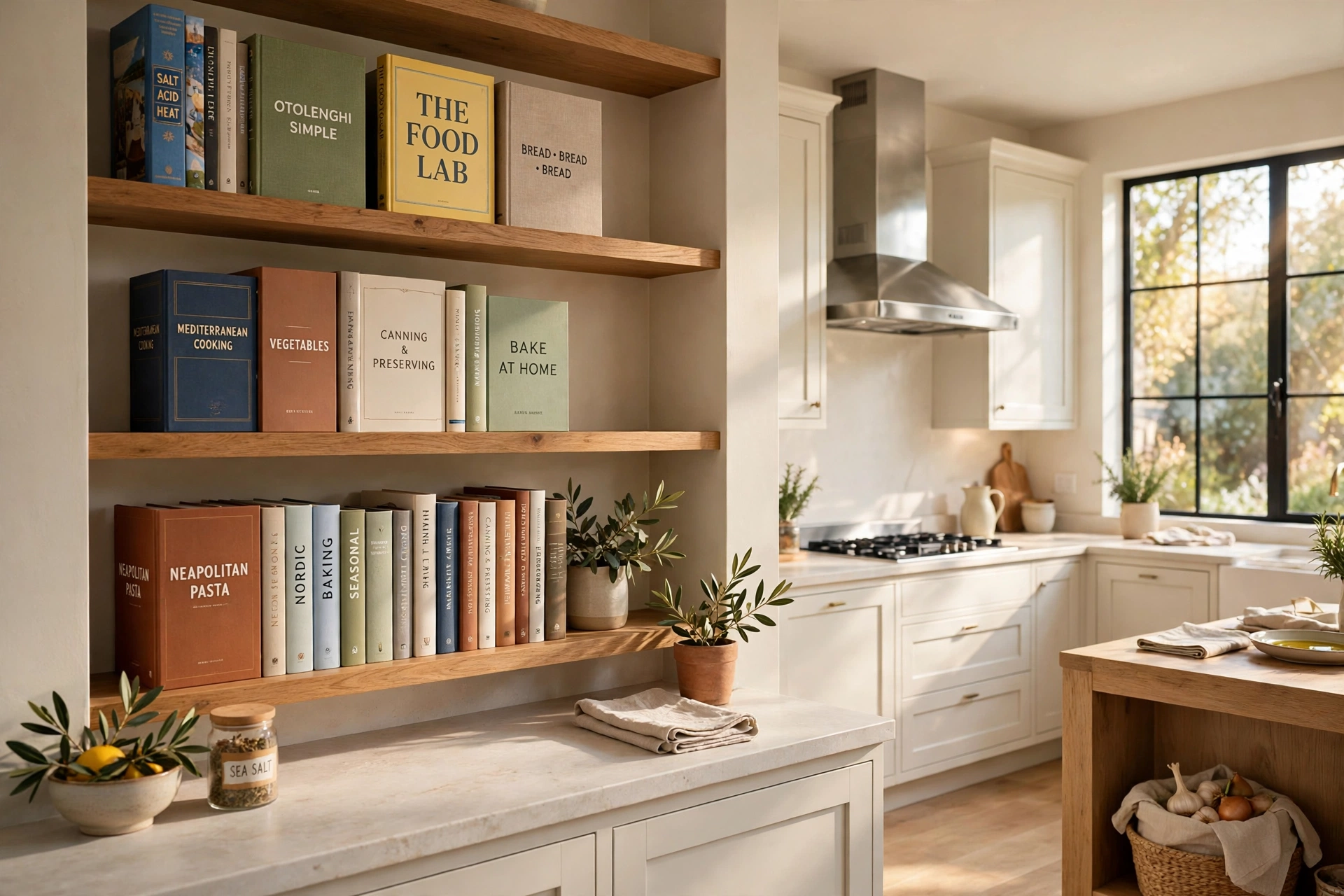

There is a particular kind of kitchen clutter that does not look like clutter at first. It is the stack of cookbooks leaning against the backsplash, the two wedged sideways on top of the microwave, the one living permanently open on the counter with a flour-dusted page. None of them are junk. Each one earned its place. But together, they quietly take over the room. Good cookbook storage ideas are not about finding more shelves. They are about giving a beloved collection a home that fits the way you actually cook.
The trick is to treat cookbooks like working tools with different jobs. The weeknight book needs a different spot from the baking encyclopedia you open twice a year. Once you sort by how you use them, the storage almost designs itself.
Cookbook Storage Ideas That Start With Editing Your Collection
Before you buy a single shelf, take every cookbook out and put it on the table. All of them, including the ones behind the slow cooker and on the fridge. Seeing the whole collection at once is the only honest way to know what you own. A collection of twelve books needs a very different plan from a collection of sixty.
Now sort them into three piles. Pile one is the books you use at least once a month. These are your working books, and they deserve the best real estate in the kitchen. Pile two is the books you love but open rarely, like the holiday baking book or the one from your grandmother. These deserve a safe home, but not prime counter space. Pile three is the books you have not opened in over a year, the duplicates, and the one with the broken spine. Donate them or pass them to a friend who will cook from them.
This edit matters more than any shelf you could buy. Trying to squeeze forty books into a kitchen that comfortably holds twenty is how piles end up on the counter.
- Keep weekly-use books within arm’s reach of your main prep area.
- Move seasonal and sentimental books somewhere higher and cleaner.
- Let go of anything unopened for over a year or duplicated.
- Count what remains before you shop, so you buy the right size first time.
Open Shelves or Cabinets: Where Should Cookbooks Live?
The first real decision is whether your cookbooks live out in the open or behind a door. Open shelves look wonderful. A row of cookbooks with their spines showing adds color, warmth, and personality to a kitchen, and grabbing a book takes two seconds. But open shelves also collect dust and a fine film of cooking grease, so the books need a wipe every few weeks, and the shelf should not sit above the stove.
Cabinets keep books cleaner and out of sight. The trade-off is access. A cookbook stored in a deep upper cabinet behind the serving platters is a cookbook you will stop using, no matter how much you love it. If you choose cabinets, give the books a dedicated shelf at eye level or below, not the top shelf. A bookend keeps the row upright and stops books ending up flat in a heap.
Many kitchens end up with a mix, and that mix is usually the smartest answer. Keep five or six daily-use books on an open shelf near the counter, and store the rest in a cabinet or on a higher shelf. If you are rethinking your kitchen layout, sorting the cupboards is a good starting point, because kitchen cabinet organization ideas often free up exactly the shelf a cookbook collection needs.
Floating Shelves and Picture Ledges That Actually Work
Floating shelves are the most popular cookbook storage solution. They are cheap, they install in an afternoon, and they turn a blank wall into useful storage. The key is choosing the right shelf for the weight. Cookbooks are heavy, much heavier than a row of mugs, so use solid wood or sturdy metal brackets fixed into wall studs, not adhesive strips or lightweight brackets rated for picture frames. A shelf that bows in the middle after six months is worse than no shelf at all.
Depth matters too. A shelf eight to ten inches deep holds most cookbooks upright with their spines facing out. Shallower shelves force books to lean or sit in a stack. Leave a couple of inches at the end of each row, so you can pull a book out without dragging three others with it.
Picture ledges are the quieter cousin of the floating shelf. A ledge is a narrow shelf with a small lip at the front that lets you display one or two books face-out, like a little gallery. Put the book you are cooking from this week on the ledge at eye level. It looks lovely, and it keeps that one book off the counter where it would otherwise collect splashes.
The best spots are the wall beside the fridge, the stretch between the counter and the upper cabinets, or the wall near the dining table. Avoid hanging shelves directly above the hob or the sink, where rising steam will age the books far too quickly. For more ways to use the vertical space you already own, these kitchen open shelving organization ideas pair well with the shelf plans here.
Smart Spots You Might Be Overlooking
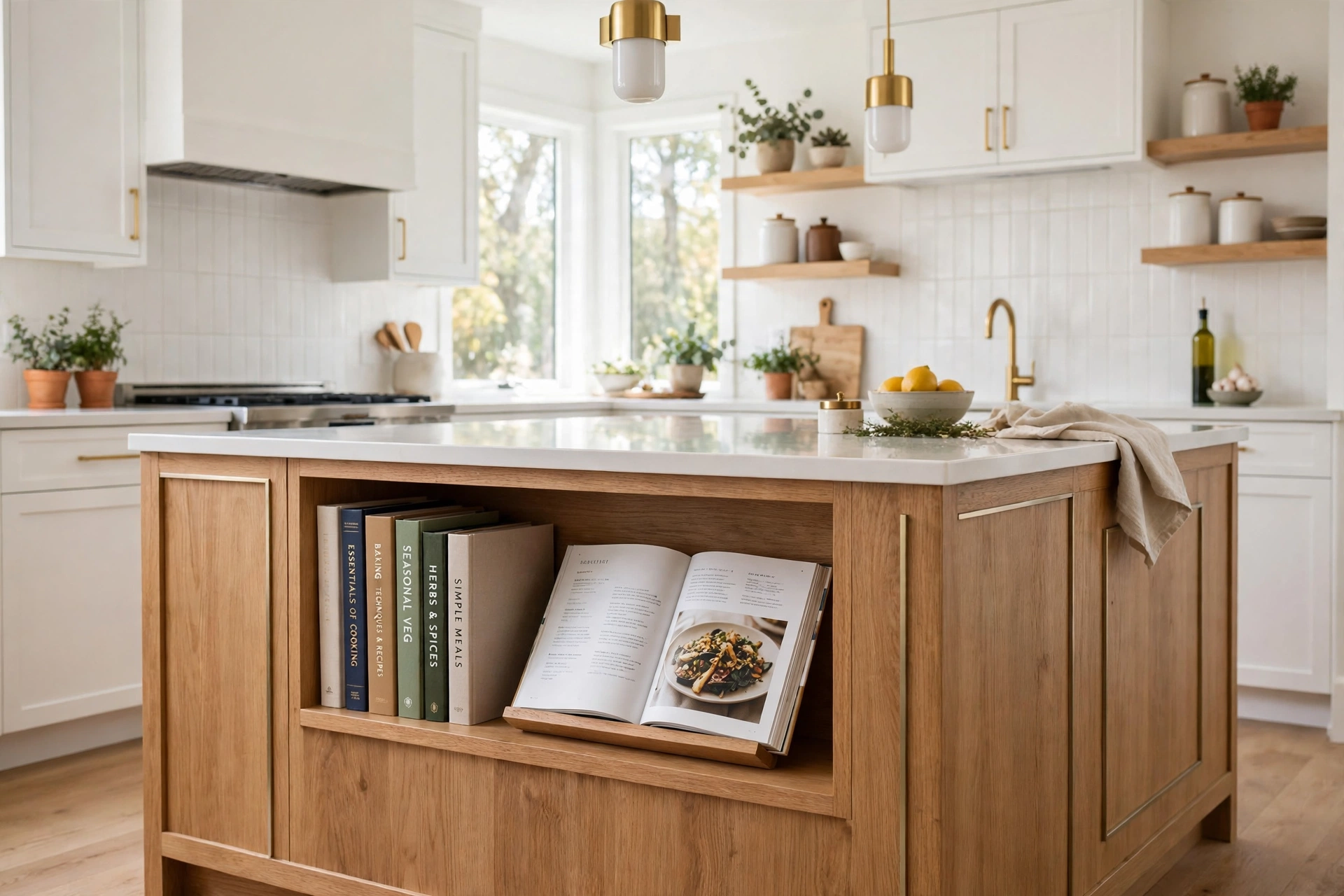
Some of the best cookbook storage is space you already have but are not using. The end of a kitchen island, for instance, is often a blank panel doing nothing at all. A shallow open nook fitted into that end panel holds six to ten books perfectly, right where you stand to chop and stir. The same idea works on the side of a peninsula or the end of a run of base cabinets. A carpenter can add a simple open cubby, or a ready-made unit can be painted to match.
Rolling carts are another overlooked hero. A slim three-tier cart can hold a surprising number of cookbooks and roll exactly where you need it. Park it beside the island while you cook, then roll it away when dinner is done. Carts are ideal for renters, because they need no drilling and no permission from a landlord. Choose one with a lip on each shelf so books do not slide off, and keep the heaviest books on the bottom tier.
Above the cabinets is a classic spot that people either love or forget entirely. If your wall cabinets stop short of the ceiling, that gap is prime real estate for the books you rarely open. Line them up spine out, and they become a decorative border that also stores a real collection. The catch is dust and grease, which rise with the warm air, so this spot suits books you open a few times a year. The rule for all of these is simple. If a spot is easy to reach, dry, and away from direct steam, it can hold cookbooks.
How to Organize Cookbooks So You Can Actually Find Them
Storage is only half the job. A shelf full of books you cannot find is barely better than a pile on the counter, so pick a system that matches how you look for a recipe. Organizing by cuisine is the most natural system for many cooks. All the Italian books together, all the baking books together, all the quick weeknight books together. Organizing by use is a close cousin. Weeknight dinners in one group, weekend projects in another, baking in a third, and entertaining in a fourth. That way, the books you need on a Tuesday night are never buried behind the one you only open at Christmas.
Organizing by color looks wonderful in photographs and terrible in real life, unless your collection is small. Your favorite Thai cookbook might sit between a green baking book and a red grilling book, and you will waste time hunting for it. If you love the look, use color within categories instead. Keep all the baking books together, and arrange just that group by color.
Whatever system you choose, a few practical habits make it last. Keep a bookend at each end of every row so books stand upright. Leave a gap of a finger’s width at the end of each group so you can pull one book out easily. Put the books you use most at eye level or just below, never on the highest shelf. And keep books upright rather than stacked flat, because stacking traps moisture and makes the bottom books hard to reach.
- By cuisine: Italian, Thai, Mexican, baking, and so on, grouped together.
- By use: weeknight dinners, weekend projects, baking, and entertaining.
- By color within a category: pretty and still findable.
- By size: tall books together so shelves sit at the right height.
Small-Kitchen Cookbook Storage Ideas That Don’t Crowd You Out
Small kitchens need cookbook storage the most and have the least room for it. The good news is that a small collection, stored well, is often all a small kitchen needs. If you cook from eight books regularly, eight books is the collection to plan for, not the thirty you used to own in a bigger kitchen. Edit first, then store what remains, and the small space suddenly feels possible.
Vertical space is your best friend in a small kitchen. A single floating shelf above the counter, a narrow ledge by the door, or a slim shelf on the side of the fridge can hold the whole working collection without taking a single inch of counter. The wall space beside windows and doors works too. A strip too narrow for a cabinet is often exactly the right size for a row of books.
Inside the kitchen, think in layers. The top shelf of a cabinet can hold the books you rarely open. A deep drawer with a simple divider can hold a few flat books completely out of sight. A small basket on top of the fridge, holding three or four books, is a classic small-kitchen solution. Pairing this approach with a tidy drawer system helps too, because kitchen drawer organization ideas free up the counter and cabinet space that a small kitchen needs most.
If your kitchen is truly tiny, keep only the working books inside it and store the rest just outside. A bookshelf in the dining area or a shelf in a nearby hallway works well, as long as the books are within a few steps of the stove. And because spices and cookbooks so often live side by side, keeping both zones tidy makes cooking smoother, which is why spice organization ideas are worth sorting at the same time.
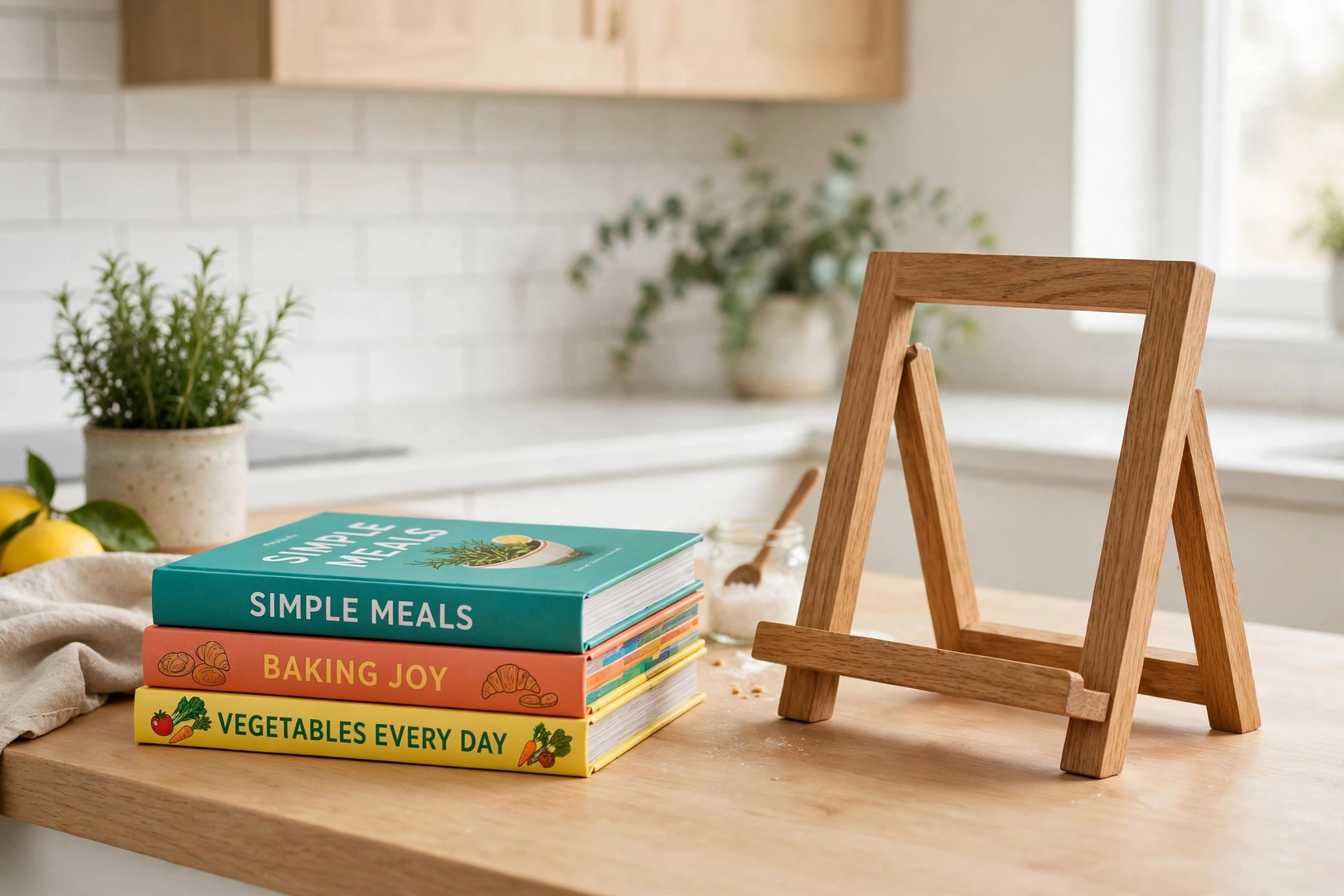
After all the planning, the test of any cookbook storage system is simple. Can you grab the book you need, with one hand, while something is on the stove? If the answer is yes, the system works. For the book you are cooking from right now, a cookbook stand is the single best purchase you can make. It holds the book open at a readable angle, off the counter and away from spills. When dinner is done, the book goes back to its shelf and the stand folds away.
Cookbooks are not clutter. They are the record of what you love to cook, the recipes that fed your family, and the dishes you are still learning to master. A little editing, a sturdy shelf or two, and a system that matches the way you cook is all it takes. Start small. Edit the collection this weekend, put the daily-use books on one shelf near the counter, and move the rest somewhere clean and dry. Cook from your tidy shelf for a week and notice how much easier dinner feels. That small, everyday ease is the whole point.